What Counts as a "Government Loan" for a Startup in India?
A government loan for a startup rarely means the government hands over cash directly. In almost every scheme, the government either guarantees a loan given by a bank or NBFC in place of collateral, subsidizes part of the interest or project cost, or channels a grant through an approved incubator. The actual credit decision, whether the startup gets funded and how much, is still made by a lender or an incubator's evaluation committee, based on the scheme's eligibility rules.
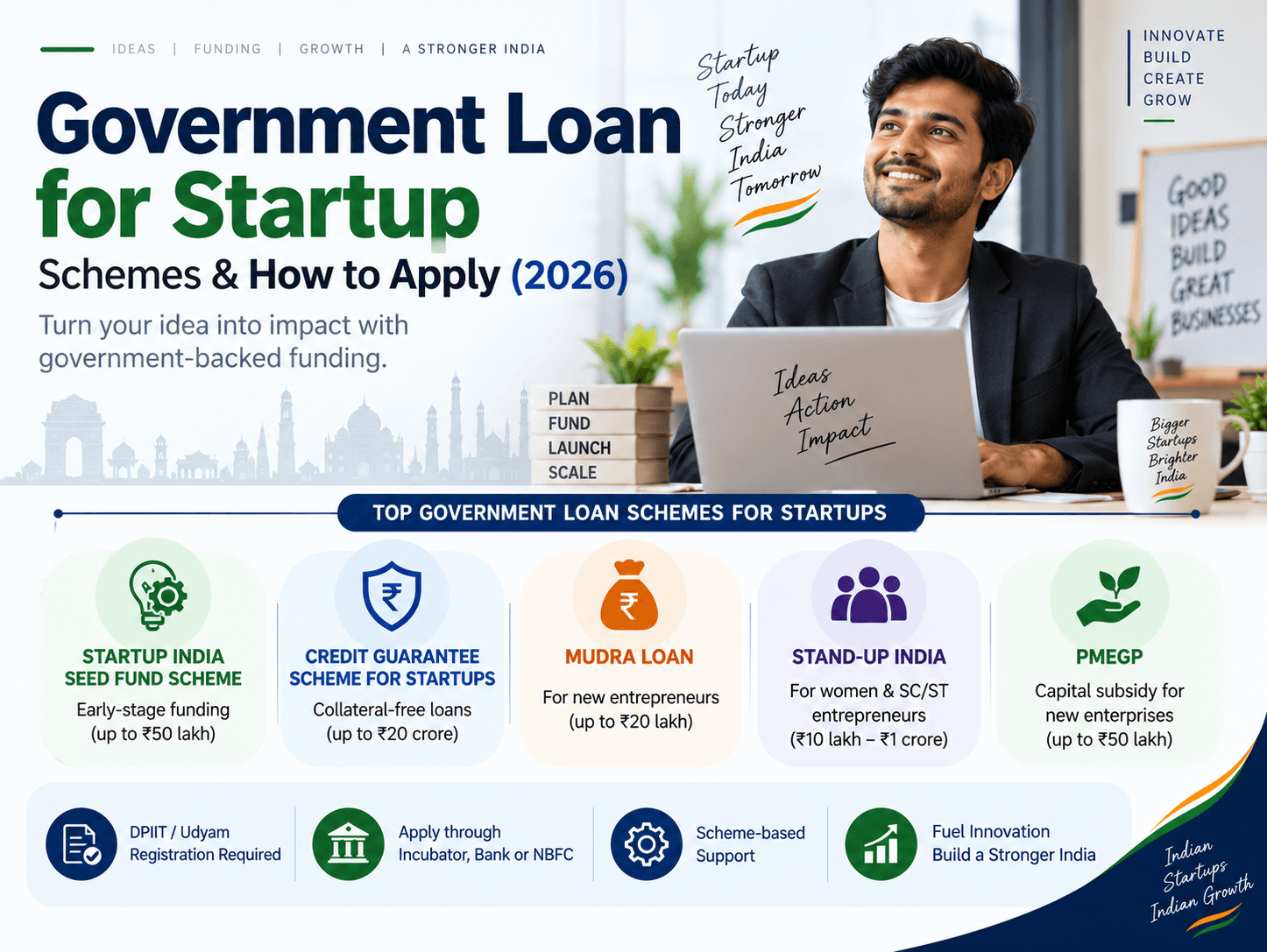
Government Startup Loan Schemes in India
The main central schemes relevant to a startup depend heavily on how early-stage the business is. Idea and prototype-stage founders look very different, on paper, from a two-year-old startup with revenue and a repayment track record.
Startup India Seed Fund Scheme (SISFS)
SISFS is aimed at the earliest stage, product validation and proof of concept, and provides up to ₹20 lakh as a non-repayable grant, plus up to ₹50 lakh structured as convertible debentures or debt for market entry and commercialization. Funds are disbursed through DPIIT-approved incubators rather than paid to founders directly, and the scheme is open to startups that are DPIIT-recognized and less than two years old at the time of application. Application windows under SISFS open and close periodically as incubator cohorts fill up, so check the current status and deadline on the official Startup India Seed Fund portal before you plan around it.
Credit Guarantee Scheme for Startups (CGSS)
CGSS is a guarantee mechanism, not a direct loan; it sits behind credit extended by scheduled banks, NBFCs, and SEBI-registered Alternative Investment Funds to DPIIT-recognized startups, covering term loans, working capital, and venture debt without requiring collateral. Under the revised framework, the maximum guarantee cover per borrower has been raised to ₹20 crore, with guarantee cover set at 85% for loans up to ₹10 crore and 75% above that, and startups in select "Champion Sectors" get a reduced annual guarantee fee. Since this ceiling has already been revised upward once, confirm the current limit with your Member Institution or on the NCGTC/Startup India portal rather than relying on an older figure.
Mudra Yojana (PMMY) for New Entrepreneurs
For a startup that looks more like a small trading, manufacturing, or service business than a venture-scale product company, Mudra loans are usually the fastest route to funding. They're collateral-free across all four bands; Shishu, Kishor, Tarun, and Tarun Plus, and Shishu in particular is built for genuinely new entrepreneurs with no operating history, evaluated mainly on the project report rather than past turnover.
Stand-Up India
Stand-Up India funds a new, greenfield business set up by a woman entrepreneur or an SC/ST borrower, with every scheduled commercial bank branch mandated to sanction at least one such loan per category. It's specifically for setting up a new unit, not for expanding an existing one, so a startup founder in one of these categories should evaluate this alongside SISFS or CGSS rather than instead of them.
PMEGP: Prime Minister's Employment Generation Programme
PMEGP works as a credit-linked capital subsidy for setting up a new micro-enterprise, administered through KVIC, KVIB, and District Industries Centres. It suits a startup with a more traditional manufacturing or service model than a tech-first venture, and the subsidy percentage and project cost ceiling vary by category and location, confirming both against the current PMEGP guidelines.
State-Level Schemes for Startups
Several states run their own layer of support for DPIIT-recognized startups registered under their own program, iStart Rajasthan, for example, which offers interest subvention and seed support alongside the central schemes. Checking your state's own startup policy is worth doing before assuming SISFS or CGSS is the only option available.
Business Loan for Startup: Options Beyond Government Schemes
Outside government-linked routes, startups also raise debt through conventional bank and NBFC business loans, secured or unsecured term loans, working capital lines, and invoice discounting, as well as venture debt from specialist lenders once there's some revenue to underwrite against. Fintech lenders that price loans off GST filings or transaction data can also work for a startup with digital sales history, even without a long operating track record, though usually at a higher interest rate than a scheme-backed loan.
Startup Loan Eligibility Criteria
Eligibility varies by scheme, but most government-linked startup loans check for a combination of the following:
| Requirement | Applies To |
|---|---|
| DPIIT Startup India recognition | SISFS, CGSS, and most state startup schemes |
| Udyam Registration | Mudra, PMEGP, CGTMSE-backed bank loans |
| Business less than 2 years old | SISFS specifically |
| Indian promoter holding (typically 51%+) | SISFS and several DPIIT-linked schemes, where foreign co-founders are involved |
| No prior loan default with any lender | Virtually all schemes, including Mudra and CGSS |
| Project report or pitch matched to the funding stage | All schemes, though the level of detail expected scales with loan/grant size |
How to Get a Business Loan With No Experience
A founder with no prior business experience isn't shut out of government-linked funding; several schemes are built precisely for that stage. Mudra Shishu loans, SISFS grants, and PMEGP all evaluate a first-time applicant mainly on the strength of the project report, the promoter's personal credit history, and (for SISFS) an incubator's assessment of the idea, rather than on past business turnover that a new entrepreneur simply won't have.
What tends to matter most for a no-experience applicant is:
- A specific, itemized project report on how the funds will be used, not a vague description of the business idea.
- A clean personal credit history, since the promoter's own CIBIL score substitutes for the business's (non-existent) credit history.
- Choosing the right entry point: Shishu-level Mudra funding or an SISFS proof-of-concept grant, rather than applying straight for a larger CGSS-backed loan that expects a lender-ready business.
- Being upfront about being a first-time founder rather than padding the application with inflated projections, which lenders and incubators both read as a red flag rather than confidence.
Documents Required for Government Loan for Startup
Documentation scales with the scheme and loan size, but a first-time applicant should expect to prepare:
| Category | Typical Documents |
|---|---|
| Identity & Address (KYC) | PAN card, Aadhaar, passport-size photographs of all founders |
| Business/Startup Proof | DPIIT Startup India recognition certificate (for SISFS/CGSS), Udyam Registration (for Mudra/PMEGP/CGTMSE routes), incorporation documents |
| Project Report / Pitch | Project Report / Pitch Business plan or pitch deck describing the product, funding use, and revenue plan — depth expected increases with funding size |
| Financial Documents | Bank statements, and — where the business has some history — ITR, GST returns, and financial statements |
| Cap Table / Shareholding Proof For SISFS and schemes with a promoter-holding condition | For SISFS and schemes with a promoter-holding condition |
| Scheme Application Form | Seed Fund portal application, PMMY form, or the relevant scheme's own form |
How to Apply for a Government Loan for Startup Online
The exact steps differ by scheme, but the broad sequence for most government-linked startup funding routes looks like this:
- Get DPIIT Startup India recognition (for SISFS/CGSS routes) or complete Udyam Registration (for Mudra/PMEGP/CGTMSE routes); this is the gateway most schemes check first.
- Identify which scheme matches your stage and loan size: SISFS for proof-of-concept, CGSS for a larger collateral-free loan once you have revenue, Mudra for a smaller working-capital need, or PMEGP for a new manufacturing/service unit.
- Prepare a project report or pitch deck scaled to that scheme; a one-page plan won't carry a CGSS-backed loan application, and an overbuilt 40-page deck isn't needed for a Mudra Shishu loan.
- Submit the application on the relevant portal: the Startup India Seed Fund portal for SISFS, a CGSS Member Institution directly, or the JanSamarth/Udyamimitra portal for Mudra and PMEGP.
- Respond quickly to any query from the incubator's evaluation committee or the lender's credit team; this is usually the biggest swing factor in how long the process takes.
- Complete any interview, pitch review, or site visit required by the scheme.
- Receive sanction and disbursal; for grant components like SISFS, funds route through the incubator rather than arriving as a lump sum directly from the government.
Government Scheme for Young Entrepreneurs in India
There's no scheme in India reserved purely by age, but several programs are structured in a way that naturally suits a young, first-time entrepreneur with limited capital and no business history. SISFS is aimed squarely at early-stage founders validating a product idea, Mudra's Shishu band asks the least in terms of vintage or turnover proof, and PMEGP is built around setting up a brand-new unit rather than expanding an existing one. A young entrepreneur under 35 with a DPIIT-recognized startup is also well positioned to combine SISFS with a state-level scheme such as iStart Rajasthan, where interest subvention or seed support can stack on top of the central scheme.
3 Things First-Time Founders Get Wrong About Startup Government Loans
Across the government scheme applications we've supported for early-stage founders, three mistakes recur far more than any documentation gap:
1. Applying for CGSS-scale funding before there's anything to underwrite
CGSS is a debt-guarantee mechanism, and a lender still needs cash flows and a credible repayment plan to sanction the loan behind it. Founders with no revenue and no operating history are usually a better fit for SISFS's grant component first, then CGSS once there's something for a bank to actually assess.
2. Confusing DPIIT recognition with Udyam Registration
These are two separate registrations serving different scheme ecosystems. DPIIT recognition unlocks SISFS, CGSS, and tax benefits under Startup India, while Udyam Registration is what MSME lending schemes like Mudra and CGTMSE check for. Founders who assume one covers the other end up applying to a scheme they aren't actually eligible for yet.
3. Treating the project report or pitch as generic paperwork
Both incubator evaluation committees and bank credit teams read the project report as a proxy for how seriously the founder has thought the business through. A templated plan that doesn't tie the requested funding to a specific, itemized use case is one of the fastest ways to get an application sent back for revision at any funding stage.
Frequently Asked Questions
Does the Indian government give loans directly to startups?
Not usually. Most government support for startups works through a guarantee behind a bank/NBFC loan (like CGSS), a grant routed through an approved incubator (like SISFS), or a subsidy that reduces the effective cost of a loan sanctioned by a lender; the government rarely disburses cash directly to a founder's account.
What is the Startup India Seed Fund Scheme (SISFS)?
SISFS is a central government scheme that provides up to ₹20 lakh as a non-repayable grant for proof-of-concept and prototype work and up to ₹50 lakh as convertible debt for market entry, disbursed to DPIIT-recognized startups through approved incubators rather than directly by the government.
Can a first-time entrepreneur with no experience get a business loan in India?
Yes. Mudra Shishu loans, SISFS grants, and PMEGP are all designed around a project report and idea evaluation rather than a business track record, which makes them accessible to genuinely first-time founders with no prior operating history.
What is the difference between DPIIT recognition and Udyam registration?
DPIIT Startup India recognition is what unlocks startup-specific benefits like SISFS, CGSS, and certain tax exemptions. Udyam Registration is the MSME classification that most bank and government MSME lending schemes, Mudra, PMEGP, and CGTMSE-backed loans, check for. A startup may need one, the other, or both, depending on which scheme it's applying under.
Is collateral-free funding available for startups in India?
Yes, mainly through the Credit Guarantee Scheme for Startups (CGSS), which guarantees bank/NBFC loans to DPIIT-recognized startups up to a revised ceiling of ₹20 crore per borrower, and through Mudra loans for smaller, more traditional small-business-style startups.
Are there government schemes specifically for women entrepreneurs starting a business?
Yes, Stand-Up India is the main central scheme, requiring a woman promoter with a majority stake in a new, greenfield business, backed by a bank-branch-level mandate to sanction at least one such loan per category. Several state governments also run supplementary support for women-led startups.
How long does it take to get a government-linked startup loan approved?
It varies widely by scheme; a Mudra Shishu loan can be sanctioned in days to a couple of weeks, while SISFS grants depend on the incubator's cohort timeline and evaluation process, and a CGSS-backed loan follows the lender's standard credit appraisal cycle, which usually takes several weeks.
Talk to Growthora Before You Apply
Picking the wrong scheme or applying for DPIIT recognition and Udyam Registration in the wrong order is one of the most common reasons startup funding applications stall. Growthora Advisory Private Limited helps founders with Startup India (DPIIT) recognition, Udyam Registration, and end-to-end government scheme and loan application support across Rajasthan and beyond. Book a free consultation with our team and we'll map out, honestly, which scheme fits your startup's actual stage before you file anything.
Next step
Apply this to your business.
Confirm whether this applies to your legal structure, industry classification, and credit history - in under 30 minutes with an advisor.