
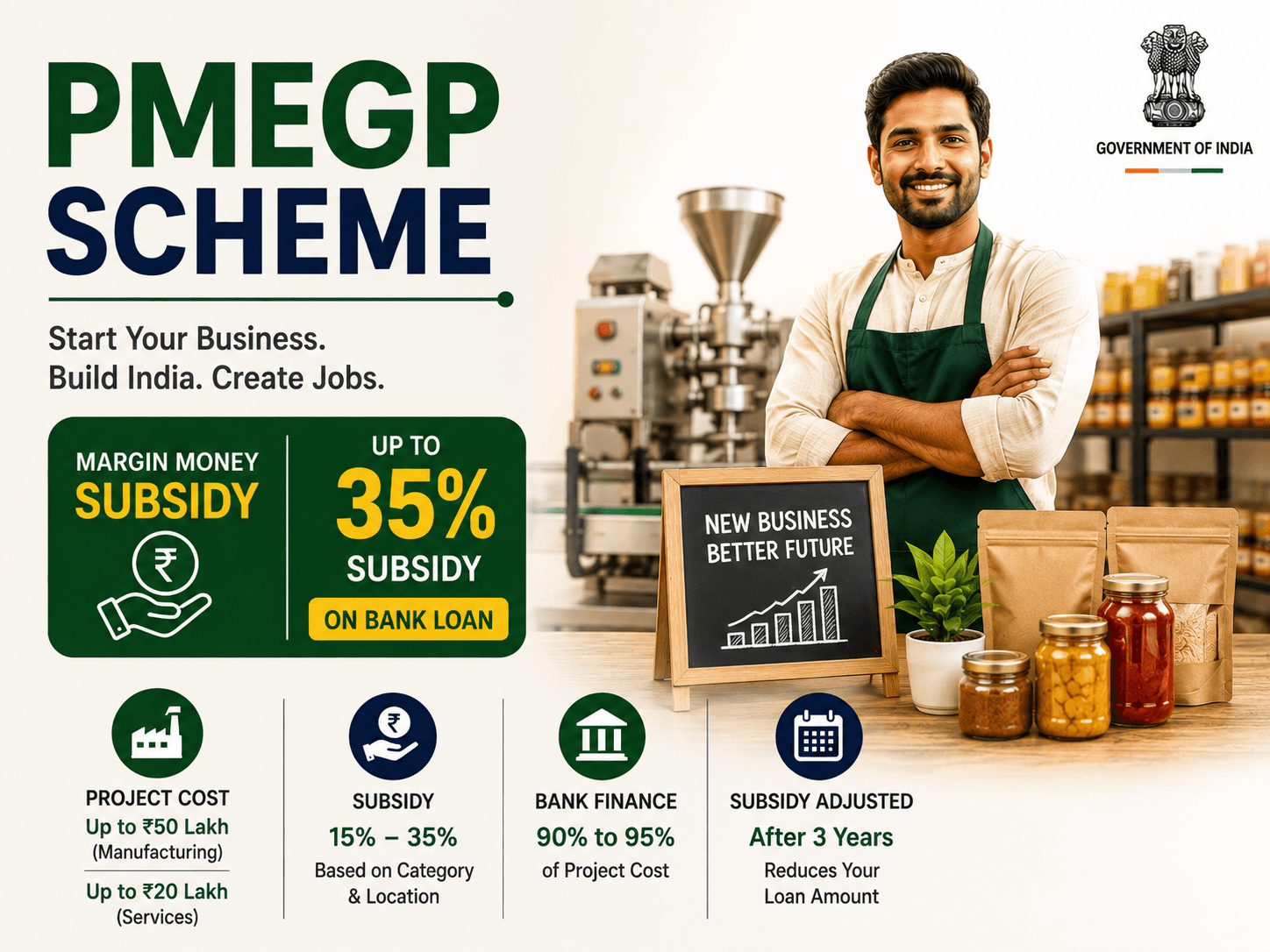
The Number Everyone Actually Wants: How Much Subsidy Will You Get
Before eligibility rules and documents, here's the part that decides whether this scheme is worth your time: the subsidy percentage is set by just two factors, your applicant category and your unit's location, and it's worth knowing exactly where you fall before you build a project report around an assumption.
- General category, urban location: 15% subsidy
- General category, rural location: 25% subsidy
- Special category (SC, ST, OBC, minorities, women, transgender persons, ex-servicemen, persons with disabilities, and applicants from the North East, hill areas, border areas, or aspirational districts), urban: 25% subsidy
- Special category, rural: 35% subsidy
The rest of the project is financed as a bank loan: 90% of project cost for general category applicants and 95% for special category applicants, with your own contribution making up the remainder, typically 5% to 10% depending on the category. The subsidy itself isn't handed to you upfront; it's credited into your loan account by the bank after a three-year lock-in period, at which point it directly reduces your outstanding loan balance, provided you've kept at least 75% of the sanctioned limit utilized throughout.
What PMEGP Actually Is
The Prime Minister's Employment Generation Programme is a credit-linked subsidy scheme administered by the Khadi and Village Industries Commission under the Ministry of MSME and implemented through state KVIC directorates, state Khadi and Village Industries Boards, and District Industries Centres. It exists to help first-time entrepreneurs set up new microenterprises in manufacturing or services, generating self-employment, particularly in rural and semi-urban areas.
The mechanics matter here: a bank sanctions and disburses the loan as it normally would, charging the normal rate of interest. The government's subsidy contribution sits with the bank and gets adjusted against the loan only after three years of demonstrated, consistent operation, not paid out as a grant at the start. This is why PMEGP is described as “credit-linked” rather than a direct subsidy, the bank's underwriting still governs whether you get the loan at all.
Who Can Apply
- Any individual above 18 years of age, with at least a Class 8 pass educational qualification, required for projects above ₹10 lakh in manufacturing or ₹5 lakh in the service sector
- Self-Help Groups, including those not availing benefits under any other scheme
- Institutions registered under the Societies Registration Act, 1860
- Production co-operative societies and charitable trusts
- Only one person per family can obtain financial assistance under PMEGP, with “family” defined to include the applicant and their spouse, which rules out multiple household members each separately claiming the subsidy
- Existing units already availing government subsidy under any other central or state scheme are not eligible to apply again under PMEGP for the same purpose
- Only new projects are eligible under the core scheme; existing PMEGP, REGP, or Mudra units become eligible for an upgradation loan of up to ₹1 crore for manufacturing or ₹25 lakh for services, only after successfully completing repayment
What Kind of Projects Qualify
The scheme covers new self-employment ventures in manufacturing and services, from food processing and textiles to small workshops and service outlets, deliberately excluding certain categories such as pure trading activities, unless linked to processing or manufacturing, and businesses already assisted under other government subsidy schemes. Project cost is capped at ₹50 lakh for manufacturing units and ₹20 lakh for service or business enterprises, with land cost specifically excluded from the eligible project cost calculation.
Documents You'll Need
- Identity and address proof: Aadhaar, PAN, and a recent photograph
- Educational qualification certificate, where the project cost crosses the threshold that makes this mandatory
- Caste, category, or special category certificate, where claiming the higher special-category subsidy rate
- A detailed project report covering the business plan, machinery and cost breakup, and revenue projections
- Bank account details for loan disbursement and subsidy credit
- For institutions, SHGs, or trusts, the relevant registration certificate and governing body resolution authorising the application
The Application Process
- Register on the official PMEGP e-portal run by KVIC and select the application tab for a new unit.
- Fill in personal details, category, project location, and the specific activity you're proposing, choosing from the scheme's list of permitted activities.
- Attach your project report along with the required KYC and category documents.
- If the project report is above ₹5 lakh, complete the mandatory Entrepreneurship Development Programme (EDP) training: 10 working days for larger projects and 5 working days for projects up to ₹5 lakh; projects up to ₹2 lakh don't require this training at all.
- The application is scored using KVIC's scoring model, developed jointly with bankers, and forwarded to the recommending implementing agency, then to your chosen bank.
- The bank independently assesses creditworthiness and sanctions the loan, financing 90% (general) or 95% (special category) of the project cost, disbursed as a term loan, working capital, or a composite of both.
- The subsidy amount is kept in a subsidy reserve fund account and adjusted into your loan account after three years, provided utilization has stayed above 75% of the sanctioned limit throughout that period.
Common Reasons Applications Get Delayed or Rejected
- Proposing an activity that isn't on the scheme's permitted list, only discovered after significant time has been invested in the application
- Submitting a vague or poorly costed project report, since the scoring model weighs this heavily
- Overestimating projected sales or margins without a realistic basis, which undermines credibility during the bank's own credit appraisal
- Exaggerating project cost specifically to inflate the subsidy amount, which KVIC's scoring and verification process is designed to catch
- More than one member of the same family applying, when only one person per family, defined as self and spouse, is eligible
- Skipping the mandatory EDP training for a project size where it's actually required, which can hold up final disbursement
Frequently Asked Questions
What is PMEGP?
The Prime Minister's Employment Generation Programme, a credit-linked margin money subsidy scheme run by KVIC to help new entrepreneurs set up manufacturing or service micro-enterprises, primarily through bank-financed projects.
How much subsidy does PMEGP give?
15% for general category applicants in urban areas, 25% for general category in rural areas or special category in urban areas, and 35% for special category applicants in rural areas.
What is the maximum project cost under PMEGP?
₹50 lakh for manufacturing units and ₹20 lakh for service or business enterprises.
Who is eligible to apply for PMEGP?
Individuals above 18, with the required educational qualification for larger projects, along with SHGs, registered societies, production cooperatives, and charitable trusts. Only one person per family can avail the benefit.
Is PMEGP a direct loan from the government?
No. A bank finances and disburses the loan normally, charging regular interest. The government subsidy is credited into the loan account only after a three-year lock-in period, reducing what you ultimately owe.
What documents are required for PMEGP?
Identity and address proof, educational certificates where applicable, category certificates for special-category applicants, a detailed project report, and bank account details.
Is training mandatory before getting a PMEGP loan?
Yes, for most project sizes. Projects above ₹5 lakh require 10 working days of Entrepreneurship Development Programme training, projects up to ₹5 lakh require 5 working days, and projects up to ₹2 lakh are exempt.
Can an existing business apply for PMEGP?
The core scheme is for new projects only. Existing PMEGP, REGP, or Mudra units that have successfully completed repayment become eligible for a separate upgradation loan facility instead.
Can more than one person from the same family apply for PMEGP?
No. Only one person per family, where family means the applicant and their spouse, can obtain financial assistance under the scheme.
Is trading activity eligible under PMEGP?
Generally no. The scheme is built around manufacturing and service enterprises, with pure trading activity typically excluded unless it's directly linked to a processing or manufacturing operation.
What happens if I don't utilise 75% of my sanctioned loan?
The subsidy adjustment is proportionately reduced, and any excess margin money is refunded by the bank to KVIC at the end of the third year rather than credited fully to your account.
Can PMEGP be combined with a state government subsidy?
Often yes, provided the state scheme isn't itself a duplicate of a central subsidy for the same purpose. It's worth checking with your state industries department before finalizing the project structure.
What to Do With This Information
Work out your subsidy tier before you draft your project report, not after, since it changes how much bank financing you actually need to arrange and how you should size the project itself. A special-category applicant in a rural area building a ₹20 lakh project is looking at ₹7 lakh in eventual subsidy, a materially different financial picture from a general-category urban applicant on the same project cost, who gets ₹3 lakh. That difference is worth planning around from day one, not discovering three years into repayment.
Beyond the subsidy math, the thing that actually determines approval is the same thing that determines any bank loan: a project report that's specific, realistically costed, and doesn't oversell its own numbers. KVIC's scoring model and the bank's own underwriting both reward exactly that.
Next step
Apply this to your business.
Confirm whether this applies to your legal structure, industry classification, and credit history - in under 30 minutes with an advisor.