
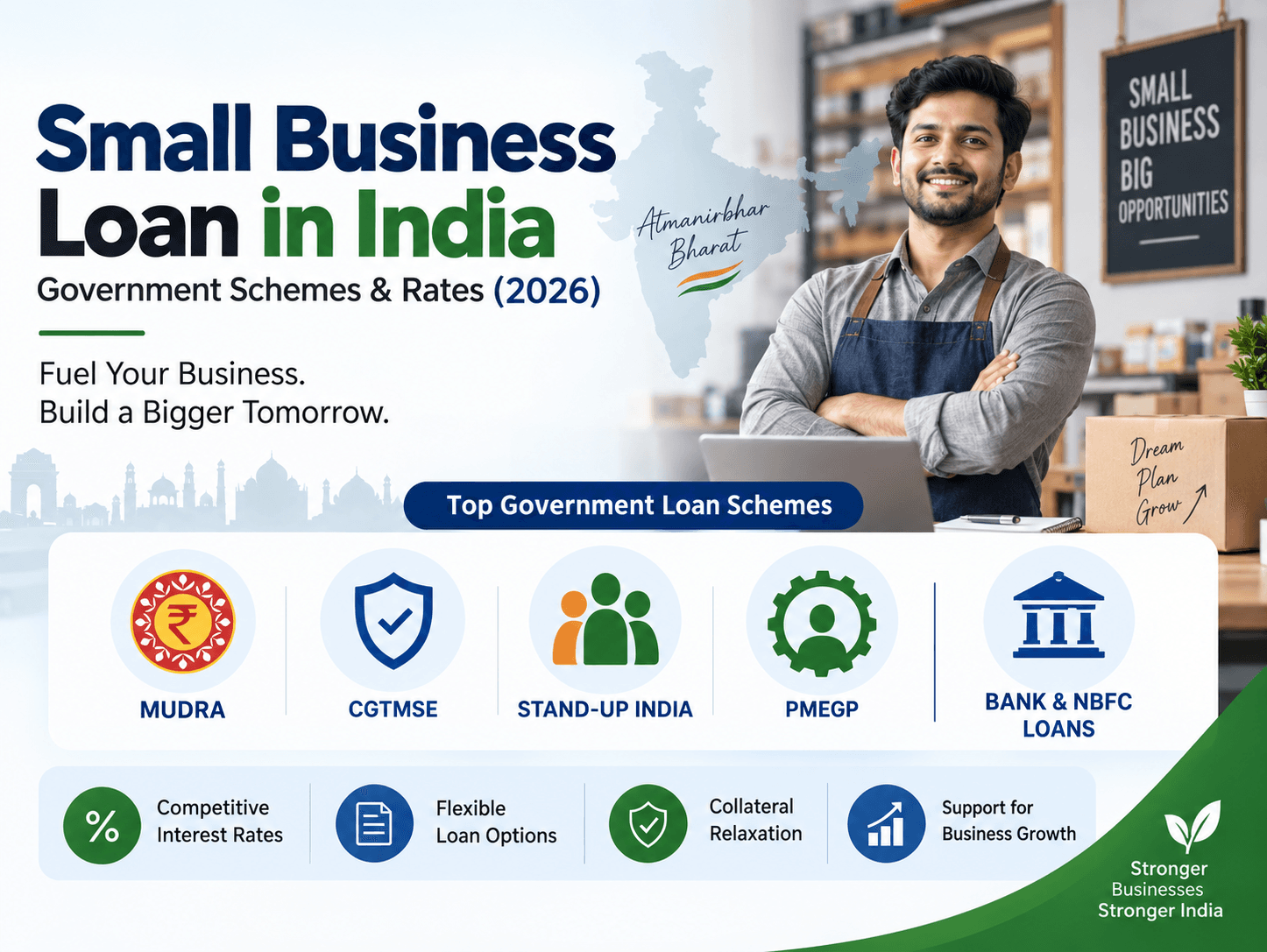
What Is a Small Business Loan?
A small business loan is a debt facility, term loan, working capital loan, overdraft, or line of credit, given to a business that falls under the Micro or Small category as defined by the MSME Development Act, 2006, and typically registered under Udyam. It can be sanctioned by a public or private bank, an NBFC, or a microfinance institution or routed through a central or state government scheme designed to make credit easier to access for smaller enterprises.
Types of Small Business Loans in India
Small business owners in India generally borrow through one of two routes: a government scheme built specifically to widen credit access for small enterprises or a standard loan product priced purely on the business's own financials. Most businesses end up using both at different stages of growth.
Government Scheme Loans for Small Business
These schemes work by reducing the lender's risk, either by guaranteeing repayment if the business defaults or by subsidizing part of the interest or project cost. The loan still has to be repaid; the government's role is to make a bank willing to lend in the first place.
Mudra Yojana (Pradhan Mantri Mudra Yojana)
PMMY is the scheme most people mean when they search for a government scheme for small business loans. It's disbursed through banks, NBFCs, and MFIs across four size bands, Shishu, Kishor, Tarun, and Tarun Plus, aimed at micro and small units rather than large capital projects. The rupee ceiling for each band has been revised in past budgets, so confirm the current limits on the official Mudra portal before setting expectations.
CGTMSE: Credit Guarantee Fund Trust for Micro and Small Enterprises
CGTMSE isn't a loan product; it's a guarantee that sits behind a bank loan, which is what makes small business loans without collateral possible at meaningful loan sizes. The bank still assesses the business's cash flows and the promoter's credit history; the guarantee replaces the need for property or asset security, not the underwriting itself. Cover limits have moved up in recent budgets, so check the current ceiling with your bank.
Stand-Up India
Stand-Up India funds a new, greenfield small business set up by a woman entrepreneur or an SC/ST borrower; it doesn't apply to expanding an existing unit. Every scheduled commercial bank branch is required to sanction at least one loan per category, which is worth knowing since some branches aren't well briefed on the scheme and will need to be pointed to the guidelines.
PMEGP: Prime Minister's Employment Generation Programme
PMEGP is a credit-linked capital subsidy scheme for setting up a new micro-enterprise, administered through KVIC, KVIB, and District Industries Centres. The subsidy percentage depends on the applicant's category and whether the unit is urban or rural, and the maximum project cost differs for manufacturing versus service businesses; both figures should be confirmed against the current PMEGP guidelines before the project report is finalized.
State and Category-Specific Schemes
Several states run their own funding layers on top of the central schemes; for example, iStart Rajasthan supports DPIIT-recognized startups with interest subvention and seed assistance. Separately, a number of state and central programs carry reserved benefits or relaxed norms specifically for women-led small businesses, which is worth checking alongside Stand-Up India rather than instead of it.
Small Business Loans from Banks and NBFCs
Outside scheme-linked lending, small businesses also borrow through conventional bank and NBFC products: secured or unsecured term loans, cash credit and overdraft against stock and receivables, invoice discounting, and short-tenure loans from fintech lenders underwritten on GST returns or UPI/POS transaction data instead of a full project report. These are usually faster to get but cost more than a scheme-linked loan.
Small Business Loan Eligibility Criteria
Eligibility for most small business loans in India starts with the enterprise's Udyam classification, based on investment in plant and machinery/equipment and annual turnover. The thresholds below reflect the Udyam classification as currently notified; confirm the latest figures on the Udyam portal, since these limits are set by government notification and are periodically revised.
| Enterprise Category | Investment (Plant & Machinery/Equipment | Annual Turnover |
|---|---|---|
| Micro | Up to ₹1 crore | Up to ₹5 crore |
| Small | Up to ₹10 crore | Up to ₹50 crore |
Beyond classification, lenders typically expect:
- Valid Udyam registration in the name of the applicant business.
- A reasonable CIBIL/credit bureau score for the promoter or partners, and no record of default with any lender.
- Minimum business vintage for most bank term loans, though Mudra Shishu, PMEGP, and several fintech products are open to genuinely new businesses.
- GST registration and up-to-date return filings, where applicable; most lenders now pull this directly instead of accepting printouts.
- A project report or business plan for term loans, showing how the funds will be used and how the loan will be repaid.
Small Business Loan Interest Rate in India: What Determines It
There's no single small business loan interest rate set by the government; each lender prices the loan off its own benchmark rate (repo-linked lending rate at most public sector banks, MCLR at some private banks) plus a spread based on your risk profile. That spread is shaped by your CIBIL score, banking vintage, whether the loan carries a CGTMSE guarantee, and any collateral offered.
This is why two businesses applying for the same scheme, at the same bank, in the same month can be quoted different rates. As of early 2026, collateral-backed small business term loans from public sector banks are typically priced a few percentage points over the bank's current benchmark rate, but that benchmark shifts every time the RBI revises the repo rate, so always ask your lender for today's figure rather than relying on a rate you saw quoted online. NBFC and fintech small business loans tend to be priced higher in exchange for faster approval and lighter documentation.
Small Business Loan Documents Required
The core documentation for a small business loan is fairly consistent across banks and NBFCs, though scheme-linked loans add a few extra forms:
| Category | Typical Documents |
|---|---|
| Identity & Address (KYC) | PAN card, Aadhaar, passport-size photographs of all promoters/partners/directors |
| Business Proof | Udyam Registration certificate, GST registration certificate, partnership deed/MOA-AOA/proprietorship declaration as applicable |
| Financial Documents | Last 2–3 years' ITR and financial statements, current-year provisional financials, bank statements for the last 6–12 months |
| Project Report | Business plan showing loan utilisation, revenue projections, and repayment capacity |
| Collateral Documents | Property papers or asset documents, where the loan isn't fully covered under CGTMSE |
| Scheme-Specific Forms | Scheme application form (Mudra/PMEGP/Stand-Up India), category certificate where the scheme requires it |
The most frequent hold-up we see isn't a missing document, it's a mismatch between the business name, PAN, or address on the Udyam certificate and what's shown on the GST registration or bank KYC. Lenders' systems now flag this automatically, and it's far quicker to correct before submission than after the file has moved to credit appraisal.
How to Apply for a Small Business Loan Online in India
The process is broadly the same whether you're applying through a scheme or going directly to a bank or NBFC:
- Confirm your Udyam classification and complete Udyam Registration if you haven't already; most scheme benefits and bank MSME programs require it.
- Put together your KYC, business proof, financial statements, and a project report matched to the loan amount and purpose you're requesting.
- Shortlist the right scheme or lender for your loan size: Mudra for smaller working-capital needs, a CGTMSE-backed bank loan for larger collateral-free term loans, PMEGP for a new manufacturing or service unit, or a direct NBFC/fintech loan if speed matters more than rate.
- Submit the application online, through the lender's own portal, the Jan Samarth portal for several government schemes, or PSB Loans in 59 Minutes for faster in-principle approval from public sector banks.
- Upload the supporting documents and project report, and respond quickly to any credit-team query; this is usually where the timeline is won or lost, not in the lender's internal processing.
- Complete verification, which may include a site visit to the business premises and reference checks.
- Receive sanction and disbursal; for CGTMSE-backed loans, the guarantee is registered in the background and needs no separate action from the borrower.
Small Business Loan Without Collateral: What's Actually Available
Yes, small business loans without collateral are genuinely available in India, mainly through CGTMSE-backed bank lending and the Shishu/Kishor bands of Mudra. What trips founders up is assuming "collateral-free" means the bank skips underwriting; it doesn't. The lender still evaluates cash flows, the promoter's credit history, and repayment capacity exactly as it would for a secured loan; the guarantee simply removes the need to pledge property or assets.
Several NBFC and fintech small business loans also skip collateral, relying on GST filings or UPI/POS transaction data for underwriting instead, usually at a higher interest rate to offset the extra risk the lender is absorbing.
Government Scheme for Small Business Loan for Women
Stand-Up India is the primary government scheme aimed at small business loans for women, requiring at least one woman promoter holding a majority stake in a new, greenfield enterprise. Every scheduled commercial bank branch is mandated to sanction at least one such loan, so a woman entrepreneur applying under this scheme has a structural advantage that founders outside the scheme's categories don't.
On top of Stand-Up India, several banks run their own concessional lending programs for women-owned MSMEs, typically a small reduction in the interest spread or processing fee rather than a separate loan product, and some state governments layer additional subsidy or interest-subvention support for women-led units. Because these vary by bank and state and are revised periodically, confirm current terms directly with the lender or the relevant state department before applying.
3 Things Founders Get Wrong About Small Business Loans
From the applications we've filed for small businesses across Rajasthan and beyond, three mistakes come up more than any documentation issue:
1. Assuming every small business loan is a Mudra loan
Mudra covers a specific, capped slice of small business lending. Founders who need funding above the Mudra ceiling often lose time applying through Mudra channels before being redirected to a CGTMSE-backed term loan that actually fits their requirement.
2. Applying with inconsistent Udyam, GST, and KYC records
A file with mismatched names, addresses, or turnover figures across these three doesn't get rejected outright; it gets stuck in repeated query cycles that add weeks to a timeline that should take days. Reconciling this before submission is the single highest-leverage step a founder can take.
3. Treating the project report as a formality
Lenders read the project report as evidence of how seriously the promoter has planned the business, not as paperwork to tick off. A generic report that doesn't tie the requested amount to specific, itemized use of funds is one of the fastest ways to get sent back for revision.
Frequently Asked Questions
What is the easiest small business loan to get in India?
Mudra loans under the Shishu band (the smallest slab) are generally the easiest to access for new or very small businesses, since they're collateral-free and don't require an established turnover history. Fintech loans underwritten on GST or UPI data are also fast for businesses with a digital transaction trail, though usually at a higher interest rate.
Can I get a small business loan without collateral in India?
Yes, mainly through CGTMSE-backed bank lending and the Shishu/Kishor bands of Mudra. The loan still goes through full underwriting on the business's cash flows and the promoter's credit history; the guarantee only removes the need for property or asset security.
What is the interest rate on a small business loan in India?
There's no fixed government rate; each lender prices off its own benchmark (repo-linked rate or MCLR) plus a spread based on your CIBIL score, banking history, and whether the loan carries a CGTMSE guarantee. Ask the lender for the current rate rather than relying on a figure quoted online, since it changes with every RBI repo revision.
Is Udyam registration required for a small business loan?
It's required to access most scheme-linked benefits, CGTMSE cover, priority-sector treatment, Mudra, PMEGP, and Stand-Up India. A regular bank loan is technically possible without it, but you'd lose every MSME-specific advantage in pricing and processing.
What government schemes offer funding for small businesses in India?
The main ones are Mudra Yojana (PMMY), CGTMSE-backed collateral-free lending, PMEGP for new units, and Stand-Up India for women and SC/ST entrepreneurs, alongside various state-level schemes such as iStart Rajasthan for DPIIT-recognized startups.
How long does it take to get a small business loan approved in India?
A straightforward Mudra loan can be sanctioned within a few days to a couple of weeks at some lenders, while a larger CGTMSE-backed term loan involving a site visit and detailed credit appraisal usually takes several weeks. Responding quickly to document queries matters more to the timeline than the lender's internal processing speed.
Are there special small business loan schemes for women entrepreneurs?
Yes. Stand-Up India is the flagship scheme, requiring a woman promoter with a majority stake in a new enterprise, and it's backed by a bank-branch-level mandate to sanction at least one such loan per category. Several banks and state governments also run supplementary concessional lending or subsidy programs for women-owned MSMEs.
Talk to Growthora Before You Apply
The wrong scheme choice, or a Udyam-GST mismatch, is what usually turns a small business loan application into a weeks-long back-and-forth. Growthora Advisory Private Limited handles Udyam Registration, GST registration, and end-to-end small business loan and government scheme application support for founders across Rajasthan and beyond. Book a free consultation with our team, and we'll tell you plainly which scheme and lender actually fit your business before you file anything.
Next step
Apply this to your business.
Confirm whether this applies to your legal structure, industry classification, and credit history - in under 30 minutes with an advisor.