
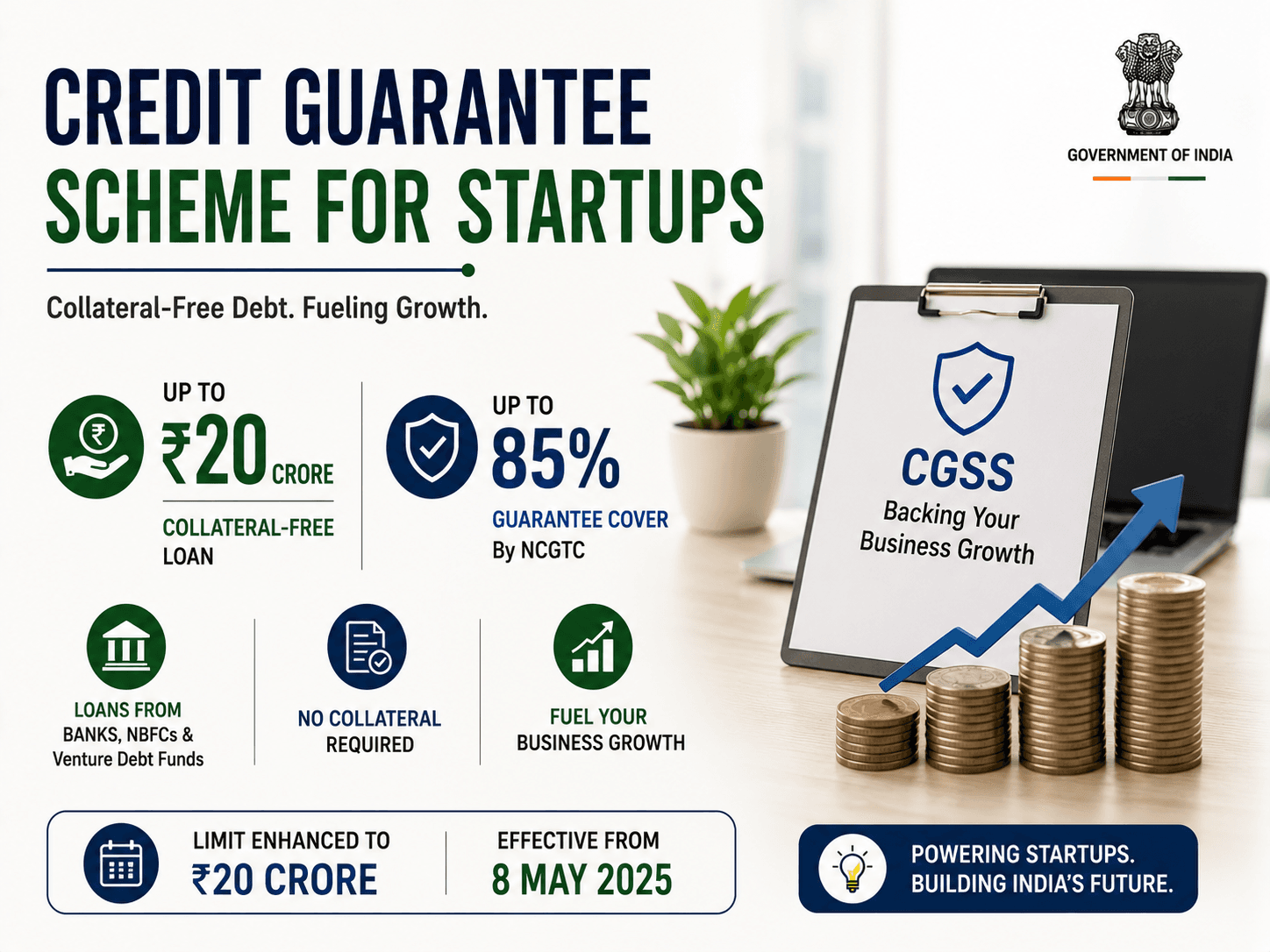
Before and After: What the May 2025 Amendment Actually Changed
A lot of content about CGSS online still describes the scheme's original 2022 parameters. Since the changes are material to how much a startup can actually borrow, here's a direct comparison.
| Parameter | Original CGSS (2022) | Revised CGSS (from 8 May 2025) |
|---|---|---|
| Maximum guarantee cover per borrower | ₹10 crore | ₹20 crore |
| Guarantee cover, loans up to ₹10 crore | 75% | 85% |
| Guarantee cover, loans above ₹10 crore | 75% | 75% (unchanged) |
| Annual Guarantee Fee, Champion Sectors | 2% per annum | 1% per annum |
| Administered by | NCGTC | NCGTC (unchanged) |
If you're reading a guide, including an older version of this one, that quotes ₹10 crore as the maximum, it's describing the pre-amendment scheme. The ₹20 crore ceiling and revised coverage percentages have been in effect since 8 May 2025 and are confirmed by DPIIT's own notification and multiple independent sources through 2026.
How CGSS Actually Works
CGSS doesn't lend money to startups, and it doesn't guarantee anything directly to the startup either. The guarantee sits between NCGTC and the lending institution: when a member institution extends credit to an eligible DPIIT-recognized startup, it can seek guarantee cover from NCGTC on that specific loan. If the startup defaults, NCGTC compensates the lender for its covered share of the loss. The startup's obligation to repay the loan is completely unaffected by this arrangement; the guarantee changes who absorbs the lender's risk, not what the borrower owes.
Who Can Lend Under CGSS
| Member Institution Type | Key Condition |
|---|---|
| Scheduled Commercial Banks | Standard banking license, no additional net worth condition specified beyond normal RBI norms |
| Non-Banking Financial Companies (NBFCs) | RBI-registered, with a minimum net worth of ₹100 crore and a credit rating of at least BBB from an RBI-accredited agency |
| Venture Debt Funds (VDFs) | Structured as SEBI-registered Alternative Investment Funds (AIFs) |
Who Qualifies as a Borrower
- Must hold valid, current DPIIT recognition as per the latest Gazette notification.
- Both Private Limited Companies and LLPs with valid DPIIT recognition are eligible
- No outstanding credit default with any financial institution or investor
- Must not be classified as a Non-Performing Asset (NPA) under RBI guidelines
- Should demonstrate stable revenue capable of supporting debt servicing, typically evidenced through audited monthly financial statements for the preceding 12 months
- Must satisfy the specific lending Member Institution's own credit appraisal criteria, since CGSS supports the lending decision, it doesn't override it
The Application Path
- Confirm your DPIIT recognition is current and valid under the latest Gazette notification.
- Approach a CGSS-registered Member Institution, a bank, an eligible NBFC, or a SEBI-registered Venture Debt Fund, directly for the credit facility you need, whether working capital, a term loan, or venture debt.
- Submit your business financials, including 12 months of audited monthly statements, and go through the institution's standard credit appraisal process.
- If the Member Institution sanctions the loan, it separately applies to NCGTC for guarantee cover on that specific facility.
- NCGTC reviews and, if approved, extends guarantee cover, either transaction-based for a single facility or umbrella-based for a broader lending relationship, depending on the structure in place.
- The loan is disbursed by the Member Institution under its normal terms, with the guarantee sitting behind it rather than altering the startup's repayment obligations.
What CGSS Is Actually Good For, and What It Isn't
| Good Fit | Not a Fit |
|---|---|
| A revenue-generating startup needing working capital without pledging collateral | A pre-revenue startup with no financials to support a debt appraisal |
| Bridging between equity rounds without further dilution | A startup wanting equity capital rather than debt |
| Funding R&D or inventory for an asset-light business model | A startup already classified as NPA or in default |
| Accessing venture debt from a SEBI-registered AIF with guarantee backing | A startup without valid, current DPIIT recognition |
Frequently Asked Questions
What is CGSS?
The Credit Guarantee Scheme for Startups, notified by DPIIT on 6 October 2022 and administered by NCGTC, which guarantees a share of the lender's risk on loans extended by banks, NBFCs, and venture debt funds to DPIIT-recognized startups.
What is the current guarantee limit under CGSS?
₹20 crore per eligible borrower, doubled from ₹10 crore through a DPIIT notification effective 8 May 2025.
Can a startup apply to CGSS directly?
No. Startups apply for a loan directly with a member institution, a bank, an NBFC, or an SEBI-registered venture debt fund. The Member Institution separately seeks guarantee cover from NCGTC on the sanctioned facility.
What percentage of the loan does CGSS guarantee?
85% for loans up to ₹10 crore, and 75% for the portion of any loan exceeding ₹10 crore, as revised in May 2025.
What is the Annual Guarantee Fee under CGSS?
A risk-based percentage that varies by lender and sector is reduced to 1% per annum for startups in 27 government-identified Champion Sectors, down from the earlier 2% rate.
Who is eligible to borrow under CGSS?
DPIIT-recognized private limited companies and LLPs with no existing default or NPA classification and demonstrated stable revenue supported by audited monthly financials for the preceding 12 months.
Which institutions can lend under CGSS?
Scheduled commercial banks; RBI-registered NBFCs with a minimum ₹100 crore net worth and a BBB or higher credit rating; and SEBI-registered venture debt funds structured as alternative investment funds.
Does CGSS provide a grant or a loan?
Neither directly. CGSS is a guarantee mechanism, not a source of funds. The actual loan comes from a member institution; CGSS makes that institution more willing to lend without collateral by sharing the default risk.
Is a pre-revenue startup eligible for CGSS-backed debt?
Generally difficult, since member institutions expect demonstrated stable revenue and audited financials to support a debt appraisal. Pre-revenue startups typically fit equity funding, such as angel or seed VC investment, better than a CGSS-backed loan.
Can an existing CGSS-covered loan be increased?
Yes, existing loans covered under CGSS can potentially be enhanced if the startup continues to meet the scheme's eligibility conditions, subject to the Member Institution's and NCGTC's review.
What happened to the older Rs 10 crore CGSS limit?
It was replaced by the ₹20 crore limit effective 8 May 2025. Any source still citing ₹10 crore as the current ceiling is describing the scheme's pre-amendment parameters.
The One Thing Worth Checking Before You Approach a Lender
Since CGSS terms have changed materially within the last couple of years, confirm the current guarantee percentage and annual guarantee fee directly with your chosen member institution before assuming a specific number applies to your situation. The scheme has been revised once already, and government schemes of this kind get periodically updated, so treat the figures here as accurate as of this writing rather than permanently fixed, and verify against NCGTC's current circulars if the exact numbers materially affect your fundraising plan.
Next step
Apply this to your business.
Confirm whether this applies to your legal structure, industry classification, and credit history - in under 30 minutes with an advisor.