
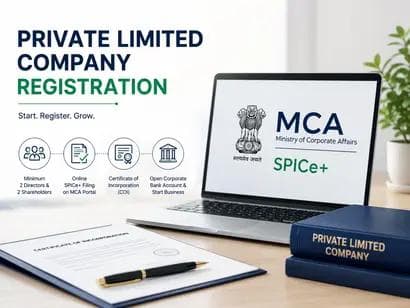
What Is a Private Limited Company (and Who It's Actually For)
A private limited company is a business structure registered under the Companies Act, 2013, and regulated by the Ministry of Corporate Affairs (MCA). It's a separate legal entity from its owners, which means the company can own assets, sign contracts, and be sued in its own name, and your personal liability is limited to what you've invested in shares.
It's the default choice for founders who expect to raise equity funding, want ESOPs for a team, plan to bring on co-founders with defined ownership splits, or need the credibility of a registered company to win B2B contracts and government tenders. If you're a solo consultant with no funding plans, a one-person company (OPC) or even a sole proprietorship may cost less and involve far less compliance, so it's worth ruling out before you commit to a Pvt Ltd's heavier annual filing load.
Who Is Eligible for Private Limited Company Registration
The eligibility bar is lower than most founders expect:
Minimum 2 directors and 2 shareholders (the same people can be both; maximum 200 shareholders, maximum 15 directors)
At least one director must be an Indian resident (someone who has stayed in India for a specified minimum period in the preceding financial year)
No minimum capital requirement: you can start with an authorised capital as low as ₹1 lakh, or even lower in practice
A unique company name that doesn't conflict with an existing registered company, trademark, or prohibited word under MCA naming rules
A registered office address in India, which can be residential, rented, or shared, as long as you can furnish proof
Directors need a valid PAN, and foreign nationals/NRIs can be directors provided at least one co-director meets the resident requirement above
There's no restriction based on business activity for most sectors: manufacturing, trading, and service businesses all register the same way, though certain regulated sectors (NBFCs, insurance, etc.) need additional sectoral approvals after incorporation.
Documents Required for Private Limited Company Registration (Checklist)
For Indian directors and shareholders
- PAN card (mandatory for every Indian director/shareholder)
- Aadhaar card or voter ID/passport/driver's license (identity proof)
- Latest bank statement, electricity bill, or mobile bill, not older than two months (address proof)
- Passport-size photograph
For NRI or foreign national directors
- Passport (mandatory, and it must be notarised/apostilled depending on the country)
- Overseas address proof (utility bill or bank statement, notarised/apostilled)
- Visa or OCI card, where applicable
Registered office proof
Latest electricity bill, gas bill, or property tax receipt for the registered office
No-objection certificate (NOC) from the property owner if the premises are rented or the founder's own residence but registered in someone else's name
Rent agreement, if applicable
Additional filings prepared during registration (not uploaded by you, but drafted as part of the process)
- Memorandum of Association (MOA): defines the company's objectives
- Articles of Association (AOA): defines internal governance rules
- Declaration and consent forms from directors (INC-9, DIR-2)
Private Limited Company Registration Process, Step by Step
- The entire process runs online through the MCA portal using a single integrated form called SPICe+ (Simplified Proforma for Incorporating Company Electronically Plus).
- Obtain Digital Signature Certificates (DSC) for all proposed directors. Every form is signed digitally, so this comes first. Typically ready in 1–2 working days.
- Reserve your company name using SPICe+ Part A (or the standalone RUN service). You can propose two names in order of preference; if both are rejected for conflicting with existing names or trademarks, you refile with new options.
- File SPICe+ Part B, the main incorporation form, along with linked forms: AGILE-PRO-S (for GST, EPFO, ESIC, professional tax and bank account facilitation), e-MOA, e-AOA, and INC-9. This is where your documents checklist above gets uploaded.
- Pay government fees and state stamp duty, calculated and collected directly on the MCA portal based on your authorized capital and the state of your registered office.
- ROC verification. The Registrar of Companies reviews the application. If anything is inconsistent, such as a mismatched address proof, an expired document, or a name too close to an existing brand, you'll get a resubmission query rather than an outright rejection, which adds time but is fixable.
- Certificate of Incorporation (COI) issued, along with your Corporate Identification Number (CIN). PAN and TAN are generated automatically as part of the same filing.
- Open a current bank account in the company's name using the COI, PAN, and MOA/AOA. Most banks now do this digitally within a few days.
Private Limited Company Registration Fees (2026)
There's no single fixed number. It depends on three separate components, and understanding each one is what lets you budget accurately instead of relying on “starting at ₹499” marketing.
- Government fees: The MCA charges no incorporation filing fee (SPICe+/INC-32) for companies with authorized capital up to ₹15 lakh. Above that threshold, fees apply in slabs based on capital. Name reservation through RUN costs around ₹1,000 per application, and PAN/TAN together add a small statutory charge (roughly ₹130 to ₹200 combined).
- Stamp duty: This is a state government levy on the e-MOA and e-AOA, calculated on your authorized capital, and it varies meaningfully by state. Maharashtra, Punjab, and Kerala tend to charge more than others. The MCA portal auto-calculates the correct amount at payment time based on where your registered office is located, so you don't need to work this out manually.
- Digital Signature Certificates: Roughly ₹1,000 to ₹1,500 per director, valid for one to two years.
- Professional fees: If you use a CA, CS, or registration consultant to handle documentation, filing, and follow-up on ROC queries, expect this to be the largest variable cost. It can range from a few thousand rupees for a basic filing service to significantly more for a fully managed setup that also handles GST, Udyam, and Startup India recognition in sequence.
Here's how the typical all-inclusive cost breaks down by component:
- Government fee (SPICe+, up to ₹15 lakh authorised capital): ₹0
- Name reservation (RUN): ₹1,000
- Stamp duty (state-dependent): ₹500 to ₹5,000 or more
- DSC, per director: ₹1,000 to ₹1,500
- PAN and TAN combined: ₹130 to ₹200
- Professional or filing fees: ₹3,000 to ₹15,000 or more
- All-inclusive total for a typical case: ₹7,000 to ₹25,000
A budgeting note most founders miss: registration is only the entry cost. Your first year of statutory compliance, including auditor appointment, the INC-20A commencement filing, DIR-3 KYC, statutory audit, income tax return, and annual ROC return, typically runs another ₹15,000 to ₹50,000 depending on your CA and transaction volume. Budgeting for registration alone and being surprised by this in month ten is one of the most common mistakes founders make.
How Long Does Private Limited Company Registration Take
With clean documentation, most private limited companies get their Certificate of Incorporation in 5 to 10 working days. DSC issuance takes 1–2 days, name reservation is usually approved within 1–2 days if there's no conflict, and SPICe+ Part B processing by the ROC is where most of the remaining time sits. Delays almost always trace back to one of three things: a name too similar to an existing company or trademark, address proof that doesn't match the format the portal expects, or a resubmission query that could have been avoided with a document review before filing.
Private Limited Company Registration Online: What “Online” Actually Means
The entire filing (DSC application, name reservation, incorporation form, MOA/AOA, and payment) happens on the MCA portal without visiting any government office. “Online” doesn't mean unattended, though: documents still need to be correctly formatted, notarized where required (especially for foreign directors), and digitally signed, which is where most self-filed applications run into avoidable resubmission delays.
Private Limited Company Registration Consultant vs. DIY Government Portal Filing
Both routes are legitimate. The right one depends on how much time you have and how comfortable you are troubleshooting ROC queries yourself.
DIY on the MCA portal
- Government fees: same as any route
- Additional cost: none beyond government fees and DSC
- Time investment: higher, since you research formats and fix rejections yourself
- Risk of resubmission delays: higher if this is your first filing
- Sequencing with GST, Udyam, and Startup India: you coordinate each registration separately
- Best for: founders comfortable with government portals and paperwork
Using a registration consultant
- Government fees: same as any route
- Additional cost: a professional fee on top, typically ₹3,000 to ₹15,000 or more
- Time investment: lower, since documentation and resubmissions are handled for you
- Risk of resubmission delays: lower, since experienced filers know common rejection reasons
- Sequencing with GST, Udyam, and Startup India: often bundled and sequenced correctly from the start
Best for: founders who'd rather spend that time on the business, or who need registration sequenced with funding and compliance plans
If your business is straightforward (two Indian resident directors, simple registered office proof, no immediate funding round), DIY filing is genuinely workable. If you're juggling co-founders in different cities or foreign directors, or you know you'll need GST, Udyam, and Startup India recognition filed in the right order shortly after, a consultant's value is mostly in avoiding rework, not in the filing itself.
Benefits of Private Limited Company Registration
- Limited liability: your personal assets are protected beyond what you've invested in shares
- Separate legal identity: the company can contract, borrow, and hold assets independently of its founders
- Easier fundraising: most VCs, angel investors, and even many banks prefer lending to or investing in a Pvt Ltd over an LLP or proprietorship
- Perpetual succession: the company continues to exist regardless of changes in directors or shareholders
- Credibility: a registered CIN, PAN, and Certificate of Incorporation carry weight with enterprise clients, government tenders, and vendors
- Structured ownership: clean cap table and share transfer rules make it easier to bring in co-founders or issue ESOPs later
What Happens After Incorporation (First 30–60 Days)
Getting the Certificate of Incorporation is the beginning of compliance, not the end of it. In the first two months, most companies need to:
- Open a current bank account and deposit subscribed share capital
- File INC-20A (commencement of business) within 180 days of incorporation. You legally cannot start operations or borrow money without this filing
- Appoint a statutory auditor within 30 days using ADT-1
- Apply for GST registration if turnover will cross the threshold, or if the business model requires it regardless of turnover
- Register on Udyam if the company qualifies as an MSME to access priority-sector lending and government scheme eligibility
- Apply for Startup India (DPIIT) recognition if eligible, which unlocks tax benefits and easier compliance for the first few years
- Set up basic bookkeeping, since your first statutory audit and income tax return will be due within the financial year
Common Mistakes That Delay Registration
- Proposing a company name too similar to an existing company or a registered trademark
- Submitting address proof older than two months
- Missing an NOC for a registered office that isn't in a director's own name
- Skipping notarisation/apostille on foreign director documents
- Choosing an authorised capital without understanding the stamp duty and later fundraising implications
- Assuming registration is the only cost, then being unprepared for first-year compliance filings
Frequently Asked Questions
What is a private limited company?
A private limited company is a business entity registered under the Companies Act, 2013, with the Ministry of Corporate Affairs. It's a separate legal entity from its owners, offering limited liability protection to shareholders.
Who is eligible for private limited company registration?
Any group of at least two people can register, provided there are a minimum of two directors and two shareholders, at least one director is an Indian resident, and the company has a unique name and a registered office address in India.
What documents are required for private limited company registration?
PAN, identity proof, and recent address proof for each director/shareholder, plus proof of the registered office (utility bill and an NOC if it isn't owned by a director). Foreign directors need a notarized passport and overseas address proof.
How much does private limited company registration cost?
Typically ₹7,000–₹25,000 all-inclusive for a standard two-director company with authorized capital up to ₹15 lakh, covering name reservation, stamp duty, DSCs, and professional fees. Government incorporation fees themselves are waived up to that capital threshold.
How long does private limited company registration take?
Usually 5 to 10 working days with clean documentation, though DSC issuance, name approval, and any ROC resubmission queries can extend this.
Can I register a private limited company online without a lawyer or CA?
Yes. The entire process runs through the MCA portal, and founders comfortable with the paperwork can file it themselves. Many still choose a consultant to reduce the risk of resubmission delays.
What is the minimum capital required to start a private limited company?
There is no mandatory minimum authorized or paid-up capital. Many companies start with ₹1 lakh in authorized capital to stay within the government fee waiver bracket.
Can a foreign national or NRI be a director?
Yes, provided at least one other director on the board is an Indian resident. Foreign directors need notarized or apostilled identity and address documents.
What is the difference between authorized capital and paid-up capital?
Authorized capital is the maximum value of shares a company can issue, set at incorporation. Paid-up capital is the actual amount shareholders have invested so far, and it can be lower than the authorized capital.
Is GST registration required at the time of company incorporation?
Not always. GST is required only once turnover crosses the applicable threshold or if your business model requires it regardless of turnover (for example, inter-state supply or e-commerce). It can be filed alongside incorporation through AGILE-PRO-S or separately later.
What happens if my proposed company name gets rejected?
You can resubmit with new name options through RUN or SPICe+ Part A. Names are typically rejected for being too similar to an existing company, LLP, or registered trademark.
Do I need to file anything immediately after getting my Certificate of Incorporation?
Yes. INC-20A (commencement of business) must be filed within 180 days, and a statutory auditor must be appointed within 30 days using ADT-1. Skipping these attracts penalties.
Private limited company vs. LLP: which should I choose?
Choose Pvt. Ltd. if you plan to raise equity funding, issue ESOPs, or need investor-friendly governance. LLPs suit service businesses with lower compliance needs and no immediate fundraising plans.
Is a registration consultant worth the extra cost over DIY filing?
It depends on complexity. Simple, single-city, all-Indian-director filings are manageable DIY. Consultants earn their fee mainly by avoiding resubmission delays and correctly sequencing GST, Udyam, and Startup India filings afterward.
What is the first-year compliance cost after registration?
Beyond registration itself, expect roughly ₹15,000 to ₹50,000 for the first year's statutory audit, ROC annual filing, income tax return, and related compliance, depending on your CA and transaction volume.
Conclusion
Registering a private limited company in India is genuinely simple once you know the shape of it: confirm you're eligible, gather the right documents for every director, file through SPICe+ on the MCA portal, and budget for both the registration itself and the compliance that follows in the first 60 days. Most delays come down to avoidable issues, a name that's too similar to an existing brand, address proof that's slightly out of date, or a missing NOC, so a careful first pass through your paperwork saves more time than anything else.
Whether you file it yourself or bring in a consultant, the outcome is the same Certificate of Incorporation and the same legal protections. What differs is how much of the process you want to own directly versus hand off. Either way, treat registration as the first step in a longer compliance and growth roadmap rather than a one-time task, and you'll be in good shape well beyond the day your company is incorporated.
Next step
Apply this to your business.
Confirm whether this applies to your legal structure, industry classification, and credit history - in under 30 minutes with an advisor.