What Is a Government Business Loan?
A government business loan is a credit facility where the Government of India (or a state government) either directly lends to businesses or provides guarantees, subsidies, or interest benefits through public-sector banks, NBFCs, and financial institutions like SIDBI.
These loans differ from regular commercial bank loans in a few important ways:
- Subsidized cost: Many schemes offer margin-money subsidies (e.g., PMEGP offers 15-35%) or interest subvention, reducing the effective borrowing cost.
- Collateral relaxation: Schemes like Mudra and CGTMSE-backed loans specifically eliminate the need for collateral or third-party guarantees.
- Targeted eligibility: Certain schemes are designed for specific groups - women entrepreneurs, SC/ST applicants, first-time business owners, or units in rural areas.
- Institutional backing: Repayment defaults are partly covered by government-backed guarantee trusts, which makes banks more willing to lend to small businesses without strong credit histories.
Important: The government doesn't hand out loans directly in most cases. It creates the framework - subsidy, guarantee, interest relief - and lending happens through scheduled commercial banks, regional rural banks, SIDBI, NBFCs, or microfinance institutions.
Government Business Loan Schemes in India - Complete List (2026)
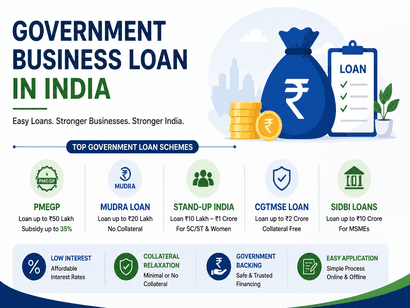
Below is a summary of every major government loan scheme for business currently active at the central level.
| Scheme | Loan Amount | Subsidy | Collateral | Best For |
|---|---|---|---|---|
| PMEGP | Up to ₹50L (mfg) / ₹20L (service) | 15-35% margin money | Not required (CGTMSE-backed) | New micro-enterprises |
| Mudra (PMMY) | Up to ₹20L (Tarun Plus) | None | Not required | Existing small businesses, traders |
| Stand-Up India | ₹10L-₹1Cr | None (but guarantee cover) | Collateral-free via CGFSIL | SC/ST and women entrepreneurs |
| CGTMSE-Backed Loans | Up to ₹10Cr (₹20Cr for startups) | None (guarantee cover) | Not required | MSEs seeking larger working capital or term loans |
| SIDBI Direct Lending | Varies (₹25L-₹50Cr+) | Scheme-specific | Varies | Established MSMEs scaling up |
| PSB Loans in 59 Minutes | Up to ₹5Cr | None | Bank-dependent | MSMEs needing fast in-principle approval |
Each scheme is explained in detail below.
PMEGP: Prime Minister's Employment Generation Programme
PMEGP is one of the most well-known government business loan schemes for new enterprises. It is administered by the Khadi and Village Industries Commission (KVIC) under the Ministry of MSME.
What it offers: A credit-linked subsidy on the project cost for setting up new micro-enterprises in manufacturing or service sectors.
Subsidy structure:
| Category | Urban Areas | Rural Areas |
|---|---|---|
| General | 15% of project cost | 25% of project cost |
| Special (SC/ST/OBC/Minorities/Women/Ex-Servicemen/PwD/NER/Hill | 25% of project cost | 35% of project cost |
| States/Aspirational Districts/Trans) |
Key details:
- Loan limit: Up to ₹50 lakh for manufacturing projects, ₹20 lakh for service/business projects
- Upgradation of existing PMEGP/REGP units: Up to ₹1 crore (applicable to units that have repaid their earlier PMEGP loan)
- Own contribution: 10% for general category, 5% for special category
- Age requirement: Minimum 18 years
- Education: VIII standard pass required for projects above ₹10 lakh (manufacturing) or ₹5 lakh (service)
- Important restriction: Only for new projects. Existing businesses cannot apply under PMEGP for their current operations.
Who should consider PMEGP: First-time entrepreneurs starting a manufacturing unit, food processing business, service centre, or any micro-enterprise. The subsidy effectively reduces your project cost by 15-35%, which is significant for businesses with project costs under ₹25-50 lakh.
Official portal: pmegp.msme.gov.in
Mudra Loan - Pradhan Mantri Mudra Yojana (PMMY)
Mudra is the most widely used government loan for small business in India. It targets non-corporate, non-farm micro and small enterprises engaged in manufacturing, trading, or services.
Loan categories:
| Category | Loan Amount |
|---|---|
| Shishu | Up to ₹50,000 |
| Kishor | ₹50,001 to ₹5 lakh |
| Tarun | ₹5,00,001 to ₹10 lakh |
| Tarun Plus | ₹10,00,001 to ₹20 lakh |
The Tarun Plus category was introduced following the Union Budget 2024-25, expanding the maximum Mudra loan limit from ₹10 lakh to ₹20 lakh.
Key details:
- Collateral: Not required for any Mudra loan category
- Interest rate: Not fixed centrally - banks set their own rates based on the borrower's profile. Typically ranges between 9-14% p.a. from banks and 14-24% p.a. from NBFCs/MFIs
- Subsidy: No subsidy component. Mudra is a pure lending programme
- Eligibility: Any Indian citizen with a non-farm business activity. Both new and existing businesses can apply
- Repayment tenure: Usually 3-5 years depending on the lender
Where to apply: Through any scheduled commercial bank, regional rural bank, NBFC-MFI, or online via JanSamarth (jansamarth.in) and Udyami Mitra (udyamimitra.in).
Who should consider Mudra: Small business owners who need working capital or equipment funding up to ₹20 lakh without collateral. Particularly useful for street vendors, small shop owners, artisans, small manufacturers, and service providers.
Stand-Up India Scheme
Stand-Up India was launched specifically to promote entrepreneurship among SC/ST communities and women. Each bank branch must extend at least one loan to an SC/ST borrower and one to a woman borrower under this scheme.
Key details:
- Loan range: Composite loan (term loan + working capital) between ₹10 lakh and ₹1 crore
- Eligible businesses: Greenfield enterprises only - meaning first-time ventures in manufacturing, services, trading, or agri-allied activities
- Collateral: Generally not required, backed by the Credit Guarantee Fund Scheme for Stand-Up India (CGFSIL)
- Interest rate: Lowest applicable rate of the bank, not exceeding base rate (MCLR) + 3% + tenor premium
- Repayment: Up to 7 years with a moratorium of up to 18 months
Eligibility requirements:
- SC/ST or woman entrepreneur, 18 years or above
- For non-individual enterprises (company, partnership), at least 51% of shareholding/stake must be held by SC/ST or woman entrepreneur
- The enterprise must be a greenfield project - the borrower should not have taken a loan for the same activity earlier
Who should consider Stand-Up India: Women and SC/ST entrepreneurs starting their first business with a project cost between ₹10 lakh and ₹1 crore. The combination of favourable interest rates, collateral relaxation, and government guarantee makes it one of the most attractive government loan schemes for eligible applicants.
Official portal: standupmitra.in
CGTMSE-Backed Loans - Credit Guarantee for Micro and Small Enterprises
CGTMSE is not a loan scheme - it's a guarantee mechanism. The Credit Guarantee Fund Trust for Micro and Small Enterprises provides collateral-free credit guarantees to banks and financial institutions, making it possible for MSEs to access loans without pledging assets.
Current guarantee limits (effective April 2025):
| Business Type | Maximum Guarantee Coverage |
|---|---|
| Micro and Small Enterprises (MSEs) | Up to ₹10 crore |
| DPIIT-Recognised Startups | Up to ₹20 crore |
This is a significant expansion from the earlier limit of ₹5 crore, making CGTMSE one of the most impactful collateral-free funding mechanisms for MSMEs in India.
How it works:
- You apply for a loan at a bank or eligible lending institution
- The bank evaluates your project and decides to sanction the loan
- Instead of asking for collateral, the bank obtains a guarantee from CGTMSE
- CGTMSE charges an Annual Guarantee Fee (AGF) - starting as low as 0.37% p.a. - which the borrower typically bears
- If the loan defaults, CGTMSE compensates the bank for up to 75-90% of the outstanding amount depending on the loan size and borrower category
Guarantee coverage by category:
- Women-owned MSEs: Up to 90% coverage
- Micro enterprises: Up to 85% coverage
- Other MSEs:75% coverage for loans above a certain threshold
Who should consider CGTMSE: Any micro or small enterprise that needs a larger loan (₹50 lakh to ₹10 crore) without providing property or fixed assets as collateral. Particularly relevant for businesses that have strong financials but lack collateral.
SIDBI Direct Lending for MSMEs
The Small Industries Development Bank of India (SIDBI) offers direct lending products beyond its role as a refinancing institution. Key schemes include:
- SMILE (SIDBI Make in India Loan for Enterprises): Soft loans with a 3-year moratorium, typically ₹25 lakh to ₹10 crore
- ARISE: Term loans up to ₹50 crore for brownfield and greenfield manufacturing/service projects
- SPEED / SPEED Plus: Equipment finance up to ₹2-3 crore, often processed faster with minimal collateral
- TULIP: Top-up loans for existing SIDBI borrowers needing additional funding
Interest rates: Competitive, typically between 8-12% p.a. - often lower than commercial bank rates for similar loan amounts.
Who should consider SIDBI: Established MSMEs with a track record, Udyam registration, and a clear project plan. SIDBI's direct lending products suit businesses looking for ₹25 lakh to ₹50 crore in term loans, equipment finance, or working capital.
PSB Loans in 59 Minutes
This is not a separate scheme but an in-principle loan approval platform. The portal analyses data from IT returns, GST, bank statements, and other sources to generate a loan eligibility report, which participating banks then use for sanctioning.
Key facts:
- Loan types: MSME loans, Mudra loans, personal and business loans
- Approval timeline: In-principle approval within 59 minutes; actual disbursement takes longer depending on the bank's due diligence
- Amount: Up to ₹5 crore for MSME loans
- Official portal: psbloansin59minutes.com
- The platform has processed over 46 lakh loan applications since inception and remains operational as of 2026.
Government Business Loan Eligibility - Who Can Apply?
Eligibility varies by scheme, but the common requirements across most government business loan programs are
- Business registration: A valid Udyam Registration (MSME registration) is the universal prerequisite for almost all MSME-targeted schemes
- Indian citizenship: The applicant must be an Indian citizen or the enterprise must be registered in India
- Age: Minimum 18 years for most schemes
- Business type: The enterprise must fall within the micro, small, or medium category as defined under the MSME Development Act
- No existing default: The applicant or enterprise should not be a wilful defaulter or have overdue loans with any financial institution
- Additional eligibility conditions by scheme:
| Scheme | Special Eligibility |
|---|---|
| PMEGP | New projects only; VIII pass for projects above specified limits |
| Mudra | Non-farm, non-corporate enterprises; new and existing both eligible |
| Stand-Up India | SC/ST or women entrepreneurs; greenfield projects only |
| CGTMSE | MSEs only (not medium enterprises); Udyam-registered |
| SIDBI | Varies by product; usually requires 2-3 years of operational history |
Government Business Loan Interest Rates - What to Expect
There is no single "government business loan interest rate." Rates vary depending on the scheme, the lending institution, the borrower's profile, and the loan amount.
Indicative interest rate ranges (2026):
| Loan Source | Typical Interest Rate |
|---|---|
| PSU Bank term loans (CGTMSE-backed) | 8.5%-12% p.a. |
| SIDBI direct lending | 8%-12% p.a. |
| Mudra loans via banks | 9%-14% p.a. |
| Mudra loans via NBFCs/MFIs | 14%-24% p.a. |
| Stand-Up India | MCLR + up to 3% + tenor premium |
| PMEGP | Bank-determined (typically 10%-13%) |
Interest subvention for MSME exporters: A new scheme launched on 2 January 2026 provides a flat 2.75% p.a. interest subsidy on pre- and post-shipment rupee export credit, with a maximum benefit of ₹50 lakh per financial year. Exporters must generate a Unique Identification Number (UIN) via the DGFT portal.
Key takeaway: If you're applying through a public-sector bank with CGTMSE backing, your effective interest rate will generally be between 8.5% and 12%. Applying through NBFCs or microfinance institutions tends to cost more, though approval processes may be faster.
Government Business Loan Without Collateral - Your Options
One of the most common searches among small business owners is whether they can get a government loan for business without collateral. The answer is yes - but with conditions.
Collateral-free loan routes:
- Mudra loans (all categories): Loans up to ₹20 lakh are completely collateral-free by design
- CGTMSE-backed loans: Banks can lend up to ₹10 crore without collateral when covered by CGTMSE guarantee (₹20 crore for recognised startups)
- Stand-Up India: Loans up to ₹1 crore with guarantee coverage under CGFSIL
- PMEGP: Subsidy-backed loans where CGTMSE coverage substitutes for collateral
What "collateral-free" actually means in practice:
The loan doesn't require you to pledge property, land, or fixed assets. However, most lenders will still require:
- A personal guarantee from the promoter(s)
- Hypothecation of assets created from the loan (machinery, equipment, stock)
- Post-dated cheques or an ECS/NACH mandate
The bank cannot ask for separate collateral security or a third-party guarantee when the loan is covered under CGTMSE or Mudra. If a bank insists on collateral for a CGTMSE-eligible loan, it may be acting outside the scheme guidelines - and you can escalate through the bank's grievance mechanism or the RBI's Banking Ombudsman.
Government Loan for Women Entrepreneurs
Several government schemes provide specific advantages for women business owners:
- Stand-Up India: Mandatory allocation - every bank branch must sanction at least one loan to a woman entrepreneur under the scheme
- CGTMSE: Women-owned MSEs receive 90% guarantee coverage (compared to 75-85% for other categories), making banks more willing to lend
- PMEGP: Women applicants qualify under the "special category," receiving 25% subsidy in urban areas and 35% in rural areas (vs. 15% and 25% for general category)
- Mudra: While there is no separate women's category, several banks run dedicated Mudra products for women (e.g., Mahila Udyami loans)
State-level schemes: Many states operate dedicated loan-cum-subsidy schemes for women entrepreneurs. For example, Tamil Nadu's NEEDS Yojana, Kerala's empowerment schemes, and Rajasthan's Startup Grant include gender-specific benefits. Check your state's DIC or MSME department portal for applicable schemes.
If you are a woman entrepreneur starting a business, Stand-Up India + CGTMSE backing is often the strongest combination - you get favourable interest rates, up to ₹1 crore without collateral, and the highest guarantee coverage.
Government Loan for New Business - What First-Time Entrepreneurs Should Know
Starting a new business and looking for a government loan? Here's what you need to understand:
Schemes open to new businesses:
- PMEGP: Designed exclusively for new micro-enterprises (not existing businesses)
- Stand-Up India: For greenfield projects only
- Mudra (Shishu/Kishor): Open to both new and existing businesses, though new businesses typically receive smaller amounts
- Startup India Seed Fund: For DPIIT-recognised startups at the proof-of-concept or commercialisation stage
Practical considerations for new businesses:
- Banks assess repayment ability, not just your idea. A strong project report - with realistic revenue projections, cost breakdowns, and working capital estimates - significantly improves your approval chances.
- Your personal CIBIL score matters. Even for a new business, the promoter's credit score is a key evaluation factor. Aim for a score above 700 before applying.
- Start with Mudra Shishu or Kishor if you're testing a business idea. The amounts are smaller (up to ₹5 lakh), but approval is faster and the process is simpler. You can graduate to larger loans as your business establishes a track record.
- PMEGP is ideal if your project cost is substantial (say ₹10-50 lakh) because the 15-35% subsidy reduces your effective cost significantly. But prepare for a longer processing time - PMEGP applications go through DIC/KVIC vetting before reaching the bank
How to Apply for a Government Business Loan Online
Most government business loan schemes in India now support online applications through unified portals. Here's a step-by-step process:
Step 1: Register on the Relevant Portal
| Purpose | Portal |
|---|---|
| Mudra, MSME loans (multiple banks) | JanSamarth |
| PMEGP applications | PMEGP Portal |
| Stand-Up India | Stand-Up Mitra |
| Bank-specific loan matching | Udyami Mitra |
| PSB Loans in 59 Minutes | PSB59 |
Step 2: Complete Your Udyam Registration
If you haven't already registered your business under Udyam (MSME registration), do this first. It's free, fully online, and takes 10-15 minutes at udyamregistration.gov.in. Udyam registration is required for CGTMSE, PMEGP, and most state-level schemes.
Step 3: Prepare Your Project Report
A project report or Detailed Project Report (DPR) is essential for loans above ₹5-10 lakh. It should include:
- Business overview and promoter background
- Product or service details
- Total project cost with breakdowns (land, building, machinery, working capital)
- Means of finance (own contribution, bank loan, subsidy)
- Projected revenue, expenses, and profitability for 5-7 years
- Break-even analysis
Step 4: Submit Your Application
Fill in the application form on the relevant portal, upload your documents (detailed below), and submit. The portal routes your application to eligible banks or the nodal agency (DIC/KVIC for PMEGP).
Step 5: Bank Evaluation and Sanction
The bank conducts its own due diligence - verifying your documents, assessing repayment capacity, and inspecting the project site (if applicable). Sanction timelines vary:
- Mudra (Shishu): 7-15 days
- Mudra (Kishor/Tarun): 2-4 weeks
- PMEGP: 45-90 days (includes DIC/KVIC processing)
- Stand-Up India: 2-4 weeks
- CGTMSE-backed bank loans: 2-6 weeks
Documents Required for Government Business Loans
While specific requirements vary by scheme and bank, the following documents are commonly needed:
Identity and address:
- Aadhaar card
- PAN card (individual and business, if applicable)
- Passport-size photographs
Business documents:
- Udyam Registration Certificate
- Business registration proof (GST certificate, partnership deed, incorporation certificate, etc.)
- Business address proof (rent agreement, utility bill, or property documents)
Financial documents:
- Bank statements (6-12 months)
- Income tax returns (2-3 years for existing businesses)
- Balance sheet and profit & loss statement (audited, if available)
- GST returns
Project-specific:
- Detailed Project Report (DPR) or project summary
- Quotations for machinery/equipment (for manufacturing projects)
- Land/premises documents (lease deed, sale deed, or NOC from landlord)
Category-specific (where applicable):
- Caste certificate (for SC/ST applicants under Stand-Up India or PMEGP)
- EDP (Entrepreneurship Development Programme) certificate (for PMEGP)
- DPIIT Recognition Certificate (for startup schemes)
Common Reasons Government Loan Applications Get Rejected
Understanding why applications fail can help you avoid the same mistakes:
- Weak or unrealistic project report: Overly optimistic revenue projections or incomplete cost estimates signal a poorly planned business. Banks see hundreds of DPRs - generic or templated reports stand out (negatively).
- Low CIBIL score: A score below 650-700 is a red flag, even for collateral-free schemes. Defaults on personal loans, credit cards, or earlier business loans hurt your application.
- Incomplete documentation: Missing GST returns, outdated ITRs, or unsigned documents delay processing and can lead to outright rejection.
- Ineligible business activity: PMEGP, for instance, does not cover retail trade or certain service activities. Applying under the wrong scheme wastes time.
- Existing defaults or overdue loans: If you or your business has any outstanding default with any financial institution, most schemes will automatically disqualify the application.
- Mismatch between loan amount and business capacity: Requesting ₹50 lakh for a business that shows ₹2 lakh annual revenue creates a credibility gap.
- Not applying through the correct channel: Some applicants approach banks directly for schemes like PMEGP, which requires prior approval from KVIC/DIC. The bank cannot process the subsidy component without this routing.
Which Government Business Loan Scheme Should You Choose?
The best government business loan scheme depends on your specific situation. Here's a practical decision framework:
If you're starting a new manufacturing or service business with a project cost under ₹50 lakh: → PMEGP is your strongest option because of the 15-35% subsidy.
If you're an SC/ST or woman entrepreneur with a project cost between ₹10 lakh and ₹1 crore: → Stand-Up India gives you preferential rates, collateral-free access, and a bank-mandated allocation.
If you need working capital or equipment funding under ₹20 lakh: → Mudra (Kishor or Tarun/Tarun Plus) is the fastest route with the simplest process.
If you need a larger loan (₹50 lakh to ₹10 crore) without collateral: → Apply for a regular bank term loan with CGTMSE guarantee coverage.
If you're an established MSME looking to scale or modernise: → SIDBI direct lending (SMILE, ARISE, SPEED) offers competitive rates and larger ticket sizes.
If you're a DPIIT-recognised startup: → CGTMSE covers you up to ₹20 crore without collateral. Combine this with the Credit Guarantee Scheme for Startups (CGSS) if applicable.
If you export goods: → The MSME Export Interest Subvention Scheme (launched January 2026) reduces your export credit cost by 2.75% p.a.
Not every scheme will suit every business. In many cases, combining two mechanisms - for example, a PMEGP subsidy with CGTMSE guarantee coverage - gives you the best overall deal.
What to Do Next
Navigating government business loan schemes involves more than just filling an application. You need to match the right scheme to your business type, prepare a credible project report, ensure your documentation is airtight, and apply through the correct portal.
If you're unsure which government scheme fits your business, Growthora can help you identify the right funding route, prepare the project report and documentation, and guide you through the application process - before you approach the bank.
Frequently Asked Questions
Can I get a government business loan with no collateral?
Yes. Several government-backed schemes provide business loans without collateral. Mudra loans (up to ₹20 lakh) are entirely collateral-free. CGTMSE-backed loans cover up to ₹10 crore for micro and small enterprises without requiring collateral - the guarantee from CGTMSE substitutes for it. Stand-Up India loans (up to ₹1 crore for SC/ST and women entrepreneurs) are also collateral-free. However, lenders may still require a personal guarantee from the promoter and hypothecation of assets purchased with the loan.
What is the interest rate on government business loans?
There is no single fixed rate. Government business loan interest rates depend on the scheme, the lending bank, your credit profile, and the loan amount. For PSU bank loans with CGTMSE coverage, rates typically range from 8.5% to 12% p.a. Mudra loans through banks cost around 9-14% p.a. SIDBI direct loans offer 8-12% p.a. Loans through NBFCs and MFIs may cost 14-24% p.a. Stand-Up India loans are capped at the bank's MCLR plus 3% plus tenor premium.
Which is the best government business loan scheme for a new business?
For a new manufacturing or service enterprise, PMEGP is generally the best option because it provides a 15-35% subsidy on the project cost. For women or SC/ST entrepreneurs, Stand-Up India offers loans up to ₹1 crore with preferential terms. If your requirement is smaller (under ₹5 lakh), Mudra Shishu or Kishor works well for both new and existing businesses. The best scheme depends on your project cost, business category, and personal eligibility.
How long does it take to get a government business loan sanctioned?
Processing times vary significantly by scheme. Mudra Shishu loans (up to ₹50,000) can be sanctioned within 7-15 days. Mudra Kishor and Tarun loans take 2-4 weeks. PMEGP applications go through KVIC/DIC screening before reaching the bank, so expect 45-90 days. Stand-Up India loans typically take 2-4 weeks. CGTMSE-backed term loans through banks take 2-6 weeks depending on the bank's internal processing speed and the completeness of your documentation.
Do I need a project report to apply for a government business loan?
For Mudra Shishu loans (up to ₹50,000), a project report is usually not required - a simple business plan or activity description suffices. For all other schemes and loan amounts above ₹5-10 lakh, a Detailed Project Report (DPR) is essential. The DPR should cover your business model, project cost, means of finance, projected financials, and break-even analysis. A well-prepared project report is one of the strongest factors influencing loan approval.
Can existing businesses apply for government business loans?
Yes, but not under all schemes. Mudra loans, CGTMSE-backed loans, and SIDBI lending products are available to both new and existing businesses. However, PMEGP is only for new projects - existing businesses cannot apply unless they are upgrading a previously funded PMEGP unit. Stand-Up India is also restricted to greenfield (first-time) ventures. PSB Loans in 59 Minutes is open to existing businesses with at least 3 years of ITR filings.
What is the difference between Mudra loan and CGTMSE?
Mudra is a lending programme - it provides actual loans up to ₹20 lakh through banks and NBFCs for small non-farm enterprises. CGTMSE is a guarantee mechanism - it doesn't lend money directly but provides a collateral-free guarantee to lenders who sanction loans up to ₹10 crore for MSEs. You can receive a Mudra loan without CGTMSE involvement. Separately, you can receive a larger bank loan backed by CGTMSE guarantee. In some cases, particularly for PMEGP, both mechanisms may apply simultaneously.
How do I apply for a government business loan online?
You can apply through centralised portals: JanSamarth (jansamarth.in) for Mudra and other bank loans, the PMEGP portal (pmegp.msme.gov.in) for PMEGP applications, Stand-Up Mitra (standupmitra.in) for Stand-Up India, and Udyami Mitra (udyamimitra.in) for bank-matching. You'll need to register, fill out the application form, upload required documents, and submit. The portal then routes your application to eligible banks or nodal agencies.
Are government business loans available for trading businesses?
Trading businesses have limited options compared to manufacturing and service enterprises. Mudra loans are available for trading businesses across all categories. Stand-Up India now covers trading activities as well. However, PMEGP generally does not cover pure retail trading. CGTMSE covers trading businesses classified as micro or small enterprises. SIDBI also provides working capital and term loans to trading MSMEs. Always verify whether your specific trading activity qualifies under the scheme you're considering.
Next step
Apply this to your business.
Confirm whether this applies to your legal structure, industry classification, and credit history - in under 30 minutes with an advisor.