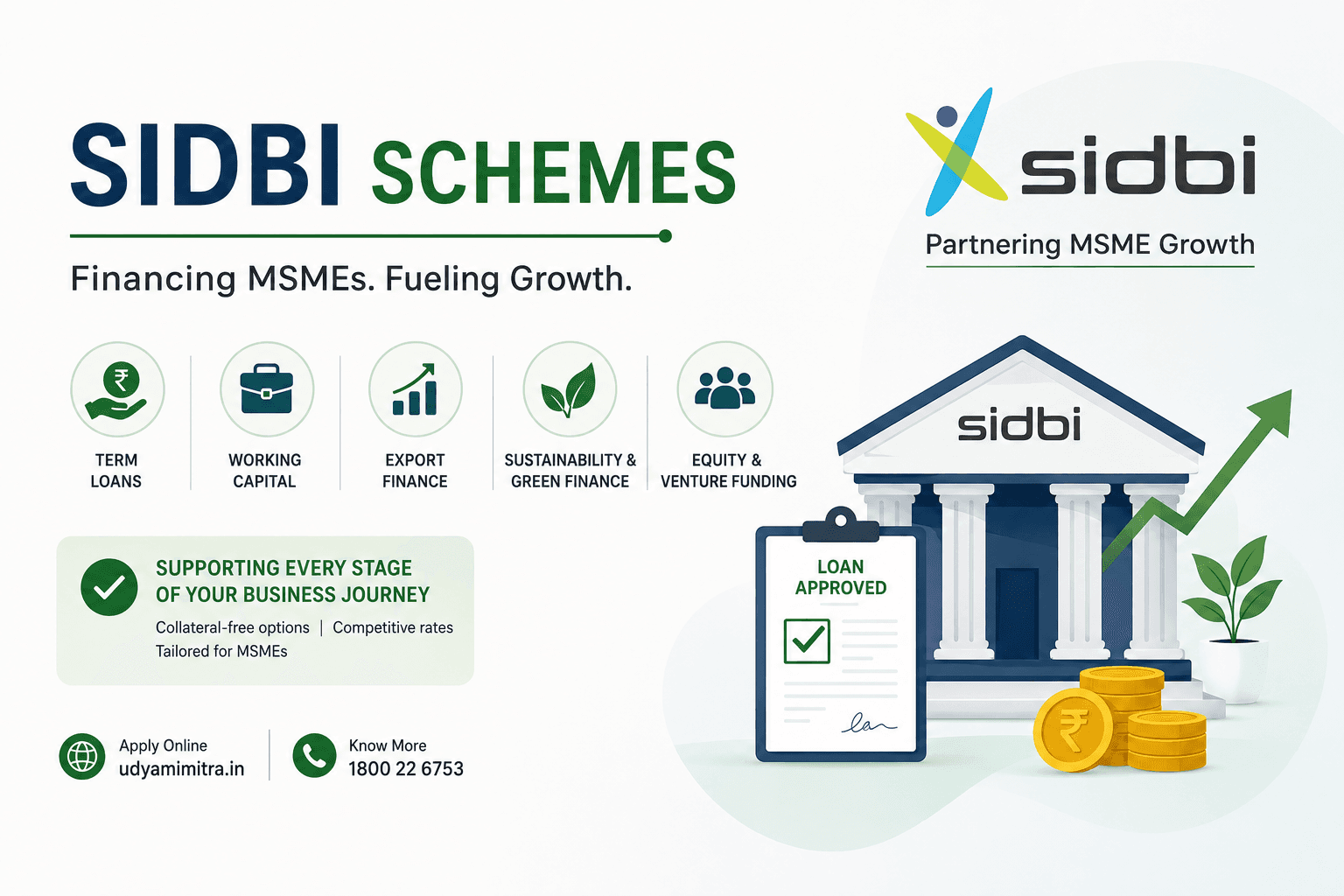
Unlike a single scheme with one set of rules, SIDBI operates a portfolio of schemes tailored to different business needs, from general working capital and term loans to specialized programs for exporters, women entrepreneurs, and clean technology adoption. SIDBI also acts as a nodal or implementing agency for several government ministries, meaning it channels funds and manages the digital application infrastructure (such as the Udyamimitra portal) for schemes originating from other departments, not just its own direct-lending products.
Why Is the SIDBI Scheme Important?
- MSMEs are a major contributor to India's production, employment, and exports, but many smaller businesses struggle to access affordable, timely credit from mainstream banks. SIDBI's schemes matter because they:
- Provide MSME-specific credit that accounts for the sector's cash flow patterns and collateral limitations
- Offer collateral-free options for loans above a certain threshold, reducing a major barrier for small businesses
- Support niche needs like export financing, energy efficiency upgrades, and equity-stage funding for startups
- Act as a single-window, technology-enabled channel (via portals like Udyamimitra) for accessing multiple government-linked credit schemes
How Does the SIDBI Scheme Work?
SIDBI provides both direct finance to MSMEs (term loans, working capital, and equity support) and indirect/refinance support through banks, State Financial Corporations (SFCs), and NBFCs, while also acting as an implementing agency for various government credit-linked schemes.
For direct finance, an eligible MSME applies to SIDBI (often digitally through the Udyamimitra portal) with business and financial documentation; SIDBI evaluates the proposal against the specific scheme's norms, years in operation, profitability, sector, and loan purpose, before sanctioning funds. For refinance schemes, SIDBI works behind the scenes by extending credit lines to banks and financial institutions, who then lend to MSMEs on the ground. This dual structure lets SIDBI reach businesses both directly and through the wider banking ecosystem.
Key Categories of SIDBI Schemes
| Category | Purpose |
|---|---|
| Direct Finance (Term Loan, Working Capital, EXPRESS 2.0, SAATH, STHAPAN, etc.) | Provides term loans and working capital directly to MSMEs for expansion, modernisation, or day-to-day operations |
| Support Refinance | Extends credit lines to banks, SFCs, and NBFCs, who then on-lend to MSMEs, widening SIDBI's reach |
| Equity and Venture Support (via SIDBI Venture) | Offers equity or venture capital-style funding to growth-stage MSMEs and startups |
| Government Linked Programs (Standup India, Udyamimitra) | SIDBI acts as implementing/nodal agency, managing digital workflows for schemes run by various ministries |
| Sustainability Financing | Supports clean production and energy-efficient technology adoption, often via bilateral lines of credit from international agencies |
Step-by-Step: How to Apply for a SIDBI Scheme
| Step | What Happens |
|---|---|
| the right Identify scheme | Review SIDBI's scheme list or the Udyamimitra portal to match your business need (term loan, working capital, refinance, etc.) |
| Check eligibility | Confirm years in operation, profitability, sector, and collateral norms for the specific scheme |
| Submit application and documents | Apply online (commonly via Udyamimitra) or through a SIDBI branch with financial statements, business proof, and KYC documents |
| Due diligence and evaluation | SIDBI or the partner bank/NBFC evaluates the proposal, including credit history and project viability |
| Sanction and disbursement | On approval, funds are sanctioned and disbursed as per the scheme's terms and repayment schedule |
Who Is Eligible Under SIDBI Schemes?
Eligibility varies by scheme, but common patterns include:
- MSME units in the manufacturing or services sector, often required to have a minimum operating history (commonly around 2–3 years, varying by scheme)
- A track record of profitability in recent years and no default history with any bank or financial institution
- For sustainability-linked schemes, additional technical requirements such as a Detailed Energy Audit by a certified agency
- For refinance-based access, eligibility is assessed by the partner bank, SFC, or NBFC rather than SIDBI directly
Since exact thresholds (turnover, years in business, loan amount ranges) differ by scheme and are periodically revised, applicants should verify current criteria directly with SIDBI.
Benefits of SIDBI Schemes
- Access to MSME-focused credit products not always available through general commercial banks
- Collateral-free loans available above a certain threshold under several schemes
- A single digital gateway (Udyamimitra) that simplifies discovery and application across multiple government-linked schemes
- Specialised support for exporters, women entrepreneurs, and sustainability-focused MSMEs
- Reasonably competitive interest rates and repayment tenures designed around MSME cash flows
Benefits vs. Limitations
| Benefits | Limitations |
|---|---|
| Wide range of schemes covering different business stages and needs | Choosing the right scheme among many options can be confusing without guidance |
| Collateral-free options available for larger loan amounts under some schemes | Smaller or newer businesses without a profit track record may not qualify for direct finance |
| Digital application via Udyamimitra simplifies discovery | Refinance-route access depends on the partner bank or NBFC's own approval process |
| Acts as implementing agency for multiple government schemes, widening options | Interest rates and terms vary by scheme and applicant profile, requiring careful comparison |
Common Mistakes Applicants Make With SIDBI Schemes
Best Practices for Applying to a SIDBI Scheme
- Compare two or three relevant schemes before applying, since terms and eligibility differ significantly
- Keep at least two years of audited financials and GST/compliance records ready
- Use the Udyamimitra portal to check scheme-matching tools before approaching a branch
- Clarify whether you're applying for direct SIDBI finance or through a partner bank/NBFC under a refinance scheme
- Track scheme updates around the union budget since terms and new programs are often announced there
FAQ Section
Q1. What does SIDBI stand for?
SIDBI stands for the Small Industries Development Bank of India.
It is a statutory financial institution set up to promote, finance, and develop the MSME sector in India.
Q2. When was SIDBI established?
SIDBI was established on 2 April 1990 under an Act of the Indian Parliament.
It was created as a dedicated institution to enhance credit flow to small-scale industries and, later, the broader MSME sector.
Q3. What types of loans does SIDBI offer?
SIDBI offers term loans, working capital loans, refinance support, and equity/venture funding, along with specialized schemes for exports and sustainability.
Loan amounts and terms vary widely by scheme, and some schemes are direct while others are routed through partner banks, SFCs, or NBFCs.
Q4. Are SIDBI loans collateral-free?
Not always, collateral-free terms are typically available only for loans above a certain amount under specific schemes.
Applicants should check the collateral requirements of the particular scheme they are applying for, since this varies significantly across SIDBI's offerings.
Q5. What is the Udyamimitra portal's role in SIDBI schemes?
Udyamimitra is a digital platform developed with SIDBI's support to simplify discovery and application across multiple credit-linked government schemes.
It also supports the Standup India program and provides handholding services to help applicants choose and apply for the right scheme.
Q6. Who is eligible for a SIDBI scheme?
Eligibility depends on the specific scheme but generally includes MSMEs in manufacturing or services with a minimum operating history and a clean repayment record.
Some schemes have additional sector-specific or technical requirements, such as energy audits for sustainability-linked financing.
Q7. Is SIDBI the same as a government scheme like ASPIRE?
No, SIDBI is a financial institution that runs its own lending schemes and also acts as an implementing agency for some government schemes, including components of programs like ASPIRE.
This dual role means SIDBI can appear both as a direct lender and as the administrative backbone for other ministries' credit-linked initiatives.
Q8. Where can I find the latest official details on SIDBI schemes?
The most current and authoritative details are available on the official SIDBI website and the Udyamimitra portal.
Because scheme names, interest rates, and eligibility criteria are revised periodically, it's best to verify specifics directly with official sources before applying.
Conclusion
SIDBI schemes cover a wide spectrum of MSME financing needs, from everyday working capital to specialized export, sustainability, and startup-equity support. Because SIDBI operates many distinct schemes rather than a single uniform program, the most useful first step for any applicant is identifying which specific scheme matches their business stage and funding purpose, then confirming eligibility and documentation requirements before applying, ideally through the Udyamimitra portal or directly with SIDBI.
Next step
Apply this to your business.
Confirm whether this applies to your legal structure, industry classification, and credit history - in under 30 minutes with an advisor.