
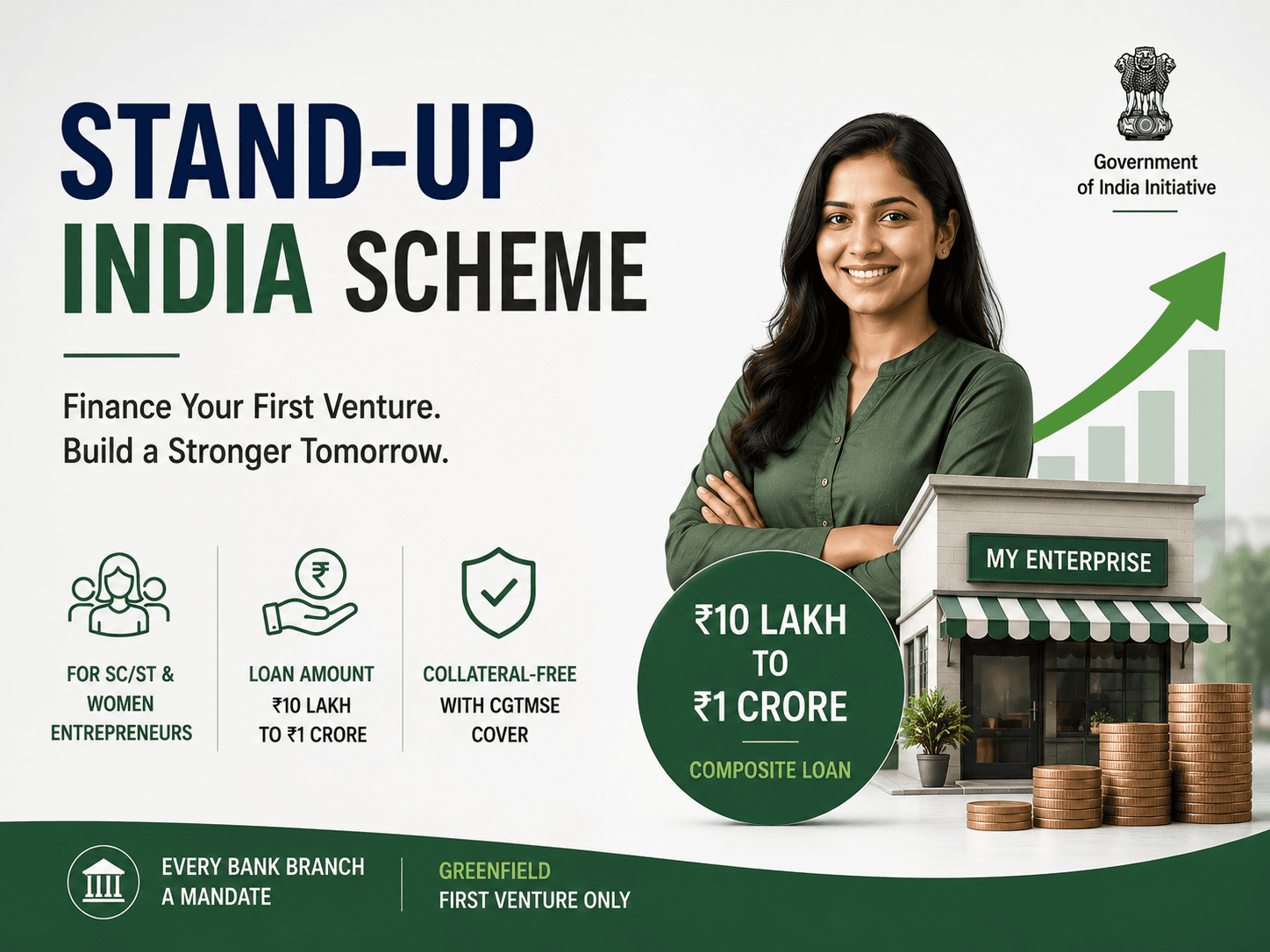
The Part Most Guides Skip: This Is a Branch-Level Obligation
Most descriptions of Stand-Up India explain it purely as “a loan for SC/ST and women entrepreneurs,” which is true but misses what actually makes the scheme work operationally. The obligation isn't diffuse; it's assigned to every individual bank branch: each branch of a scheduled commercial bank is expected to facilitate at least one loan to an SC or ST borrower and at least one to a woman borrower for setting up a new enterprise. This is why the scheme has reached over 150,000 bank branches and sanctioned loans to nearly 275,000 applicants; it isn't a discretionary program some banks opt into; it's a target built into how every branch is expected to operate.
What this means practically is that if you're eligible, you're not competing for a limited central pool of funds; you're asking a specific branch to fulfill an obligation it already carries. That doesn't guarantee approval; the bank still evaluates your project, but it does mean the conversation starts from a different footing than a generic business loan request.
The Rule That Actually Disqualifies Most People Who Apply Anyway: Greenfield Only
This is the single most common reason for rejection, and it's worth being blunt about it: Stand-Up India funds only a first-time venture, meaning your very first business in manufacturing, services, trading, or an activity allied to agriculture. It does not fund expanding a business you already run, adding a location to an existing operation, or upgrading equipment for a business that's been trading for years.
If you already run a shop and want a loan to open a second one, this isn't your scheme, however well you otherwise fit the SC/ST or women entrepreneur criteria. The greenfield condition is checked, not just declared, so it's worth being honest with yourself about whether your project genuinely qualifies before investing time in the application.
Who Actually Qualifies
- At least one SC or ST individual, or at least one woman (of any caste or community, including general category), aged 18 or above
- The enterprise must be a greenfield project, a genuinely first-time venture, not an expansion or upgrade of an existing business
- For non-individual enterprises, such as a partnership or a private limited company, at least 51% of the shareholding and controlling stake must be held by the qualifying SC/ST or woman entrepreneur
- The business must fall in manufacturing, services, trading, or an activity allied to agriculture
- The applicant must not be in default to any bank or financial institution
- Relevant business skill or experience is expected, and where it's lacking, the scheme's handholding support connects applicants to an Entrepreneurship Development Programme rather than automatically disqualifying them
How the Money Is Actually Structured
Loan amount: a composite loan, meaning it bundles a term loan and working capital together rather than treating them as separate applications, ranging from ₹10 lakh to ₹1 crore.
Bank's share of project cost: the loan is intended to cover a large majority of the project, commonly cited as up to 85% to 90%.
Your margin contribution: sources describe this somewhat differently, generally in the range of 10% to 15% of the project cost as your own contribution, with a minimum mandatory margin of around 10% applying even if you're separately eligible for a state or central subsidy that could otherwise cover more of it. If convergence support from another scheme is available, it can be used toward this margin, but it doesn't eliminate the minimum entirely.
Collateral: loans are typically structured to be collateral-free through CGTMSE-style guarantee coverage, so you're generally not required to pledge property or other assets as security.
Repayment: up to 7 years, with a moratorium period of up to 18 months before repayment begins, giving a new business genuine runway before the first installment is due.
Interest rate: not fixed centrally, typically priced at the bank's MCLR plus roughly 3% plus a tenor premium, putting most Stand-Up India loans in a broadly similar range to other secured MSME lending once the spread is applied.
Given how much the margin percentage in particular is described differently across sources, ranging from roughly 10% to 25% depending on where you look, it's genuinely worth confirming the exact figure with your specific bank branch rather than budgeting around a number pulled from a single guide.
Documents You'll Need
- Identity and address proof of the applicant
- Caste certificate from the appropriate authority (Tehsildar or Sub-Divisional Magistrate), where applying under the SC/ST category
- A detailed project report for the proposed greenfield venture, covering cost, revenue projections, and how the funds will be used
- Proof that the enterprise is genuinely new, since this is actively verified rather than simply taken on the applicant's word
- For non-individual applicants, incorporation or partnership documents showing the required 51% controlling stake held by the qualifying entrepreneur
- Bank account details and standard KYC documentation
Applying Through Stand-Up Mitra
- Register on the Stand-Up Mitra portal (standupmitra.in), the dedicated platform built for this scheme, which also connects applicants to handholding agencies for pre- and post-loan support.
- Complete your profile, confirming your eligibility category, SC/ST status, or woman entrepreneur status, and outline your proposed greenfield business.
- Prepare your project report, ideally with support from a handholding agency if you're not confident structuring one yourself, since a weak project report is a common reason for delay regardless of how well you meet the demographic eligibility criteria.
- Submit your application, which gets routed to a bank branch, often one near your proposed business location, for review.
- The bank evaluates the project on its merits: viability, your relevant skill or experience, and the completeness of your documentation, alongside confirming the greenfield and demographic eligibility conditions.
- On approval, the composite loan is sanctioned and disbursed, with the repayment schedule and moratorium period set according to the bank's terms within the scheme's framework.
What Disqualifies an Otherwise-Eligible Applicant
- Applying to expand or upgrade a business that already exists, the single most common disqualifying mistake
- An existing default with any bank or financial institution
- A non-individual enterprise where the SC/ST or woman entrepreneur holds less than the required 51% controlling stake
- A project report that doesn't hold up to the bank's own viability assessment, since Stand-Up India doesn't waive normal credit evaluation, it changes who the scheme is targeted at, not how carefully the bank checks the plan
Frequently Asked Questions
What is the Stand-Up India scheme?
A government scheme launched in April 2016 that mandates every scheduled commercial bank branch to finance at least one SC or ST borrower and at least one woman borrower for setting up a new, greenfield enterprise, with composite loans ranging from ₹10 lakh to ₹1 crore.
What does greenfield mean under this scheme?
A first-time venture, the applicant's very first business in manufacturing, services, trading, or an allied agricultural activity. The scheme does not fund expanding or upgrading a business that already exists.
Who is eligible for Stand-Up India?
At least one SC or ST individual, or a woman entrepreneur of any caste or community, aged 18 or above, setting up a genuinely new enterprise, with no existing default on record with any bank or financial institution.
What is the loan amount under Stand-Up India?
A composite loan, combining term loan and working capital, ranging from ₹10 lakh to ₹1 crore.
Is collateral required for a Stand-Up India loan?
Generally no. Loans are typically structured to be collateral-free through CGTMSE-style guarantee coverage, though it's worth confirming the specific arrangement with your lending bank.
Can a woman entrepreneur apply even if she isn't SC or ST?
Yes. The woman entrepreneur eligibility track under Stand-Up India is independent of caste category and open to women of any community, including general category.
What documents are required for Stand-Up India?
Identity and address proof, a caste certificate for SC/ST applicants, a detailed project report, proof the enterprise is genuinely new, and incorporation or partnership documents for non-individual applicants.
How do I apply for a Stand-Up India loan?
Through the Stand-Up Mitra portal at standupmitra.in, which routes applications to a bank branch and connects applicants to handholding agencies for support with the project report and process.
What is the repayment period for a Stand-Up India loan?
Up to 7 years, with a moratorium period of up to 18 months before repayment begins.
What is the minimum ownership stake required for a non-individual applicant?
At least 51% of the shareholding and controlling stake must be held by the qualifying SC/ST individual or woman entrepreneur for partnerships or companies applying under the scheme.
Can Stand-Up India be used to expand an existing business?
No. The scheme is restricted to greenfield, first-time ventures. An existing business looking to expand should look at other MSME credit options, such as a CGTMSE-backed loan or a Mudra loan, depending on scale.
What is the interest rate on a Stand-Up India loan?
Not fixed centrally. It's typically the bank's MCLR plus roughly 3%, plus a tenor premium, so the effective rate varies by lending institution.
The Honest Filter to Apply Before You Even Start
Before preparing a single document, ask one question: is this genuinely your first venture, or are you trying to fund something adjacent to a business you already run? If it's the latter, Stand-Up India isn't the scheme, no matter how well you fit the demographic criteria, and no application effort will change that outcome. If it is genuinely your first business, the scheme's structure, the branch-level mandate, the collateral-free design, and the built-in handholding through Stand-Up Mitra give you a real institutional reason to expect a fair hearing rather than a cold approach to a bank that has no particular obligation to listen.
Next step
Apply this to your business.
Confirm whether this applies to your legal structure, industry classification, and credit history - in under 30 minutes with an advisor.