
The Ladder, Rung by Rung
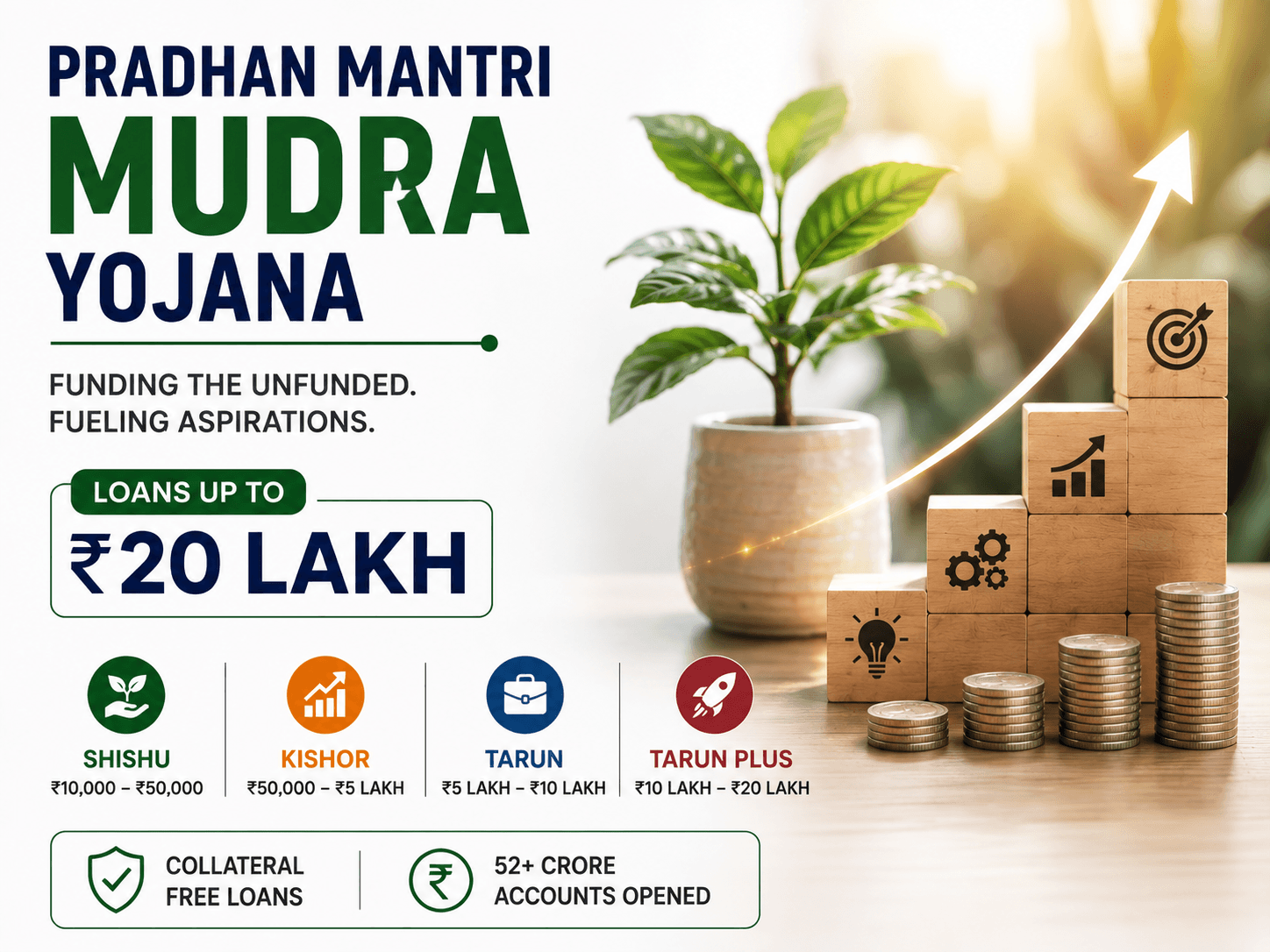
Most Mudra guides list the four categories as a flat menu. They're better understood as a ladder, since the scheme is explicitly designed for a business to climb it: start at Shishu, graduate to Kishor once you have some track record, move to Tarun as the business matures, and only then become eligible for Tarun Plus. Each rung has a different amount, a different evidentiary bar, and a different kind of business it's actually built for.
Rung one: Shishu, ₹10,000 to ₹50,000
This is the entry point for genuinely new businesses, and it's deliberately low-friction. It's aimed at first-time borrowers with no credit history, covering costs like initial raw materials, basic tools, or first inventory. Because there's no repayment history to evaluate, approval leans more heavily on the business idea and basic documentation than on financial statements you likely don't have yet.
Rung two: Kishor, ₹50,000 to ₹5 lakh
Once a Shishu loan has been taken and successfully repaid, or if you're starting with a somewhat more established idea, Kishor is the next step, intended for businesses that have begun operating and need capital to grow rather than to start. Lenders expect to see basic financial records and a business plan at this stage, since the loan size has grown enough to warrant more than a good idea.
Rung three: Tarun, ₹5 lakh to ₹10 lakh
Tarun targets businesses with a genuine track record: stable cash flow, a proven model, and clear expansion plans. This is where you start seeing dairy farmers expanding their herd, small manufacturers adding a production line, or service businesses opening a second location. A meaningful financial history is expected here, not just a plan.
Rung four: Tarun Plus, ₹10 lakh to ₹20 lakh
This is the newest rung, added through Budget 2024-25 and effective from October 2024, doubling what used to be Mudra's ₹10 lakh ceiling. It exists specifically for borrowers who took a Tarun loan and repaid it successfully; there's no way to enter the scheme directly at this tier. If you see a source describing ₹10 lakh as Mudra's maximum, it's describing the pre-2024 rules; current sources consistently confirm ₹20 lakh as the ceiling under Tarun Plus.
Who Can Get on the Ladder at All
- Age between 18 and 65
- Indian citizenship, running a non-farm income-generating micro or small enterprise, including allied agricultural activities
- No prior default on a loan from a bank or financial institution
- Open to individuals, proprietorships, partnerships, and small private companies operating in manufacturing, trading, or services
- For higher-value loans, particularly at the Tarun and Tarun Plus tiers, lenders increasingly expect Udyam registration, in line with broader MSME compliance requirements even though it isn't a blanket condition across every lender at every tier
What Doesn't Qualify
- Purely agricultural production activities that fall outside the scheme's definition of allied non-farm activity
- Large enterprises or businesses that don't fit the micro and small enterprise profile the scheme targets
- Applicants with an existing default on record with any bank or financial institution
Documents by Tier
- Identity proof: Aadhaar, PAN, voter ID, or driving license, for all tiers
- Address proof: passport, utility bills, or bank statements
- Business proof: any existing license or registration for the enterprise, more closely scrutinised as loan size increases
- PAN card specifically required for any loan amount above ₹2 lakh, regardless of tier
- Basic financial records and a business plan, expected from Kishor onward, and essential by Tarun and Tarun Plus
- Category certificate, where applicable, though Mudra itself isn't category-restricted the way Stand-Up India is
Applying, Start to Finish
- Identify which tier actually fits your situation and loan need, since applying at the wrong tier, say Tarun without the track record it expects, slows things down rather than speeding up approval.
- Gather identity, address, and business proof appropriate to your tier, along with a business plan if you're applying for Kishor, Tarun, or Tarun Plus.
- Apply either online through the Udyamimitra portal or the Jan Samarth portal, or offline directly at a participating bank branch, RRB, or NBFC that's a Mudra-approved lending institution.
- Complete the application form with business activity details, the loan category you're applying under, and the amount requested.
- Upload or submit the required documents, and you'll receive an application reference number to track status.
- The lender reviews your creditworthiness and documentation; approved Kishor and Tarun category borrowers receive a MUDRA Card, a RuPay debit card that allows flexible withdrawal of the sanctioned working capital component.
Interest Rates: Why There's No Single Answer
Mudra doesn't set a fixed interest rate the way a subsidy scheme might. Each lending institution prices Mudra loans against its own Marginal Cost of Funds-based Lending Rate (MCLR) plus a spread that reflects the borrower's credit profile, the loan category, and the specific bank's own risk assessment. This means the same Tarun loan amount can carry meaningfully different rates at two different banks, and it's genuinely worth comparing offers from more than one lender rather than assuming a standard government rate applies uniformly. What is consistent across the scheme is that Mudra loans are collateral-free at every tier, with no processing fee typically charged and repayment tenure generally extending up to 5 years.
Mudra vs. a Regular MSME Loan
- Mudra loans are capped at ₹20 lakh even at the top tier; regular MSME loans, particularly CGTMSE-backed ones, can go up to several crore
- Mudra is specifically structured around business lifecycle stage, Shishu through Tarun Plus; a regular MSME loan doesn't segment this way
- Mudra loans skip a formal guarantee scheme application in the way a CGTMSE-backed loan requires, since Mudra loans are inherently structured to be collateral-free through the scheme's own design
- Mudra is generally faster and less document-intensive for smaller amounts, particularly at Shishu and Kishor; larger MSME credit needs typically outgrow what Mudra alone can offer
Why Mudra Applications Get Rejected
- Applying for a tier that doesn't match your actual business stage, particularly jumping straight to Tarun or Tarun Plus without the track record those tiers expect
- A prior loan default on record with any bank or financial institution, which is close to an automatic disqualifier
- Missing PAN on an application above ₹2 lakh, a hard documentation requirement regardless of tier
- A vague or missing business plan at the Kishor tier and above, where lenders expect more than just an idea
- Applying for Tarun Plus without having actually taken and repaid a prior Tarun loan, since this tier isn't open to direct applicants
Frequently Asked Questions
What is Pradhan Mantri Mudra Yojana?
A government scheme launched in 2015 offering collateral-free loans to small and micro non-farm enterprises through member lending institutions, structured across four tiers based on business stage: Shishu, Kishor, Tarun, and Tarun Plus.
What is the maximum loan amount under Mudra Yojana?
₹20 lakh, under the Tarun Plus category introduced after Budget 2024-25, effective October 2024. This replaced the earlier ₹10 lakh ceiling that many older sources still reference.
What are the four Mudra loan categories?
Shishu (₹10,000 to ₹50,000) for new businesses, Kishor (₹50,000 to ₹5 lakh) for growing businesses, Tarun (₹5 lakh to ₹10 lakh) for established businesses scaling up, and Tarun Plus (₹10 lakh to ₹20 lakh) for repeat borrowers who've successfully repaid a Tarun loan.
Is collateral required for a Mudra loan?
No. All four categories are collateral-free, with no security or third-party guarantee required from the borrower.
Who is eligible for a Mudra loan?
Indian citizens aged 18 to 65 running a non-farm income-generating micro or small enterprise, including allied agricultural activities, with no prior loan default on record.
What documents are required for a Mudra loan?
Identity and address proof for all tiers, business proof, PAN mandatory above ₹2 lakh, and basic financial records plus a business plan from the Kishor tier onward.
What is the interest rate on a Mudra loan?
There's no fixed government rate. Each lender sets its own rate, typically its MCLR plus a spread based on the borrower's profile and loan category, so rates vary between banks.
Can I apply directly for a Tarun Plus loan?
No. Tarun Plus is only available to borrowers who previously took a Tarun loan and repaid it successfully. There's no direct entry point at this tier.
What is a MUDRA Card?
A RuPay-based debit card issued to approved Kishor and Tarun category borrowers, allowing flexible withdrawal of the sanctioned working capital component of the loan.
How do I apply for a Mudra loan?
Online through the Udyamimitra portal or Jan Samarth portal, or offline directly at a participating bank, RRB, or NBFC branch.
Is Udyam registration mandatory for a Mudra loan?
It isn't a universal requirement at every tier and lender, but it's increasingly expected for higher-value loans, particularly at the Tarun and Tarun Plus levels, in line with broader MSME lending practice.
What is the repayment tenure for a Mudra loan?
Generally up to 5 years, though the specific tenure depends on the lending institution and the loan category.
Where You Actually Sit on the Ladder
The single biggest mistake in approaching Mudra isn't a documentation error; it's misjudging which rung actually fits. A brand-new business applying at Tarun because the owner wants a bigger number, without the track record to back it, moves slower and gets rejected more often than one that starts honestly at Shishu or Kishor and climbs as the business actually earns its way up.
Since interest rates aren't fixed by the scheme itself, the other genuine lever you have is comparing offers across two or three lending institutions at your tier, rather than accepting the first quote from whichever bank branch happens to be nearest. The tier structure and collateral-free design are the same everywhere; the price for that isn't.
Next step
Apply this to your business.
Confirm whether this applies to your legal structure, industry classification, and credit history - in under 30 minutes with an advisor.