
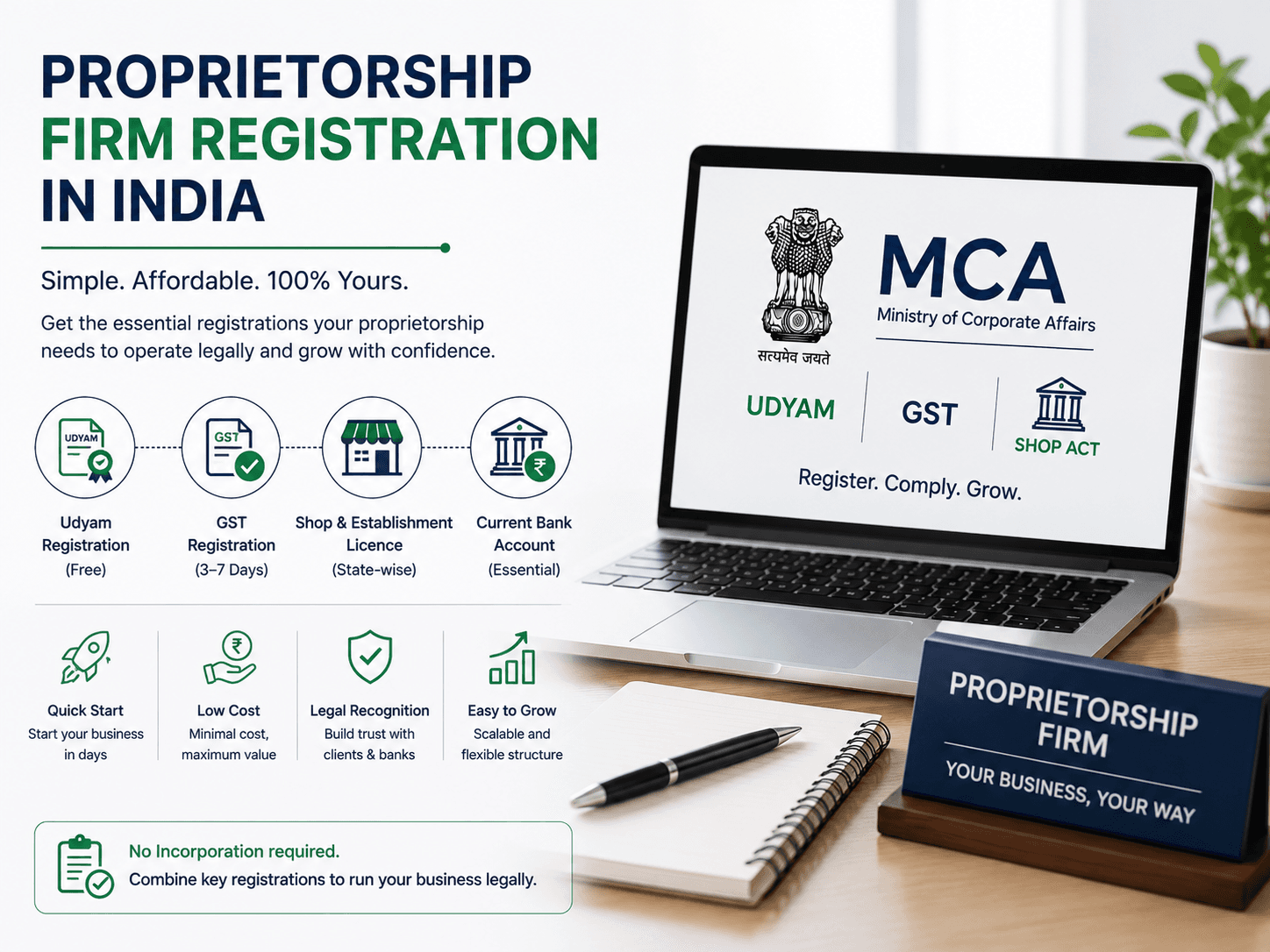
What Is a Proprietorship Firm (and Who It's Actually For)
A sole proprietorship is a business owned and run by a single individual, where the owner and the business are legally the same person. There's no separate legal entity, no Companies Act or LLP Act involved, and no Registrar of Companies anywhere in the picture. The business exists the moment you start operating it. What formal registrations like GST, Udyam, and a Shop and Establishment license add isn't legal existence; they add proof of existence that banks, clients, and government departments will actually accept.
It's the natural starting point for freelancers, consultants, small traders, and local service businesses who want to start quickly with minimal cost and don't need investors or a formal ownership structure. If you know you'll want to bring in a partner soon, raise funding, or simply want your personal assets fully separated from business risk, a private limited company, LLP, or OPC will serve you better than staying a proprietorship.
Who Is Eligible for Proprietorship Firm Registration
There's no formal eligibility test to clear, since there's no incorporation application to be accepted or rejected. In practice, though:
Any adult Indian resident individual can start and operate a proprietorship, with no minimum capital requirement
Only one owner is allowed. The moment a second person takes an ownership stake, the structure legally becomes a partnership, not a proprietorship
There's no restriction tied to citizenship the way there is for an OPC, though NRIs often face practical banking and compliance hurdles that make a company structure easier to operate remotely
Certain regulated activities, such as banking, insurance, or NBFC operations, cannot be run as a proprietorship and require a company structure instead
A registered office isn't mandatory in the way it is for a company, but you'll need a valid business address to support GST, Udyam, or Shop Act registration if you pursue any of them
Documents Required for Proprietorship Firm Registration (Checklist)
Identity and address proof of the proprietor
PAN card of the proprietor, which also serves as the business PAN since there's no separate entity
Aadhaar card, linked to an active mobile number for OTP verification on Udyam and GST
Passport-size photograph
Personal address proof, such as a utility bill, voter ID, or passport
Business proof (for GST, Udyam, and Shop Act)
- Business address proof: a utility bill, property tax receipt, or rent agreement for the premises
- No-objection certificate (NOC) from the property owner if the premises isn't owned by the proprietor
- Basic business details: trade name, NIC business activity code, commencement date, and estimated investment or turnover
Bank account opening documents
A declaration, in the bank's required format, stating that the firm is a proprietary concern
At least two of the following: GST registration certificate, Udyam registration certificate, or Shop and Establishment license, since most banks apply a two-document KYC rule for current accounts
Proprietorship Firm Registration Process, Step by Step
There's no single portal or form that covers all of this the way SPICe+ does for a company. Instead, you work through a short sequence of registrations, most of which can run in parallel rather than strictly one after another.
Choose a trade name for the business. It doesn't need to be reserved or approved anywhere, but it should be consistent across every registration you apply for.
Confirm your personal PAN is in order, since it doubles as the proprietorship's PAN. There's no separate business PAN to apply for.
Register on the Udyam portal using Aadhaar OTP verification. This is free, fully online, and the certificate is usually issued the same day.
Apply for GST registration on the GST portal if your turnover crosses the applicable threshold or if your business model requires GST regardless of turnover. Approval typically takes 3 to 7 working days after document verification.
Apply for a shop and establishment license through your state labor department's portal if you operate from physical premises. Requirements and fees vary by state.
Open a current bank account in the firm's trade name, using your Udyam certificate, GST certificate, or Shop Act license alongside your personal KYC documents.
Apply for any sector-specific license your business needs, such as FSSAI for food businesses, an Importer Exporter Code (IEC) for import or export activity, or professional tax registration in states that require it.
Proprietorship Firm Registration Fees
This is where a proprietorship differs most sharply from a Pvt. Ltd., LLP, or OPC. There's no MCA filing fee at all, since there's no incorporation happening, and most of the core registrations are free.
- Udyam registration: Free on the government Udyam portal, with no professional fee needed unless you choose to have someone file it for you.
- GST registration: Free on the GST portal. Registration is mandatory once turnover crosses ₹40 lakh for goods or ₹20 lakh for services, with lower thresholds of ₹20 lakh and ₹10 lakh, respectively, in a few special category states.
- Shop and establishment license: Fees vary by state and by the number of employees, typically ranging from a few hundred rupees to around ₹5,000, and some states also charge a periodic renewal fee.
- Professional fees: If you use a CA or consultant to handle Udyam, GST, and Shop Act registration together, expect this to be the main cost, typically ₹2,000 to ₹8,000 depending on how much is bundled in.
Here's how the typical all-inclusive cost breaks down by component:
- Udyam registration: ₹0
- GST registration: ₹0
- Shop and Establishment license (state-dependent): ₹500 to ₹5,000
- Professional or filing fees: ₹2,000 to ₹8,000 or more
All-inclusive total for a typical case: ₹2,000 to ₹10,000
Ongoing compliance costs stay light compared to a company or LLP. If you're GST registered, expect basic monthly or quarterly GST return filing support to run ₹1,000 to ₹3,000 a month depending on transaction volume, and income tax return filing typically adds another ₹2,000 to ₹8,000 a year unless a tax audit becomes applicable.
How Long Does Proprietorship Firm Registration Take
Udyam registration is usually instant, often completed the same day you apply. GST registration typically takes 3 to 7 working days once documents are verified. A shop and establishment license takes anywhere from 3 to 10 working days depending on the state and whether an inspection is required. Running these in parallel rather than one after another, most proprietors have their full set of registrations and a working current account within 7 to 15 working days.
Proprietorship Firm Registration Online: What “Online” Actually Means
Each registration has its own online portal: Udyam has its own national portal, GST registration runs through the GST Network portal, and the Shop and Establishment license is applied for through your state labor department's portal, which varies in design and requirements from state to state. Unlike a Pvt Ltd, LLP, or OPC, none of this touches the MCA portal at all, since a proprietorship isn't incorporated under the Companies Act or the LLP Act.
Proprietorship vs. Private Limited Company vs. LLP vs. OPC: Which Should You Choose
All four are legitimate ways to run a business in India, but they trade off control, liability, and compliance very differently.
- Legal identity: a proprietorship has no separate legal identity from its owner, while a private limited company, LLP, and OPC are all separate legal entities
- Liability: a proprietor has unlimited personal liability for business debts, while owners of a Pvt Ltd, LLP, or OPC are protected up to what they've invested
- Registration: a proprietorship is established through GST, Udyam, and Shop Act registrations rather than a single MCA incorporation, which the other three structures require
- Compliance: a proprietorship has the lightest ongoing compliance, filing only an individual income tax return and applicable GST returns, with no mandatory statutory audit unless turnover crosses tax audit thresholds
- Fundraising: a proprietorship cannot issue equity or bring in outside shareholders, while a Pvt Ltd is the structure investors generally prefer, and an OPC or LLP would first need to convert or restructure to bring in outside capital
Best fit: proprietorships suit freelancers, consultants, and small local businesses testing an idea with minimal overhead, while Pvt Ltd, LLP, and OPC suit businesses that need liability protection, credibility, or a path to raising money
Benefits of Proprietorship Firm Registration
- Fastest and cheapest to start: no incorporation fee, no MCA filing, and most core registrations are free
- Complete control: every business decision rests with the sole owner, with no board, partners, or shareholders to consult
- Minimal ongoing compliance: just an individual income tax return and, where applicable, GST returns, with no separate corporate filings
- Simple taxation: business income is taxed at the individual's applicable slab rate, which can be more favourable than a flat corporate tax rate at lower income levels
- Easy to wind down: closing a proprietorship is far simpler than winding up a company, since there's no formal dissolution process under the Companies Act
- Low-friction entry into MSME benefits: Udyam registration alone gives access to priority-sector lending, collateral-free credit schemes, and payment protection under the MSMED Act
What Happens After Registration
Since there's no single incorporation event, compliance for a proprietorship is really about staying current on the registrations you've taken and the filings tied to them:
File an individual income tax return every year, using ITR-3 or the presumptive taxation schemes under Section 44AD or 44ADA where eligible
If GST registered, file GSTR-1 and GSTR-3B monthly or quarterly depending on your scheme, plus the annual GSTR-9 once turnover crosses ₹2 crore
If you've opted for the GST Composition Scheme, file the simplified quarterly CMP-08 instead
Get a tax audit done under Section 44AB if turnover exceeds ₹1 crore, or ₹10 crore where cash transactions are minimal, or if you opt out of presumptive taxation despite being eligible
Renew your Shop and establishment license as required by your state's renewal cycle
Apply for a TAN and deduct TDS if you're paying salaries or vendor payments above the prescribed thresholds
Keep basic books of accounts, since both GST and income tax filings depend on them being reasonably current
Common Mistakes That Delay Proprietorship Registration
Assuming no registration is needed at all, then discovering GST is mandatory only after turnover has already crossed the threshold
Operating out of the proprietor's personal bank account instead of opening a dedicated current account, which complicates both GST filing and future loan applications
Treating the Shop and establishment license as optional in a state where it's actually mandatory for any physical premises
Underestimating unlimited personal liability, and not realising personal assets are exposed if the business runs into debt
Choosing a proprietorship despite already planning to bring in a co-founder or raise outside funding within the next year
Letting Udyam registration details go stale, since turnover and investment figures should be updated as the business grows
Frequently Asked Questions
What is a proprietorship firm?
A proprietorship firm is a business owned and run by one individual, with no legal separation between the owner and the business. It's recognized through registrations like GST, Udyam, and a Shop and Establishment license rather than a single incorporation certificate.
Who is eligible to start a proprietorship firm?
Any adult Indian resident individual can start one, with no minimum capital requirement and no approval process to clear, since there's no incorporation application involved.
What documents are required for proprietorship firm registration?
PAN and Aadhaar of the proprietor, personal address proof, and business address proof such as a utility bill or rent agreement, along with basic business details for whichever registrations you pursue.
Is proprietorship firm registration mandatory in India?
There's no single mandatory registration certificate. However, GST becomes mandatory once turnover crosses the threshold, and a Shop and establishment license is mandatory in most states if you operate from physical premises.
How much does proprietorship firm registration cost?
Typically ₹2,000 to ₹10,000 all-inclusive. Udyam and GST registration are free on the government portals, while the Shop and establishment license fee and any professional fees vary by state.
How long does proprietorship firm registration take?
Udyam registration is usually instant, GST takes 3 to 7 working days, and a Shop and Establishment licence takes 3 to 10 working days. Most proprietors complete everything within 7 to 15 working days.
Can I register a proprietorship firm online?
Yes. Udyam, GST, and most state Shop and establishment portals are entirely online, though none of it runs through the MCA portal, since a proprietorship isn't incorporated under the Companies Act.
Is GST registration mandatory for a proprietorship?
Only once turnover crosses ₹40 lakh for goods or ₹20 lakh for services, with lower thresholds in a few special category states, or if your business model requires GST regardless of turnover, such as inter-state supply or e-commerce.
What is the difference between a proprietorship and an OPC?
A proprietorship has no separate legal identity and exposes the owner to unlimited liability, while an OPC is a separate legal entity with limited liability, a mandatory nominee, and company-level compliance including an annual audit.
Can a proprietorship raise funding from investors?
Not in the equity sense, since there are no shares to issue and no separate legal entity to invest in. Proprietorships typically rely on personal savings, business loans, or MSME credit schemes rather than investor funding.
Is a proprietor personally liable for business debts?
Yes. Since the business and the owner are legally the same person, the proprietor's personal assets can be used to satisfy business debts and liabilities.
Do I need a separate PAN for my proprietorship firm?
No. The proprietor's personal PAN also functions as the business PAN, since a proprietorship has no separate legal identity from its owner.
Is a Shop and Establishment licence mandatory?
In most states, yes, if you operate from a physical business premises. Requirements, fees, and renewal cycles vary by state, so it's worth checking your specific state Labour Department's rules.
What happens to the business if the proprietor dies?
The business doesn't automatically continue the way a company or LLP would, since there's no separate legal entity or nominee structure. Assets and liabilities typically pass to the proprietor's legal heirs, who would need to start fresh registrations to continue operating it as a business.
Is an audit mandatory for a proprietorship firm?
Not by default. A tax audit under Section 44AB becomes mandatory only if turnover exceeds ₹1 crore or ₹10 crore where cash transactions are minimal, or if the proprietor opts out of presumptive taxation despite being eligible for it.
Conclusion
Proprietorship firm registration works differently from every other structure covered in this series, there's no single certificate to chase, just a short, practical sequence of registrations that together prove your business exists and is ready to operate. For a freelancer, consultant, or small local business, that's genuinely an advantage: you can be operational within two weeks, for a few thousand rupees, without touching the MCA portal at all.
What it doesn't give you is the thing companies and LLPs are built for: a legal wall between your personal assets and your business risk. If your business stays small, local, and low-risk, that trade-off is usually a reasonable one. If you're taking on real liability, hiring a team, or planning to raise money, it's worth treating proprietorship as a starting point rather than a permanent choice and moving to a Pvt Ltd, LLP, or OPC once the business outgrows it.
Next step
Apply this to your business.
Confirm whether this applies to your legal structure, industry classification, and credit history - in under 30 minutes with an advisor.