
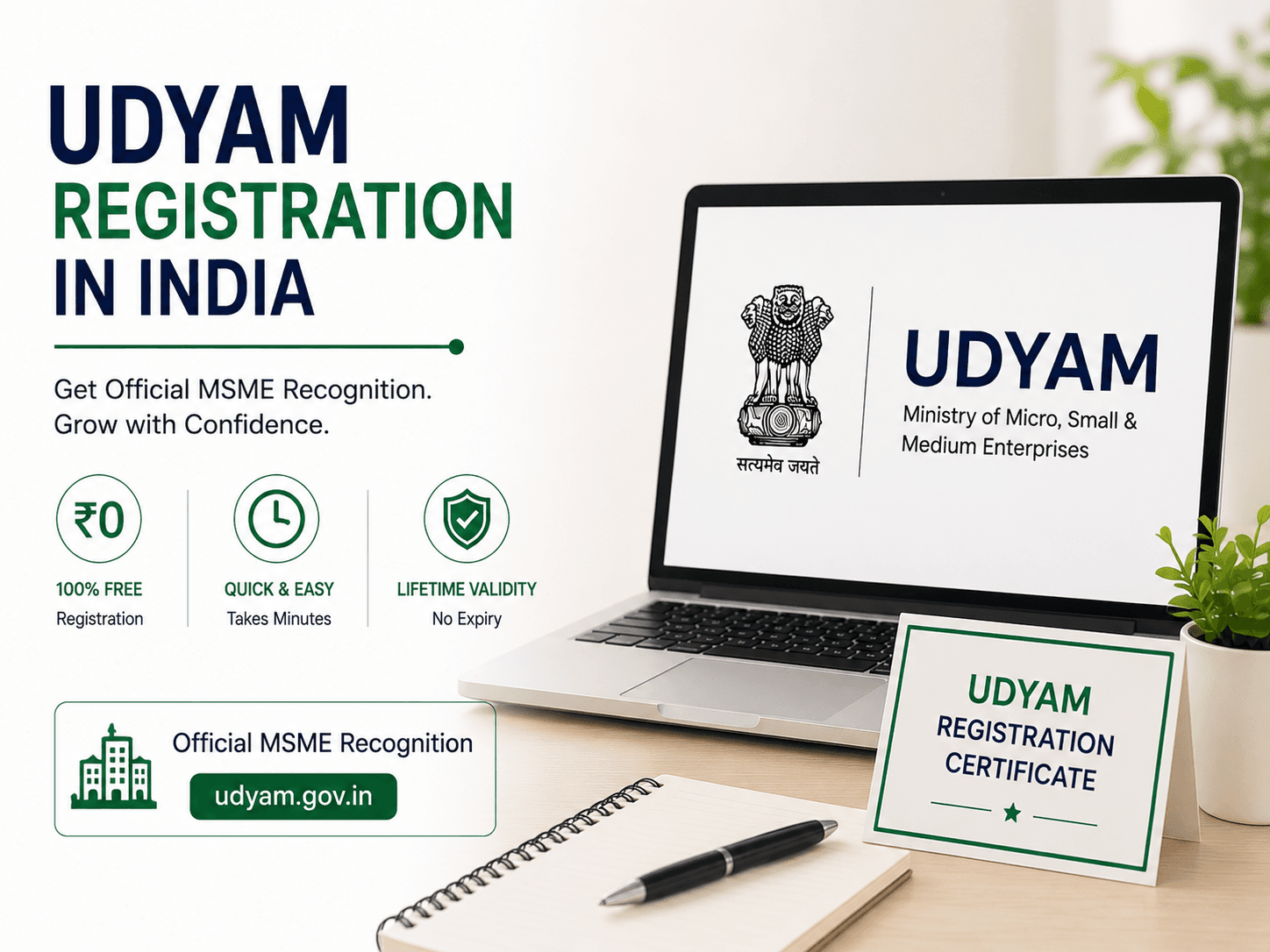
What Is Udyam Registration (and Who It's Actually For)
Udyam registration is the official government process for recognizing a business as a Micro, Small, or Medium Enterprise (MSME) under the Ministry of MSME. It replaced the older Udyog Aadhaar Memorandum (UAM) system, and by 2026 most banks, government tender portals, and buyer-side MSME payment systems have stopped accepting UAM entirely, so businesses still holding only a UAM need to migrate to Udyam to keep using MSME benefits.
It's relevant to almost any small or mid-sized business, proprietorship, partnership, LLP, OPC, and private limited companies alike, including manufacturers, service providers, traders, exporters, startups, and home-based businesses, provided they fall within the investment and turnover limits for their category. It isn't tied to any particular legal structure the way company incorporation is; what determines eligibility is the scale of the business, not how it's organized.
Who Is Eligible for Udyam Registration (MSME Classification)
Eligibility comes down to two numbers, investment and annual turnover, both of which must fall within the limit for a category at the same time. Crossing either threshold moves a business into the next category up.
- Microenterprise: investment up to ₹2.5 crore and turnover up to ₹10 crore
- Small enterprise: investment up to ₹25 crore and turnover up to ₹100 crore
- Medium enterprise: investment up to ₹125 crore and turnover up to ₹500 crore
These limits took effect on 1 April 2025 after the Union Budget 2025-26 raised investment thresholds by 2.5 times and turnover thresholds by 2 times across all three categories
For investment, only the cost of plant and machinery in a manufacturing unit, or equipment in a service business, is counted. Land, buildings, and pollution-control equipment are excluded
Proprietorships, partnership firms, LLPs, OPCs, and private limited companies can all register, provided they're incorporated or established in India
Retail and wholesale traders can register on Udyam for priority-sector lending purposes, though they remain excluded from some manufacturing-specific MSME schemes
Indian companies with foreign shareholders can register too, since the portal validates the PAN of the Indian entity, not the nationality of its shareholders, subject to sector-specific FDI limits
Documents Required for Udyam Registration (Checklist)
This is the shortest documents list of any registration in this series, since Udyam runs almost entirely on self-declaration and data the portal pulls automatically.
- Aadhaar number of the proprietor, managing partner, karta, or authorised signatory, depending on the business structure
- PAN of the business, or the proprietor's personal PAN for a sole proprietorship
- GSTIN, where the business is required to hold one. Businesses exempt from GST registration can still register using PAN alone
- Bank account number and IFSC code
- Basic business details: NIC activity code for what the business does, number of employees, and approximate investment and turnover figures
No physical documents are uploaded at any point. The portal verifies Aadhaar and PAN through OTP and auto-fetches investment and turnover data directly from Income Tax and GST records rather than asking you to submit proof.
Udyam Registration Process, Step by Step
The entire process runs on a single form at the official Udyam Registration portal.
Visit udyam.gov.in and select New Registration for MSMEs. Businesses without GST or PAN, such as very small informal enterprises, can use the Udyam Assist Platform instead, typically through a bank or another authorized channel.
Enter the Aadhaar number of the proprietor, managing partner, or authorized signatory, and verify it using an OTP sent to the linked mobile number.
Enter the business PAN. The portal automatically fetches relevant investment and turnover figures from Income Tax and GST filings linked to that PAN.
Fill in business details: name, type of organization, location, bank account details, NIC activity codes for up to ten business activities, and employee count.
Review the auto-fetched and self-entered details carefully, since NIC code, turnover, and Aadhaar-PAN mismatches are the main source of errors that affect benefits later.
Submit the form. A Udyam Registration Number (URN) is generated instantly, and the e-certificate is issued and made available for download the same day.
Udyam Registration Fees
- Udyam registration is one of very few business registrations in India with genuinely no cost at all attached to the core process.
- Government fee: ₹0. Registration, the certificate, and any category updates are entirely free on the official portal.
- A caution worth repeating: several third-party websites design their pages to look like the official Udyam portal and charge a fee, sometimes ₹1,000 to ₹2,500, for a process that costs nothing on udyam.gov.in. There's no reason to pay a government fee here under any circumstances.
- Optional professional fees: Some businesses still choose to pay a consultant ₹500 to ₹2,000 for help selecting the correct NIC codes or getting the investment and turnover figures right, particularly if the business has multiple activities or an unclear classification. This is optional, not a government requirement.
How Long Does Udyam Registration Take
Most applications are completed within a few minutes once Aadhaar and PAN verification go through cleanly, and the certificate is generated the same day in almost every case. There's no separate approval queue or officer review step the way there is for GST or company incorporation, since Udyam relies on self-declaration backed by data the portal already has access to.
Udyam Registration Online: What “Online” Actually Means
The entire process happens on udyam.gov.in without any physical filing, document upload, or office visit. “Online” here genuinely means self-service from start to finish: you verify your own Aadhaar and PAN, enter your own business details, and download your own certificate the same day, with no intermediary verification step built into the standard process.
Udyam Registration vs. Udyog Aadhaar: What Changed
If you registered before July 2020, you likely hold a Udyog Aadhaar Memorandum (UAM) rather than a Udyam certificate. The two aren't interchangeable anymore.
Udyog Aadhaar allowed self-declared investment and turnover figures with limited cross-verification. Udyam auto-fetches this data from Income Tax and GST records instead
Udyog Aadhaar didn't automatically reclassify a business as it grew. Udyam re-assesses your category every financial year based on your latest filings
By 2026, most banks, government tender portals, and buyer-side MSME payment protection systems will have stopped accepting a UAM on its own
If you still hold only a UAM, migrating to Udyam is necessary to keep accessing loans, tender benefits, and delayed-payment protection under current rules
Benefits of Udyam Registration
- Delayed payment protection: under Section 43B(h) of the Income Tax Act, buyers must pay Micro and Small enterprises within 45 days, or lose the ability to claim that expense as a tax deduction
- Collateral-free lending: Udyam-registered businesses get easier access to collateral-free loans under schemes like CGTMSE, along with priority-sector lending and interest rate concessions from many banks
- Government tender advantages: preferential access on GeM, and many ministries and PSUs issue MSE-specific tenders with relaxed qualification criteria and exemption from tender fees and Earnest Money Deposit
- Subsidies and reimbursements: access to schemes covering ISO certification costs, patent and trademark registration subsidies, and various state-level incentives for registered MSMEs
- Simplified tax compliance: MSMEs with turnover up to ₹3 crore can opt into the presumptive taxation scheme under Section 44AD, reducing the tax computation burden
- No renewal burden: the certificate has lifetime validity, with classification updated automatically each year based on your ITR and GST data
What Happens After Registration
Udyam registration is largely maintenance-free compared to the other registrations in this series, but a few things are worth staying on top of:
File your ITR and GST returns on time each year, since your MSME classification is auto-updated from this data, and missing filings can mean your category doesn't update correctly
Watch for automatic reclassification: crossing a threshold moves you up a category, and falling below one moves you back down, both without any action needed on your part
If your Small enterprise crosses ₹100 crore turnover, for example, you'll lose Section 43B(h) buyer-payment protection the following financial year, since that protection applies only to Micro and Small categories
Use the certificate proactively: attach it to loan applications, tender submissions, and vendor onboarding forms where MSME status can unlock better terms
Update your NIC codes if your business activities change or expand, since this affects which sector-specific schemes and benefits apply to you
If you still hold only a Udyog Aadhaar Memorandum, migrate to Udyam through the same portal to keep accessing current MSME benefits
Common Mistakes That Cause Problems With Udyam Registration
- Registering under the proprietor's personal name instead of the actual business or trade name
- Entering incorrect or outdated NIC activity codes that don't reflect what the business actually does
- Mismatched details between Aadhaar, PAN, and the business's GST records, which can cause verification issues
- Overstating or understating investment and turnover figures, which affects classification accuracy and can create issues when the portal cross-checks against ITR and GST data
- Registering on a third-party site that charges a fee, mistaking it for the official free government portal
- Not migrating from an old Udyog Aadhaar Memorandum, then finding it's no longer accepted by a bank or tender portal when it matters
Frequently Asked Questions
What is Udyam registration?
Udyam registration is the official government process for recognizing a business as a micro, small, or medium enterprise, based on its investment and annual turnover, administered through the Ministry of MSME.
Who is eligible for Udyam registration?
Any proprietorship, partnership, LLP, OPC, or private limited company incorporated in India can register, provided its investment and turnover fall within the Micro, Small, or Medium thresholds.
What documents are required for Udyam registration?
Just Aadhaar of the proprietor or authorised signatory, PAN of the business, GSTIN where applicable, and basic bank and business activity details. No physical documents are uploaded.
How much does Udyam registration cost?
Nothing. Udyam registration is entirely free on the official portal, udyam.gov.in. Be cautious of third-party websites that charge a fee for the same free process.
How long does Udyam registration take?
Usually just a few minutes to the same day, since the process is self-declaration based with instant certificate generation.
What are the MSME classification limits for 2026?
Micro: investment up to ₹2.5 crore and turnover up to ₹10 crore. Small: up to ₹25 crore and ₹100 crore. Medium: up to ₹125 crore and ₹500 crore. Both investment and turnover must fall within the limit for that category.
Is GST registration mandatory for Udyam registration?
No. Businesses that are exempt from GST registration under GST law can still complete Udyam registration using PAN alone. Businesses required to hold a GSTIN need to provide it.
Do I need to renew my Udyam certificate?
No. The certificate has lifetime validity with no renewal requirement. Your MSME category is reassessed automatically each year based on your ITR and GST filings.
Can retail and wholesale traders register on Udyam?
Yes, since a 2021 notification allowed retail and wholesale traders to register, primarily for priority-sector lending purposes. They remain excluded from some manufacturing-specific MSME schemes.
What is the difference between Udyam registration and Udyog Aadhaar?
Udyog Aadhaar was the earlier, largely self-declared system with limited data verification. Udyam replaced it with a process that auto-fetches investment and turnover data from Income Tax and GST records and reclassifies businesses automatically each year. Most banks and tender portals no longer accept a UAM on its own.
Can a company with foreign shareholders register on Udyam?
Yes, provided the entity is incorporated in India and meets the investment and turnover thresholds. The portal validates the PAN of the Indian entity rather than the nationality of its shareholders, subject to sector-specific FDI limits.
What happens if my turnover crosses the threshold for my current category?
Your classification is automatically upgraded to the next category, Micro to Small or Small to Medium, based on the turnover and investment data linked to your PAN. No manual application is needed for this reclassification.
What benefits does Udyam registration actually unlock?
Collateral-free loans under schemes like CGTMSE, delayed-payment protection under Section 43B(h) of the Income Tax Act, preferential access to government tenders and GeM, subsidies for ISO and patent or trademark costs, and eligibility for presumptive taxation up to ₹3 crore turnover.
Is Udyam registration the same as company registration?
No. Udyam registration doesn't create or incorporate a business; it recognizes an already-existing proprietorship, partnership, LLP, OPC, or company as an MSME. You still need the relevant incorporation or registration for your chosen business structure separately.
Conclusion
Udyam registration is about as low-friction as government registration gets in India: free, self-declared, and usually done within minutes, yet it unlocks real, practical advantages, from collateral-free credit to delayed-payment protection to tender access, that are worth claiming even if your business is comfortably small today. The main discipline it asks of you isn't at registration; it's afterward: keeping your ITR and GST filings current, since that's what your classification and your benefits quietly depend on every year.
If you're running a proprietorship, LLP, OPC, or private limited company that falls within the micro, small, or medium thresholds, there's little reason not to register. It costs nothing, takes almost no time, and the certificate keeps working for you without any renewal effort, right up until your business genuinely outgrows the MSME definition altogether.
Next step
Apply this to your business.
Confirm whether this applies to your legal structure, industry classification, and credit history - in under 30 minutes with an advisor.