
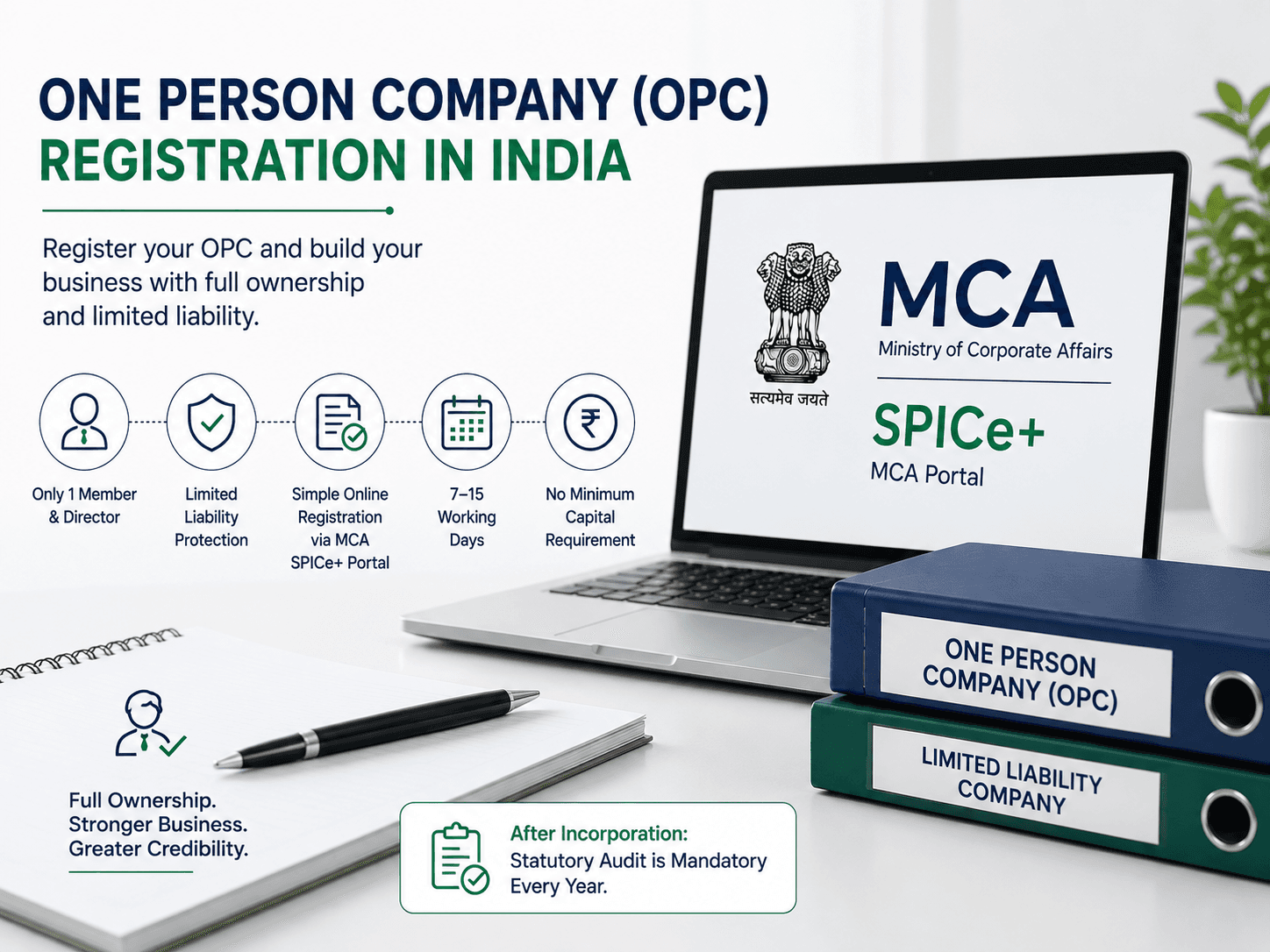
What Is an OPC (and Who It's Actually For)
A one-person company, or OPC, is a business structure introduced under Section 2(62) of the Companies Act, 2013, to let a single individual run a private limited company without needing a second shareholder or director. It sits between a sole proprietorship and a private limited company: you get full ownership and control like a proprietorship, plus the separate legal identity and limited liability protection of a company.
It's the right fit for solo founders, freelancers, and consultants who want their personal assets protected and a more credible, bank-friendly legal structure than a proprietorship but who don't need or want a co-founder. If you already know you'll be bringing in a partner or raising outside investment, a private limited company is the better starting point, since an OPC has to be converted before it can add a second shareholder.
Who Is Eligible for OPC Registration
OPC eligibility is narrower than a private limited company or an LLP because the structure is built around a single owner:
- Only a natural person who is an Indian citizen can be the sole member, whether resident or NRI, not a company, LLP, or other entity
- If the member is an NRI, they must have stayed in India for at least 120 days in the preceding financial year, following the Companies (Incorporation) Second Amendment Rules, 2021
- Foreign nationals who are not Indian citizens cannot register an OPC, even if they are resident in India
- The sole member must also appoint a nominee at the time of incorporation, using Form INC-3, who will step in if the member dies or becomes incapacitated
- A minor cannot be a member or a nominee of an OPC
- One individual can be the member of only one OPC at a time, and cannot simultaneously be a nominee in another OPC
- No minimum capital requirement, and since the 2021 amendment there is no longer a forced conversion threshold based on paid-up capital or turnover
- An OPC also cannot be incorporated to carry out non-banking financial investment activities. Most other business activities are permitted.
Documents Required for OPC Registration (Checklist)
For the sole member and director
- PAN card, mandatory for the sole member
- Aadhaar card, or voter ID, passport, or driving licence as identity proof
- Latest bank statement, electricity bill, or mobile bill, not older than two months, as address proof
- Passport-size photograph
For the nominee
- PAN card and Aadhaar card of the nominee
- Written consent from the nominee, filed as Form INC-3
Registered office proof
- Latest electricity bill, gas bill, or property tax receipt for the registered office
- No-objection certificate (NOC) from the property owner if the premises aren't owned by the member
- Rent agreement, if applicable
Prepared as part of the process, not uploaded by you
Memorandum of Association (MOA), which must state the nominee's name as required for an OPC
Articles of Association (AOA), defining internal governance rules
OPC Registration Process, Step by Step
Like private limited company registration, the entire process runs through the MCA portal using the SPICe+ (INC-32) form, with a few OPC-specific steps built in for the nominee.
Obtain a Digital Signature Certificate (DSC) for the sole director. Typically ready in 1 working day, since there's only one signatory to process.
Reserve your company name using SPICe+ Part A. You can propose two names, and the name must end with “(OPC) Private Limited.” Approval usually takes 1 to 3 working days, and the reserved name is valid for 20 days.
File SPICe+ Part B, along with the eMOA, eAOA, and the nominee's written consent in Form INC-3. This is where your documents checklist above gets uploaded, including the nominee's PAN and Aadhaar.
Pay government fees and state stamp duty, calculated and collected directly on the MCA portal based on your authorized capital and registered office state.
RoC verification. The Registrar of Companies reviews the application, including the nominee consent form. Inconsistencies result in a resubmission query rather than an outright rejection.
Certificate of Incorporation (COI) issued, along with your Corporate Identification Number (CIN). PAN and TAN are generated automatically as part of the same filing.
Open a current bank account in the company's name using the COI, PAN, and MOA/AOA.
OPC Registration Fees
OPC registration follows the same government fee structure as a private limited company, but total costs usually come in lower since there's only one director and one set of DSC charges.
- Government fees: The MCA charges no incorporation filing fee (SPICe+/INC-32) for OPCs with authorized capital up to ₹15 lakh. Name reservation through SPICe+ Part A costs around ₹1,000, and PAN/TAN together add a small statutory charge of roughly ₹130 to ₹200 combined.
- Stamp duty: This is a state government levy on the eMOA and eAOA, calculated on your authorized capital, and it varies by state in the same way it does for a private limited company.
- Digital Signature Certificate: Roughly ₹1,000 to ₹1,500 for the sole director, valid for one to two years.
- Professional fees: If you use a CA, CS, or registration consultant for documentation and filing, this typically adds ₹3,000 to ₹10,000, depending on how much of the post-incorporation setup, such as GST or Udyam, is bundled in.
Here's how the typical all-inclusive cost breaks down by component:
- Government fee (SPICe+, up to ₹15 lakh authorised capital): ₹0
- Name reservation (SPICe+ Part A): ₹1,000
- Stamp duty (state-dependent): ₹500 to ₹5,000 or more
- DSC for the sole director: ₹1,000 to ₹1,500
- PAN and TAN combined: ₹130 to ₹200
- Professional or filing fees: ₹3,000 to ₹10,000 or more
- All-inclusive total for a typical case: ₹6,000 to ₹18,000
Unlike an LLP, an OPC needs a statutory audit every year regardless of turnover, since it's incorporated as a company. Factor that into your budgeting from year one: annual compliance, including the statutory audit, MGT-7A annual return, AOC-4 financial statements, and income tax return, typically runs ₹12,000 to ₹25,000 depending on your CA and transaction volume.
How Long Does OPC Registration Take
With clean documentation, most OPCs get their Certificate of Incorporation in 7 to 15 working days. DSC issuance for a single director usually takes just 1 day, name reservation is approved within 1 to 3 days if there's no conflict, and SPICe+ Part B processing by the RoC is where most of the remaining time sits. Since the reserved name is only valid for 20 days, it's worth having your nominee's documents ready before you start the name reservation step, so you don't lose the window.
OPC Registration Online: What “Online” Actually Means
The entire filing, DSC application, name reservation, SPICe+ incorporation form, MOA/AOA, nominee consent, and payment happen on the MCA portal without visiting any government office. As with other company structures, “online” doesn't mean unattended: the nominee's consent form and identity documents need to be correctly prepared alongside your own, since a missing or inconsistent nominee filing is one of the more common reasons OPC applications get sent back for resubmission.
OPC vs. Private Limited Company vs. LLP: Which Should You Choose
All three offer limited liability, but they're built for different situations. Here's how OPC compares to the other two:
- Ownership: an OPC has exactly one member and one mandatory nominee, a private limited company has 2 to 200 shareholders, and an LLP has 2 or more partners with no upper limit
- Fundraising: an OPC cannot bring in additional shareholders while it remains an OPC, so it needs to convert to a private limited company before raising equity funding; a private limited company is the structure investors prefer directly
- Compliance: an OPC requires a mandatory annual statutory audit regardless of turnover, the same as a private limited company, while an LLP only needs an audit above certain turnover or capital thresholds
- Control: an OPC gives the sole member complete decision-making control, without needing board or shareholder consensus, which a private limited company requires as ownership is shared
- Conversion: an OPC can be voluntarily converted into a private limited company at any time since the 2021 amendment removed the earlier forced-conversion thresholds
- Best fit: OPCs suit solo founders and freelancers who want limited liability without a co-founder; private limited companies suit teams planning to raise funding; and LLPs suit professional services firms prioritising lower compliance over fundraising
Benefits of OPC Registration
- Limited liability: the member's personal assets are protected beyond what's invested in the company
- Full ownership and control: no need to consult co-founders or other shareholders on business decisions
- Separate legal identity: the OPC can contract, borrow, and hold assets independently of its member, with perpetual succession through the nominee
- More credible than a sole proprietorship: a registered CIN, PAN, and Certificate of Incorporation carry more weight with banks, vendors, and enterprise clients
- No forced conversion: since the 2021 amendment, an OPC can grow beyond earlier capital and turnover limits without being required to convert into a private limited company
- Simplified governance: OPCs are exempt from holding AGMs, and many board-level formalities are simplified for a single-member structure
What Happens After Incorporation
Getting the Certificate of Incorporation is the start of compliance, not the end of it. In the weeks that follow, most OPCs need to:
- Open a current bank account and deposit subscribed share capital
- Appoint a statutory auditor, since an audit is mandatory for an OPC every year regardless of turnover
- Apply for GST registration if turnover will cross the threshold, or if the business model requires it regardless of turnover
- Register on Udyam if the OPC qualifies as an MSME to access priority-sector lending and government scheme eligibility
- Apply for Startup India (DPIIT) recognition if eligible, which unlocks tax benefits and easier compliance for the first few years
- Set up basic bookkeeping, since the annual return (MGT-7A) and financial statements (AOC-4) are due every year
- Keep the nominee's consent on file, and use Form INC-4 promptly if you ever need to change the nominee
Common Mistakes That Delay OPC Registration
- Forgetting that the company name must end with “(OPC) Private Limited”
- Filing incomplete or inconsistent nominee details, since Form INC-3 is checked as closely as the member's own documents
- Letting the 20-day name reservation window lapse before finishing the SPICe+ Part B filing
- Assuming a foreign national can register an OPC, when only Indian citizens, resident or NRI, are eligible
- Not realising a statutory audit is mandatory from year one, and budgeting only for registration costs
- Planning to add a co-founder later without accounting for the conversion process that requires first
Frequently Asked Questions
What is a one-person company (OPC)?
An OPC is a business structure under Section 2(62) of the Companies Act, 2013, that allows a single individual to own and run a private limited company, combining full ownership control with limited liability protection.
Who is eligible to register an OPC?
Only a natural person who is an Indian citizen, resident, or NRI can be the sole member. NRIs must have stayed in India for at least 120 days in the preceding financial year. A nominee must also be appointed at incorporation.
What documents are required for OPC registration?
PAN, identity proof, and address proof for the sole member, plus PAN, Aadhaar, and written consent (Form INC-3) for the nominee, along with proof of the registered office.
How much does OPC registration cost?
Typically ₹6,000 to ₹18,000 all-inclusive for authorized capital up to ₹15 lakh, covering name reservation, stamp duty, DSC, and professional fees. Government incorporation fees themselves are waived up to that capital threshold.
How long does OPC registration take?
Usually 7 to 15 working days with clean documentation, including DSC issuance, name approval, and SPICe+ Part B processing.
Can I register an OPC online without a CA or CS?
Yes. The process runs through the MCA portal and can be self-filed, though many founders use a consultant to reduce the risk of resubmission, particularly around the nominee consent filing.
What is the minimum capital required for an OPC?
There is no mandatory minimum capital requirement, and since the 2021 amendment, there is no longer a forced conversion threshold based on capital or turnover either.
Can an NRI register an OPC?
Yes. Since the Companies (Incorporation) Second Amendment Rules, 2021, NRIs who are Indian citizens can incorporate an OPC, provided they've stayed in India for at least 120 days in the preceding financial year.
Can a foreign national register an OPC?
No. OPC ownership is restricted to Indian citizens, whether resident or NRI. Foreign nationals, even those living and working in India, are not eligible to be the sole member.
Who can be a nominee, and why is one required?
The nominee is the person who takes over as the sole member if the original member dies or becomes incapacitated. It's commonly a family member or trusted associate, and their written consent, PAN, and Aadhaar must be filed using Form INC-3 at the time of incorporation.
Is a statutory audit mandatory for an OPC?
Yes. Unlike an LLP, an OPC must have its accounts audited every year regardless of turnover, since it's incorporated as a company under the Companies Act, 2013.
Can an OPC raise funding from investors?
Not directly while it remains an OPC, since it can only have one member. To bring in outside investors or a co-founder as a shareholder, the OPC needs to convert into a private limited company first.
Is an OPC required to convert to a private limited company after a certain turnover?
No, not anymore. The Companies (Incorporation) Second Amendment Rules, 2021 removed the earlier mandatory conversion thresholds. An OPC can now stay an OPC regardless of how large its capital or turnover grows, and convert voluntarily whenever it chooses.
What is the difference between an OPC and a private limited company?
An OPC has exactly one member and is built for solo founders who want full control. A private limited company has 2 to 200 shareholders and is the structure investors and larger teams generally prefer.
What is the first-year compliance cost after OPC registration?
Beyond registration itself, expect roughly ₹12,000 to ₹25,000 for the first year's statutory audit, annual return (MGT-7A), financial statements (AOC-4), and income tax return, depending on your CA and transaction volume.
Conclusion
OPC registration gives a solo founder nearly everything a private limited company offers: limited liability, a separate legal identity, and credibility with banks and clients, without needing to find a co-founder just to satisfy a minimum shareholder rule. The trade-off is that it comes with company-level compliance, including a mandatory annual audit, so it isn't automatically cheaper to run than it is to set up.
If you're confident you'll stay a solo operation for the next few years, an OPC is a clean, credible way to formalize that. If you already suspect you'll want to bring in a co-founder or raise outside money sooner rather than later, it's worth registering as a private limited company from the start, since converting later adds a step you could skip entirely by choosing the right structure now.
Next step
Apply this to your business.
Confirm whether this applies to your legal structure, industry classification, and credit history - in under 30 minutes with an advisor.