
What Is an LLP (and Who It's Actually For)
A Limited Liability Partnership, or LLP, is a business structure registered under the Limited Liability Partnership Act, 2008, and regulated by the Ministry of Corporate Affairs. It combines the flexibility of a traditional partnership with limited liability protection for its partners, so personal assets stay protected if the business runs into debts or losses, and no partner is held liable for another partner's actions or misconduct.
It's the preferred structure for professional services firms such as CAs, company secretaries, consultants, and law practices, as well as small businesses and family-run ventures that want a formal, credible structure without the annual audit and compliance load a private limited company carries. If you're planning to raise equity funding from VCs or angel investors, a private limited company is usually the better fit, since most institutional investors prefer a share-based structure over a partner-based one.
Who Is Eligible for LLP Registration
- Eligibility for LLP registration is straightforward:
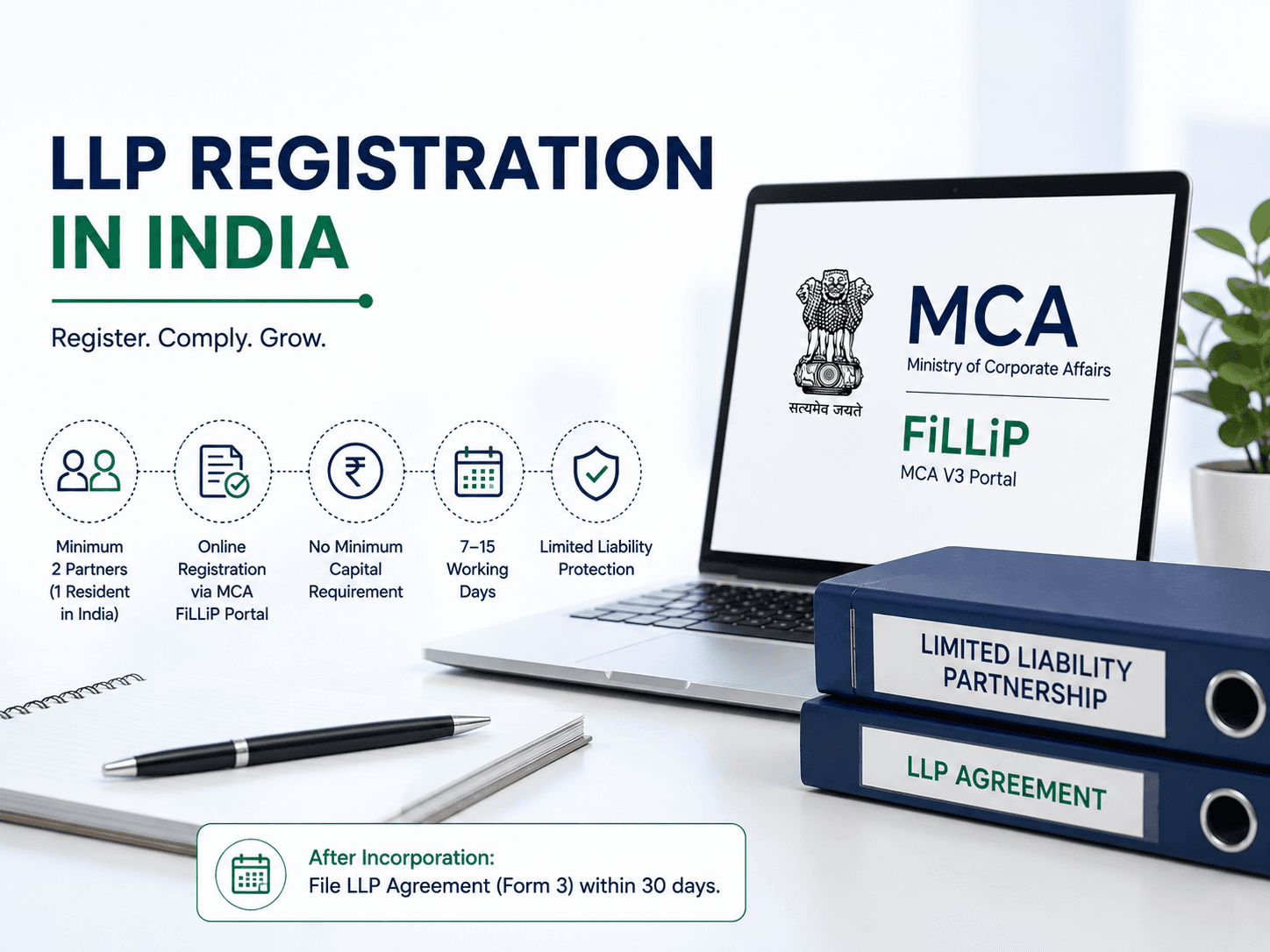
- Minimum 2 designated partners, with no upper limit on the total number of partners
- At least one designated partner must be an Indian resident
- No minimum capital contribution requirement, an LLP can be formed with any amount of contributed capital
- A unique LLP name that doesn't conflict with an existing company, LLP, or registered trademark
- A registered office address in India, which can be residential, commercial, rented, or a virtual office, as long as valid supporting documents are provided
- Designated partners need a valid PAN, and foreign nationals or NRIs can be partners provided at least one designated partner meets the resident requirement above
Most business activities are eligible, though certain regulated sectors may require additional approvals after incorporation. Since 2021, LLPs have also become eligible for Startup India recognition, which was previously limited to companies.
Documents Required for LLP Registration (Checklist)
For Indian partners
- PAN card, mandatory for every Indian partner and used for OTP verification during filing
- Aadhaar card, linked to PAN, needed for OTP-based authentication on the MCA portal
- Latest bank statement, electricity bill, or mobile bill, not older than two months, as address proof
- Passport-size photograph
For NRI or foreign national partners
- A passport is mandatory and it must be notarised or apostilled depending on the country
- Overseas address proof, such as a utility bill or bank statement, notarised or apostilled
Registered office proof
- Latest electricity bill, gas bill, or property tax receipt for the registered office
- No-objection certificate (NOC) from the property owner if the premises are rented or not owned by a partner
- Rent agreement, if applicable
Filed as part of the process, not uploaded by you
Subscriber sheet and consent forms for designated partners
LLP Agreement, filed separately after incorporation, which sets out profit-sharing ratios, rights, and duties among partners
LLP Registration Process, Step by Step
- The entire process runs online through the MCA V3 portal, centered on a single integrated form called FiLLiP, the Form for Incorporation of Limited Liability Partnership.
- Obtain Digital Signature Certificates (DSC) for all designated partners. Every form is signed digitally, so this comes first. Typically ready in 1 to 2 working days.
- Reserve your LLP name using the RUN-LLP service on the MCA portal. Approval usually takes 2 to 3 working days, and the reserved name is valid for 90 days from approval.
- File the FiLLiP form, which captures partner details, registered office address, and capital contribution and also facilitates DPIN allotment for up to two designated partners. Additional partners beyond two need to apply for DPIN separately. This is submitted along with your documents, typically certified by a CA, CS, or CMA.
- Pay the applicable government fees, calculated based on the total capital contribution declared by all partners.
- RoC verification. The Registrar of Companies reviews the FiLLiP filing. Inconsistent documentation, such as a mismatched address proof or a name too close to an existing entity, results in a resubmission query rather than an outright rejection.
- Certificate of Incorporation (COI) issued under Section 12, along with the LLP Identification Number (LLPIN). PAN and TAN are typically allotted alongside the COI, though it's worth confirming they've been received since this can vary by filing.
- File the LLP Agreement using Form 3 within 30 days of incorporation. This is mandatory and defines profit-sharing ratios, partner responsibilities, and internal governance. Missing this window attracts a daily additional fee.
- Open a current bank account in the LLP's name using the COI, PAN, and LLP Agreement.
LLP Registration Fees
LLP registration is generally cheaper than private limited company registration, and the total again comes down to a handful of separate components rather than one flat number.
- Government fees: Name reservation through RUN-LLP costs around ₹200 and is valid for 90 days. The FiLLiP incorporation fee is based on total capital contribution, starting at ₹500 for a contribution up to ₹1 lakh and scaling up in slabs to around ₹5,000 for a contribution above ₹25 lakh.
- Digital Signature Certificates: Roughly ₹500 to ₹1,500 per designated partner, so a typical two-partner LLP spends about ₹1,000 to ₹3,000 on DSCs combined.
- Stamp duty on the LLP agreement: This is a state government levy on Form 3, and it varies significantly by state and by the amount of capital contribution. Some states charge as little as ₹100, others considerably more.
- PAN and TAN: A small statutory charge, roughly ₹131 combined.
- Professional fees: If you use a CA, CS, or registration consultant for documentation, filing, and RoC follow-up, this typically adds ₹4,000 to ₹9,000, sometimes more for a fully managed setup.
Here's how the typical all-inclusive cost breaks down by component:
- Name reservation (RUN-LLP): ₹200
- FiLLiP incorporation fee (capital-based): ₹500 to ₹5,000
- DSC for two designated partners: ₹1,000 to ₹3,000
- Stamp duty on LLP Agreement (state-dependent): ₹100 to ₹10,000 or more
- PAN and TAN combined: about ₹131
- Professional or filing fees: ₹4,000 to ₹9,000 or more
- All-inclusive total for a typical two-partner LLP: ₹5,000 to ₹15,000
Annual compliance is where LLPs genuinely save money compared to a private limited company. Form 11, the annual return, and Form 8, the statement of accounts and solvency, together with basic CA or CS support, typically run ₹12,000 to ₹30,000 a year. A statutory audit is only required once turnover crosses ₹40 lakh or capital contribution crosses ₹25 lakh, and when it applies, expect an additional ₹18,000 to ₹55,000 depending on complexity.
How Long Does LLP Registration Take
With clean documentation, LLP registration typically takes 7 to 15 working days from start to certificate of incorporation. DSC issuance takes 1 to 2 days, name reservation through RUN-LLP takes 2 to 3 days, and FiLLiP approval by the RoC usually takes 5 to 7 days. The LLP Agreement then needs to be filed via Form 3 within 30 days of incorporation, and that deadline is separate from the incorporation timeline itself, so it's easy to lose track of if you're not watching for it.
LLP Registration Online: What “Online” Actually Means
The entire filing, from DSC application through name reservation, Fillip, and the LLP Agreement, happens on the MCA V3 portal without visiting any government office. As with company registration, “online” doesn't mean unattended: documents need to be correctly formatted, notarized where required for foreign partners, and digitally signed, and Aadhaar needs to be linked to PAN for the OTP verification steps to work smoothly.
LLP vs. Private Limited Company: Which Should You Choose
Both structures offer limited liability, but they suit different situations. Here's how they actually compare:
- Ownership structure: an LLP is governed by partners and an LLP Agreement, while a private limited company is governed by shareholders and a fixed shareholding structure
- Fundraising: private limited companies are strongly preferred by VCs and angel investors, since LLPs don't have share capital to issue against equity funding
- Compliance burden: LLPs file two main annual forms, Form 8 and Form 11, and only need an audit above certain turnover or contribution thresholds, while private limited companies face a fuller annual filing schedule and mandatory audit regardless of turnover
- Minimum members: an LLP needs 2 designated partners, a private limited company needs 2 directors and 2 shareholders
- Maximum members: an LLP has no cap on the number of partners; a private limited company is capped at 200 shareholders
- Best fit: LLPs suit professional services firms, consultants, and businesses not planning to raise equity funding, while private limited companies suit startups planning to raise VC or angel funding or issue ESOPs
Benefits of LLP Registration
Limited liability: partners' personal assets are protected, and no partner is liable for another partner's actions
Lower compliance burden: only two annual forms in most cases, compared to the fuller filing schedule a private limited company carries
No mandatory audit at lower scale: audits are only required once turnover crosses ₹40 lakh or capital contribution crosses ₹25 lakh
Separate legal entity: the LLP can contract, own property, and sue or be sued in its own name, with perpetual succession regardless of changes in partners
Flexible internal governance: the LLP Agreement can be structured to fit the partners' actual working arrangement, rather than following a rigid, standardised format
No cap on partners: useful for professional firms that expect to add partners over time
What Happens After Incorporation
Getting the Certificate of Incorporation isn't the end of the process. In the days and weeks that follow, most LLPs need to:
File the LLP Agreement using Form 3 within 30 days of incorporation. This is mandatory, and missing the deadline attracts a daily additional fee
Confirm PAN and TAN have been issued, and apply separately if they weren't allotted automatically alongside the COI
Open a current bank account in the LLP's name
Apply for GST registration if turnover will cross the threshold, or if the business model requires it regardless of turnover
Register on Udyam if the LLP qualifies as an MSME to access priority-sector lending and government scheme eligibility
Apply for Startup India recognition if eligible, since LLPs have been eligible for DPIIT recognition since 2021
Set up basic bookkeeping, since Form 8 and Form 11 are due annually even in a year with no business activity
Common Mistakes That Delay LLP Registration
- Proposing a name too similar to an existing company, LLP, or registered trademark, without checking both the MCA portal and the trademark registry
- Missing the 30-day window to file the LLP Agreement, which attracts penalties
- Assuming Form 8 and Form 11 aren't needed in a year with zero activity, they still are
- Not applying for PAN and TAN promptly if they weren't auto-allotted with the Certificate of Incorporation
- Underestimating how much stamp duty on the LLP Agreement varies from state to state
- Choosing an LLP when the real plan is to raise equity funding, and discovering later that investors prefer a private limited company
Frequently Asked Questions
What is an LLP?
An LLP, or Limited Liability Partnership, is a business structure registered under the Limited Liability Partnership Act, 2008 that combines partnership-style flexibility with limited liability protection for its partners.
Who is eligible for LLP registration?
Any group of at least two people can register an LLP, provided there are a minimum of two designated partners, at least one of whom is an Indian resident, along with a unique name and a registered office address in India.
What documents are required for LLP registration?
PAN, Aadhaar, and recent address proof for each Indian partner, plus proof of the registered office. Foreign or NRI partners need a notarized passport and overseas address proof.
How much does LLP registration cost?
Typically ₹5,000 to ₹15,000 all-inclusive for a standard two-partner LLP, covering name reservation, the FiLLiP fee, DSCs, stamp duty on the LLP Agreement, and professional fees.
How long does LLP registration take?
Usually 7 to 15 working days for the Certificate of Incorporation, with the LLP Agreement due separately within 30 days of incorporation.
Can I register an LLP online without a CA or CS?
Yes, the process runs through the MCA portal and can be self-filed, though FiLLiP filings are commonly certified by a CA, CS, or CMA, and many founders use a consultant to reduce resubmission risk.
What is the minimum capital required for an LLP?
There is no minimum capital contribution requirement. An LLP can be formed with any amount partners choose to contribute.
Can a foreign national or NRI be a partner in an LLP?
Yes, provided at least one designated partner is an Indian resident. Foreign partners need notarised or apostilled identity and address documents.
What is the LLP Agreement and why does it matter?
The LLP Agreement is the document that sets out profit-sharing ratios, partner rights and duties, and internal governance. It must be filed using Form 3 within 30 days of incorporation, and missing that deadline attracts a daily additional fee.
Is a statutory audit mandatory for an LLP?
No, not automatically. An audit is only required once annual turnover crosses ₹40 lakh or capital contribution crosses ₹25 lakh.
What is the difference between an LLP and a private limited company?
An LLP is partner-governed with lower compliance and no share capital, making it well suited to professional firms. A private limited company is shareholder-governed, carries fuller compliance, and is generally preferred by investors for equity fundraising.
What happens if I don't file the LLP Agreement within 30 days?
The filing is still required, but it attracts a daily additional fee for every day past the 30-day deadline, so the cost of delay compounds the longer it's left.
Do I need to file annual returns even if my LLP has no activity?
Yes. Form 11 and Form 8 are mandatory every year regardless of whether the LLP had any business activity, and skipping them leads to penalties and possible strike-off over time.
Is a registration consultant worth it for LLP registration?
It depends on how comfortable you are with the paperwork. LLP filings are generally simpler than company incorporation, so many founders manage it themselves, but a consultant still helps avoid resubmission delays and correctly timed follow-up filings.
What is the first-year compliance cost after LLP registration?
Beyond registration itself, expect roughly ₹12,000 to ₹30,000 for basic annual compliance such as Form 8 and Form 11, and an additional ₹18,000 to ₹55,000 only if a statutory audit becomes applicable.
Conclusion
LLP registration is one of the more straightforward ways to formalize a business in India, especially for professional firms and founders who don't have immediate plans to raise equity funding. The process itself, DSC, name reservation, FiLLiP, and the Certificate of Incorporation are quick once your documents are in order, and the real discipline is remembering what comes right after: filing the LLP Agreement within 30 days, keeping basic books, and not skipping Form 8 and Form 11 even in a quiet year.
If your plans might change toward equity fundraising down the line, it's worth weighing a private limited company before you commit. But for the professional services firms, consultants, and small businesses this structure was built for, an LLP offers real liability protection with meaningfully less ongoing compliance than the alternative, which is exactly the trade-off most of these founders are looking for.
Next step
Apply this to your business.
Confirm whether this applies to your legal structure, industry classification, and credit history - in under 30 minutes with an advisor.