
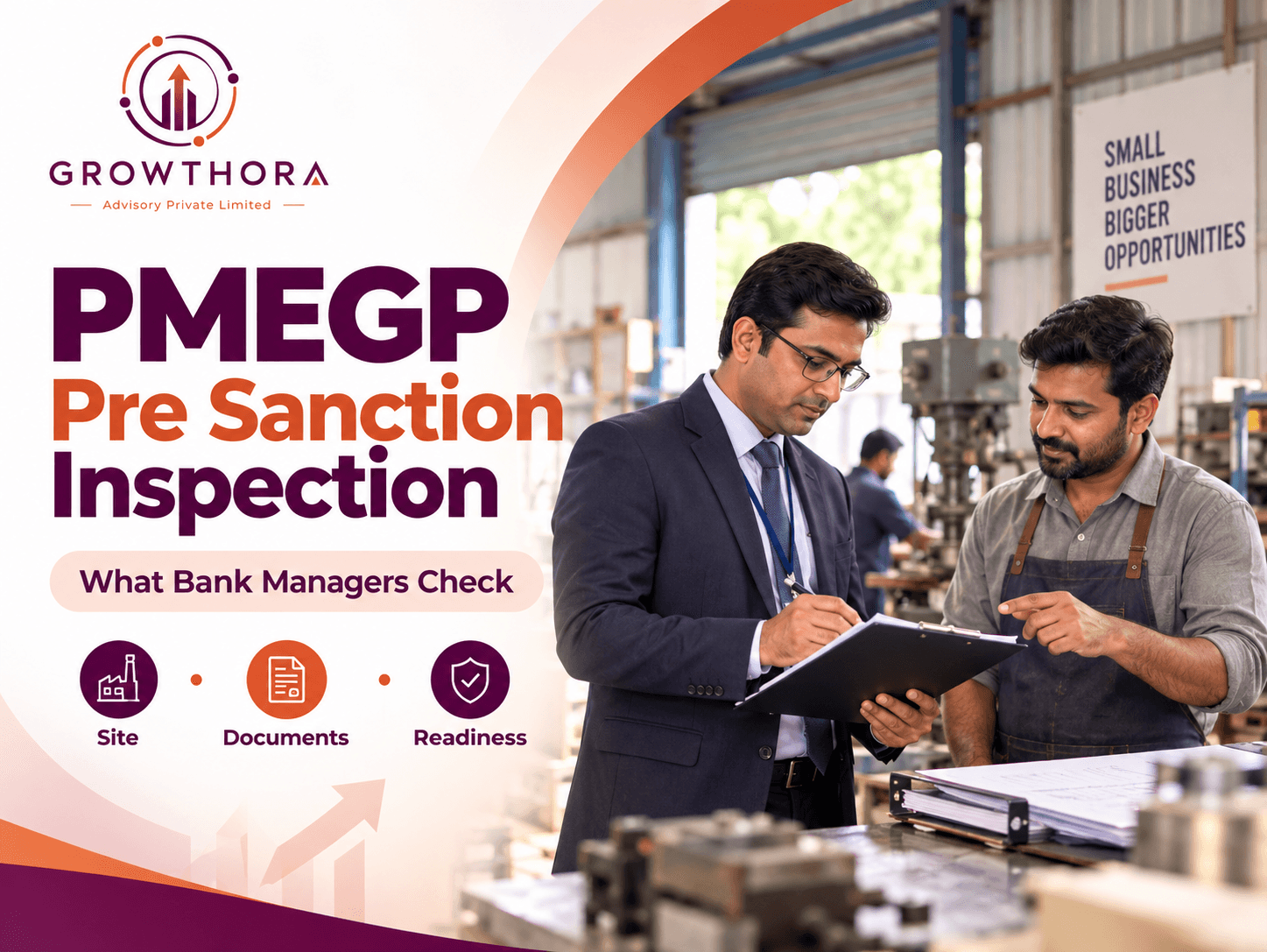
What is a PMEGP pre-sanction inspection?
A pre-sanction inspection, where conducted by the lender, is a practical review of the proposed business location and the feasibility of setting up the enterprise as described in the application. It can help the bank understand whether the premises, equipment, funding request and business activity fit together. The visit does not guarantee approval, and not every bank or project necessarily follows an identical checklist.
The bank's assessment may also include credit appraisal, eligibility checks, the applicant's contribution, quotations, repayment capacity and compliance with current PMEGP instructions. Do not treat informal advice about a particular inspection as a universal scheme rule unless it appears in the current official guidelines or a written bank instruction.
What the bank manager may inspect
| Inspection area | What the officer may review | How to prepare |
|---|---|---|
| Premises and layout | Whether the proposed location can accommodate the stated activity, equipment, storage and safe working space | Keep a simple layout, site photographs if useful, and ownership or lease documents available |
| Lease or ownership | Whether you have a lawful basis to use the premises for the proposed business and whether the terms fit the project | Keep the ownership proof or lease deed, landlord consent where relevant, rent details and permission for the stated activity |
| Electricity and utilities | Whether the available or planned connection can support the equipment and whether any required upgrade is feasible | Carry recent bills if available, sanctioned load details, load calculation from the equipment list, and DISCOM application or demand note if the connection is pending |
| Machinery and installation | Whether the equipment in the project report matches the activity, quotations and available space | Organise vendor quotations, catalogues, technical specifications, power requirements and a realistic installation plan |
| Water, drainage and safety | Whether the activity has the utilities and safety arrangements it reasonably needs | Explain the water source, drainage, ventilation, fire or safety arrangements and any approvals applicable to the activity |
| Road and logistics access | Whether raw materials and finished goods can be delivered and moved safely | Explain delivery access, vehicle limitations, loading arrangements and any alternative logistics plan |
| Market and supply chain | Whether suppliers, customers and distribution routes are reasonably | Keep supplier estimates, customer enquiries, letters of intent if genuine, |
| accessible | and a realistic sales plan | |
| Applicant's understanding | Whether you can explain the activity, costs, capacity, pricing and expected cash flow | Practise explaining the process, production assumptions, monthly costs, expected sales and repayment plan |
This table is a preparation aid, not a mandatory official inspection form. The bank may focus on different issues for a small service business, a home-based activity, a workshop or a manufacturing unit.
Lease and factory shed rules: what to confirm
There is no safe universal rule that every PMEGP applicant must have a registered lease for exactly three to five years. The right document and tenure depend on the bank's requirements, the proposed project, local law and the legal nature of the premises. A long-term registered lease may be appropriate in some cases, but do not assume that a plain paper agreement is always accepted or always rejected without checking the applicable rules.
Before signing a lease, ask the bank what it needs to see. Confirm the permitted use of the premises, lease period, renewal terms, landlord consent, access for installation, electricity arrangements and who is responsible for modifications. Check whether registration or stamp duty is required under the applicable state law. Do not commit to a costly lease solely on verbal assurances.
Electricity connection: domestic versus commercial or industrial
The required electricity connection depends on the activity, sanctioned load, local electricity rules and the distribution company's tariff classification. A manufacturing unit with substantial machinery may need a suitable commercial or industrial connection or an approved load change. However, a domestic meter does not automatically prove that every PMEGP application must be rejected. The applicant should demonstrate that the proposed setup can legally and safely obtain the supply required for the activity.
If the correct connection is not yet installed, keep the DISCOM application, demand note, load estimate or written status available, where applicable. Compare the machinery's electrical specifications with the sanctioned load and ask the bank whether a pending connection can be accepted at the current stage. Never run equipment in a way that breaches electricity rules or safety requirements.
How to prepare the site before the visit
Make sure the bank has the correct site address and a working contact number for the applicant.
Keep the premises accessible at the agreed time, and make sure the person who can explain the project is present.
Keep the project report, sanction or application papers, vendor quotations and equipment specifications organised.
Carry ownership or lease papers and landlord consent where applicable.
Keep available utility bills, sanctioned load details or DISCOM correspondence ready.
Prepare a simple floor plan showing machinery, work areas, storage and movement of materials.
Organise genuine supplier quotations, customer enquiries, purchase estimates and sales assumptions.
List unresolved issues, such as a pending power connection or a lease clause, and be ready to explain the next step.
Do not install a signboard, buy equipment or create records just to give a misleading impression that a business is already operating. If the project is still proposed, explain the actual stage accurately.
Questions bank managers may ask
Questions about the business
- What product or service will the enterprise provide, and who is the target customer?
- Why did you choose this location?
- Who are the main suppliers and how will raw materials reach the unit?
- How will you find customers and receive payments?
Questions about machinery and capacity
- Which machines are required, and what is each machine's function?
- What are the production capacity and expected working hours?
- What power load, water supply or other utilities will the equipment require?
- How did you choose the vendor and what is included in the quotation?
Questions about money and repayment
- What is the total project cost and how much own contribution will you bring?
- What are the estimated monthly sales, raw material costs, wages, rent, utilities and other expenses?
- How much working capital will you need before customers pay you?
- How will the business repay the loan if sales take longer than expected to grow?
You do not need to memorise a script. You should understand the assumptions in your own project report and be able to explain how you arrived at the numbers. If you do not know an answer, say so and offer to confirm it from a reliable quotation or record rather than guessing.
Market demand and competitor questions
A nearby competitor is not automatically a reason for rejection, and a remote location is not automatically unsuitable. The officer may want to understand whether the business has enough demand, access to suppliers, reasonable transport arrangements and a credible way to reach customers.
Prepare a short market explanation: who will buy from you, why they may choose your product or service, what alternatives already exist, how you plan to price the offer, and how customers will find you. Use genuine enquiries, local market observations, supplier quotations or customer letters where available. Do not create fake letters of intent or inflate projected sales.
Common red flags and how to address them
| Potential concern | Why it may raise questions | Practical response |
|---|---|---|
| Premises do not fit the proposed activity | The equipment, storage or workflow may not fit the site | Rework the layout or identify a suitable location before committing funds |
| Lease terms are unclear | The right to occupy or install machinery may be uncertain | Clarify the lease, permitted use, tenure and landlord consent with the bank and a qualified local adviser |
| Power load is insufficient or undocumented | Equipment may not be usable as planned | Obtain a load assessment and written DISCOM status; revise equipment or connection plans if needed |
| Quotation does not match the project report | The bank cannot reconcile costs or technical details | Correct inconsistencies with genuine revised quotations and update the report through the bank's process |
| Sales projections lack evidence | Repayment assumptions may be unrealistic | Show the basis for pricing, customer demand, costs and expected sales |
| Applicant cannot explain the plan | The project may not be understood or adequately prepared | Review the project report, supplier quotations, process flow and monthly cash flow |
A concern is not always a final rejection. Ask the officer what needs clarification, what document would resolve it, and whether a revised report or additional evidence can be submitted. Do not assume that a verbal comment is a final decision unless the bank confirms the status.
What if the site is not ready yet?
Some applicants apply while the proposed premises are still being finalised or utility work is pending. Explain the actual status and ask the bank which evidence it needs at the current stage. Depending on the case, it may ask for a lease, utility application, updated quotation, site layout or other supporting document. The bank decides whether the information is sufficient for its appraisal.
If the site changes after submission, tell the bank before making assumptions about approval. A new address can affect site suitability, utility arrangements, project costs and records. Obtain written guidance about whether the application or project report needs an update.
A simple preparation plan for the week before inspection
| When | Action |
|---|---|
| Seven days before | Re-read the project report and list every major cost, machine and operating assumption |
| Five days before | Confirm premises papers, lease conditions and any landlord consent |
| Four days before | Check electricity load, water availability and pending utility applications |
| Three days before | Organise vendor quotations, catalogues, layout and market evidence |
| Two days before | Practise explaining the business model, monthly costs, expected sales and repayment plan |
| One day before | Confirm the visit time, site access and the documents requested by the bank |
This is a personal preparation schedule, not a prescribed bank deadline. Follow any specific instruction or deadline provided by your branch.
Frequently asked questions
Is a PMEGP pre sanction inspection mandatory for every application?
The exact appraisal process can differ by lender, project and current scheme instructions. Confirm with your financing bank whether an on-site pre sanction inspection is required for your application and which documents will be reviewed.
Can I apply for PMEGP if my factory shed is rented?
A rented premises may be considered if the arrangement is acceptable under the lender's requirements and local rules. Confirm the required lease document, tenure, permitted use and landlord consent before signing.
Will a domestic electricity meter cause rejection?
Not automatically in every case. The connection and sanctioned load must be appropriate for the activity under applicable electricity rules. Ask the bank and DISCOM what connection or load approval the proposed equipment requires.
Does the bank manager check competitors?
The bank may review market demand, customers, suppliers and competition as part of business feasibility. A competitor nearby is not automatically disqualifying; explain how your business can attract and serve customers.
What should I do if the officer finds a problem?
Ask for the issue and the supporting requirement clearly. Submit genuine clarifications or revised documents through the official bank process, and keep a copy of the communication. Do not alter records to hide a gap.
Can a pre-sanction inspection guarantee loan approval?
No. A site visit is only one part of the appraisal where applicable. Eligibility, credit assessment, project viability, documents, bank policy and current PMEGP rules may also affect the decision.
Next step
Apply this to your business.
Confirm whether this applies to your legal structure, industry classification, and credit history - in under 30 minutes with an advisor.