
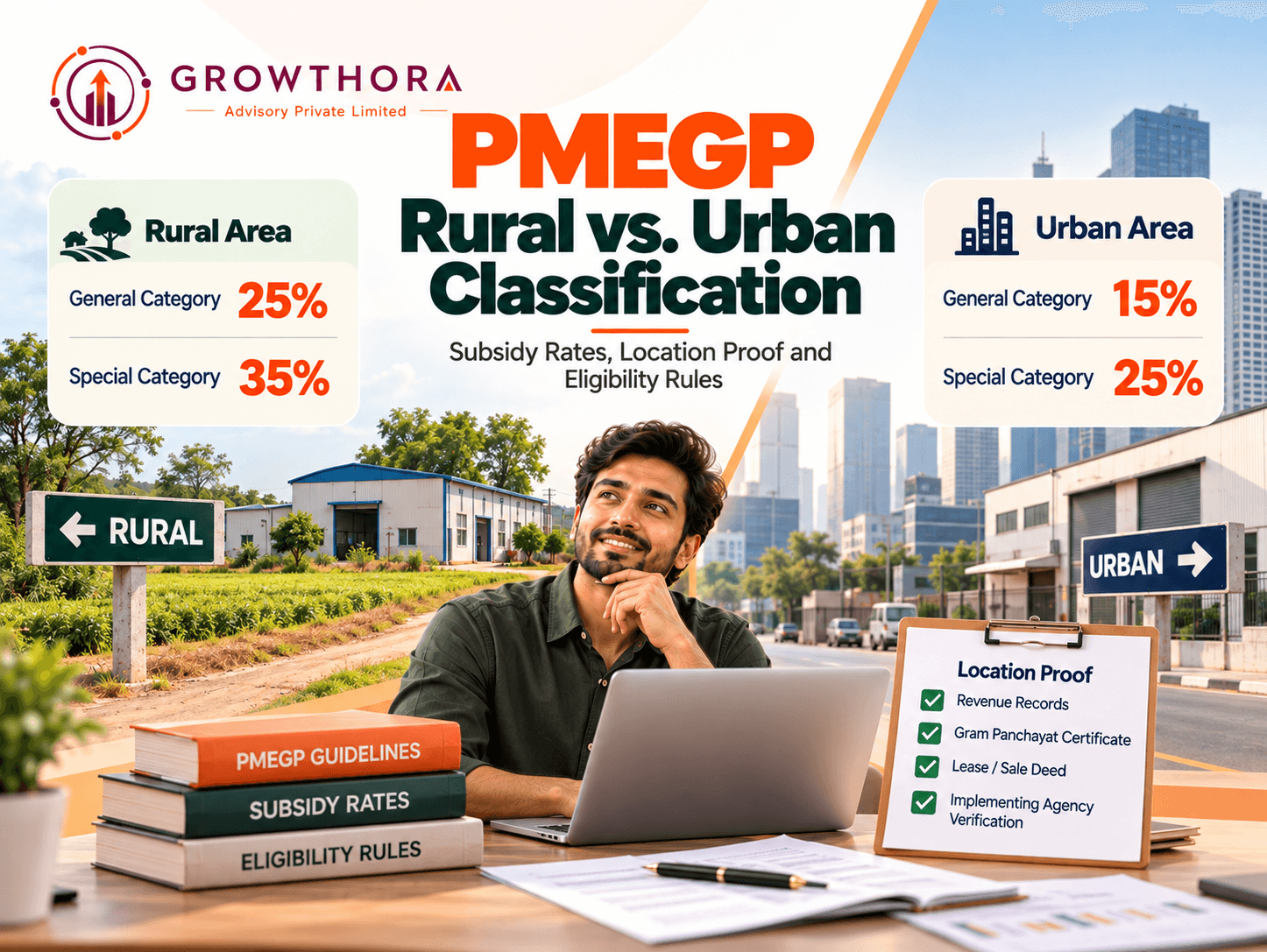
How much does rural versus urban classification change the subsidy?
The location rate can make a meaningful difference, but calculate the amount using the eligible project cost accepted under PMEGP. Land cost is not included in the eligible project cost. The maximum project cost eligible for margin money subsidy under the revised guidelines is ₹50 lakh for manufacturing and ₹20 lakh for business or service projects.
| Beneficiary category | Own contribution | Urban subsidy rate | Rural subsidy rate | Difference |
|---|---|---|---|---|
| General category | 10% of project cost | 15% | 25% | 10 percentage points |
| Special category, where eligible | 5% of project cost | 25% | 35% | 10 percentage points |
Special categories include the categories listed in the applicable guidelines, such as SC, ST, OBC, minorities, women, ex-servicemen, transgender persons, differently abled beneficiaries, and specified regional or district categories. Confirm the current list and documentation requirements before applying.
Example: difference on an eligible ₹50 lakh manufacturing project
| Category | Urban calculation | Rural calculation | Difference |
|---|---|---|---|
| General | 15% × ₹50 lakh = ₹7.50 lakh | 25% × ₹50 lakh = ₹12.50 lakh | ₹5 lakh |
| Special category | 25% × ₹50 lakh = ₹12.50 lakh | 35% × ₹50 lakh = ₹17.50 lakh | ₹5 lakh |
This is an illustration, not a promise that every ₹50 lakh proposal will receive subsidy on the full amount. The final eligible project cost and assistance depend on scheme conditions, application assessment and the bank or implementing agency process. Margin money subsidy is handled under the scheme's rules and should not be described as an upfront cash grant paid directly to the applicant.
What counts as a rural area under PMEGP?
The PMEGP scheme definition has historically referred to an area classified as a village in State or Union Territory revenue records, irrespective of population. It also includes an area classified as a town where the population does not exceed 20,000 persons. Before relying on this wording for a current application, check the latest applicable revised guidelines and any portal instructions or clarifications.
This means that the answer cannot be based only on distance from a city centre, a rural-looking landscape, the PIN code, or whether a site is in an industrial estate. A site near a city may still require careful record-based classification. Conversely, a village name or Gram Panchayat administration alone should not be treated as conclusive proof without checking the applicable definition and official records.
Does a Gram Panchayat certificate prove rural status?
- It may support the application if requested or accepted by the implementing agency, but do not assume it is the only document required or that it overrides official revenue and local-body records. Ask the relevant KVIC, KVIB or DIC office which documents it accepts for the exact plot and district.
- Useful records to ask about may include:
- Current revenue record identifying the revenue village and plot, such as the relevant khasra, jamabandi or equivalent State record.
- An official certificate or written confirmation from the competent local or revenue authority, if required by the implementing agency.
- Lease deed, sale deed or possession document that identifies the proposed unit's plot and location consistently.
- Industrial estate allotment or land-use documents, where applicable.
- Any additional location proof requested in the PMEGP portal or by the implementing agency.
How to prove rural location for PMEGP
- Identify the exact site where the new unit will operate. Do not use the applicant's home address as a substitute for the factory or business address.
- Collect the plot's official revenue and ownership or lease records. Check spelling, village name, plot number, tehsil and district across every document.
- Ask the implementing agency which rural classification evidence it requires for the particular site. If the plot is in a boundary area, request written clarification before committing to the location.
- Confirm whether a Gram Panchayat certificate, revenue officer certificate, municipal boundary record or another document is applicable in that State or district.
- Enter the project address accurately in the PMEGP application and DPR. Keep the address consistent with supporting records and the actual operating site.
- Save the written response and submitted evidence. If the portal shows a different area classification, request the reason and the correction process rather than assuming the subsidy rate has already changed.
KVIC, KVIB and DIC: who confirms the location?
KVIC, State Khadi and Village Industries Boards (KVIBs), and District Industries Centres (DICs) are among the implementing agencies involved in PMEGP. The relevant route can vary by application and local arrangements. Do not assume that one agency's informal statement automatically settles every portal or bank record.
For a proposed site, ask the agency handling your application to confirm the rural or urban classification, the document it relies on, and the process for correcting a mismatch. Keep the answer in writing. The financing bank still assesses the loan proposal, while scheme administration and subsidy handling follow PMEGP procedures.
Does a factory in an industrial corridor qualify as rural?
Not automatically. Industrial corridors and estates can span areas with different revenue and local-body classifications. Check the exact plot number, revenue village, relevant local-body boundaries and the applicable PMEGP definition. Do not choose a site solely on the assumption that a Gram Panchayat name guarantees the rural subsidy rate.
Does my home address affect the subsidy rate?
The subsidy classification is based on the project or unit location under the scheme rules, not simply the applicant's residential address. An urban home address does not by itself establish that a proposed rural unit is urban. However, inconsistent addresses across the application, DPR, lease, revenue records and site documents can trigger questions. State the residence and unit address accurately in their respective fields.
Common mistakes to avoid
- Assuming that every plot outside a city centre is rural.
- Assuming that a Gram Panchayat certificate alone guarantees rural classification.
- Using the applicant's home address instead of the proposed unit location.
- Calculating subsidy on land cost or on a project amount that exceeds the applicable subsidy ceiling.
- Treating the margin money subsidy as immediate cash paid to the applicant.
- Selecting a location before checking the records and the implementing agency's requirements.
- Promising a fixed ₹5 lakh additional subsidy without confirming the eligible project cost and category.
Pre-submission rural classification checklist
- ☐ I have identified the exact proposed unit location.
- ☐ I have checked the applicable PMEGP rural definition and latest instructions.
- ☐ I have collected the relevant revenue and ownership or lease records.
- ☐ I have asked the implementing agency which location documents it accepts.
- ☐ My project address is consistent across the application, DPR and supporting records.
- ☐ I have confirmed the category rate and own-contribution requirement.
- ☐ I understand that final eligibility and subsidy are subject to scheme assessment.
Frequently asked questions
What is the PMEGP rural vs urban subsidy rate?
For new units, the standard rate is 25% rural and 15% urban for general-category beneficiaries. For eligible special-category beneficiaries, it is 35% rural and 25% urban.
How much extra subsidy can a rural unit receive?
The rural rate is 10 percentage points higher. On an eligible project cost of ₹50 lakh, that equals ₹5 lakh more than the urban rate. The actual amount depends on eligible project cost and scheme conditions.
What is the PMEGP rural area definition?
The scheme definition has referred to areas classified as villages in State or Union Territory revenue records, irrespective of population, and certain areas classified as towns with a population not exceeding 20,000. Check the latest applicable guidelines before relying on this definition.
Is a Gram Panchayat certificate compulsory for PMEGP rural subsidy?
Do not assume one document is universally compulsory or sufficient. Ask the implementing agency which revenue, local-body or certificate documents it accepts for the exact site.
Does a plot near Jaipur or another large city count as rural?
Not based on distance alone. The exact plot, revenue records, local-body classification and applicable PMEGP definition need to be checked.
If my home is in an urban area but my factory is rural, which rate applies?
The unit's location is the relevant location for rural or urban classification under the scheme. Keep the home and unit addresses separate and accurate, and document the proposed unit location.
Are subsidy rates different for women or OBC applicants?
Women and OBC applicants are among the categories listed as special categories in the guidelines, subject to applicable eligibility and proof. The stated rates are 25% urban and 35% rural for eligible special-category beneficiaries.
Is the subsidy calculated on land cost too?
No. Land cost is not included in the eligible PMEGP project cost.
Who should confirm whether my plot is rural?
Contact the KVIC, KVIB or DIC implementing agency handling the application and ask for the accepted documents and classification in writing.
Does rural classification guarantee PMEGP approval?
No. Location affects the applicable subsidy rate, but it does not guarantee scheme eligibility, loan sanction or subsidy release.
Next step
Apply this to your business.
Confirm whether this applies to your legal structure, industry classification, and credit history - in under 30 minutes with an advisor.