
Think of It From the Bank's Side First
Most explanations of CGTMSE start from the borrower's perspective, "You can get a loan without collateral,” and skip past why a bank would ever agree to that. Understanding the bank's incentive is actually the fastest way to understand the whole scheme.
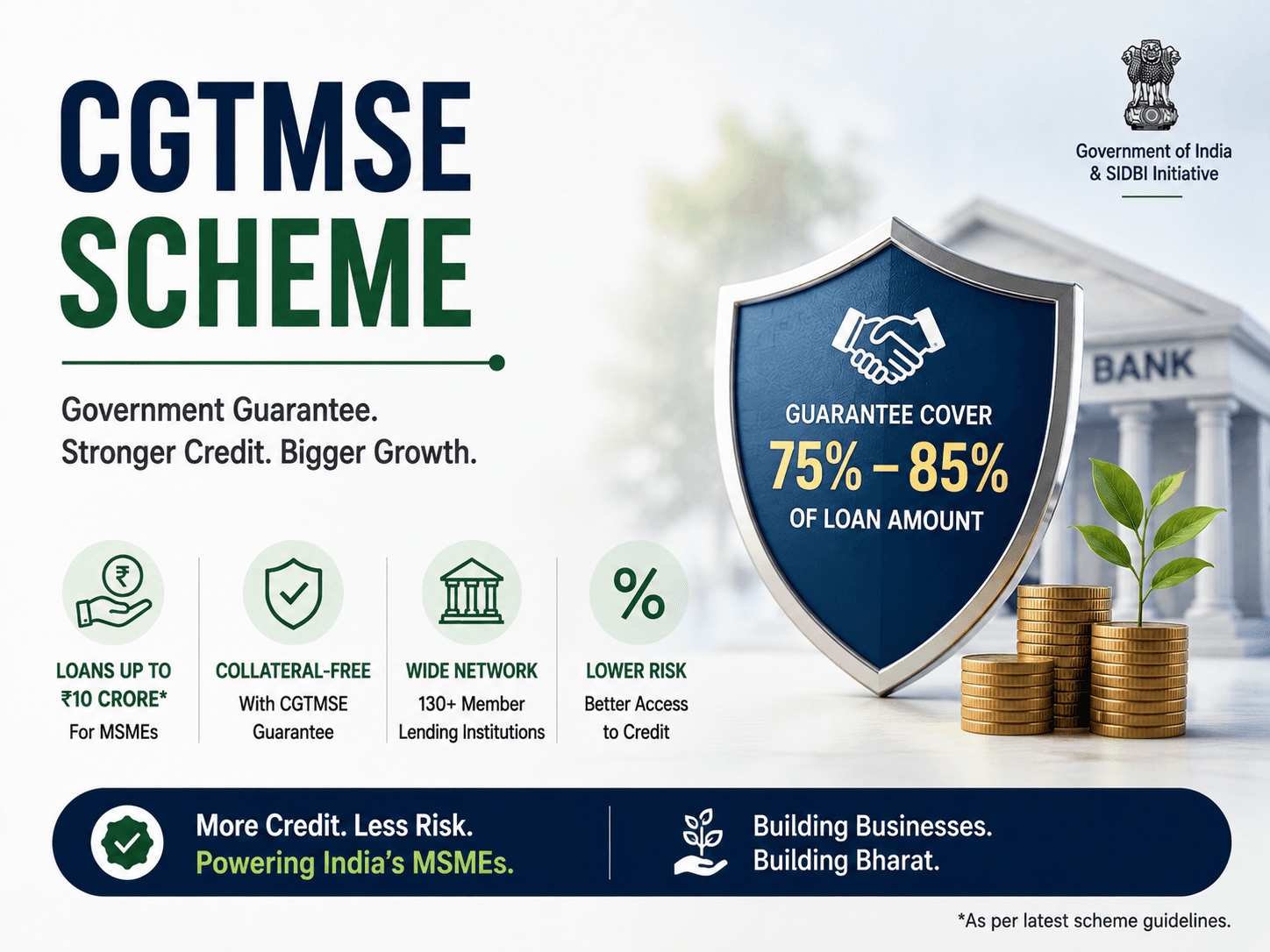
A bank lending to a small business with no collateral is taking on real default risk with nothing to recover if things go wrong. CGTMSE exists to change that math: when a bank registers an eligible loan under the scheme, the trust agrees to absorb a defined share of any eventual loss, currently 75% for most standard cases, rising to 85% or even 90% for specific categories like women-led enterprises, SC/ST borrowers, Zero Defect Zero Effect-certified units, and Agniveers. The bank isn't taking a leap of faith on your business; it's sharing the downside with a government-backed trust, which is a very different risk calculation.
This is also why CGTMSE coverage doesn't replace credit evaluation. The bank still reviews your business plan, financials, and repayment capacity exactly as it would for any loan; the guarantee changes what happens if you default, not whether you qualify for the loan in the first place.
What's Actually Covered
- Maximum loan amount: ₹10 crore per borrower as of 2026, a figure that's been revised upward from earlier ₹2 crore and ₹5 crore ceilings that a lot of older guides and even some current sources still quote, so if you're comparing information across sources, check the date
- Standard guarantee coverage: 75% of the sanctioned credit facility
- Enhanced coverage, 80% to 85%: available for microenterprises, women entrepreneurs, SC/ST borrowers, units in the Northeastern Region, and Zero Defect Zero Effect (ZED) certified units
- Coverage up to 90%: reported for women-led enterprises and Agniveers under recent scheme enhancements
- DPIIT-recognized startups are eligible for a separate, higher guarantee ceiling of up to ₹20 crore under the Credit Guarantee Scheme for Startups (CGSS), a distinct scheme from the standard CGTMSE facility for MSMEs generally
- Covered facilities: both fund-based (term loans, cash credit) and non-fund-based (letters of credit, bank guarantees) credit extended by eligible institutions to new and existing micro and small enterprises, including service enterprises
Since guarantee ceilings and coverage percentages get revised through periodic circulars, treat any specific number here as a snapshot rather than a permanent fact, and confirm the currently applicable figures directly on cgtmse.in or with your lender before finalizing a loan application around them.
What's Not Covered
- Educational institutions
- Agriculture-focused lending
- Training institutions
- Self-Help Groups, which are generally covered under separate microfinance-oriented mechanisms rather than CGTMSE
Who Can Lend Under This Scheme
You don't apply to CGTMSE; you apply to a bank or NBFC that's registered as a Member Lending Institution, or MLI. This category has expanded meaningfully over the scheme's life and now includes the following:
- Public and private sector scheduled commercial banks
- Regional Rural Banks (RRBs)
- Small Finance Banks (SFBs)
- Select NBFCs approved as MLIs
- Microfinance institutions are now eligible as MLIs following recent scheme revisions
- Specialised institutions such as NEDFi (North Eastern Development Finance Corporation) for the North East region
Over 130 to 200 institutions, depending on the source and how recently it was updated, currently participate as MLIs, giving borrowers a genuinely wide choice of where to seek a CGTMSE-backed loan.
The Annual Guarantee Fee, and Who Actually Pays It
This is the part that trips people up, since the fee structure is described from the bank's side but lands on the borrower's side in practice.
Who pays it legally: the Member Lending Institution pays the Annual Guarantee Fee (AGF) directly to the CGTMSE Trust, not the borrower.
Who pays it, in practice: almost universally, the bank recovers this cost from the borrower, either built into the interest rate or billed separately, so it functions as a real cost of the loan even though the borrower never pays CGTMSE directly.
The rate: AGF is a risk-based premium starting around 0.37% per annum for loans up to ₹10 lakh, scaling up to roughly 1.20% for loans between ₹8 crore and ₹10 crore, calculated on the guaranteed amount in the first year and on the outstanding balance in subsequent years. A well-performing bank may get a discount of up to 10% on the standard rate, while a higher-risk MLI can be charged a premium of up to 70% over standard, a variation that ultimately reflects back onto borrower pricing at that institution.
Concessions: roughly a 10% fee reduction is available for units in notified regions and ZED-certified units, with additional concessions typically available for women entrepreneurs and North Eastern Region units.
Putting it together with a simple example: a loan at a 10% bank interest rate with a 0.55% AGF works out to an effective annual cost of roughly 10.55%, before any processing charges. The AGF is a real, calculable addition to your borrowing cost, not a hidden or negligible line item.
How the Guarantee Actually Gets Applied to Your Loan
- You approach an eligible bank or NBFC and apply for a business loan in the normal way, submitting financials, KYC, and a business plan.
- The lender reviews your creditworthiness and eligibility, then sanctions the credit facility on its own underwriting merits, exactly as it would for any loan application.
- The lender separately logs into the CGTMSE online portal and submits your core business details, PAN, sanctioned amount, and interest rate, formally seeking guarantee cover for the facility.
- The lender calculates and pays the applicable annual guarantee fee to the trust, a cost that's typically recovery-billed to your loan account.
- Once CGTMSE verifies the data and receives the fee, it issues a digital Guarantee Cover Number, formally activating the guarantee on your loan.
- Your obligation to repay the loan in full is entirely unchanged by any of this. The guarantee protects the lender's downside if you default; it doesn't reduce or waive what you owe.
What CGTMSE Doesn't Change
It doesn't waive your repayment obligation: CGTMSE compensates the lender for its loss, and the borrower's liability to repay remains exactly as agreed.
It doesn't replace credit evaluation: banks still assess your business on its own merits, and a CGTMSE-eligible business type doesn't guarantee loan approval.
It doesn't set the interest rate: CGTMSE-covered loans are typically priced like standard bank lending; the guarantee affects collateral requirements and risk-sharing, not the base interest rate itself, though the AGF adds to your effective cost as covered above.
Frequently Asked Questions
What is CGTMSE?
The Credit Guarantee Fund Trust for Micro and Small Enterprises, a scheme jointly run by the Government of India and SIDBI since August 2000, that guarantees a share of a bank's loss on eligible collateral-free MSME loans.
What percentage of a loan does CGTMSE guarantee?
Generally 75% of the sanctioned amount, rising to 80% to 85% for microenterprises, women entrepreneurs, SC/ST borrowers, North Eastern Region units, and ZED-certified units, with up to 90% reported for certain categories under recent enhancements.
What is the maximum loan amount under CGTMSE?
As of 2026, up to ₹10 crore per borrower, revised upward from the ₹2 crore and ₹5 crore ceilings that many older or unrevised sources still show. DPIIT-recognized startups can access up to ₹20 crore under the separate CGSS scheme.
Who pays the CGTMSE Annual Guarantee Fee?
Legally, the lending bank or NBFC pays it directly to the Trust. In practice, this cost is almost always passed through and recovered from the borrower as part of the loan's overall pricing.
Can I apply to CGTMSE directly as a borrower?
No, applications must go through a member lending institution. You apply for a loan at an eligible bank or NBFC, and the institution separately seeks guarantee cover from CGTMSE on the sanctioned facility.
Does CGTMSE reduce my interest rate?
Not directly. CGTMSE-backed loans are generally priced similarly to standard bank lending. What it does is remove the collateral requirement at the cost of the annual guarantee fee, which does add to your total borrowing cost.
Which businesses are not eligible for CGTMSE cover?
Educational institutions, agriculture-focused lending, training institutions, and self-help groups are excluded from CGTMSE coverage.
What happens if I default on a CGTMSE-covered loan?
CGTMSE compensates the lender for its covered share of the loss. Your obligation to repay the loan doesn't disappear, and default still affects your credit history and can lead to recovery action by the lender for the uncovered portion.
Are NBFCs eligible to offer CGTMSE-backed loans?
Yes, select NBFCs, along with microfinance institutions following recent scheme revisions, are approved as member lending institutions, alongside public and private banks, RRBs, and SFBs.
Does CGTMSE cover working capital loans or only term loans?
Both. The scheme covers fund-based facilities like term loans and cash credit, as well as non-fund-based facilities like letters of credit and bank guarantees, provided they're extended by an eligible institution to a qualifying MSME.
How is the guarantee fee calculated?
It's a risk-based percentage, roughly 0.37% for loans up to ₹10 lakh, scaling up toward 1.20% for loans between ₹8 crore and ₹10 crore, calculated on the guaranteed amount in the first year and on the outstanding balance afterward.
What This Actually Means for You as a Borrower
Don't think of CGTMSE as free money or as a guarantee that you'll get approved; think of it as the reason a bank is even willing to have the conversation with you about a collateral-free loan in the first place. The fee you pay for that access is real and calculable, and it's worth asking your lender directly, before signing anything, exactly what AGF rate applies to your loan and what guarantee percentage they're seeking, since both genuinely affect your total cost of borrowing.
The businesses that get the most value from CGTMSE are the ones that come in with the same preparation they'd bring to any bank loan, clean financials, a clear use of funds, and realistic projections, because the guarantee changes who bears the risk of default, not how carefully the bank evaluates you before lending in the first place.
Next step
Apply this to your business.
Confirm whether this applies to your legal structure, industry classification, and credit history - in under 30 minutes with an advisor.