
The Question Worth Answering First: How Is This Even Possible?
“Collateral-free” sounds like the bank is simply taking your word for it, and that confuses people into either distrusting the offer or misunderstanding what they're actually signing up for. Neither reaction is quite right, because "collateral-free" doesn't mean "risk-free" for the lender; it means the risk has been moved somewhere else.
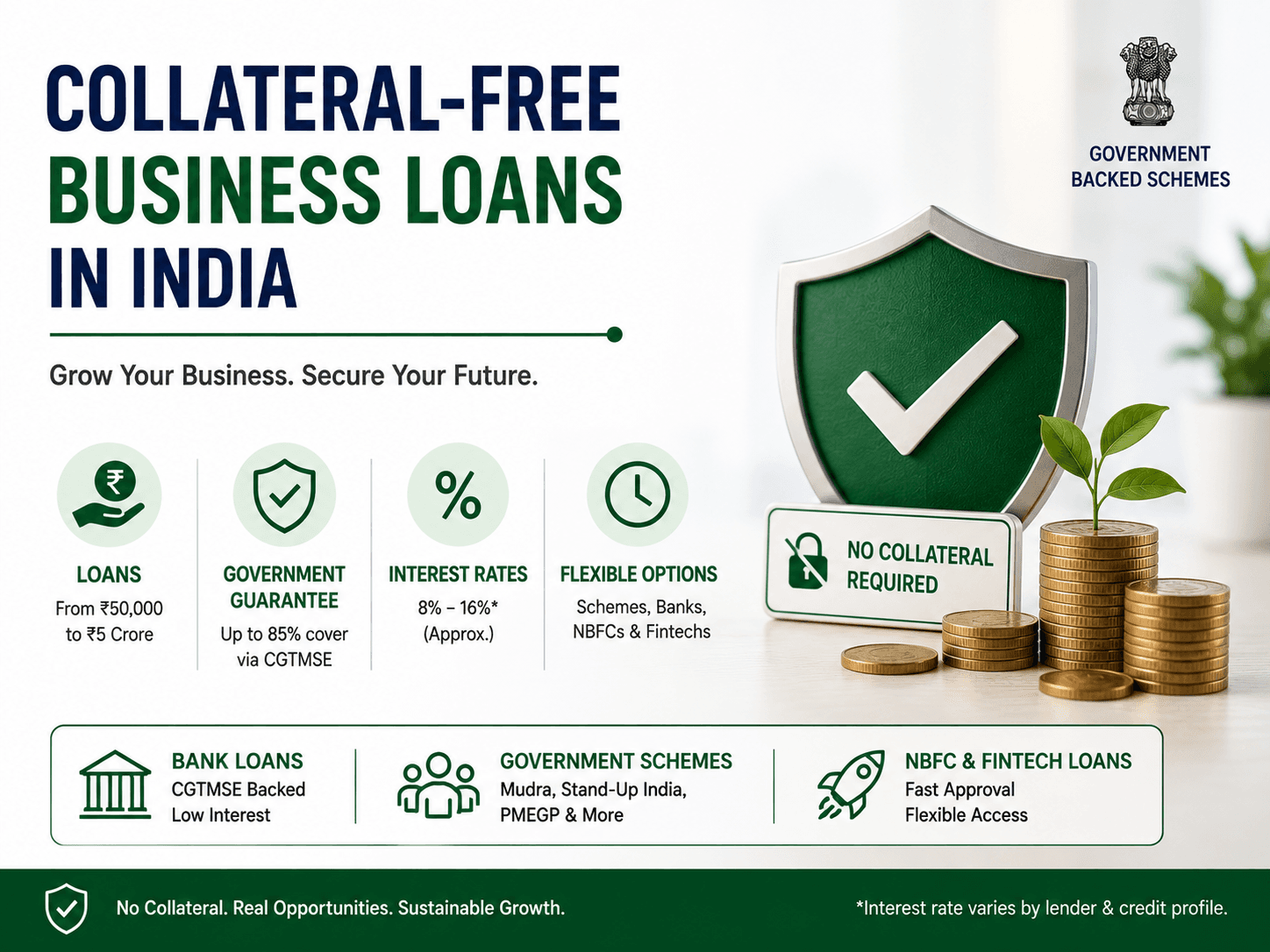
For most genuinely collateral-free MSME lending in India, that somewhere else is the Credit Guarantee Fund Trust for Micro and Small Enterprises, CGTMSE, a scheme run jointly by the government of India and SIDBI. When a bank lends to an eligible MSME under this scheme, CGTMSE guarantees 50 to 85 percent of the loan amount, with the exact percentage depending on the borrower's category; women and SC/ST-owned enterprises and the North-East typically get the higher end of that range. If the borrower defaults, CGTMSE absorbs the guaranteed share of the loss, not the bank alone. That's what actually lets a bank extend credit without asking you to pledge a house, a shop, or equipment as security.
Where a loan isn't CGTMSE-backed, collateral-free lending still exists, but the mechanism is different: NBFCs and fintech lenders price the absence of collateral directly into a higher interest rate and shorter tenure, rather than sharing the risk with a guarantee trust. Both are legitimate; they just work on different logic, and it's worth knowing which one you're actually being offered.
The Three Real Paths to a Collateral-Free Loan
Path one: a CGTMSE-backed loan from a bank
This is the path with the most attractive economics if you qualify, since interest rates are typically the same as regular bank lending, not a premium for going collateral-free. The trade-off is more paperwork and stricter eligibility, since you need Udyam registration, and usually 1 to 2 years of financial history for meaningful ticket sizes, though newer businesses can access smaller amounts through it as well.
Path two: a government scheme loan (Mudra, Stand-Up India, PMEGP)
These are collateral-free by design rather than by guarantee mechanism alone, aimed specifically at first-time or small-ticket borrowers. Mudra covers up to ₹20 lakh across its tiers, Stand-Up India covers ₹10 lakh to ₹1 crore for new SC/ST or women-led ventures specifically, and PMEGP adds a margin money subsidy on top of the loan itself. These typically move faster through public sector bank channels than a from-scratch CGTMSE application.
Path three: unsecured lending from an NBFC or fintech lender
This path exists for businesses that don't fit neatly into a government scheme box, need money faster than a bank's underwriting cycle allows, or don't want the compliance overhead of a guarantee-scheme application. It's genuinely collateral-free, but the lender compensates for taking on full risk with higher interest rates, often shorter repayment periods, and underwriting based heavily on digital signals like GST filings and bank statement cash flow rather than traditional collateral or lengthy credit history.
Comparing the Three Paths Directly
- Cost: CGTMSE-backed bank loans are typically the cheapest, priced like standard bank credit; NBFC and fintech unsecured loans are the most expensive, reflecting the lender's full exposure to risk
- Speed: fintech and NBFC lenders are usually fastest, often disbursing within days based on digital underwriting; bank and government scheme loans generally take longer due to more thorough documentation review
- Ticket size: CGTMSE supports the largest amounts, up to several crore rupees; Mudra and similar government schemes cap out at ₹10 lakh to ₹20 lakh; NBFC and fintech loans vary widely by lender but often sit in a smaller-to-mid range
- Eligibility flexibility: NBFC and fintech lenders are generally most willing to work with thinner credit histories, at a price; banks and government schemes have clearer, more rigid eligibility rules but reward you with better pricing if you meet them
- Best fit: an established MSME with clean books and time to spare should look at CGTMSE first; a first-time entrepreneur should look at Mudra, Stand-Up India, or PMEGP; a business that needs cash quickly or doesn't fit a scheme's boxes should compare NBFC and fintech options carefully on total cost, not just approval speed
What Lenders Actually Look At
- Udyam registration certificate, close to universal requirement for bank and government scheme routes, less strictly enforced by some fintech lenders
- Business vintage, generally 1 to 3 years for meaningful ticket sizes at banks, though schemes like Mudra's Shishu and Kishor tiers are built for genuinely new businesses
- Turnover and cash flow, evidenced through bank statements (commonly 6 to 12 months) and GST returns
- Income tax returns for established businesses, typically the last 1 to 3 years
- CIBIL score of the business and its promoters, generally 700 or above for the best terms at mainstream banks, with NBFCs and fintech lenders more willing to work with lower scores at a cost
- A clear project report or use-of-funds explanation, particularly for new ventures or larger ticket sizes
Documents to Have Ready
- Udyam registration certificate
- PAN and Aadhaar of the business and its promoters or partners
- Bank statements, typically 6 to 12 months
- GST returns, where applicable
- Income tax returns, generally 1 to 3 years for established businesses
- Business registration proof: partnership deed, LLP agreement, or Certificate of Incorporation depending on structure
- A project report or business plan, especially important for new ventures or when applying for a scheme-specific loan
How to Apply, Whichever Path You Choose
Trade-Offs Worth Being Honest About
- Cheaper usually means slower: the most cost-effective collateral-free route, CGTMSE through a bank, typically takes longer to process than an NBFC or fintech alternative
- Faster usually means pricier: digital lenders that can disburse in days are pricing that speed and flexibility into a higher interest rate
- Collateral-free isn't consequence-free: defaulting on any of these loans still damages your personal and business credit score and exposes you to legal recovery action, a guarantee scheme protects the lender's downside, not yours
- Government scheme rules don't bend: Stand-Up India's greenfield-only restriction and similar scheme conditions are firm; applying under the wrong scheme wastes time rather than getting approved with an exception
Frequently Asked Questions
How is a collateral-free business loan actually possible?
Most commonly through CGTMSE, a government guarantee scheme that covers 50 to 85 percent of a bank's loss if the borrower defaults, letting the bank extend credit without requiring pledged assets. NBFC and fintech lenders offer collateral-free loans through a different mechanism, pricing the added risk into a higher interest rate instead.
Is a collateral-free loan more expensive than a secured one?
CGTMSE-backed bank loans are typically priced the same as regular secured bank lending. Unsecured NBFC and fintech loans, which don't rely on a government guarantee, generally do carry higher rates to compensate the lender for the added risk.
Who is eligible for a collateral-free business loan?
Requirements vary by path. CGTMSE and government schemes generally require Udyam registration and some minimum business documentation. NBFC and fintech lenders are often more flexible on credit history but weigh this into pricing and loan terms.
What documents are needed for a collateral-free loan?
Udyam registration, PAN and Aadhaar, bank statements, GST returns where applicable, income tax returns for established businesses, and a project report for new ventures or larger amounts.
What is CGTMSE?
The Credit Guarantee Fund Trust for Micro and Small Enterprises, a scheme run jointly by the Government of India and SIDBI that guarantees a significant share of a bank's loss on eligible MSME loans, enabling collateral-free lending up to several crore rupees.
What's the maximum amount I can borrow without collateral?
Through CGTMSE-backed bank loans, amounts can reach several crore rupees depending on the guarantee ceiling in effect. Government schemes like Mudra cap out lower, up to ₹20 lakh, while NBFC and fintech unsecured loans vary by lender.
Are NBFC and fintech collateral-free loans legitimate, or is there a catch?
They're legitimate options, particularly for speed and flexibility, but the trade-off is generally a higher interest rate and shorter tenure than a CGTMSE-backed bank loan, since the lender is absorbing the full default risk rather than sharing it with a guarantee scheme.
Does a collateral-free loan mean no consequences for defaulting?
No. Default still damages the borrower's personal and business credit score and can lead to legal recovery proceedings, the absence of collateral affects what the lender can seize, not whether they can pursue recovery through other means.
Can a brand-new business get a collateral-free loan?
Yes, through Mudra's Shishu and Kishor tiers, PMEGP, or Stand-Up India if eligible by category, all of which are specifically designed for new entrepreneurs without an extensive financial track record.
How long does it take to get a collateral-free business loan?
This varies significantly by path: fintech and NBFC lenders often disburse within days using digital underwriting, while bank and government scheme routes generally take longer due to more thorough documentation and guarantee-related processing.
Which is better, a CGTMSE-backed loan or an unsecured NBFC loan?
Neither is universally better, it depends on your priorities. CGTMSE-backed loans are generally cheaper but slower and more document-intensive. NBFC and fintech loans are faster and more flexible on eligibility but typically cost more.
The Decision, Simplified
If you have some operating history, clean books, and can afford to wait a few weeks, a CGTMSE-backed bank loan is almost always better economically. If you're starting from nothing, a government scheme built for first-time entrepreneurs, Mudra, Stand-Up India, or PMEGP, is the more natural fit than trying to qualify for standard bank credit. If you need money quickly or don't fit any of these boxes cleanly, an NBFC or fintech lender is a real option; just go in knowing you're paying for that speed and flexibility rather than assuming collateral-free automatically means cheap.
The one thing worth carrying into any of these conversations is that collateral-free changes what you risk losing if things go wrong, not whether there's a real obligation to repay. Treat the underlying loan with the same seriousness you would a secured one, and the absence of collateral becomes a genuine advantage rather than a trap.
Next step
Apply this to your business.
Confirm whether this applies to your legal structure, industry classification, and credit history - in under 30 minutes with an advisor.