
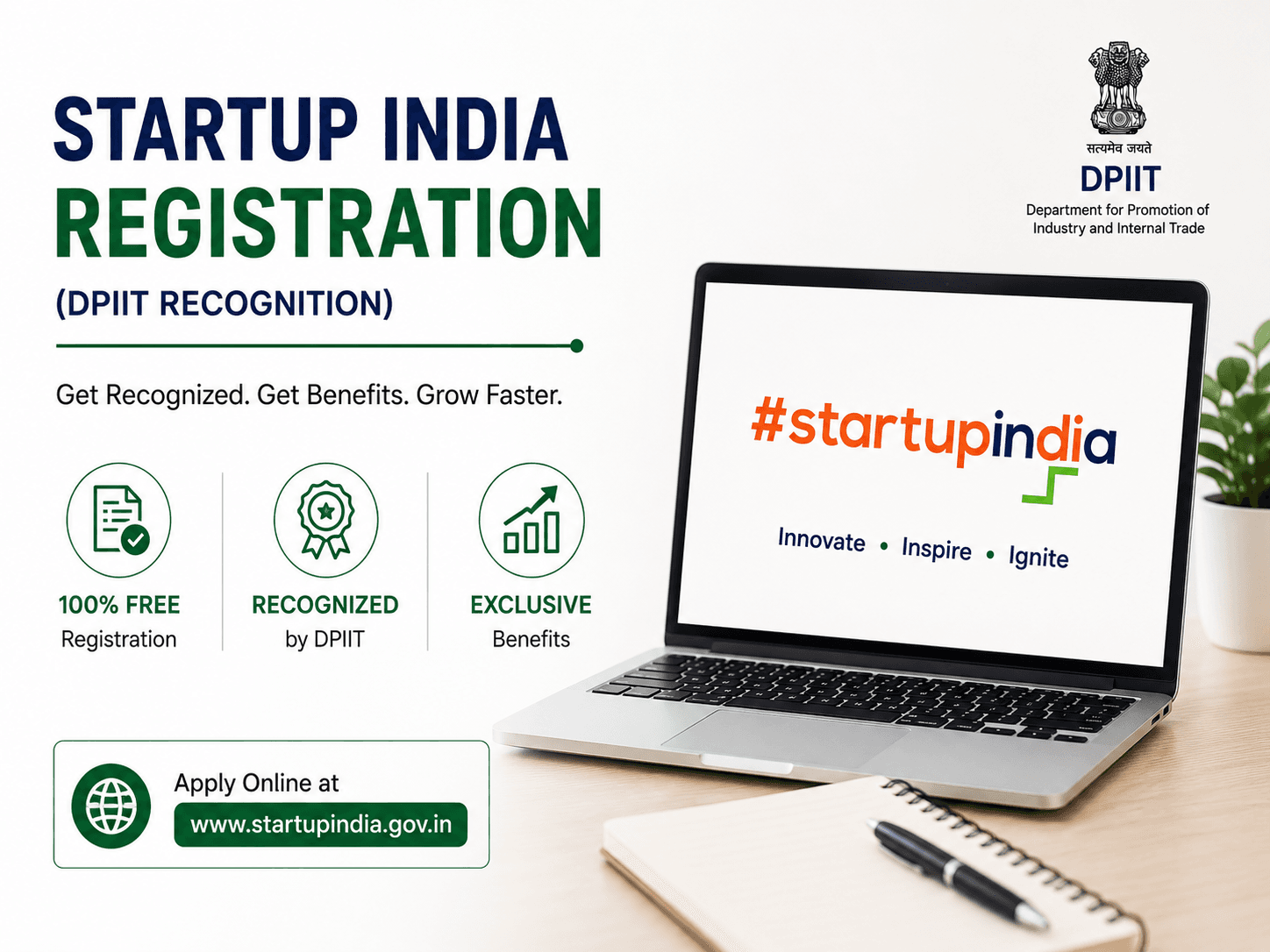
What Is Startup India Registration (and Why It's Different From Incorporation)
Startup India registration and company incorporation are two separate processes, and conflating them is one of the most common misunderstandings founders have. Incorporating a Private Limited Company, LLP, or Registered Partnership Firm makes your business legally exist. DPIIT recognition, granted by the Department for Promotion of Industry and Internal Trade under the Ministry of Commerce and Industry, is a further certification on top of that, one that officially designates the incorporated entity as a recognised startup and unlocks a specific set of tax, funding, and compliance benefits.
Without DPIIT recognition, a company can be fully incorporated and operating normally, but it cannot claim the Section 80-IAC income tax holiday, cannot access the government's Fund of Funds for Startups, cannot claim the patent filing fee rebate, and doesn't qualify for angel tax exemption under Section 56(2)(VIIB) of the Income Tax Act. Since the certification itself is free and the benefits are substantial, it's widely considered one of the highest-return, lowest-effort registrations an early-stage founder can complete.
Who Is Eligible for Startup India Registration (2026 Criteria)
DPIIT revised the recognition framework through notification G.S.R. 108(E), dated 4 February 2026, which replaced the earlier 2019 framework. Since this is a recent change, it's worth cross-checking the current notification on the Startup India portal if anything here seems to have shifted further by the time you apply. Under the current framework, four conditions all need to be met.
Entity type: the business must be incorporated or registered as a Private Limited Company, Limited Liability Partnership, Registered Partnership Firm, or Cooperative Society (including Multi-State Cooperative Societies, newly added in 2026). Sole proprietorships and Hindu Undivided Families are not eligible
Age: the entity must be within 10 years of its date of incorporation or registration, extended to 20 years for recognised Deep Tech startups
Turnover: annual turnover must stay below ₹200 crore in any financial year since incorporation, doubled from the earlier ₹100 crore ceiling, or below ₹300 crore for Deep Tech startups
Innovation or scalability: the entity must be working towards innovation, development, or improvement of products, processes, or services, or have a scalable business model with high potential for employment generation or wealth creation
An entity formed by splitting up or reconstructing an already-existing business is specifically disqualified from recognition, regardless of how it otherwise scores on the criteria above
The Deep Tech category
The 2026 framework formally defines Deep Tech Startups for the first time: entities working on novel scientific or engineering innovation, such as semiconductors, advanced materials, biotech, or space technology, with meaningful R&D expenditure relative to revenue, ownership of or a clear path to meaningful intellectual property, and a defined commercialisation plan. In exchange for the longer 20-year recognition window and higher ₹300 crore turnover ceiling, Deep Tech applicants need to submit additional documentation establishing that the technology is genuine rather than a labelling choice.
Documents Required for Startup India Registration (Checklist)
- Certificate of Incorporation or Registration for the entity
- PAN card of the entity
- Details of directors or partners, including an Aadhaar-linked mobile number for the person creating the application
- An innovation statement describing the product, service, or business model and how it meets the innovation or scalability criteria. This is the most scrutinised part of the application, and a vague or generic statement is the leading cause of rejection
- One supporting document, such as a pitch deck, patent filing, website link describing the product, an award, or a letter of recommendation from an incubator, though the incubator letter is no longer mandatory the way it once was
For Deep Tech applicants, additional documentation demonstrating R&D expenditure, intellectual property status, and a commercialisation plan
Startup India Registration Process, Step by Step
- Recognition is applied for after incorporation, through the Startup India portal.
- Incorporate an eligible entity first, if you haven't already: a private limited company, LLP, registered partnership firm, or cooperative society. A sole proprietorship cannot apply for DPIIT recognition at all.
- Create an account on the Startup India portal at startupindia.gov.in using the company's details and a director or partner's Aadhaar-linked mobile number.
- Complete the application form: incorporation date, entity type, sector, current turnover, and a brief description of the business.
- Draft the innovation statement carefully. Most rejections trace back to this section being too vague or too close to a generic business description rather than explaining the actual innovation or scalability angle.
- Upload the Certificate of Incorporation, PAN, and one supporting document, adding the extra Deep Tech documentation if applying under that category.
- Self-certify that the entity meets all eligibility conditions. There's no officer visit or physical audit at this stage.
- Submit the application and track its status on the portal. On approval, you receive a digital DPIIT Certificate of Recognition with a unique reference number.
Startup India Registration Fees
This is one of the simplest cost pictures in the entire registration series: there is no government fee at any stage.
- Government fee: ₹0. DPIIT recognition is entirely free to apply for and to receive, with no charge for the certificate itself or for the review process.
- Section 80-IAC application: Also free to apply for, though it's a separate application to the Inter-Ministerial Board (IMB) made after DPIIT recognition is granted and typically requires more supporting financial documentation.
- Professional fees: The main cost most founders actually incur is optional, paying a consultant to help draft a strong innovation statement or assemble Deep Tech documentation, since a weak submission is the most common reason applications get sent back. This varies widely depending on complexity and isn't a fixed government charge.
How Long Does Startup India Registration Take
Timelines vary somewhat depending on how complete and clear the application is. Straightforward applications with a strong innovation statement are sometimes approved within about 72 hours, while others report a more typical window of roughly 7 to 14 working days. If DPIIT requests additional information or clarification, most often around the innovation statement, the timeline extends until that's resolved. Deep Tech applications, given the additional documentation involved, tend to sit toward the longer end of that range.
Startup India Registration Online: What “Online” Actually Means
The entire application, account creation, form completion, document upload, and self-certification, happens on the Startup India portal without any physical filing or office visit. Recognition is granted purely on the strength of the submitted application and self-certified declarations, with DPIIT reviewing the documentation and innovation statement rather than conducting an in-person audit at this stage.
DPIIT Recognition vs. Section 80-IAC Tax Exemption: What's the Difference
These two get confused constantly, and they're genuinely separate approvals with separate applications.
- DPIIT recognition is the base certification that makes an entity a “recognised startup,” unlocking most Startup India benefits, and is open to Private Limited Companies, LLPs, Registered Partnership Firms, and cooperative societies.
- Section 80-IAC is a specific income tax exemption, 100 percent exemption on profits for any 3 consecutive years out of the first 10 years from incorporation, and requires a separate application to the Inter-Ministerial Board after DPIIT recognition is already granted
80-IAC eligibility is narrower than DPIIT recognition itself: it's generally limited to Private Limited Companies and LLPs incorporated on or after 1 April 2016, so Partnership Firms and Cooperative Societies that qualify for DPIIT recognition don't automatically qualify for this particular tax benefit
The 80-IAC application requires additional documents beyond what DPIIT recognition needed, including the MOA or LLP deed, board resolutions where applicable, and financial statements and returns for the last three financial years
Benefits of Startup India Registration (DPIIT Recognition)
- Income tax holiday: eligible companies and LLPs can claim 100 percent exemption on profits for any 3 consecutive years out of the first 10 years, once separately approved under Section 80-IAC
- Angel tax exemption: recognised startups can be exempted from tax on share premium received from investors under Section 56(2)(VIIB) of the Income Tax Act
- Self-certification under labour and environmental laws: reduces routine inspection burden for a defined period, letting founders self-certify compliance under a set of specified labour and environmental laws instead
- Cheaper intellectual property protection: an 80 percent rebate on patent filing fees and a 50 percent rebate on trademark filing fees, along with fast-tracked patent examination
- Access to the Fund of Funds for Startups: a SIDBI-managed fund that invests indirectly in startups through SEBI-registered alternative investment funds
- Relaxed public procurement norms: exemption from prior turnover and experience requirements in many government tenders, similar in spirit to the MSE relaxations available through Udyam
- Faster, simplified winding up: recognised startups can access an expedited exit process under the relevant insolvency framework, rather than the standard company winding-up timeline
What Happens After Recognition
Getting the DPIIT certificate is the beginning of using the recognition, not the end of the process. Most recognized startups still need to:
Apply separately to the Inter-Ministerial Board for Section 80-IAC tax exemption if eligible, since this doesn't happen automatically alongside DPIIT recognition
Apply for angel tax exemption declarations where relevant, ahead of raising a funding round involving share premium
Keep turnover and entity status under the applicable ceiling, since recognition ends automatically once turnover crosses ₹200 crore (₹300 crore for Deep Tech) in any financial year, or once the 10-year (20-year for Deep Tech) window from incorporation passes, whichever comes first
Use the recognition certificate when applying for patent and trademark fee rebates, government tenders, and the Fund of Funds pathway
Keep supporting documentation current, since recognition obtained on inaccurate information can be withdrawn by DPIIT on review
Continue normal ROC, GST, and income tax compliance for the underlying entity, since DPIIT recognition is an additional status, not a replacement for standard filings
Common Mistakes That Get Startup India Applications Rejected
- A vague or generic innovation statement that reads like a standard business plan rather than explaining the actual innovation or scalable model, by far the most common rejection reason
- Applying as a sole proprietorship, which isn't an eligible entity type under any version of the framework
- Applying for an entity formed by splitting up or restructuring an already-existing business, which is an automatic disqualifier
- Mismatches or incomplete details in the Certificate of Incorporation or PAN uploaded with the application
- Assuming DPIIT recognition automatically includes the Section 80-IAC tax exemption, and not filing the separate IMB application it actually requires
- Applying under the Deep Tech category without the R&D, IP, or commercialisation documentation needed to substantiate it
Frequently Asked Questions
What is Startup India registration?
Startup India registration, formally known as DPIIT recognition, is a government certification granted to eligible incorporated entities that designates them as recognised startups, unlocking tax, funding, and compliance benefits under the Startup India initiative.
Who is eligible for Startup India registration?
Private Limited Companies, LLPs, Registered Partnership Firms, and Cooperative Societies within 10 years of incorporation (20 for Deep Tech), with turnover below ₹200 crore (₹300 crore for Deep Tech), and working toward genuine innovation or a scalable business model. Sole proprietorships are not eligible.
What documents are required for Startup India registration?
The Certificate of Incorporation, PAN of the entity, director or partner details, an innovation statement, and one supporting document such as a pitch deck, patent, or website link.
How much does Startup India registration cost?
Nothing. DPIIT recognition is completely free to apply for through the Startup India portal, with no government fee at any stage.
How long does DPIIT recognition take?
Typically a few days to about two weeks. Straightforward applications are sometimes approved within roughly 72 hours, while others take longer, especially if DPIIT requests clarification on the innovation statement.
Can a sole proprietorship register under Startup India?
No. Only Private Limited Companies, LLPs, Registered Partnership Firms, and Cooperative Societies are eligible entity types under the current DPIIT framework.
What is the turnover limit for Startup India registration?
Below ₹200 crore in any financial year since incorporation for regular startups, under the framework effective from February 2026, and below ₹300 crore for recognised Deep Tech startups.
What is a Deep Tech startup under the 2026 framework?
An entity working on novel scientific or engineering innovation, such as semiconductors, advanced materials, or biotech, with significant R&D spending relative to revenue, meaningful intellectual property, and a clear commercialisation plan. Deep Tech startups get a longer 20-year recognition window and a higher ₹300 crore turnover ceiling.
Is DPIIT recognition the same as the Section 80-IAC tax exemption?
No. DPIIT recognition is the base certification. Section 80-IAC is a separate income tax exemption requiring its own application to the Inter-Ministerial Board after DPIIT recognition is granted, and is generally limited to companies and LLPs incorporated on or after 1 April 2016.
Why do most Startup India applications get rejected?
The leading reason is a weak or vague innovation statement that doesn't clearly explain the innovation or scalable business model. Other common reasons include ineligible entity type, document mismatches, or the entity having been formed by splitting up an existing business.
Can an OPC apply for Startup India registration?
One Person Companies are incorporated under the same Companies Act, 2013 as private limited companies, so they are generally understood to be eligible, though it's worth confirming your specific entity's eligibility on the current Startup India portal guidance before applying.
What happens if my startup's turnover crosses the threshold?
Recognition ends automatically once turnover exceeds ₹200 crore (₹300 crore for Deep Tech) in any financial year, or once the entity passes the 10-year (20-year for Deep Tech) window from incorporation, whichever happens first.
Can DPIIT recognition be withdrawn?
Yes. If recognition was obtained based on incorrect or misleading information, DPIIT can withdraw it on review, along with any benefits already claimed on the basis of that recognition.
Do Partnership Firms and Cooperative Societies get the same benefits as companies?
They're eligible for DPIIT recognition and most associated benefits, but not for Section 80-IAC specifically, which is generally restricted to Private Limited Companies and LLPs incorporated on or after 1 April 2016.
Conclusion
Startup India registration is a rare case of a government process that's genuinely low-cost relative to what it unlocks: it's free, doesn't require a lawyer to attempt, and the difference between having DPIIT recognition and not having it can be the difference between claiming a real tax holiday and not being eligible to apply for one at all. The 2026 revisions, a higher turnover ceiling, a dedicated Deep Tech track, and expanded entity eligibility, make it accessible to a wider range of businesses than the original 2019 framework did.
The part worth taking seriously is the innovation statement, since that's where most rejections actually happen. A clear, specific explanation of what's genuinely innovative or scalable about the business does more for your application than any other document you'll submit. Get that right, and DPIIT recognition is one of the most straightforward high-value registrations available to an early-stage founder in India today.
Next step
Apply this to your business.
Confirm whether this applies to your legal structure, industry classification, and credit history - in under 30 minutes with an advisor.