
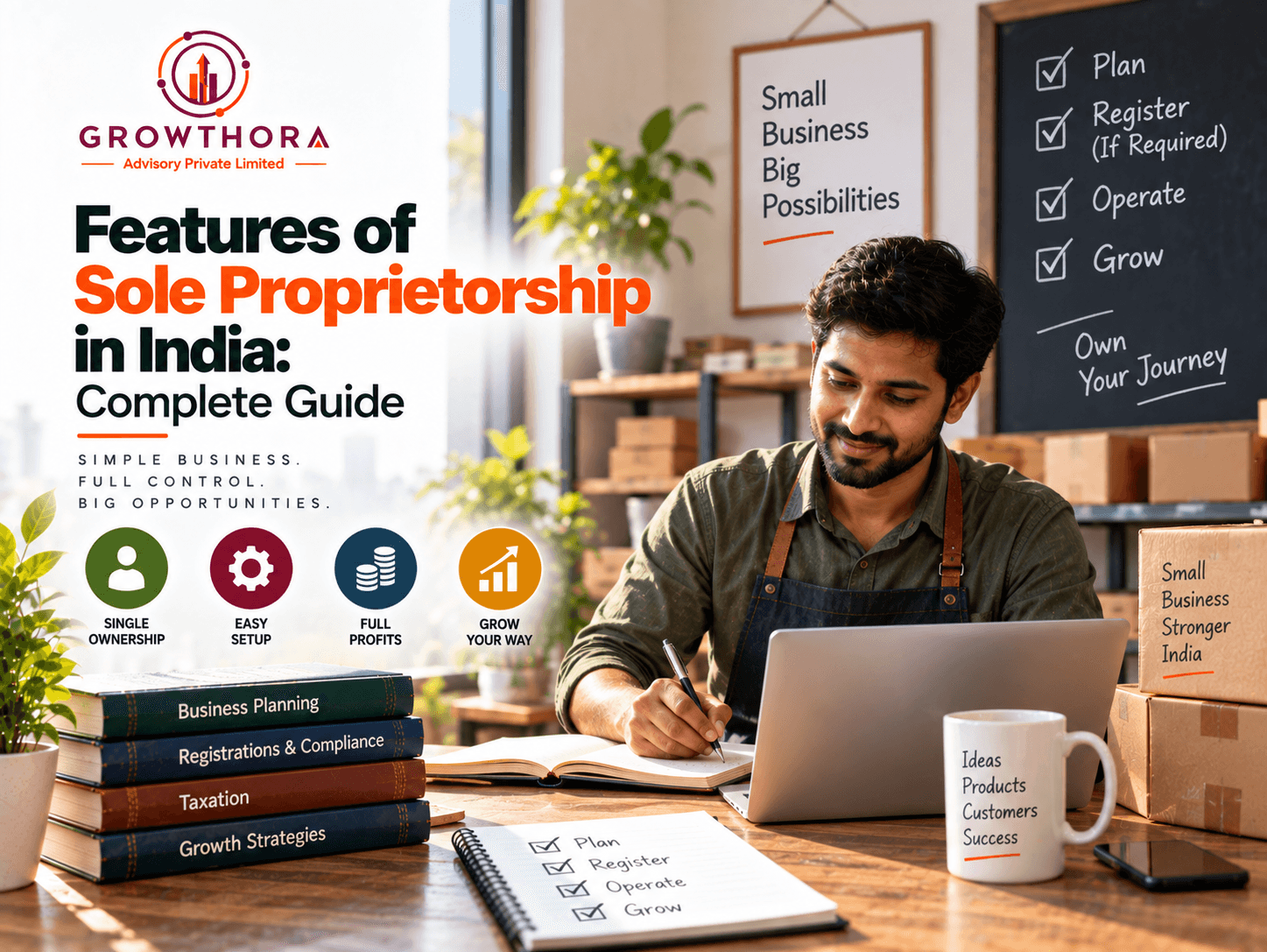
What is a Sole Proprietorship?
What is a sole proprietorship?
A sole proprietorship is the simplest form of business structure in India, owned and run by a single person who bears full responsibility for the business, where the proprietor and the business are legally treated as one and the same entity, unlike a company or LLP which has a separate legal identity from its owners.
This single feature, the absence of legal separation between owner and business, is the thread that runs through nearly every other characteristic of this structure, from how it is taxed to how liability works to how easily it can be set up.
Key Features of Sole Proprietorship
- Single ownership: the business is owned entirely by one individual, who makes all decisions without needing approval from partners, shareholders, or a board.
- No separate legal entity: the proprietorship has no legal identity distinct from the proprietor, meaning contracts, licenses and bank accounts are effectively held in the individual’s own name or trade name.
- Unlimited liability: the proprietor is personally liable for all business debts and obligations, meaning personal assets can be used to settle business liabilities if the business cannot pay.
- Minimal compliance and registration burden: there is no mandatory central registration solely to form a sole proprietorship, though certain registrations like GST or a Shop and Establishment license may still be needed depending on the nature and scale of activity.
- Complete control over profits: all profits belong entirely to the proprietor, with no obligation to share them with any partner or shareholder.
- Easy to start and easy to close: since there is no separate legal formation process required specifically for a sole proprietorship, starting and winding up the business is generally simpler and faster than for a company or LLP.
- Limited continuity: the business does not have perpetual succession in the way a company does, and typically ceases to exist upon the proprietor’s death or incapacity, unless specific arrangements are made for continuation
Registration Requirements
While there is no single dedicated “sole proprietorship registration” certificate issued by a central authority, a proprietorship typically needs one or more of the following registrations depending on its activity and turnover:
| Registration | When It’s Needed |
|---|---|
| GST Registration | Mandatory once turnover crosses the applicable threshold, or voluntarily for input tax credit and B2B credibility |
| Udyam Registration | Recommended for MSME benefits, priority sector lending and government scheme eligibility |
| Shop and Establishment License | Required under most state laws for a physical business premises employing staff |
| Professional Tax Registration | Required in states that levy professional tax on business owners and employees |
| Current Bank Account | Typically opened using GST certificate, Udyam certificate, or other proof of business existence |
Taxation of a Sole Proprietorship
How is a sole proprietorship taxed in India?
A sole proprietorship is not taxed as a separate entity; instead, the business income is added to the proprietor’s other personal income and taxed according to the individual income tax slab rates applicable to the proprietor under the Income Tax Act, using either the old or new tax regime as the proprietor chooses.
This is a structurally important point that trips up many first-time business owners. Unlike a company, which files its own corporate tax return and pays tax at a flat corporate rate, a sole proprietorship’s profit simply flows into the owner’s personal income tax return, meaning tax planning for the business and tax planning for the individual are effectively the same exercise.
Advantages of Sole Proprietorship
- Fastest and least expensive structure to start, since no separate incorporation process is legally required
- Complete decision-making control remains with the owner, allowing quick decisions without needing partner or board consent
- Minimal ongoing statutory compliance compared to a company or LLP, since there is no mandatory annual filing with the Registrar of Companies
- All profits are retained entirely by the owner, with no requirement to distribute to partners or shareholders
- Business losses can be set off against the proprietor’s other personal income in the same financial year, subject to income tax provisions
Disadvantages of Sole Proprietorship
- Unlimited personal liability means the proprietor’s personal assets, including personal savings and property, are at risk if the business cannot meet its debts
- Limited ability to raise capital, since a sole proprietorship cannot issue shares or bring in equity investors the way a company can
- Business continuity is uncertain, since the proprietorship generally does not survive the proprietor’s death or incapacity in its existing form
- Credibility with larger clients, banks and government tenders can be lower compared to a registered company or LLP, particularly for high-value contracts
- Growth is inherently limited by the capacity and resources of a single individual, since there is no structural mechanism to formally bring in co-owners
| Aspect | Sole Proprietorship | Partnership Firm | LLP | Private Limited Company |
|---|---|---|---|---|
| Legal identity | Same as owner | Same as partners collectively | Separate legal entity | Separate legal entity |
| Liability | Unlimited | Unlimited (joint and several) | Limited to capital contribution | Limited to shareholding |
| Number of owners | One | Two or more | Two or more designated partners | At least two shareholders (one for OPC) |
| Compliance burden | Minimal | Moderate | Moderate | Highest |
| Ability to raise equity funding | Not possible | Limited | Limited | Most suited for external investment |
Key Takeaways
- A sole proprietorship has no legal separation between the owner and the business, which shapes nearly every other characteristic of this structure.
- Unlimited personal liability is the single most significant risk, since personal assets can be used to settle business debts.
- Business income is taxed as the proprietor’s personal income under applicable individual income tax slab rates, not as separate corporate income.
- There is no dedicated registration certificate for forming a sole proprietorship itself, though GST, Udyam, and other registrations may still be required based on activity and turnover.
- The structure suits small, low-risk businesses well but becomes limiting once a business needs external equity funding or wants to project stronger credibility for large contracts.
FAQs
What is the biggest disadvantage of a sole proprietorship in India?
The biggest disadvantage is unlimited personal liability, meaning the proprietor’s personal assets, including savings and property, can be used to settle business debts if the business itself cannot pay.
Do I need to register my sole proprietorship in India?
There is no single dedicated registration certificate required to form a sole proprietorship itself, but depending on your activity and turnover, you may need GST registration, Udyam registration, or a shop and establishment license.
How is a sole proprietorship taxed?
A sole proprietorship’s business income is added to the proprietor’s other personal income and taxed according to individual income tax slab rates, since the business is not treated as a separate taxable entity.
Can a sole proprietorship raise funding from investors?
No, a sole proprietorship cannot issue shares or formally bring in equity investors, since it has no separate legal identity from the owner; businesses seeking external equity funding typically need to convert to an LLP or Private Limited Company.
What happens to a sole proprietorship when the owner dies?
A sole proprietorship generally does not have perpetual succession and typically ceases to exist in its current form upon the proprietor’s death or incapacity, unless specific succession arrangements have been made.
Is a sole proprietorship a good structure for a new small business?
Yes, for a small, low-risk business seeking a fast, low-cost way to start operating with minimal compliance, a sole proprietorship is often a practical starting structure, though the owner should weigh the unlimited liability risk against the nature of the business.
Conclusion
Whether you are starting as a sole proprietorship or evaluating whether to convert to an LLP or private limited company as your business grows, Growthora Advisory can help you choose and set up the right structure. Book a free consultation with our team today.
Next step
Apply this to your business.
Confirm whether this applies to your legal structure, industry classification, and credit history - in under 30 minutes with an advisor.