
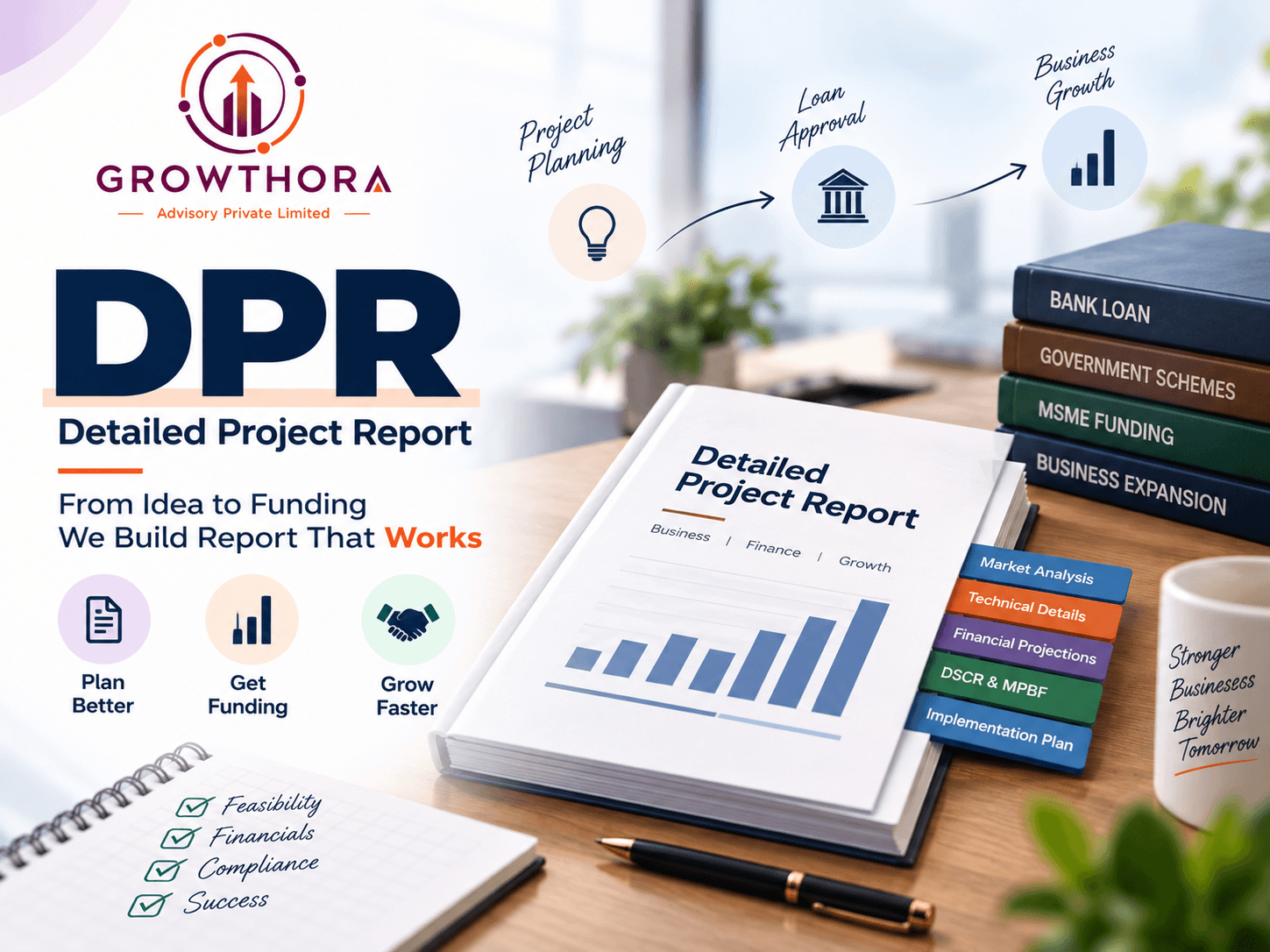
What exactly is a DPR?
A detailed project report, used interchangeably with the term 'project report' for bank loans in the MSME context, is a comprehensive financial and operational document that presents the complete business case to a lender or scheme nodal agency. For smaller loans, a concise project report is often enough. For larger or scheme-linked funding, banks and departments expect the fuller DPR, with deeper market study, technical detail and a complete financial model. This guide covers the MSME and business-loan DPR. Infrastructure DPRs, for highways or power plants, carry heavier engineering and environmental content that sits outside this scope.
The sections every credit-ready DPR needs
- Promoter background and business profile
- Market study and demand assessment
- Technical feasibility, location, machinery and process, with sector-specific depth
- Project cost and means of finance, splitting the loan amount from the promoter's own contribution
- Financial projections, typically 3 to 5 years
- CMA data in IBA-standard format
- DSCR and MPBF calculations
- Implementation schedule and risk notes
DSCR and MPBF: the two numbers that decide your file
DSCR, the Debt Service Coverage Ratio, measures whether projected profit is enough to cover loan repayment. Indian banks generally look for a minimum of 1.25 to 1.5. MPBF, the Maximum Permissible Bank Finance, caps working capital lending using the Tandon Committee method, based on current assets and current liabilities. A DPR without both figures worked out clearly gets sent back for revision or rejected outright, regardless of how strong the underlying business idea is.
How DPR requirements change by sector
| Sector | What gets extra weight in the DPR |
|---|---|
| Manufacturing | Machinery specifications, supplier quotations, plant layout, power and water needs |
| Food processing | FSSAI compliance, raw material sourcing seasonality, cold chain where applicable |
| Services and trading | Working capital cycle, receivables assumptions, a lighter technical section |
| Agriculture and allied | Land holding proof, crop or yield data, NABARD refinance alignment where relevant |
| Infrastructure and large projects | Environmental clearance, engineering feasibility, phased implementation |
DPRs for government schemes need the scheme's own format.
PMEGP, Mudra under its Shishu, Kishor and Tarun categories, CGTMSE and Stand-Up India each carry their own DPR expectations, tied to how that scheme calculates its subsidy and eligibility. Using a generic template for a scheme-linked application is one of the most common reasons a file stalls at the nodal agency stage rather than moving to sanction.
Growthora's DPR process
- Understand the business: promoter background, project cost, funding target and the specific bank or scheme.
- Build the financial model: cost sheet, means of finance, 3- to 5-year projections, DSCR and MPBF, matched to the lender's format.
- Add sector-specific technical and market detail rather than industry-average boilerplate.
- Review internally against bank or scheme checklists before the report goes out.
- Deliver the report in PDF, Word and Excel formats, with support through bank queries and revisions until the file is sanctioned.
Frequently Asked Questions
Is a DPR the same as a business plan?
No. A business plan sells a vision. A DPR is a financial case built to survive bank scrutiny, with cost sheets, DSCR and MPBF a credit officer can independently verify.
What DSCR do banks usually expect?
Most Indian banks look for a minimum DSCR of 1.25 to 1.5, though the exact figure depends on the lender and the scheme.
Do I need a different DPR for each government scheme?
Yes. PMEGP, Mudra, CGTMSE and Stand-Up India each expect the report structured to their own subsidy and eligibility format.
Can an existing business use a DPR, or is it only for new projects?
Existing businesses often have an advantage, since actual turnover, verified profit and loss data, and an existing banking relationship strengthen the DPR.
How long does Growthora take to prepare a DPR?
Turnaround depends on project complexity, but most MSME-scale DPRs are ready within a few working days once financial and project details are shared.
Ready to move forward?
Applying for a term loan, a PMEGP subsidy, or CGTMSE-backed credit and need a DPR the bank will actually accept on the first try? Book a free consultation with Growthora and we will scope the report to your project and your lender's format.
Next step
Apply this to your business.
Confirm whether this applies to your legal structure, industry classification, and credit history - in under 30 minutes with an advisor.