
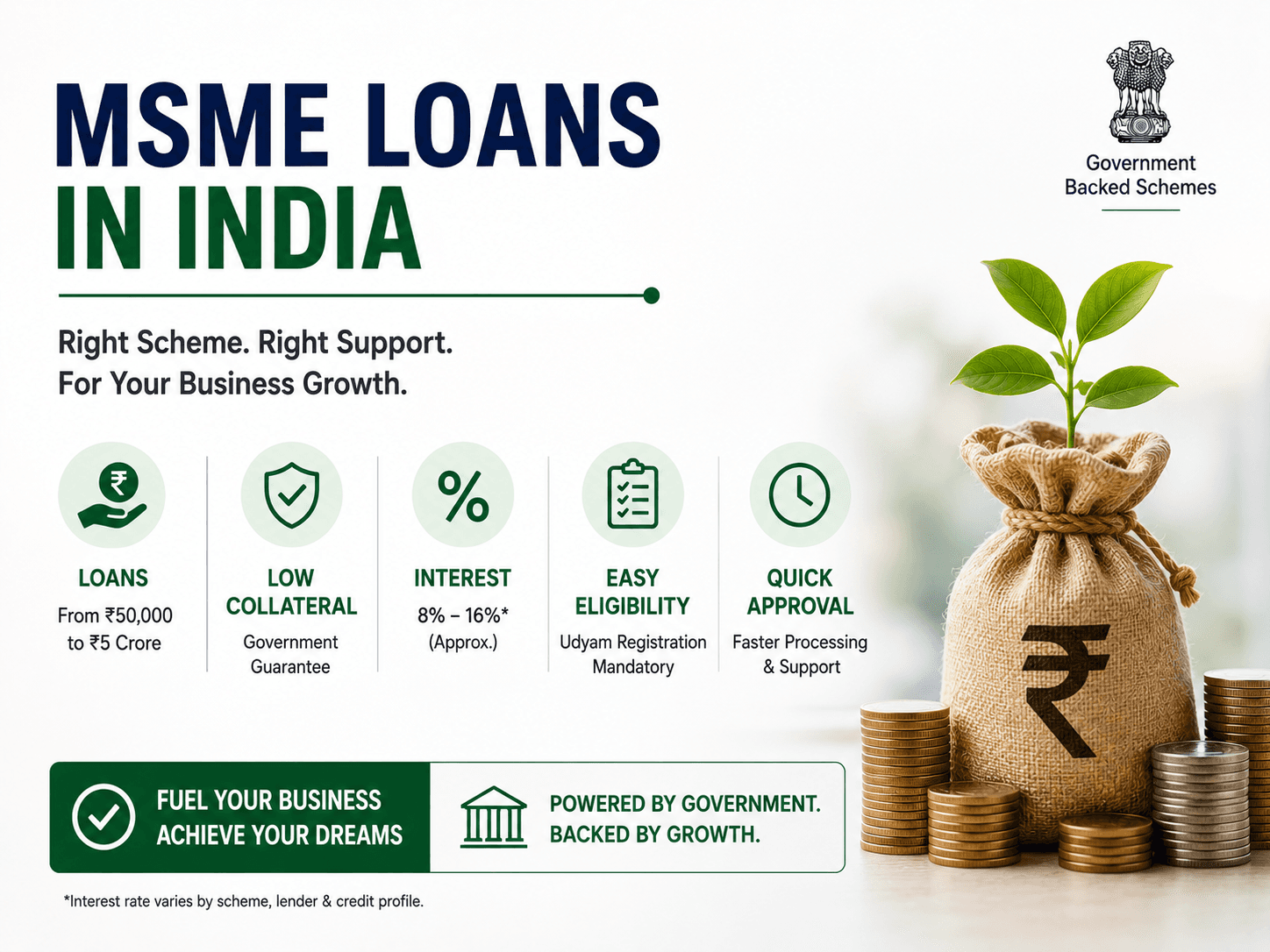
Start Here: The Schemes Side by Side
Before eligibility rules and paperwork, it's worth seeing the actual landscape, since most confusion around MSME loans comes from not knowing which scheme even applies to your situation.
- Mudra Yojana (PMMY): up to ₹20 lakh, collateral-free, split into Shishu (up to ₹50,000), Kishor (₹50,000 to ₹5 lakh), Tarun (₹5 lakh to ₹10 lakh), and the newer Tarun Plus (up to ₹20 lakh for repeat borrowers with a clean repayment record). Best for micro and small units of almost any kind, from kirana stores to small service businesses
- CGTMSE (Credit Guarantee Fund Trust for Micro and Small Enterprises): government guarantee covering 50% to 85% of a bank's exposure, unlocking loans up to ₹5 crore (some recent sources report enhancement toward ₹10 crore for certain categories, worth confirming with your lender) without requiring you to pledge collateral. Best for established MSMEs needing a larger ticket size than Mudra covers
- Stand-Up India: ₹10 lakh to ₹1 crore composite loans, restricted specifically to greenfield, meaning brand-new, enterprises promoted by SC/ST or women entrepreneurs. Not usable for expanding an existing business, only for starting one
- PMEGP (Prime Minister's Employment Generation Programme): margin money subsidy of roughly 15% to 35% depending on category and location, administered through KVIC, aimed at new manufacturing or service ventures, particularly in rural areas
- PM Vishwakarma: concessional loans at around 5% interest, up to ₹3 lakh across two tranches, specifically for traditional artisans and craftspeople
- Regular bank and NBFC MSME loans, with or without a CGTMSE guarantee: for businesses with an established track record that don't fit neatly into any of the above government scheme boxes
Matching Business Stage to Scheme
If you're starting from zero, no track record, no ITR history
Mudra's Shishu and Kishor tiers, PMEGP, and Stand-Up India (if you qualify by category) are built precisely for this situation. None of them expect years of financial statements, though PMEGP and Stand-Up India both require a workable project report showing how the money will actually be used and repaid.
If you have 1 to 2 years of operating history and steady turnover
Mudra's Tarun tier, and increasingly Tarun Plus for those who've already repaid a Tarun loan cleanly, becomes the natural next step. This is also the stage where a CGTMSE-backed regular bank loan starts to make sense if you need more than Mudra's ceiling allows.
If you're established and need a genuinely large ticket size
This is CGTMSE territory, using the guarantee to access up to ₹5 crore without collateral or a straightforward secured MSME loan if you're comfortable pledging assets and want potentially better pricing than a purely guarantee-backed facility.
If you're a woman or SC/ST entrepreneur starting something entirely new
Stand-Up India was built specifically for this situation and offers a composite term loan plus working capital facility between ₹10 lakh and ₹1 crore, though it's worth remembering it applies only to new, greenfield ventures, not to expanding a business you already run.
Eligibility, Across Most Schemes
- A valid Udyam registration certificate, mandatory for Mudra and essentially every other government-backed MSME scheme
- Applicant age 18 or above
- A workable business plan or project report, particularly for new ventures under PMEGP, Stand-Up India, or Mudra's Shishu and Kishor tiers
- For existing businesses seeking larger amounts, 1 to 2 years of ITR filings and roughly 12 months of bank statements showing consistent turnover
- Category-specific conditions apply to Stand-Up India (SC/ST or woman promoter, greenfield only) and PM Vishwakarma (registered traditional artisans and craftspeople)
Documents You'll Typically Need
- Udyam registration certificate
- PAN and Aadhaar of the applicant or promoters
- Bank statements, generally the last 6 to 12 months
- GST returns, where the business is GST-registered
- Income tax returns for existing businesses, typically the last 1 to 3 years
- A detailed project report or business plan for new ventures, machinery quotations where the loan is for equipment purchase
- KYC documents for all partners or directors in a partnership, LLP, or company
How to Actually Apply
- Confirm your Udyam registration is current, since almost every scheme checks for this before anything else.
- Match your situation to a scheme using the stage-based breakdown above, rather than applying to whichever bank branch is nearest.
- Prepare a clear project report or business plan, even for schemes that don't strictly demand one, since it consistently improves approval odds and loan sizing.
- Apply either directly at a participating bank or NBFC branch, or through the unified government lending portal at jansamarth.in, which routes applications for several of these schemes including Mudra, PMEGP, and Stand-Up India.
- For faster processing, the PSB Loans in 59 Minutes platform is geared toward quicker in-principle approval for MSME credit at public sector banks.
- Submit KYC, financial documents, and the project report as required, and where the scheme is CGTMSE-eligible, confirm with the lender that the loan is being tagged under the guarantee.
- Once sanctioned, funds are disbursed either as a lump sum, for term loans, or as a working capital limit you draw against as needed.
What Interest Rates Actually Look Like
- Mudra Tarun: roughly 8.60% to 12% per annum, varying by lender and borrower profile
- CGTMSE-backed bank loans: priced the same as regular bank lending, generally linked to an external benchmark like the repo rate plus a spread, since the guarantee reduces collateral risk rather than directly lowering the interest rate
- Stand-Up India: competitive, typically capped at base rate plus 3%
- PM Vishwakarma: a concessional flat rate of around 5%, well below typical market MSME lending rates
- General bank and NBFC MSME loans: commonly in the 8% to 16% range depending on the lender, collateral position, and the borrower's credit profile
A CIBIL score of 700 to 750 generally gets the most favourable pricing and fastest approval at mainstream banks. Scores between 650 and 699 are often still approvable but at somewhat higher rates, while scores below 600 typically push a borrower toward Mudra, PMEGP, or microfinance-style lenders rather than mainstream bank credit.
Common Ways Applications Get Stuck
- Applying without a current Udyam registration, which disqualifies the application before it's even reviewed at most banks
- Submitting a vague or missing project report for a new venture, which is often the actual reason for rejection even when it's presented as a “credit score issue”
- Assuming Stand-Up India applies to expanding an existing SC/ST or woman-owned business, when it's restricted strictly to new, greenfield enterprises
- Not asking the lender explicitly whether a loan is being processed under a CGTMSE guarantee, then being surprised when collateral is requested anyway
- Treating “collateral-free” as “consequence-free,” and not appreciating that default under a CGTMSE-backed Mudra or MSME loan still damages personal and business credit and can trigger legal recovery
Frequently Asked Questions
What is an MSME loan?
It's not one product but a category covering multiple government-backed and regular bank or NBFC lending schemes designed for Micro, Small, and Medium Enterprises, ranging from small collateral-free Mudra loans to larger CGTMSE-guaranteed credit facilities.
Who is eligible for an MSME loan?
Generally, any Udyam-registered business or individual aged 18 or above with a viable business plan. Specific schemes carry additional conditions, such as Stand-Up India's restriction to new SC/ST or women-led ventures.
What documents are required for an MSME loan?
Udyam registration, PAN and Aadhaar, bank statements, GST returns where applicable, ITRs for established businesses, and a project report for new ventures.
What is the maximum loan amount under Mudra Yojana?
Up to ₹10 lakh across the Shishu, Kishor, and Tarun tiers, with a newer Tarun Plus category extending to ₹20 lakh for borrowers with a clean repayment record on an earlier Tarun loan.
Is Udyam registration mandatory for MSME loans?
Yes, for Mudra and virtually every other government-backed MSME loan scheme, a valid Udyam certificate is a baseline requirement.
What CIBIL score do I need for an MSME loan?
Mainstream banks generally look for 700 to 750 for the best terms. Scores in the 650 to 699 range are often still workable, while lower scores typically point toward Mudra, PMEGP, or microfinance-style lenders instead.
Can a completely new business get an MSME loan?
Yes. Mudra's Shishu and Kishor tiers, PMEGP, and Stand-Up India are all specifically designed for new entrepreneurs without an extensive credit or operating history, provided a workable project report is submitted.
What's the difference between Mudra and CGTMSE?
Mudra is a specific loan scheme with defined tiers up to ₹20 lakh. CGTMSE isn't a loan itself, it's a government guarantee mechanism that lets banks extend larger, collateral-free loans up to several crore rupees by shifting the default risk onto the guarantee trust.
Who can apply under Stand-Up India?
SC/ST or women entrepreneurs setting up a new, greenfield enterprise, meaning a first-time venture rather than an expansion of an existing business. Loan amounts range from ₹10 lakh to ₹1 crore.
How do I apply for a government MSME loan scheme?
Either directly through a participating bank or NBFC branch, or through the unified Jan Samarth portal at jansamarth.in, which routes applications for several schemes including Mudra, PMEGP, and Stand-Up India.
Are collateral-free MSME loans really risk-free if I can't repay?
No. Collateral-free means the bank doesn't ask you to pledge an asset upfront, guaranteed instead by CGTMSE or the specific scheme's structure. Defaulting still damages your credit score and can lead to legal recovery action.
What interest rate should I expect on an MSME loan?
Typically 8% to 16% depending on the scheme, lender, and your credit profile, with PM Vishwakarma's concessional 5% rate as a notable exception for its specific artisan-focused eligibility.
Choosing Without Overthinking It
The scheme names can make this look more complicated than the underlying decision actually is. If you're brand new with no track record, look at Mudra's Shishu or Kishor tiers, PMEGP, or Stand-Up India if you qualify by category. If you've been operating for a year or two with clean books, Mudra Tarun or a CGTMSE-backed bank loan is the natural next step. If you're established and need real scale, CGTMSE is what makes a large, unsecured facility possible in the first place.
The paperwork that actually moves an application forward, in every one of these schemes, is the same: a current Udyam registration and a project report or financial history that makes it obvious the loan will be used and repaid as described. Get that right before you walk into a bank, and the scheme-specific rules become much easier to navigate.
Next step
Apply this to your business.
Confirm whether this applies to your legal structure, industry classification, and credit history - in under 30 minutes with an advisor.