
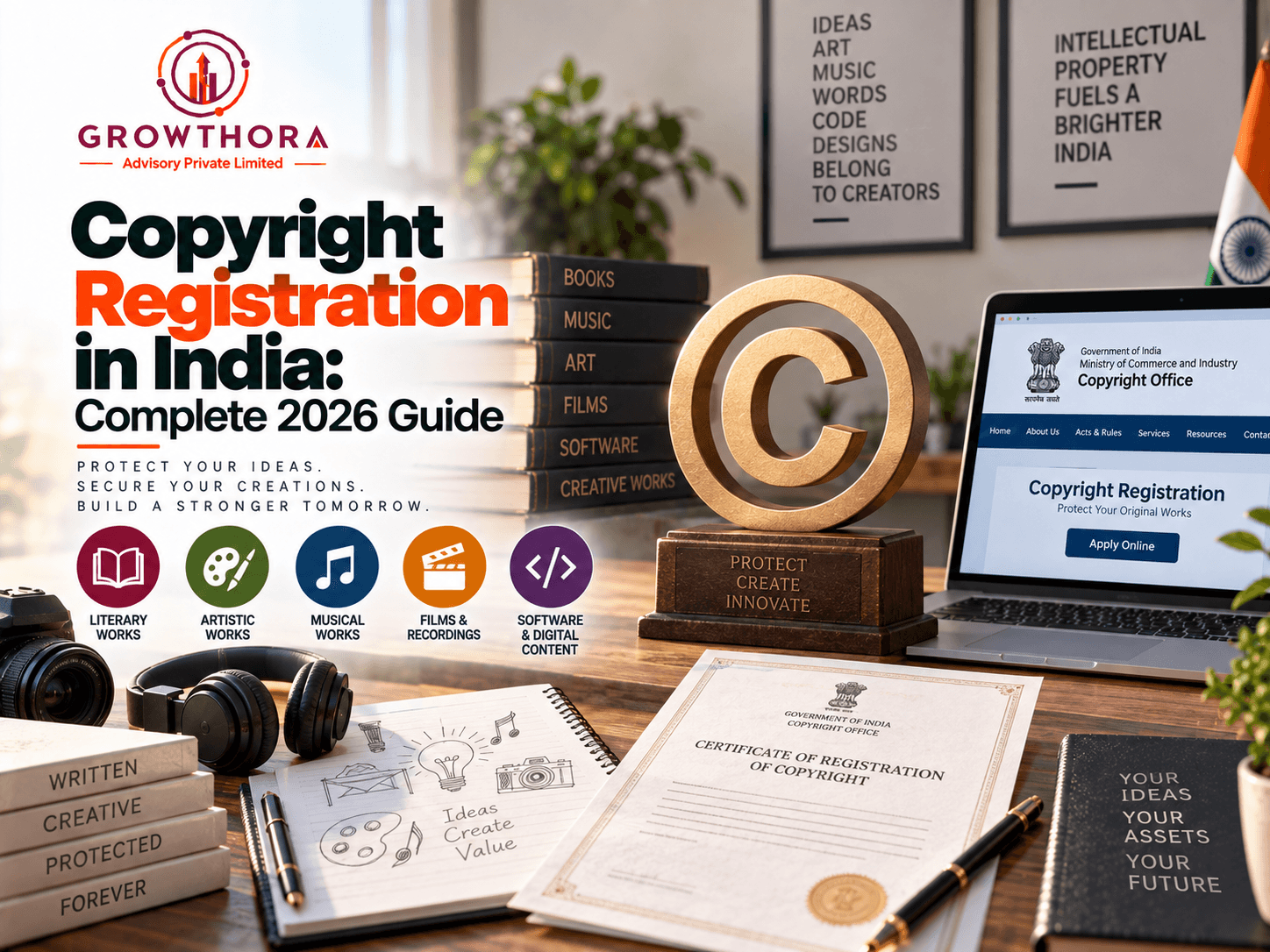
Is Copyright Registration Mandatory in India?
Is copyright registration mandatory in India?
No, copyright protection under the Copyright Act, 1957 arises automatically the moment an original work is created and fixed in a tangible form, without any requirement to register it, but registration creates an official, dated public record of ownership that serves as strong prima facie evidence in court if the work is ever copied or disputed.
This is a point of genuine confusion for many creators and businesses. Unlike a trademark, where registration is what actually creates enforceable exclusive rights over a mark, copyright exists the moment the work is created. Registration does not create the right; it documents and strengthens your ability to prove and enforce it.
What Works Can Be Registered
- Literary works, including books, articles, computer software and source code, and website content
- Artistic works, including paintings, drawings, logos, photographs and illustrations
- Musical works, covering the musical notation and composition, separate from any lyrics or sound recording
- Dramatic works, including scripts, choreography and screenplays
- Sound recordings, covering the recorded performance itself, separate from the underlying musical or literary work
- Cinematograph films, covering the visual recording, separate from copyright in the underlying script, music or dialogue
| Category of Work | Approximate Government Fee |
|---|---|
| Literary, dramatic, musical or artistic work (unpublished) | A modest fee per application, as notified on the Copyright Office portal |
| Literary, dramatic, musical or artistic work (published) | Fee scales with the number of works or editions covered in a single application |
| Computer software/source code | Generally filed as a literary work, with an additional fee where source code is submitted |
| Sound recording | Separate fee category, distinct from the underlying musical or literary work |
| Cinematograph film | Separate, typically higher fee category given the complexity of the work |
Exact government fees are periodically revised and published on the Copyright Office’s official portal, copyright.gov.in, so applicants should always confirm the current fee schedule at the time of filing rather than relying on a previously quoted figure.
Documents Required
- Application in the prescribed format (Form XIV) along with a Statement of Particulars and, for certain categories, a Statement of Further Particulars
- Copy or sample of the work being registered, such as a manuscript, software code printout, artwork image, or recording
- Identity proof and address proof of the applicant
- No Objection Certificate from any co-author, publisher, or other party with a potential interest in the work, where applicable
- Power of Attorney, if the application is being filed through an advocate or authorised agent
- Details of the author, and if different, the person claiming to be the owner of the copyright, along with the nature of that ownership claim
Step-by-Step Registration Process
- Create a user account on the Copyright Office’s official online portal, copyright.gov.in
- Select the appropriate application type based on the category of your work, whether literary, artistic, musical, dramatic, sound recording or cinematograph film
- Fill in Form XIV with details of the work, the author, and the applicant, along with the Statement of Particulars
- Upload the required supporting documents, including a copy of the work and any necessary No Objection Certificates
- Pay the applicable government fee online through the portal’s integrated payment system
- The application is examined by the Copyright Office, and a mandatory waiting period of at least 30 days is observed to allow any objections to be filed against the application
- If no objection is received, or once any objection raised is resolved, the application is scrutinised by the examiner, and if found in order, the work is registered and an entry is made in the Register of Copyrights
- The Certificate of Registration is issued once the entire process, including the Registrar’s examination and any objection handling, is complete
Duration of Copyright Protection
How long does copyright protection last in India?
For most literary, dramatic, musical and artistic works, copyright protection lasts for the lifetime of the author plus 60 years from the beginning of the calendar year following the author’s death, while for works like cinematograph films, sound recordings, and works published anonymously or under a pseudonym, protection generally lasts 60 years from the beginning of the calendar year following the year of publication.
| Type of Work | Duration of Protection |
|---|---|
| Literary, dramatic, musical, artistic work (known author) | Lifetime of author plus 60 years |
| Anonymous or pseudonymous works | 60 years from publication |
| Cinematograph films | 60 years from publication |
| Sound recordings | 60 years from publication |
| Government works | 60 years from publication |
Copyright vs Trademark: Key Differences
What is the difference between copyright and trademark registration? Copyright protects original creative expression, such as a written work, artwork, song or film, and arises automatically upon creation, while a trademark protects a brand identifier, such as a name, logo or slogan used to distinguish goods or services in the market, and only becomes enforceable through the registration process itself.
A business’s logo, for instance, can potentially be protected under both regimes simultaneously: as an artistic work under copyright, and separately as a brand identifier under trademark law, each serving a different legal purpose.
Key Takeaways
- Copyright protection in India arises automatically upon creation of an original work, but registration creates strong, dated evidence of ownership that helps significantly in infringement disputes.
- Registration is done entirely online through the Copyright Office’s portal, copyright.gov.in, using Form XIV along with a Statement of Particulars.
- A mandatory minimum 30-day waiting period is built into the process to allow objections to be filed before registration is finalised.
- Copyright protection typically lasts for the author’s lifetime plus 60 years for most literary, artistic, musical and dramatic works.
- Copyright and trademark protect different things and can sometimes both apply to the same asset, such as a logo, serving distinct legal purposes.
FAQs
Is it necessary to register copyright in India to get legal protection?
No, copyright protection arises automatically upon creation of an original work under the Copyright Act, 1957, but registration provides strong, dated evidence of ownership that is valuable in any future infringement dispute.
How long does the copyright registration process take in India?
The process includes a mandatory minimum 30-day waiting period to allow objections, followed by examination, so the overall registration timeline typically extends to a few months from filing to certificate issuance, depending on whether any objection is raised.
What is Form XIV used for in copyright registration?
Form XIV is the prescribed application form used to file a copyright registration application with the Copyright Office, accompanied by a Statement of Particulars describing the work being registered.
Can software or source code be registered for copyright in India?
Yes, computer software and source code are generally registered as literary works under the Copyright Act, with an additional fee typically applicable where source code is submitted as part of the application.
How long does copyright protection last for a book or artwork in India?
For most literary, dramatic, musical and artistic works with a known author, copyright protection lasts for the lifetime of the author plus 60 years from the beginning of the calendar year following the author’s death.
Can a logo be protected by both copyright and trademark in India?
Yes, a logo can potentially be protected as an artistic work under copyright law and separately registered as a trademark to protect it as a brand identifier, since the two forms of protection serve different legal purposes.
Talk to Growthora
Registering your creative work, software or brand assets correctly, and understanding whether copyright, trademark, or both apply to your situation, protects your business in the long run. Book a free consultation with Growthora Advisory’s intellectual property team.
Next step
Apply this to your business.
Confirm whether this applies to your legal structure, industry classification, and credit history - in under 30 minutes with an advisor.