
Key Takeaways
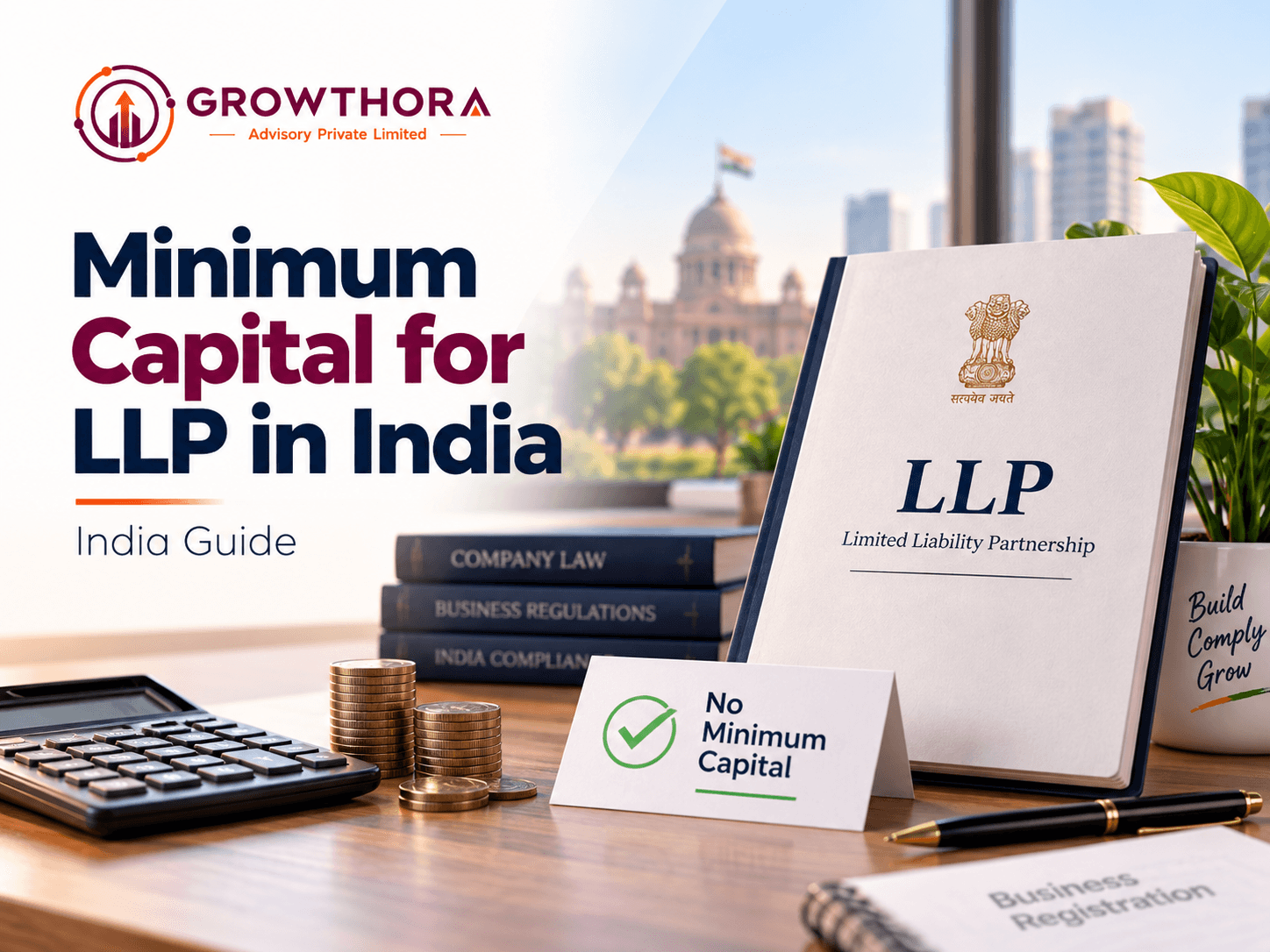
- The LLP Act, 2008 does not prescribe any minimum or maximum capital contribution for incorporation.
- Capital contribution in an LLP can be in the form of cash, tangible assets, intellectual property, or services, as agreed among partners.
- This is different from a Private Limited Company, though post the Companies Amendment Act, 2015, private companies also no longer have a mandatory minimum paid-up capital.
- MCA registration fees for LLP incorporation increase in slabs based on the declared capital contribution, so a very high declared amount raises upfront cost without added benefit.
- A statutory audit becomes mandatory only if annual turnover exceeds Rs 40 lakh or the capital contribution exceeds Rs 25 lakh.
- While technically possible, a very low declared capital may affect how banks and investors perceive the LLP's credibility.
What Is Capital Contribution in an LLP?
An LLP does not have authorised or paid-up share capital like a company. Instead, it has a capital contribution, which is the amount or value that each partner agrees to bring into the business, as recorded in the LLP Agreement.
Each partner's liability is limited to the extent of their agreed contribution, which is one of the core protections an LLP structure offers compared to a traditional partnership firm.
How LLP Capital Differs From Other Structures
- LLP vs Private Limited Company: Neither structure has a mandatory minimum capital today, but a company issues shares against paid-up capital, while an LLP records a capital contribution without issuing shares.
- LLP vs traditional partnership firm: A partnership firm's capital is purely a private arrangement between partners with no separate legal registration of contribution; an LLP's contribution is formally documented in the LLP Agreement filed with the Registrar.
- LLP vs One Person Company (OPC): An OPC also has no mandatory minimum paid-up capital under current rules, but it is limited to a single member, unlike an LLP which needs at least two partners.
- Capital contribution vs partner's loan: A partner can also lend money to the LLP as a loan, which is treated differently from capital contribution and does not affect the partner's ownership share.
Types of Capital Contribution Allowed
- Cash brought in by the partners
- Tangible assets such as equipment, machinery or property
- Intangible assets such as intellectual property, where agreed and valued by the partners
- Services rendered by a partner, where recognised and valued as per the LLP Agreement
How Capital Contribution Works in Practice
- Partners decide the total capital contribution and each partner's share, and record this in the LLP Agreement at the time of incorporation.
- MCA registration fees for LLP incorporation are charged in slabs linked to the declared contribution amount, so a higher declared figure means a higher government fee.
- The contribution amount, once decided, can be increased or changed later by mutual agreement and by amending the LLP Agreement.
- The value of contribution should be certified appropriately when it is in a non-cash form, such as property or services, to avoid disputes later.
Who This Applies To
- Founders and professionals planning to register a new LLP in India, including startups, consultants and small businesses.
- Existing partnership firms considering conversion to an LLP structure for limited liability protection.
- Anyone confused by MCA forms asking for a declared contribution amount during incorporation.
Documents and Information Needed for Incorporation
- PAN and address proof of all designated partners
- Digital Signature Certificate (DSC) for at least one designated partner
- Designated Partner Identification Number (DPIN) for each designated partner
- Proposed LLP name for approval through the MCA portal
- Registered office address proof and a No Objection Certificate from the property owner, if rented
- LLP Agreement specifying each partner's agreed capital contribution and profit-sharing ratio
Step-by-Step: Deciding and Filing Your LLP Capital Contribution
- Discuss with all partners and agree on a total and individual capital contribution amount, considering initial operating expenses.
- Decide the form of contribution for each partner, whether cash, assets, or a combination.
- Draft the LLP Agreement clearly stating each partner's contribution and how it may be revised in future.
- File the incorporation forms (FiLLiP) with the Ministry of Corporate Affairs, declaring the total capital contribution.
- Pay the MCA registration fee applicable to your declared contribution slab.
- File the LLP Agreement with the Registrar within the prescribed timeline after incorporation.
Common Mistakes
- Declaring an unrealistically low capital contribution just to save a small amount on registration fees, which can affect the LLP's credibility with banks later.
- Not documenting non-cash contributions (like assets or services) properly in the LLP Agreement, leading to valuation disputes among partners.
- Assuming capital contribution cannot be changed later, which discourages partners from planning realistically at the start.
- Confusing capital contribution with a partner's loan to the LLP, which has different accounting and repayment implications.
Practical Tips
- Choose a contribution amount that covers your realistic initial expenses rather than an arbitrary minimum, even though the law does not require a specific figure.
- Keep the declared contribution reasonable to manage MCA registration fees, since fees rise in slabs as the declared amount increases.
- Track your turnover and capital contribution against the Rs 40 lakh and Rs 25 lakh audit thresholds so you are prepared if a statutory audit becomes mandatory.
- Get non-cash contributions valued and documented clearly to avoid disagreements between partners later.
Who Should Consider an LLP Structure
An LLP suits professionals, consultants, and small to mid-sized businesses that want limited liability protection along with the flexibility of a partnership, without the compliance burden or the historical minimum capital expectations associated with a private limited company.
FAQs
Is there a minimum capital requirement to start an LLP in India?
No. The LLP Act, 2008 does not prescribe any minimum capital contribution. Partners can start an LLP with any agreed amount.
Can I register an LLP with just Rs 1,000?
Yes, this is legally possible, since there is no statutory minimum. However, most LLPs declare a higher amount for credibility with banks and investors.
Does the government charge higher fees for higher declared capital?
Yes. MCA registration fees for LLP incorporation are charged in slabs that increase with the declared capital contribution amount.
Is an LLP audit compulsory regardless of capital contribution?
No. A statutory audit is mandatory only if annual turnover exceeds Rs 40 lakh or capital contribution exceeds Rs 25 lakh.
Can capital contribution in an LLP be non-cash?
Yes. Contribution can include tangible assets, intellectual property, or services, as agreed and valued by the partners in the LLP Agreement.
Can partners change the capital contribution after incorporation?
Yes. Partners can revise the contribution amount by mutual agreement and by amending the LLP Agreement accordingly.
Is LLP capital contribution the same as a company's paid-up capital?
No. An LLP does not issue shares against its capital contribution, unlike a company, which allots shares corresponding to its paid-up capital.
Next step
Apply this to your business.
Confirm whether this applies to your legal structure, industry classification, and credit history - in under 30 minutes with an advisor.