
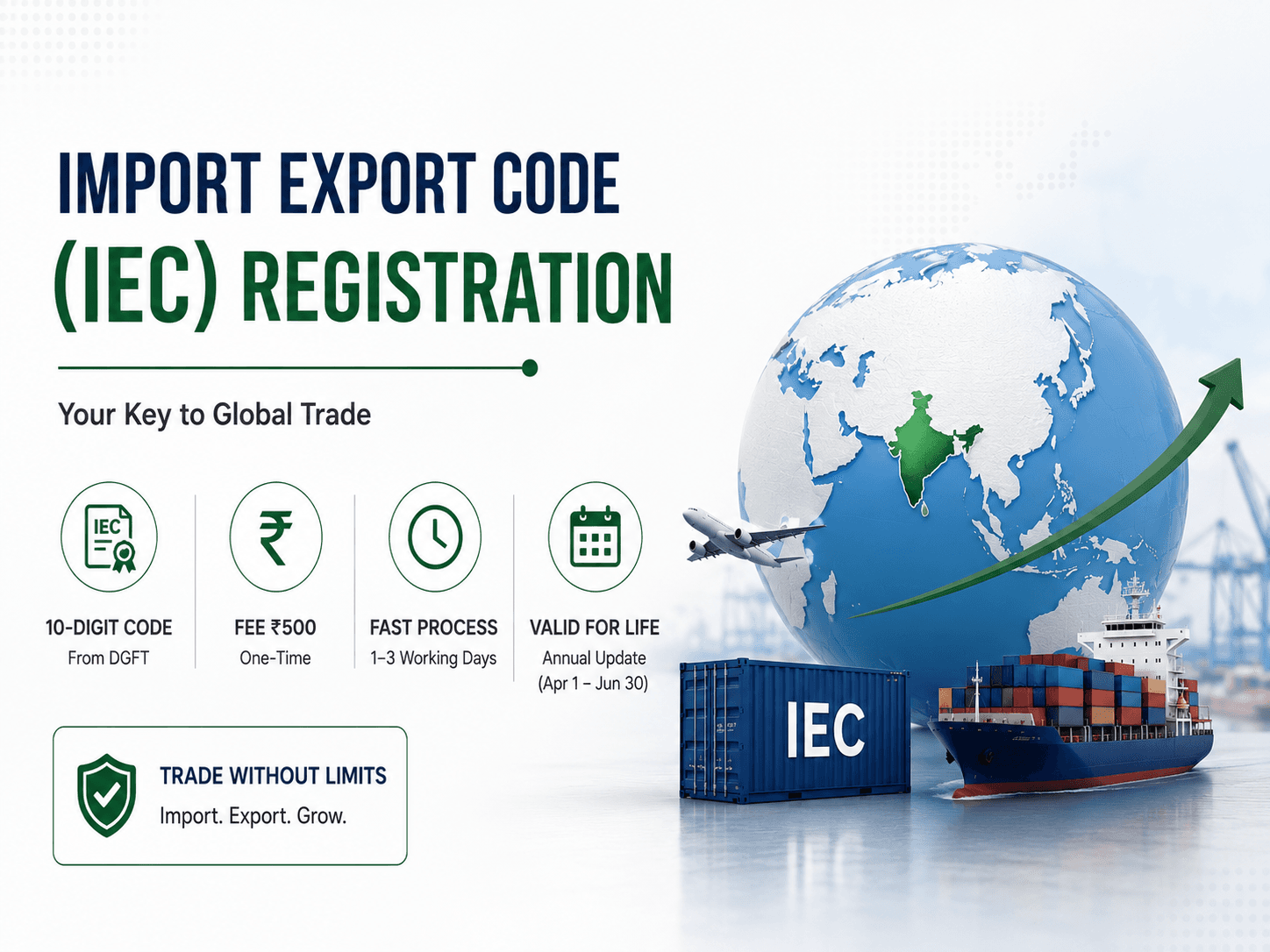
Quick Facts, Before the Detail
- What it is: A 10-digit code from DGFT, identical to your business PAN since GST rollout
- Who issues it: Directorate General of Foreign Trade, Ministry of Commerce and Industry
- Government fee: ₹500, one-time, non-refundable
- Time to issue: 1 to 3 working days
- Validity: Lifetime, no renewal, but mandatory annual online update between April and June
- Where to apply: dgft.gov.in, Form ANF-2A, entirely online
Why This Exists and Who Actually Needs One
Under the Foreign Trade (Development and Regulation) Act, 1992, any person or entity importing or exporting goods or services from India needs an IEC. Without it, customs won't clear your shipments and banks won't process the foreign remittances tied to your trade, whether that's an import payment going out or an export payment coming in. It's the single credential that connects your business to India's customs and foreign exchange systems.
A sole proprietor can apply using nothing more than their personal PAN and Aadhaar; no separate legal entity is required. Partnerships, LLPs, and companies apply using the entity's own PAN. The IEC stays valid even if the business structure changes later, say a proprietorship converts into an LLP, provided DGFT is notified of the change. A handful of categories are exempt, including government departments and individuals importing or exporting for strictly personal, non-commercial use, but for any business genuinely trading across borders, this isn't optional.
What You Need Before You Start
- PAN of the business or proprietor
- Aadhaar of the proprietor, partner, director, or authorized signatory for OTP-based verification
- A current bank account in the business's name, with a cancelled cheque or bank certificate showing account number and IFSC code
- Address proof for the business premises
- A passport-size photograph of the applicant
- A valid email address and mobile number to receive OTPs and portal communication
The Application, Start to Finish
- Go to dgft.gov.in and register for a user profile using a valid email address and mobile number. The system verifies both through OTP and links the profile to your PAN.
- Log in and select “Apply for IEC” from the Services menu, which opens Form ANF-2A.
- Fill in applicant details; business address; the nature of your concern, whether proprietorship, partnership, LLP, or company; and your banker's details.
- Upload the supporting documents, PAN, identity and address proof, and the bank certificate or cancelled cheque, in PDF or JPEG format within the portal's file size limits.
- Pay the ₹500 government fee online through net banking, UPI, or a debit or credit card.
- Complete Aadhaar-based OTP verification, or sign using a digital signature certificate if you're applying on behalf of a company or LLP.
- Once processed, download the e-IEC certificate directly from your DGFT dashboard, typically within 1 to 3 working days of submission.
What It Actually Costs
- Government fee: ₹500, one-time and non-refundable
- Fee for modifying details after issuance: ₹200
- Professional assistance, if used: typically ₹1,000 to ₹2,500 for the full filing and document preparation
There's genuinely very little room for this to get expensive. If your PAN, Aadhaar, and bank documents are in order, this is one registration in this entire series that most businesses can comfortably self-file without professional help.
The Rule That Trips People Up: Annual Update
Lifetime validity sounds like it means you file once and never think about it again. That's not quite true. Since a 2021 DGFT requirement, every IEC holder must log into the portal and confirm their details between April 1 and June 30 each year, even if absolutely nothing has changed since the last update. Skip this window, and the IEC is automatically deactivated, which means shipments get stuck and foreign payments stop processing until you reactivate it. This single, easy-to-forget step is the most common reason an otherwise valid IEC suddenly stops working for a business that assumed “lifetime validity” meant “set and forget.”
What an IEC Actually Unlocks
- Legal clearance to trade internationally: customs will not clear an import or export shipment without a valid IEC tied to the business
- Smooth foreign currency payments: banks require an IEC on file to process incoming or outgoing payments related to international trade
- Access to export incentive schemes: many DGFT and government export promotion schemes require a valid IEC as a baseline eligibility condition
- A stable business identifier for trade: since the IEC is the same number as your PAN, it creates one consistent identity across your tax and trade records
Where People Go Wrong
- Assuming lifetime validity means no further action is ever needed, then missing the April to June annual update window
- Applying with a bank account not yet in the business's own name, causing a document mismatch at verification
- Not updating DGFT after a business structure change, such as converting from a proprietorship to an LLP or company
- Assuming an individual importing personal goods needs an IEC, when the exemption for strictly personal, non-commercial use applies
- Letting Aadhaar-linked mobile numbers go stale, which blocks the OTP verification step entirely
Frequently Asked Questions
What is an IEC?
A 10-digit Import Export Code issued by the DGFT is mandatory for any business or individual importing or exporting goods or services from India. Since GST rollout, it's the same number as the entity's PAN.
Who needs an IEC?
Any person or entity engaged in importing or exporting goods or services, whether a sole proprietor, partnership, LLP, or company. A narrow set of exemptions covers government departments and personal, non-commercial imports or exports.
What documents are required for IEC registration?
PAN, Aadhaar of the applicant, business bank account details with a cancelled cheque or bank certificate, address proof, and a photograph.
How much does IEC registration cost?
The government fee is ₹500, a one-time, non-refundable charge. Professional help, if used, typically adds ₹1,000 to ₹2,500.
How long does it take to get an IEC?
Typically 1 to 3 working days from submitting Form ANF-2A and paying the fee, assuming documents are in order.
Does an IEC expire or need renewal?
It has lifetime validity and never needs to be renewed. It does need a mandatory online update every year between April 1 and June 30, or it gets deactivated.
Can a sole proprietor apply for an IEC?
Yes. A sole proprietor can apply using their personal PAN and Aadhaar, with no separate legal entity required.
What happens if I don't complete the annual update?
The IEC is automatically deactivated, which halts customs clearance for shipments and blocks trade-related foreign currency payments until the update is completed and the IEC is reactivated.
Can I apply for an IEC online without visiting any office?
Yes. The entire process, from account creation to certificate download, happens on the DGFT portal at dgft.gov.in, with no physical office visit needed.
Does the IEC change if my business converts from a proprietorship to an LLP or company?
The IEC itself can continue to be used, but DGFT must be notified of the structural change so the portal's records stay accurate.
Is GST registration required to get an IEC?
No, IEC and GST are separate registrations. However, since IEC now mirrors PAN and many customs and banking processes cross-check GST details, most actively trading businesses hold both.
Can an individual get an IEC for personal imports?
Generally no need arises, since imports or exports for strictly personal, non-commercial use are exempt from the IEC requirement under the Foreign Trade Policy.
The Practical Takeaway
Of every registration covered across this series, IEC is the one with the least reason to delay or overthink. It's inexpensive, fast, and, for a straightforward proprietorship or company with clean PAN and bank details, entirely self-serviceable in an afternoon. The only discipline it demands is remembering it exists at all each April, since the annual update is a genuinely easy thing to let slip once the initial registration feels done and dusted.
If international trade is even a plausible part of your business's near-term plans, there's very little reason not to get the IEC in place now rather than scrambling for it when a shipment or an incoming payment is already waiting on it.
Next step
Apply this to your business.
Confirm whether this applies to your legal structure, industry classification, and credit history - in under 30 minutes with an advisor.