
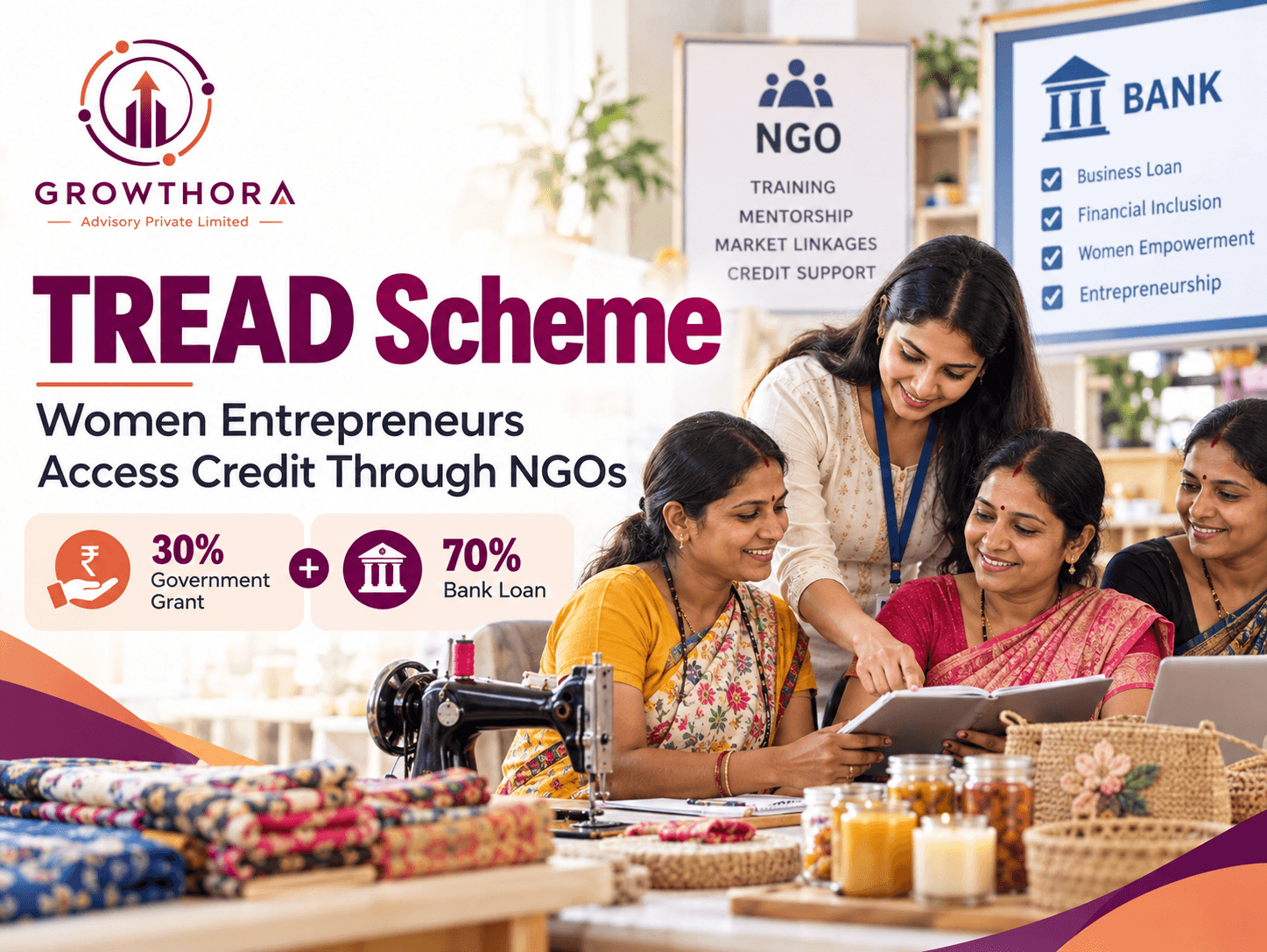
What is the TREAD Scheme?
TREAD is a Government of India scheme administered under the Ministry of MSME, aimed at the economic empowerment of women, particularly those without access to formal credit, by routing government grant support and bank loans through eligible NGOs that identify, train, and support women in setting up income-generating, non-farm sector activities.
The scheme exists specifically because a large number of women, especially in Self Help Groups and economically disadvantaged communities, have never had direct access to formal banking credit and lack the documentation, credit history or confidence to approach a bank on their own. TREAD closes that gap by making a trusted NGO the intermediary for both the credit and the capacity-building support.
How the Credit and Grant Structure Works
How does the government grant work under TREAD?
The Government of India provides a grant of up to 30 percent of the total project cost, subject to a maximum ceiling of Rs 30 lakh, to NGOs that have been appraised by lending institutions or banks, and this grant supports capacity-building activities such as training, counselling, participation in exhibitions, and establishment of new Self Help Groups, while the remaining 70 percent of the project cost is financed as a loan through the lending institution.
This structure means the woman entrepreneur herself is not directly handling a large formal loan application process; instead, the NGO, which already has an established banking relationship and appraisal history, acts as the conduit for both the government grant and the bank credit.
Training and Counselling Support
- Training programmes are conducted by recognised institutions, including Entrepreneurship Development Institutes, the National Institute of Small Industry Extension Training, the National Institute of Entrepreneurship and Small Business Development, MSME Development Institutes and eligible NGOs
- Women beneficiaries identified under the scheme receive a grant of up to Rs 1 lakh per training programme, typically running for about one month with a batch size of around 20 women
- Training institutions must contribute a minimum of 25 percent of the government grant themselves as their own share, or 10 percent in the case of institutions in the North Eastern Region
- Government grant support for broader empowerment activities, such as research studies, field surveys and evaluation studies related to women’s entrepreneurship, is available up to a maximum of Rs 5 lakh per project
Eligibility for Women Applicants
- Women, particularly those from economically disadvantaged backgrounds who lack access to formal credit, are the intended beneficiaries
- Applicants are typically identified and supported through Self Help Groups or through the eligible NGO facilitating the scheme in their area
- The focus is on non-farm sector income-generating activities, meaning purely agricultural production activities generally fall outside the scheme’s core scope
Eligibility for NGOs
- NGOs must be a legally registered entity that has existed for at least three years
- NGOs need demonstrated experience with thrift and savings programmes, showing familiarity with handling small-scale financial activity among the target community
- NGOs must have qualified staff and a track record of engagement in income-generating activities specifically for women
- The NGO’s proposal is appraised and recommended by the lending institution or bank that will extend the 70 percent loan component
Typical Activities Supported
Non-farm activities commonly supported under TREAD include tailoring, handicrafts, embroidery, toy making, readymade garments, candle making, agarbatti making, paper cup and plate making, masala powder making, saree weaving, coir mat making, pickle making, basketry, broom making and jute bag making, reflecting the scheme’s focus on accessible, skill-based income generation activities rather than capital-intensive manufacturing.
How to Apply
- Identify an eligible NGO or institution running TREAD programmes in your area, since individual women generally access the scheme through these intermediaries rather than applying directly
- Participate in the training and counselling programme conducted by the recognised institution, which is often the first formal step in the process
- Work with the NGO to develop a project proposal for your proposed income-generating activity, which the NGO will use to approach the lending institution
- The NGO’s proposal, covering both the grant and loan components, is appraised by the lending bank, which finances the 70 percent loan portion
- Once appraised and sanctioned, the government grant of up to 30 percent is released to the NGO, alongside the bank’s loan disbursement, to support the woman’s project
- Continue engaging with the NGO for ongoing counselling, market access support and capacity building as the enterprise develops
Key Takeaways
- TREAD provides a government grant of up to 30 percent of project cost, capped at Rs 30 lakh, to NGOs, with the remaining 70 percent financed as a bank loan.
- Women beneficiaries participating in TREAD training programmes can receive a grant of up to Rs 1 lakh per programme, run in batches of around 20 participants.
- The scheme is specifically designed for women without access to formal credit, routed through NGOs that already have established banking relationships.
- Eligible NGOs must be at least three years old, with demonstrated thrift and savings programme experience and qualified staff.
- Typical supported activities include tailoring, handicrafts, embroidery, food processing and similar accessible, skill-based non-farm sector work.
FAQs
How much grant does the government provide under the TREAD scheme?
The Government of India provides a grant of up to 30 percent of the total project cost, subject to a maximum ceiling of Rs 30 lakh, to eligible NGOs supporting women entrepreneurs.
Can a woman apply for TREAD scheme funding directly without an NGO?
No, the scheme is specifically structured so that credit and grant support are routed through eligible NGOs appraised by lending institutions, rather than through direct individual applications to a bank or government office.
What activities are typically supported under TREAD?
Typical activities include tailoring, handicrafts, embroidery, toy making, readymade garments, candle making, agarbatti making, food processing activities like pickle and masala powder making, and craft-based work like basketry and jute bag making.
What is the eligibility criteria for an NGO to participate in TREAD?
An NGO must be a legally registered entity existing for at least three years, with demonstrated experience in thrift and savings programmes, qualified staff, and a track record of engagement in income-generating activities for women.
How much can a woman beneficiary receive through TREAD training programmes?
Women beneficiaries identified under the scheme can receive a grant of up to Rs 1 lakh per training programme, which typically runs for about one month with a batch size of around 20 women.
Does TREAD scheme cover agricultural activities?
The scheme’s core focus is on non-farm sector income-generating activities, so purely agricultural production activities generally fall outside its primary scope, though allied non-farm processing activities may be considered depending on the specific proposal.
Talk to Growthora
If you run an NGO interested in becoming a TREAD implementation partner, or are a woman entrepreneur looking to understand how this scheme fits alongside other funding options like Mudra Yojana or Stand-Up India, Growthora Advisory can guide you through the right path. Book a free consultation with our team today.
Next step
Apply this to your business.
Confirm whether this applies to your legal structure, industry classification, and credit history - in under 30 minutes with an advisor.