
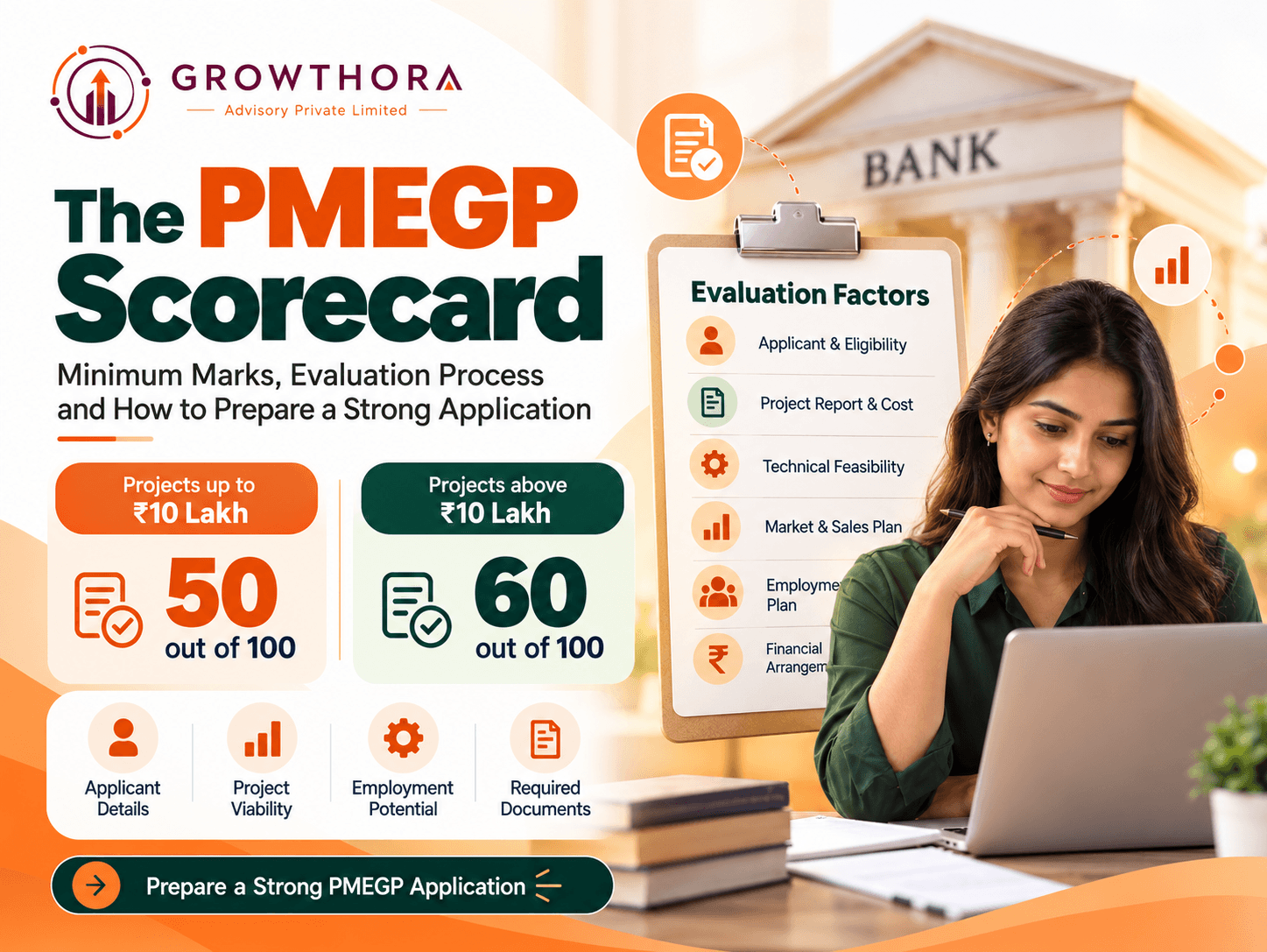
PMEGP minimum score: what the official guidelines say
| Project cost | Minimum score stated for forwarding to banks | How to interpret it |
|---|---|---|
| Up to ₹10 lakh | 50 out of 100 | This is a forwarding threshold in the revised guidelines, not a loan approval |
| Above ₹10 lakh | 60 out of 100 | This is a forwarding threshold in the revised guidelines, not a loan approval. |
The guidelines also say that complete or corrected applications should be forwarded to banks as soon as possible and, in no case, later than three weeks after the implementing agency receives the final application. This is a stated processing instruction for forwarding a complete or corrected application, not a promise that a bank will sanction the loan within three weeks.
Because portals and operational instructions can change, verify the current applicable guidance before publishing or making a financial decision. If your portal status conflicts with a general article, ask the implementing agency for the specific reason and the rule applied to your application.
Important accuracy note
The draft brief supplied for this article describes a 100-point DLTFC matrix with age, education, social category, rural location, employment and viability points, and says every application needs 60 marks. Those details should not be presented as the current official scoring rules without a matching current government document. Official PMEGP material says the DLTFC's role in recommending applications to banks was discontinued in May 2020, and a scorecard model was introduced for implementing agencies. The current revised guidelines specify different forwarding thresholds based on project cost. This article uses that verified framing rather than repeating an unsupported matrix.
This is general information, not a promise of forwarding, loan sanction or subsidy approval. Applicants should confirm the latest rules and their application status through the official PMEGP portal and their implementing agency.
What is the PMEGP scorecard?
The PMEGP scorecard is part of the application screening process used to assess whether a proposal is ready to be forwarded to a financing bank. It should not be confused with a guarantee of loan sanction. A scorecard helps the implementing agency assess the application against the scheme's prescribed process, while the bank evaluates creditworthiness, technical feasibility and economic viability before making its lending decision.
For applicants, the practical goal is not to chase a made-up score. It is to submit accurate information, upload the required evidence, explain the project clearly and make sure that the proposed unit and financial assumptions are credible.
Is the DLTFC still responsible for approving PMEGP applications?
Not in the earlier application-recommendation role described in older PMEGP explainers. A KVIC circular dated 6 May 2020 states that the DLTFC's role in recommending proposals to financing banks was discontinued. A Government of India parliamentary answer also explains that implementing agencies use the scorecard model to recommend eligible applications directly to banks, while banks assess the project and take their own credit decision. District-level monitoring responsibilities should not be confused with the former selection and recommendation process.
This distinction matters because older blog posts and PDFs may still mention committee interviews or scoring rules that no longer describe the current process. Before relying on a score threshold or a specific criterion, check the latest official scheme guidelines and portal instructions.
What does the scorecard evaluate?
- Do not assume the age-based or category-based point distribution copied into an unofficial article is the current scorecard. Use the criteria and evidence requested by the live PMEGP portal and the latest official circulars. In practical terms, applicants should prepare for scrutiny in the following areas because they affect completeness, eligibility, or bank appraisal.
- Applicant and scheme eligibility: Check that the applicant details, category declarations and proposed activity are consistent with current PMEGP rules. Attach category or qualification evidence only where applicable and requested.
- Project report and cost: Make sure the machinery, equipment, working capital and other cost estimates are supported by realistic quotations and align with the activity proposed.
- Technical feasibility: Explain the production or service process, capacity, premises, equipment, utilities, suppliers and skills needed to operate the unit.
- Market and sales assumptions: Identify target customers, competitors, pricing, demand, distribution and how the business expects to generate sales. Avoid unsupported claims about guaranteed orders.
- Employment plan: State the number and type of jobs the unit can reasonably support. Do not inflate staffing figures simply to improve a score.
- Promoter contribution and funding: Show how the required own contribution will be arranged and ensure the figures in the application, bank records and project report agree.
- Repayment capacity: Use realistic revenue, operating costs, working capital and repayment assumptions. A bank may independently test these figures.
- Supporting documents: Check identity, address, education or training records where applicable, quotations, registrations or permissions where applicable, and any additional documents requested by the portal or agency.
How to strengthen your PMEGP application before submission
- Use the live portal checklist. Download or review the latest instructions from the official PMEGP portal. Do not rely on a third-party list if it conflicts with the portal.
- Make the DPR internally consistent. The project activity, machinery list, capacity, employment, sales estimates and funding requirement should tell the same story. A mismatch between the application and DPR can trigger clarification.
- Support major costs. Keep recent supplier quotations and explain the purpose of each major asset. Avoid unexplained lump-sum machinery costs.
- Show a credible market. Explain who will buy the product or service, how customers will be reached and what evidence supports the expected sales.
- Use conservative financial assumptions. Include realistic prices, utilisation, raw-material costs, wages, electricity, rent, maintenance, working capital and repayment assumptions. Make clear which figures are estimates.
- Prepare a document index. List every uploaded file and check that scans are readable, pages are complete and names or amounts match across documents.
- Answer clarification requests promptly. If the implementing agency asks for corrections, respond with the requested evidence and keep a copy of the communication.
- Keep proof of submission. Save the application number, acknowledgement, submitted DPR, uploaded documents and any messages received from the portal or agency.
A practical DPR example: how to make the numbers credible
Illustration only: imagine an applicant proposes a small packaging unit with a total project cost of ₹12 lakh. The project report should explain what each machine does, how many units can realistically be produced in a shift, the expected selling price, material cost per unit, staffing needs, rent, electricity and monthly working capital. If the forecast claims high sales from the first month but provides no customer acquisition plan or capacity explanation, the bank may ask questions.
A simple consistency check is to compare the monthly sales forecast with production capacity. For example, if the unit can produce 10,000 pieces per month and the projected selling price is ₹8 per piece, maximum monthly sales at full capacity would be ₹80,000 before considering downtime, rejected pieces or unsold stock. A forecast above that figure needs a clear explanation, such as additional shifts or higher capacity supported by the machinery and staffing plan. These figures are illustrative and are not a PMEGP-prescribed formula.
The same principle applies to staffing. List the people the business genuinely needs to operate safely and reliably. Do not add fictional workers or inflate employment numbers to chase scorecard points.
What happens after the application is forwarded to the bank?
Forwarding means the application has moved to the financing bank for its credit appraisal. It does not mean the loan has been approved. The bank can assess the promoter's repayment capacity, the project's technical and economic viability, credit information, quotations, own contribution and any other relevant lending factors. The bank may seek clarifications or decline the proposal under its credit assessment.
If the application is returned or held for clarification, ask for the exact reason in writing. Correct the specific issue rather than repeatedly uploading different versions of the same file without guidance. Keep the implementing agency and bank correspondence together so that the application history is easy to follow.
Common mistakes that can weaken an application
- Treating an unofficial 100-point chart as a current government rule.
- Assuming a score of 60 guarantees bank sanction or subsidy.
- Submitting a generic DPR that does not explain the proposed business.
- Using machinery quotations that do not match the project activity or total cost.
- Projecting sales without a realistic production, pricing and customer plan.
- Showing employment figures that are inconsistent with the unit's capacity.
- Uploading unreadable or incomplete documents.
- Ignoring clarification requests or failing to retain submission proof.
- Using old portal links or old scheme guidance without checking current instructions.
PMEGP scorecard checklist
- ☐ I have checked the latest official PMEGP instructions.
- ☐ My applicant details and proposed activity are consistent across the application and DPR.
- ☐ The project cost is supported by current quotations and clear explanations.
- ☐ The sales and repayment assumptions are realistic and traceable.
- ☐ The employment plan reflects genuine operating requirements.
- ☐ The required own contribution is planned and documented.
- ☐ All requested documents are readable and complete.
- ☐ I have saved my application acknowledgement and portal status.
- ☐ I understand that forwarding is not the same as bank sanction.
Frequently asked questions
What is the minimum PMEGP scorecard mark?
The revised PMEGP guidelines state a minimum score of 50 out of 100 for forwarding projects costing up to ₹10 lakh and 60 out of 100 for projects costing above ₹10 lakh. Confirm the latest applicable instructions on the official portal.
Is 60 marks compulsory for every PMEGP application?
No. The revised guidelines distinguish between projects up to ₹10 lakh and projects above ₹10 lakh. They state 50 out of 100 for the former and 60 out of 100 for the latter for forwarding to banks.
Does the DLTFC interview decide my PMEGP score?
Do not assume the earlier DLTFC selection process is still used. A KVIC circular dated 6 May 2020 discontinued the DLTFC's role in recommending applications to financing banks and introduced the scorecard model through implementing agencies.
Does a qualifying score guarantee a PMEGP loan?
No. The score relates to forwarding under the scheme process. The financing bank separately appraises the proposal and makes its credit decision.
Where can I get the official PMEGP scorecard PDF?
Start with the official PMEGP portal and the Ministry of MSME scheme-guidelines page. Check the document date and issuing authority before relying on a PDF copied to another website.
Will EDP training automatically add 10 marks?
Do not rely on a fixed 10-mark claim unless the current official scorecard explicitly says so. Check the current portal instructions for training requirements and how training evidence is treated.
Should I show more employees to improve my score?
No. Employment projections should reflect real operating needs and the unit's capacity. Inflated staffing can undermine the credibility of the project report.
How long does it take for a complete application to reach the bank?
The revised guidelines state that complete or corrected applications should be forwarded as soon as possible and no later than three weeks after receipt of the final application by the implementing agency. This does not set a bank sanction deadline.
What should I do if my application is returned?
Ask the implementing agency for the specific reason, correct the relevant information or document, and retain the updated acknowledgement and communication.
Can a consultant guarantee 75 or more marks or loan approval?
No responsible consultant should guarantee a score or bank sanction. A consultant can help organise documents and improve the clarity of a project report, but the implementing agency and bank make decisions under the applicable process.
Next step
Apply this to your business.
Confirm whether this applies to your legal structure, industry classification, and credit history - in under 30 minutes with an advisor.