
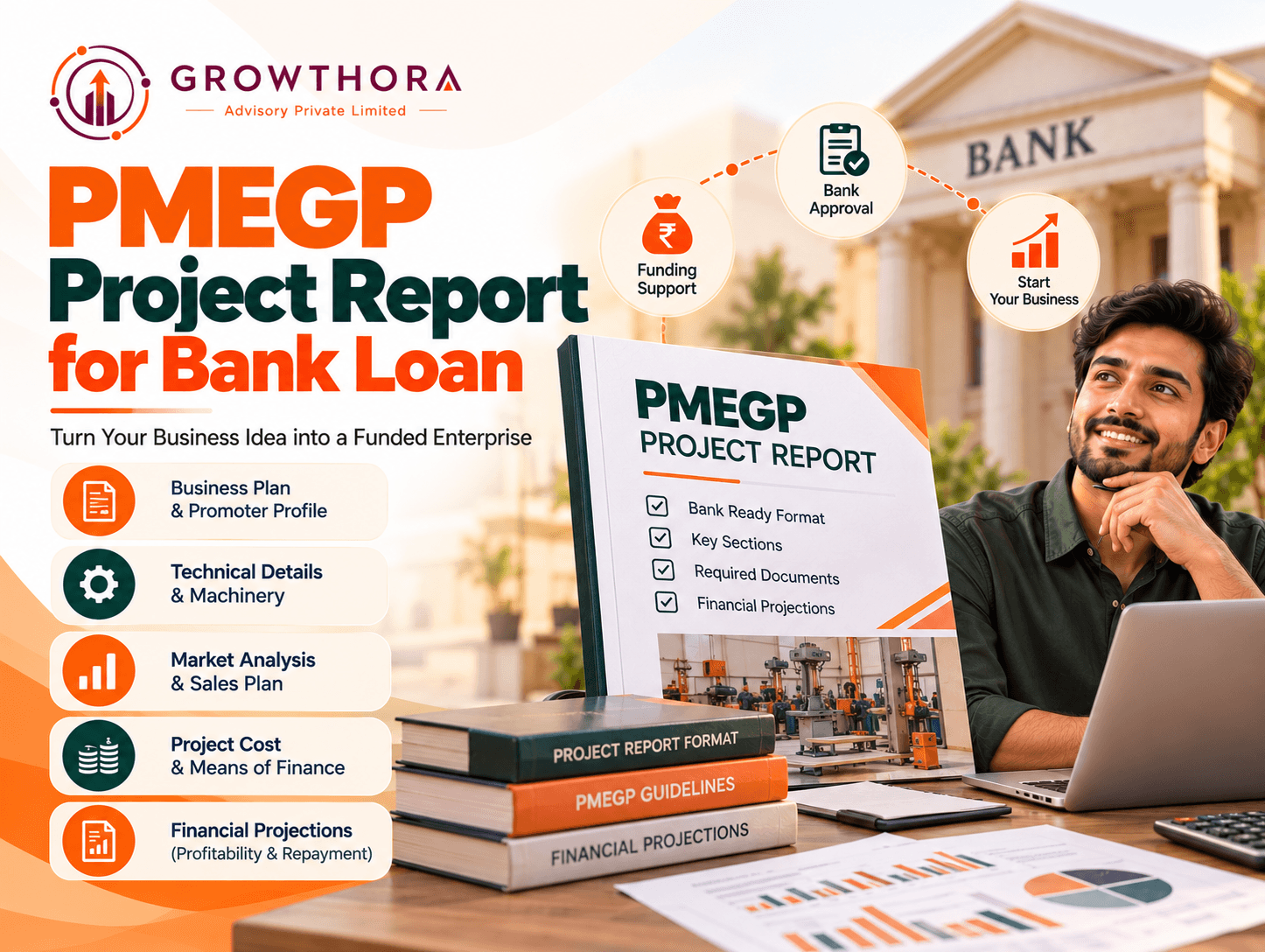
What Is a PMEGP Project Report?
The Prime Minister's Employment Generation Programme, or PMEGP, is a credit-linked subsidy programme intended to support eligible new micro-enterprises in the non-farm sector.
A project report explains how your proposed business will be established and operated. It brings together the business plan, estimated investment, operating costs, funding structure and financial projections in a format that can be assessed by a lending institution.
For example, suppose you want to establish a small manufacturing unit. The bank needs more than the name of the business and the loan amount you are requesting. It needs to understand which products you will manufacture, what machinery you require, how much raw material you will consume, who your customers may be and how the business will generate enough cash to meet expenses and repay the loan.
A project report supports the loan assessment, but it does not guarantee approval. The bank will also evaluate eligibility, documents, creditworthiness, project feasibility and other applicable lending conditions.
Mandatory Components of a PMEGP Project Report
The exact format can vary by bank and business type. The following sections provide a practical structure for a detailed project report format for PMEGP.
1. Executive Summary and Promoter Profile
The executive summary gives the reader a quick understanding of the proposed enterprise. It should be concise, specific and consistent with the financial tables that follow.
- Proposed business name and activity
- Location of the enterprise
- Products or services offered
- Total estimated project cost
- Promoter's proposed contribution
- Proposed bank finance
- Expected production or service capacity
- Target customers and market opportunity
- Estimated employment generation
The promoter profile should explain the applicant's education, relevant experience, technical knowledge and ability to manage the business. Mention training or practical experience that supports the proposed activity.
Include identity, address, registration and other eligibility documents as required. Do not assume that Udyam registration alone establishes PMEGP eligibility or replaces other scheme requirements.
Practical tip: Keep the project cost and funding figures identical throughout the report, application and supporting documents. Even small differences can lead to clarification requests.
2. Technical and Infrastructure Blueprint
This section explains how the business will actually operate. For a manufacturing unit, describe the manufacturing process, installed capacity, machinery, production stages, raw materials, power requirements and workforce. For a service enterprise, explain service delivery, equipment, premises, staffing and operating requirements.
- Business premises and location
- Ownership or lease details, where applicable
- Machinery and equipment specifications
- Supplier quotations and installation costs
- Electricity, water and other utilities
- Production capacity and expected capacity utilisation
- Staffing and salary estimates
- Required registrations, permissions or licences
A machinery table makes the investment easier to review. The following is a suggested layout, not a mandatory official eight-column format.
| Machinery or equipment | Quantity | Unit cost | Total cost | Supplier | Installation cost | Power or capacity details | Quotation reference |
|---|---|---|---|---|---|---|---|
| Machine A | 1 | ₹2,00,000 | ₹2,00,000 | Supplier name | ₹10,000 | As quoted | Quote 001 |
| Machine B | 2 | ₹50,000 | ₹1,00,000 | Supplier name | ₹5,000 | As quoted | Quote 002 |
These are illustrative figures. Use actual supplier quotations and adjust the table to suit the business.
3. Market Analysis and Business Potential
A project may look attractive on paper but struggle if there is insufficient demand. The market section should explain why customers are likely to buy the product or service.
- Main customer groups
- Local or regional demand
- Competitors and alternatives
- Selling price and pricing assumptions
- Distribution or service delivery channels
- Seasonal demand, if relevant
- Expected sales volume and the basis for the estimate
Avoid statements such as 'there is huge demand' unless you can support them. Use local market observations, supplier or buyer discussions, quotations, industry data or other credible information where available.
For example, a proposed food processing unit should estimate monthly production, the proportion of output it expects to sell and a reasonable selling price. The sales projection should follow from those assumptions, not from a desired profit figure.
4. Total Project Cost and Means of Finance
This section shows how much money is needed to establish the business and where that money will come from. Project costs may include eligible machinery, installation, other capital expenditure and working capital, depending on the nature of the project and applicable scheme rules.
| Cost component | Estimated amount |
|---|---|
| Plant and machinery | ₹4,00,000 |
| Installation and setup | ₹50,000 |
| Other eligible fixed assets | ₹1,00,000 |
| Initial working capital requirement | ₹2,50,000 |
| Illustrative total project cost | ₹8,00,000 |
The amounts above are only an example. Actual costs must be supported by the project's requirements and relevant quotations.
The means of finance section explains the proposed funding structure, including the promoter's contribution and the bank finance being requested. PMEGP margin money subsidy must be shown and handled according to the applicable scheme and bank process. Do not simply deduct the expected subsidy from the initial bank loan without checking the scheme's treatment of margin money.
5. Five-Year Financial Projections
Financial projections help the bank understand how the enterprise is expected to perform over time. A five-year forecast can be useful where required by the bank or appropriate for the scale of the project.
Depending on the lender's format, the report may include:
Projected profit and loss statement: estimated sales, material costs, wages, rent, utilities, administrative expenses, interest, depreciation and profit.
Projected balance sheet: expected assets, liabilities, borrowings, capital and retained earnings.
Cash flow statement: expected cash inflows and outflows, including operating cash, capital spending and loan repayments.
Loan repayment schedule: proposed instalments, interest and outstanding loan balance based on the lender's terms.
Working capital assessment: funds needed to maintain stock, pay operating expenses and manage customer credit.
Build projections from transparent assumptions. Estimate monthly production, selling price, operating days, raw material consumption and expected sales collection period. These assumptions should be consistent across the report.
Do not increase revenue by an arbitrary percentage each year just to make the business appear profitable. Explain what will support any increase in sales, such as additional capacity, a wider customer base or improved utilisation.
6. CMA Data and Banking Ratios
CMA stands for Credit Monitoring Arrangement. CMA data refers to financial information used by banks for certain credit appraisal and monitoring requirements, particularly in relevant business lending cases.
CMA data for PMEGP is not automatically a universal requirement for every applicant. Ask the proposed lending bank whether CMA statements are needed for your particular loan and, if so, obtain its prescribed format.
Debt Service Coverage Ratio (DSCR)
DSCR helps assess whether the business is expected to generate enough funds to meet debt repayment obligations. The exact calculation can vary according to the lender's methodology. DSCR above 1.5 should not be presented as a universal PMEGP rule applicable to every bank and every project. The bank may apply its own appraisal criteria.
Current Ratio
This ratio compares current assets with current liabilities and helps assess short-term liquidity. Its interpretation depends on the business model and the lender's assessment.
Break-Even Point (BEP)
The break-even point estimates the sales level at which total revenue covers total costs under the assumptions used.
Net Working Capital (NWC)
Net working capital is generally calculated as current assets minus current liabilities. It helps show the funds available to support day-to-day operations.
Sensitivity Analysis
Where useful, test how the financial outcome changes if sales are lower than expected, raw material costs increase or operating expenses rise. This can reveal whether the proposed business has enough flexibility to manage common risks.
Financial ratios are decision-making tools, not guarantees of loan approval.
PMEGP Subsidy and Means of Finance: What Applicants Should Understand
PMEGP assistance depends on the applicant's category, the location of the unit and the applicable scheme rules. The revised scheme guidelines published by KVIC set out the contribution and margin money subsidy structure. Applicants should confirm their eligibility and the current procedure through the official PMEGP portal and implementing agency.
| Applicant category | Own contribution |
|---|---|
| General category | 10% |
| Eligible special category | 5% |
Special categories are defined under the scheme guidelines. Applicants should check the official rules to determine which category applies to them.
What Are the PMEGP Project Cost Limits?
Under the revised PMEGP guidelines, the maximum project cost eligible for margin money subsidy is generally ₹50 lakh for manufacturing projects and ₹20 lakh for business or service projects.
The guidelines also address cases where a bank may consider finance beyond the subsidy-eligible ceiling. Any amount above the applicable ceiling is not automatically eligible for PMEGP margin money subsidy. Confirm the proposed activity, eligible cost and financing structure with the implementing agency and lending bank before finalising the DPR.
Official revised guidelines: https://www.kviconline.gov.in/pmegpeportal/dashboard/notification/Revised_PMEGP_Scheme_Guidelines_07122023_compressed.pdf
How Does the Subsidy Affect the Loan Structure?
The subsidy should not be treated as ordinary cash that the applicant can freely use at the beginning of the project. PMEGP margin money is processed through the scheme's prescribed banking mechanism and is subject to applicable conditions.
The report should distinguish between total eligible project cost, promoter's own contribution, bank finance, eligible margin money subsidy, and working capital or term loan requirements.
For instance, an eligible project costing ₹10 lakh in a general-category rural location may have an indicative margin money subsidy rate of 25%. That rate does not mean the applicant will immediately receive ₹2.5 lakh in cash or that the bank will automatically reduce the initial loan by that amount. The actual funding arrangement and subsidy adjustment must follow the applicable guidelines and bank process.
Worked example (illustrative only): Suppose an eligible project costs ₹10,00,000 and is in a general-category rural location. Using the commonly published PMEGP rates for illustration, the promoter contribution at 10% would be ₹1,00,000, the margin money subsidy rate at 25% would represent ₹2,50,000, and the indicative bank-financed balance at 65% would be ₹6,50,000. This is a simplified percentage example, not a sanction estimate. The bank and implementing agency must confirm eligible costs, subsidy treatment and timing, working capital arrangements and the actual financing structure.
Repayment illustration only: If ₹6,50,000 were repaid as a fully amortising loan over five years at an assumed 11% annual interest rate, the approximate EMI would be about ₹14,100 per month. This does not predict actual PMEGP loan terms. Instalments depend on the sanctioned amount, interest rate, moratorium, repayment schedule, fees and any subsidy adjustment.
Why Generic Online Project Report Generators May Not Be Enough
Online tools and templates can be useful for organising information and preparing financial tables. The problem arises when an applicant accepts the output without checking whether the assumptions match the real business.
1. Unrealistic Working Capital Estimates
Working capital depends on the nature of the business. A manufacturer may need funds for raw materials, work in progress, finished goods and customer credit. A service provider may have a different cost structure and shorter operating cycle. Using the same inventory or debtor collection period for every business can produce an inaccurate estimate.
If customers typically pay after 30 days, the business may need to finance expenses during that period. If the report assumes all sales are collected immediately, cash flow may look stronger than it will be in practice. Use realistic assumptions supported by supplier terms, customer payment practices and the operating model.
2. Sales Projections That Do Not Match Capacity
Revenue projections should reflect the business's actual production or service capacity. If a unit can produce 1,000 items per month but the report forecasts sales of 2,000 items without explaining extra shifts, additional equipment or outsourced production, the projection needs revision or a credible operating plan.
Check whether projected turnover aligns with installed capacity, expected capacity utilisation, staff and working hours, raw material availability, market demand, selling price and customer payment terms. Tax and GST obligations should be assessed according to the business's circumstances and applicable law. GST registration thresholds and filing requirements are not a universal measure of whether a sales forecast is commercially realistic.
3. Incorrect Depreciation and Tax Assumptions
Depreciation affects projected profit and the value of fixed assets. The method and rates used should be appropriate to the financial statement purpose, the nature of the assets and applicable accounting or tax requirements.
Do not assume that one depreciation method, including the written down value method, applies identically to every asset and every calculation in a DPR. Tax depreciation and depreciation used in financial projections may serve different purposes. Where tax treatment is material, obtain suitable professional guidance and clearly state the assumptions used.
4. Financial Statements That Do Not Reconcile
A common problem with spreadsheets and automated reports is that one change may not be reflected correctly in every financial statement. Check that total project cost matches the means of finance, loan amounts agree with the repayment schedule, interest expense is consistent with borrowing assumptions, cash flow and balance sheets reconcile, depreciation agrees with the fixed asset schedule, and sales and expenses use consistent assumptions.
5. Missing Documents or Scheme-Specific Details
A generic report may not include all the details needed for a particular business or application. Additional information, quotations, licences, category documents or other evidence may be needed depending on the project and bank requirements. Use a template as a starting point, not as a substitute for verifying requirements with the lending bank and PMEGP implementing agency.
Documents to Keep Ready Before Preparing a PMEGP DPR
The required documents depend on the applicant, proposed activity and lending institution. The following checklist is a practical starting point.
- Applicant identity and address documents
- Educational or technical qualification documents, where applicable
- Category certificate, if claiming a special category benefit
- Business activity and location details
- Machinery and equipment quotations
- Premises ownership or lease information, as applicable
- Estimates for installation, utilities and other project expenses
- Working capital assumptions and operating cost estimates
- Market information and expected selling prices
- Bank statements or other financial information if requested
- Required registrations, declarations, permissions or scheme documents
- Any prescribed application form or supporting statement requested by the bank
Check the official PMEGP portal for the application process and latest scheme information: https://www.kviconline.gov.in/pmegpeportal/pmegphome/
You can also review the official PMEGP project report sample PDF to understand how a sample project may be presented: https://kviconline.gov.in/pmegpeportalappdoc/pmegpappuploadSecond/app27052436.pdf. A sample is a reference, not a substitute for figures that match your own business.
How to Prepare a PMEGP Project Report Step by Step
- Define the business activity. State what you intend to manufacture or provide, where the unit will operate and who the customers will be.
- Confirm eligibility and scheme details. Review current PMEGP guidelines and confirm that the proposed activity and applicant meet applicable requirements.
- Estimate the project cost. Collect quotations for machinery and major expenses. Separate fixed capital from working capital and document assumptions.
- Calculate the funding requirement. Show promoter contribution, proposed bank finance and applicable subsidy treatment separately. Check that totals reconcile.
- Prepare the operating plan. Estimate production, sales, raw material consumption, staff costs, utilities and other regular expenses.
- Build financial projections. Prepare statements and ratios requested by the bank. Use realistic assumptions rather than copying figures from an unrelated sample.
- Check supporting documents. Verify that quotations, application details and the project report use consistent names, amounts and business descriptions.
- Review the report against the lender's requirements. Ask whether additional financial schedules, CMA data or a specific format is needed before submission.
A clear, internally consistent report makes it easier for the bank to understand the proposal and request any further information it needs.
Should You Hire a Project Report Consultant?
Preparing a DPR yourself may be practical for a straightforward project if you understand the costs, business operations and financial assumptions. Professional help can be useful when the project has multiple machinery items, complex working capital needs, detailed projections or lender-specific financial requirements.
A project report consultant can help organise information, build financial projections, identify inconsistent figures and prepare the document in a format suited to the lender's requirements.
Before hiring a consultant, ask:
- What sections will the report include?
- Will projections be based on actual quotations and operating assumptions?
- Can the consultant prepare CMA data if the bank requests it?
- What documents and information must I provide?
- Are revisions included if the bank asks for clarification?
- What is the fee, expected delivery time and scope of work?
- Who will review the financial calculations, and what qualifications do they have?
No consultant can guarantee that a bank will approve a loan. The lending institution makes the final decision after its appraisal.
Related resource: Visit Growthora's [PMEGP scheme page](https://www.growthora.co.in/schemes/pmegp) for related information, after confirming that the destination is live and current.
Need a Bank-Ready PMEGP DPR?
A well-prepared DPR should do more than fill pages. It should explain the business clearly, justify the project cost and show how the enterprise expects to operate and meet its financial commitments.
If you are planning to apply under PMEGP, gather your project details, machinery quotations, estimated operating costs and the bank's document requirements first. Visit Growthora Advisory's website to check the current contact options and discuss whether its services fit your project. Before proceeding, ask for a written scope of work, required documents, fees, delivery time and revision policy. Publish specific service promises only after Growthora has confirmed that it provides them.
Looking for help with your PMEGP project report? Contact Growthora Advisory to discuss your proposed business, the lender's requirements and the documents needed to prepare a report based on your project details.
A carefully prepared report can help you present your proposal clearly, but approval remains subject to scheme eligibility and the bank's assessment.
Frequently Asked Questions
What is a PMEGP project report for a bank loan?
It is a document explaining the proposed business, promoter profile, project cost, funding structure, operating plan and expected financial performance. It helps the bank assess the feasibility of the project and proposed loan.
What is the detailed project report format for PMEGP?
A practical format includes an executive summary, promoter profile, market analysis, technical details, machinery and infrastructure costs, project cost, means of finance, working capital and financial projections. Additional schedules depend on the business and lender.
Is CMA data mandatory for every PMEGP loan?
Not necessarily. CMA data requirements depend on the lender, loan facility and project circumstances. Ask the bank handling your application whether it requires CMA statements and which format should be used.
What is the maximum project cost under PMEGP?
Under revised scheme guidelines, the project cost eligible for margin money subsidy is generally capped at ₹50 lakh for manufacturing and ₹20 lakh for business or service projects. Confirm the activity and current eligibility conditions against official guidelines.
What is the PMEGP subsidy rate for general and special categories?
Commonly published rates are 15% urban and 25% rural for the general category, and 25% urban and 35% rural for eligible special categories. Own contribution is generally 10% for general and 5% for special category applicants. Eligibility and processing are governed by scheme guidelines.
Is a DSCR above 1.5 compulsory for every PMEGP application?
It should not be treated as a universal PMEGP rule. DSCR is one measure of repayment capacity, and a bank may apply its own financial appraisal criteria. Ask the lending bank about its requirements.
Can I use a PMEGP project report sample PDF?
Yes. A sample can help you understand the structure and typical sections. Replace sample figures with actual project costs, quotations, operating assumptions and financial projections.
Can a consultant guarantee PMEGP loan approval?
No. A consultant can help prepare and review the report, but the bank and relevant scheme authorities decide eligibility, appraisal and approval.
How long does it take to prepare a PMEGP project report?
Timing depends on project complexity and how quickly the applicant provides accurate costs, quotations, operating assumptions and documents. Confirm the expected timeline with the person or firm preparing the report.
What should I check before submitting the DPR?
Check that project cost matches the funding table, projections use realistic assumptions, machinery costs are supported by quotations, repayment calculations are consistent and the report meets the bank's requirements.
Final Checklist Before You Submit Your PMEGP Project Report
- Describe the business activity and promoter background clearly.
- Use realistic machinery, infrastructure and operating cost estimates.
- Explain the market and sales assumptions.
- Reconcile total project cost and means of finance.
- Check the subsidy category and applicable PMEGP guidelines.
- Prepare financial statements and ratios requested by the bank.
- Confirm whether CMA data or additional schedules are required.
Match the report with supporting documents and application details.
Review the final report for calculation errors and missing information.
A strong PMEGP project report does not depend on a complicated template. It depends on clear business reasoning, credible estimates, consistent calculations and compliance with requirements applicable to your project.
If you are unsure how to structure your report, start by reviewing the official PMEGP guidelines and sample, then confirm the exact format with the bank that will assess your application
Next step
Apply this to your business.
Confirm whether this applies to your legal structure, industry classification, and credit history - in under 30 minutes with an advisor.