
What the official data says
The PMEGP portal's rejection report provides a useful reality check. In the report covering 1 April 2022 to 12 November 2025, the most common recorded reasons included:
| Recorded reason | Cases | Share shown in report |
|---|---|---|
| Unable to submit documents | 126,713 | 22.84% |
| Improper application | 59,101 | 10.65% |
| CIBIL report not satisfactory | 50,543 | 10.65% |
| Existing unit | 39,916 | 7.20% |
| Project not viable | 36,198 | 6.53% |
| Inadequate knowledge of proposed industry | 31,508 | 5.68% |
| Activity in negative list | 2,162 | 0.39% |
Important: this is a snapshot of the official portal report retrieved for this article. The report's dates and figures should be rechecked before publication because the portal may update.
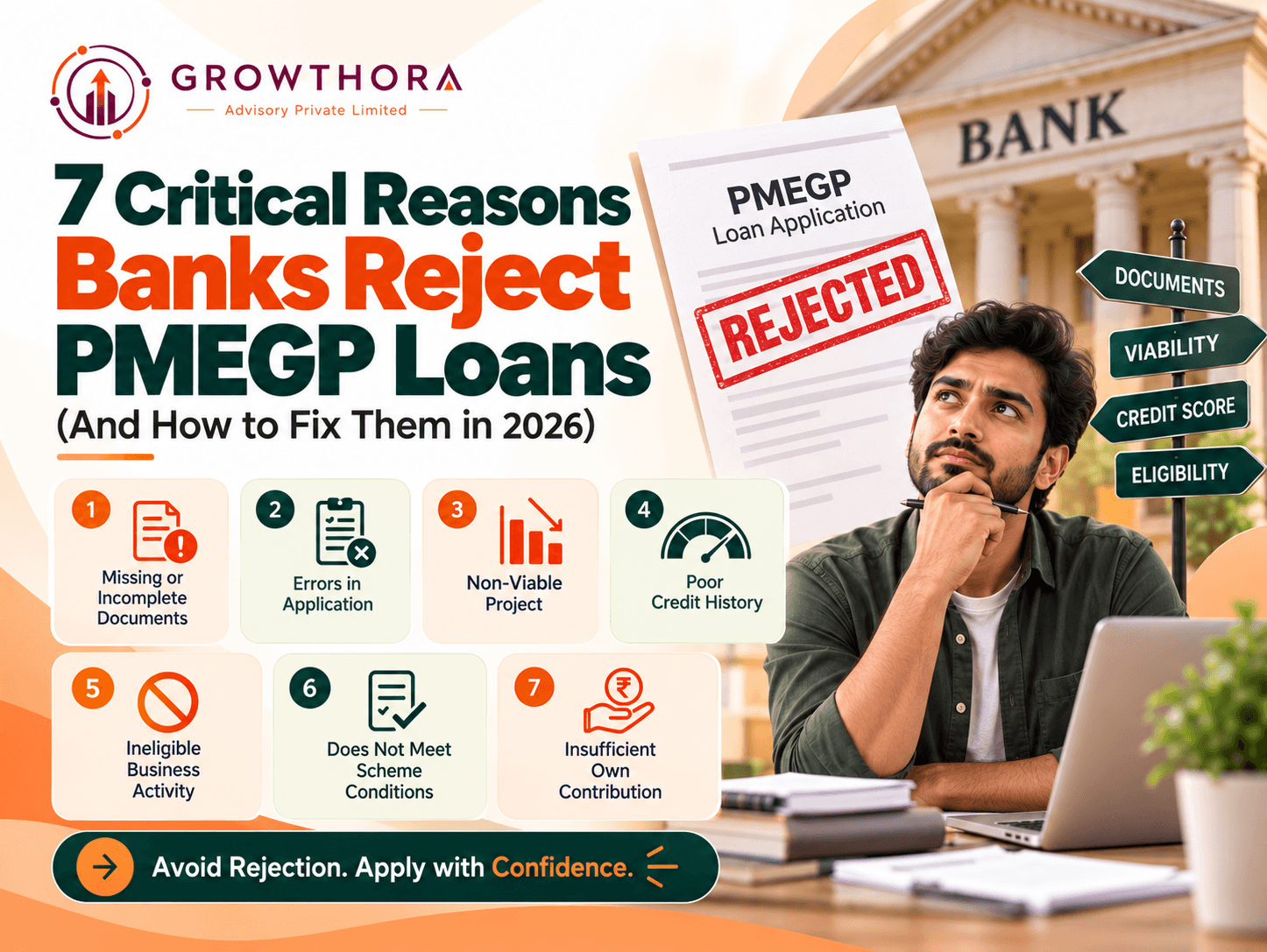
1. Incomplete documents or an incorrect application
Missing, inconsistent or unclear paperwork is one of the largest recorded rejection categories in the official PMEGP report. A form may also be returned or delayed when personal details, project information, quotations or supporting records do not match.
How to fix it:
- Read the portal status and every remark carefully. Distinguish a request to correct or complete the application from a final rejection.
- Check that the applicant's name, address, category, project cost and bank details match the supporting documents.
- Prepare clear, current copies of the documents requested by the implementing agency or bank. Follow the exact checklist provided for your case.
- Keep a copy of the submitted form, uploaded files, acknowledgement and any communication.
2. The project report does not demonstrate viability
A bank must assess whether the proposed business can operate and repay the loan. A project report can raise concerns if it uses unrealistic sales assumptions, omits operating costs, understates working capital, uses unsupported equipment prices, or fails to explain local demand and the applicant's experience.
Improve the Detailed Project Report (DPR) by including:
- A specific description of the product or service, target customers, competitors and local demand.
- Itemised machinery, equipment, installation and other eligible project costs, supported by current quotations where appropriate.
- A realistic sales forecast with a clear explanation of pricing, capacity, seasonality and how customers will be acquired.
- Monthly operating expenses, working-capital needs, cash-flow estimates, break-even analysis and repayment assumptions.
- A brief explanation of the applicant's relevant skills, training, experience and operating plan.
Financial ratios such as the debt-service coverage ratio (DSCR), current ratio and break-even point may be used by a lender to evaluate a proposal. However, this review did not verify a single universal PMEGP-wide minimum for DSCR of 1.50 to 2.00, a current ratio of 1.33, or a break-even point of 40% to 60%. Do not present those figures as official mandatory PMEGP thresholds. Ask the concerned bank which assumptions or ratios it expects for your project.
3. Unsatisfactory credit history or existing defaults
The PMEGP portal lists an unsatisfactory CIBIL report and defaulter status among bank rejection reasons. A lender may consider repayment history, overdue accounts, existing obligations and the overall ability to service new debt.
How to fix it:
- Obtain and review your credit report from the relevant credit information company.
- Check for errors, accounts that do not belong to you, incorrect overdue amounts or loans incorrectly shown as unpaid.
- If an entry is wrong, raise a dispute with the credit bureau and the lender reporting it. Keep the complaint reference and evidence.
- If an overdue is genuine, ask the lender about the outstanding amount and available resolution options. Do not assume that paying it guarantees approval.
- Avoid submitting repeated applications without understanding the issue in the current report.
No universal PMEGP rule setting an automatic rejection or review cutoff at a CIBIL score of 650 or 680 was verified in the official sources reviewed for this article. Do not advertise either score as an official scheme rule.
4. The proposed activity may be ineligible
PMEGP does not support every business activity. The applicable scheme guidelines contain eligibility conditions and a negative list, and some activities may be allowed only subject to specific conditions. Do not rely on a generic list copied from an old blog or assume that every trading, agriculture-related or manufacturing activity qualifies.
Before submitting or revising the application:
- Check the current PMEGP guidelines and portal instructions for the exact activity and business model.
- Describe the activity precisely. A vague label can make it difficult to assess eligibility.
- If the activity has multiple components, explain what the proposed unit will actually produce or provide.
- Ask the implementing agency to clarify eligibility in writing if the rule is not clear.
5. The applicant cannot arrange the required own contribution
PMEGP is a credit-linked subsidy programme, not a grant that automatically pays the full project cost. Applicants are generally required to bring an own contribution. The applicable rate depends on the applicant category and current scheme rules; the commonly published structure is 10% for the general category and 5% for special categories, subject to eligibility and the current guidelines.
Confirm the rate that applies to you with the official guidelines and implementing agency. Build the contribution into your budget, retain evidence of the funds' source if requested, and do not assume that the subsidy is paid to you upfront as cash.
6. The proposal may conflict with PMEGP eligibility conditions
PMEGP generally supports eligible new micro-enterprises. An existing unit or an application that conflicts with other scheme conditions can be rejected. The official portal's rejection report includes 'Existing unit' and other eligibility-related categories.
The revised scheme guidelines state that an individual applicant must be above 18 years of age. They also specify minimum education requirements for certain project sizes: at least Class VIII for manufacturing projects costing more than ₹10 lakh and business/service projects costing more than ₹5 lakh. Other eligibility and activity-specific conditions also apply. Verify the current guidelines before relying on a simplified summary.
Practical checks:
- Confirm that the proposed project qualifies as a new unit under the applicable scheme rules.
- Review whether prior assistance or a related PMEGP/REGP benefit affects eligibility in your circumstances.
- Check age, education, category and project-cost requirements against the current official guidelines.
- Ensure the application is routed through the correct implementing agency and bank process.
7. The bank is not satisfied with the proposal or the application is outside its service area
- The official rejection report also records non-viable projects, inadequate knowledge of the proposed industry, out-of-service-area cases and cases where the annual PMEGP target had been achieved. The meaning of a status can depend on the case and the stage of processing.
- What to do next:
- Ask for the specific concern rather than assuming the rejection was caused by one general rule.
- Be ready to explain how the business will operate, who will manage it, where customers will come from and how the loan will be repaid.
- If the issue is jurisdiction or service area, ask the implementing agency which bank or branch should handle the proposal.
- If the bank identifies a weakness in the DPR, revise that part with supporting evidence before requesting reconsideration or resubmission.
Does PMEGP have a 60-mark scorecard minimum?
Do not rely on online claims that every applicant must currently score at least 60 marks on a District Level Task Force Committee (DLTFC) scorecard. A KVIC circular dated 6 May 2020 states that the DLTFC role was discontinued for recommending applications to financing banks, with the committee's role limited to monitoring scheme performance. The official process and any later instructions should be checked on the PMEGP portal. This article therefore does not present 60 marks, an age band of 21 to 45, or a fixed scorecard threshold as a verified current universal requirement. [2]
What to do if your PMEGP application says 'Returned' or 'Rejected'
- Open the official PMEGP portal and check the exact status, remarks and application stage.
- Save a screenshot or PDF of the status and keep your application ID and submission acknowledgement.
- If it says returned or asks for correction, follow the listed instructions and confirm the deadline or resubmission method.
- If it says rejected, request the main reason in writing from the bank or relevant office and ask whether the same application can be corrected, reconsidered or must be submitted again.
- Create a correction checklist that links each recorded issue to the document or explanation that resolves it.
- Submit only through official channels and keep copies of all correspondence.
- The word 'returned' should not automatically be treated as a final rejection. Equally, do not assume that every rejected application can be reopened or transferred to another bank. The next step depends on the portal status, the reason recorded and the instructions from the implementing agency or lender.
Can you reapply after a PMEGP loan rejection?
Possibly, but there is no safe one-size-fits-all answer. First find out whether the application is pending correction, has been formally rejected, or has been returned at an earlier stage. Ask the implementing agency or bank whether correction, resubmission, reconsideration or a fresh application is permitted in your case. Do not create duplicate applications or change banks without understanding the official process.
Can the bank reject a PMEGP loan without explaining why?
The Reserve Bank of India's Master Direction on Lending to the MSME Sector says banks must convey the main reasons for rejecting MSME loan applications in writing, within their board-approved sanction time norms. Ask the bank for the reason in writing and retain its response. This RBI direction is a general MSME lending requirement; the exact process for a particular PMEGP application may also involve the scheme's implementing agency and portal workflow. [3]
Is a PMEGP loan automatically collateral-free up to ₹50 lakh?
Do not assume that every PMEGP loan is automatically collateral-free up to ₹50 lakh, or that a third-party guarantee or property mortgage can never be requested. The applicable lending and credit-guarantee framework, facility size, lender's assessment and current instructions matter. Ask the bank to explain in writing what security or guarantee requirements apply to your proposed loan. PMEGP subsidy eligibility does not itself guarantee loan sanction or remove every lender requirement.
Should you hire a PMEGP consultant?
A competent adviser may help organise documents, prepare or review a DPR, check the application for inconsistencies and explain the process. A consultant cannot guarantee approval, override the bank's credit decision or promise a subsidy. The official PMEGP portal warns that KVIC, KVIB, DIC and Coir Board have not engaged private middlemen or franchises for promotion or sanction of PMEGP loans. Use official portals and verify any service provider, fees and claims before paying.
Frequently asked questions
Why does a bank reject a PMEGP loan?
Common recorded reasons include missing documents, an improper application, unsatisfactory credit history, a non-viable project, an existing unit, ineligible activity or inability to meet scheme conditions. Ask for the exact reason for your case.
What is the minimum CIBIL score for PMEGP?
The official sources reviewed do not establish one universal PMEGP-wide CIBIL cutoff. Banks assess creditworthiness under their lending policies. Check your report and ask the bank which issue affected the decision.
What are the minimum marks for the PMEGP scorecard?
Do not assume a universal current 60-mark DLTFC threshold. A KVIC circular dated 6 May 2020 discontinued the DLTFC's role in recommending applications to banks. Check current official instructions.
What does 'PMEGP application returned' mean?
It can indicate that a correction or further action is required. Read the exact portal remarks and ask the implementing agency what must be submitted and how.
Can I apply again after rejection?
Ask whether your case permits correction, reconsideration, resubmission or a fresh application. The answer depends on the recorded status and reason.
Does a good project report guarantee approval?
No. A well-supported DPR can improve clarity, but the bank makes its credit decision and the applicant must satisfy all applicable scheme and lender requirements.
Official sources and verification links
- [1] PMEGP official bank-rejection status report, 1 April 2022 to 12 November 2025
https://www.kviconline.gov.in/pmegpeportal/dashboard/detail_pmegpfail_case.jsp?FROMDT=01-APR-2022&OFF_NAME=TOTAL&TODT=12-Nov-2025 - [2] KVIC circular dated 6 May 2020 on simplification of PMEGP application processing
https://kviconline.gov.in/pmegpeportal/pmegphome/ScoreCardCircular.pdf - [3] RBI Master Direction: Lending to Micro, Small & Medium Enterprises Sector, updated 9 February 2026
https://www.rbi.org.in/Scripts/BS_ViewMasDirections.aspx?id=11060 - [4] Official PMEGP portal
https://www.kviconline.gov.in/pmegpeportal/pmegphome/ - [5] Revised PMEGP Scheme Guidelines, December 2023
https://www.kviconline.gov.in/pmegpeportal/dashboard/notification/Revised_PMEGP_Scheme_Guidelines_07122023_compressed.pdf
Editorial and funding disclaimer
This article is for general information and is not legal, tax, investment or lending advice. Scheme rules, eligibility conditions, portal workflows and lender policies can change. Confirm the latest official documents and the instructions applicable to your application before making a financial commitment. Eligibility does not guarantee subsidy release or loan approval.
Publisher checklist before publishing
- Add a verified author name and biography. Add an expert reviewer only after that person has reviewed and approved the article.
- Recheck the PMEGP portal's rejection figures and all scheme requirements on the publication date.
- Confirm the final URL, canonical URL, meta title and meta description.
- Add relevant internal links only after confirming that each destination exists and is useful.
- Ensure the page has a visible publication or review date and an accurate contact route.
- If adding Article or BreadcrumbList structured data, ensure it matches the visible page and contains no placeholders.
- Test the live page on mobile, check links, indexability and sitemap inclusion, and validate structured data.
Next step
Apply this to your business.
Confirm whether this applies to your legal structure, industry classification, and credit history - in under 30 minutes with an advisor.