
Key Takeaways
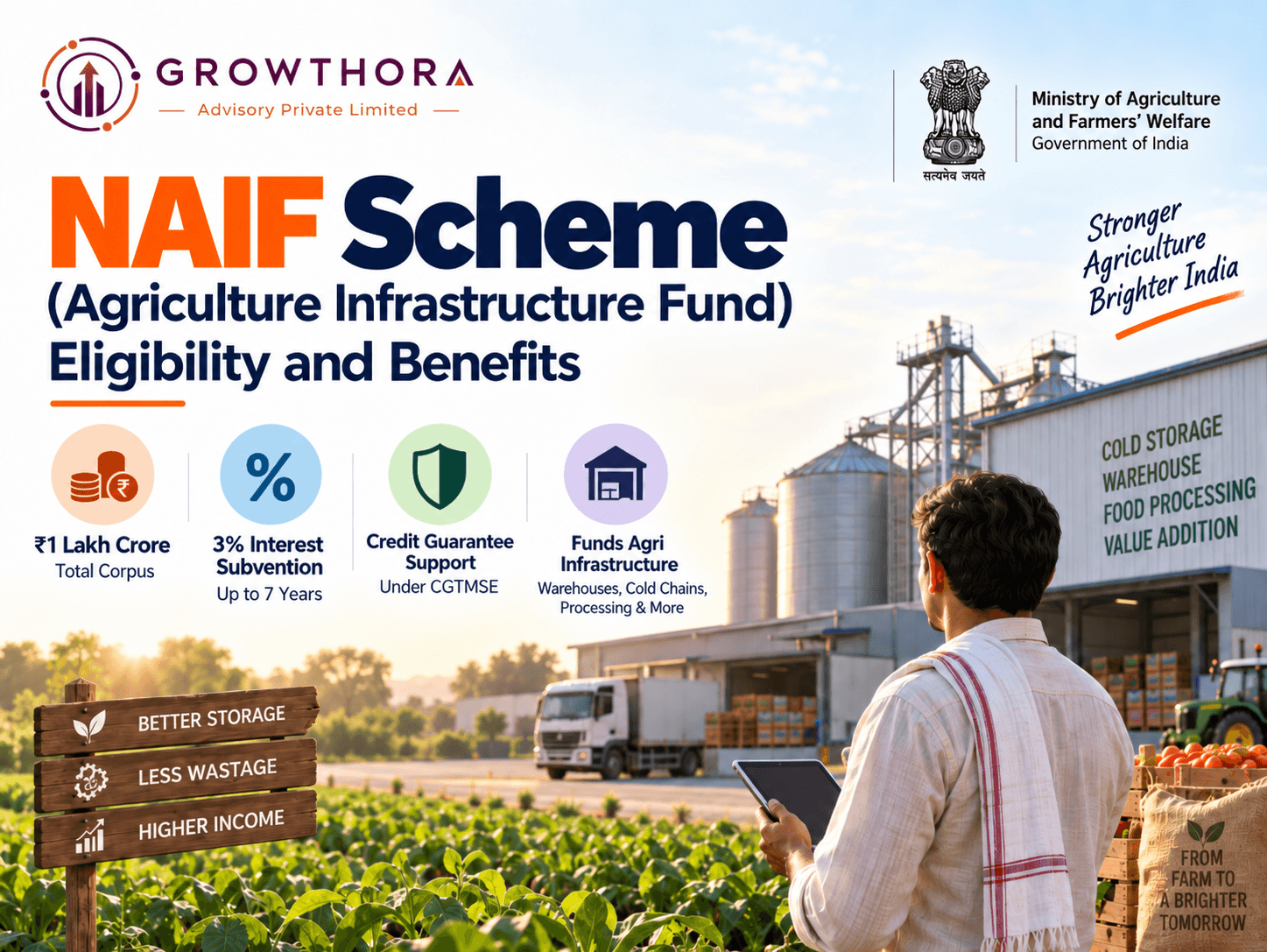
- AIF (widely called NAIF or NAIFF) has a total sanctioned corpus of Rs 1 lakh crore for financing agriculture infrastructure projects.
- Loans carry a 3 percent per annum interest subvention, capped at a loan amount of Rs 2 crore, for a maximum of 7 years.
- A credit guarantee cover is available under CGTMSE for eligible loans up to Rs 2 crore, reducing the collateral burden on borrowers.
- The scheme funds infrastructure such as warehouses, cold chains, grading units, and other post-harvest and community farming assets.
- Eligible borrowers include farmers, FPOs, self-help groups, cooperatives, agri-entrepreneurs, agri-startups, and state agencies.
- There is no minimum or maximum loan cap prescribed under the scheme itself, though individual lenders apply their own credit norms.
What Is the Agriculture Infrastructure Fund (AIF / NAIF)?
The Agriculture Infrastructure Fund was announced on 15 May 2020, with revised guidelines issued in May 2022, to address a long-standing gap in India's farm-gate and post-harvest infrastructure. It offers medium to long-term debt financing for projects that reduce post-harvest losses and improve value realisation for farmers.
This should not be confused with AgriSURE, a separate Rs 750 crore Category-II Alternative Investment Fund managed by NABVENTURES that provides equity and debt support directly to agri-startups. AIF is a loan-and-subvention scheme executed through banks, while AgriSURE is an AIF (Alternative Investment Fund) in the SEBI sense that invests in startups.
How AIF Differs From Related Schemes
- AIF vs AgriSURE: AIF is a bank-loan scheme with interest subvention for infrastructure projects, while AgriSURE is a SEBI-registered investment fund providing equity and debt directly to agri-startups.
- AIF vs regular agricultural term loans: A regular term loan does not carry the 3 percent interest subvention or the CGTMSE-linked credit guarantee that AIF-backed loans offer.
- AIF vs PM-FME (Formalisation of Micro Food Processing Enterprises): PM-FME focuses on formalising micro food processing units with capital subsidy support, while AIF is broader, covering value-chain infrastructure like warehousing and cold storage across the agriculture sector.
- AIF vs state-level infrastructure subsidy schemes: AIF is a central scheme implemented through a national portal and MoUs with NABARD/DA&FW, while several states run their own parallel infrastructure subsidy programmes that can sometimes be combined with AIF.
What Kind of Projects AIF Funds
- Warehouses and modern storage facilities
- Cold chains and cold storage units
- Grading, sorting and packaging units
- Primary processing centres and mobile pack-houses
- Other community farming assets that improve post-harvest management and reduce wastage
How the AIF (NAIF) Scheme Works
- A borrower approaches an eligible lending institution, such as a scheduled commercial bank, cooperative bank, regional rural bank, small finance bank, or NBFC, that has signed an MoU with NABARD or the Department of Agriculture and Farmers Welfare (DA&FW).
- The borrower submits a detailed project report outlining the infrastructure to be built, cost estimates, and expected benefits.
- On sanction, the loan is disbursed as per the lender's standard process, and the interest subvention of 3 percent per annum is applied for up to 7 years on loans up to Rs 2 crore.
- For loans above Rs 2 crore, interest subvention applies only up to the first Rs 2 crore of the loan amount.
- Eligible loans can also avail a credit guarantee cover under CGTMSE, reducing the need for collateral.
- Borrowers can combine any existing central or state grant or subsidy with this facility; in case of a capital subsidy, that amount is treated as part of the promoter's contribution.
Who Is Eligible
- Individual farmers and groups of farmers
- Primary Agricultural Credit Societies (PACS), Farmer Producer Organisations (FPOs), and Self-Help Groups (SHGs)
- Agri-entrepreneurs and agri-startups
- Multipurpose cooperative societies and marketing cooperative societies
- State agencies and federations of FPOs or SHGs, which face no upper loan limit under the scheme
- Central and state government agencies or local body-promoted public-private partnership projects
Documents Typically Required
- Bank's loan application form or a customer request letter for AIF financing
- Identity proof such as PAN, Aadhaar, voter ID, or driving license of the promoter, partners, or directors
- Address and residence proof
- Detailed Project Report (DPR) covering the proposed infrastructure, cost estimates, and implementation plan
- Passport-size photographs of promoters, partners, or directors
- Entity registration documents (for FPOs, cooperatives, companies, or LLPs, as applicable)
Step-by-Step: How to Apply for AIF Financing
- Identify a lending institution (bank, NBFC, or cooperative bank) that has an active MoU with NABARD or DA&FW for AIF lending.
- Prepare a detailed project report describing the infrastructure project, cost, and expected impact on post-harvest losses or value addition.
- Submit the loan application along with the DPR and required identity, address and entity documents to the lender.
- Respond to the lender's due diligence queries and provide any additional financial or project information requested.
- On sanction, ensure the loan is registered on the AIF online portal so the interest subvention and any applicable credit guarantee are correctly applied.
- Maintain project records and utilisation proof, since these may be required during monitoring or audit.
Common Mistakes and Rejection Reasons
- Submitting a vague or incomplete detailed project report that does not clearly justify the project's viability.
- Applying to a lender that has not signed an MoU for AIF financing, causing avoidable delays or rejection.
- Not meeting the minimum promoter contribution requirement, generally around 10 percent of the project cost.
- Overlooking that interest subvention applies only up to Rs 2 crore of the loan amount, and budgeting on the assumption it covers a larger sum.
- Failing to register the sanctioned loan on the AIF portal, which can delay subvention or guarantee benefits.
Practical Tips
- Prepare your detailed project report with realistic cost estimates and clear post-harvest loss reduction benefits, since this is central to approval.
- Check whether any existing state or central capital subsidy can be layered on top of AIF financing, since it can be treated as part of your promoter contribution.
- Confirm with your chosen lender that they are empanelled for AIF financing before investing time in a detailed application.
- Track the loan's interest subvention credit periodically with your lender rather than assuming it is applied automatically without any monitoring.
Who Should Consider This
Farmers, FPOs, cooperatives, and agri-entrepreneurs planning to invest in warehousing, cold storage, grading, or similar post-harvest infrastructure are well suited to this scheme, given the combination of interest subvention and credit guarantee support that lowers the effective cost of borrowing.
FAQs
What is NAIF or NAIFF in simple terms?
NAIF and NAIFF are common names used for the Agriculture Infrastructure Fund (AIF), a Rs 1 lakh crore central government scheme that funds warehouses, cold chains, and other post-harvest infrastructure through subsidised bank loans.
How much interest subvention is available under AIF?
A 3 percent per annum interest subvention is available on loans up to Rs 2 crore, for a maximum period of 7 years.
Can startups apply for AIF financing?
Yes. Agri-entrepreneurs and agri-startups working on post-harvest infrastructure, processing, or logistics are explicitly eligible under the scheme.
Is there a minimum or maximum loan amount under AIF?
The scheme itself does not prescribe a minimum or maximum loan cap, though individual lenders apply their own credit assessment and limits.
Is AIF the same as AgriSURE?
No. AIF is a bank-loan scheme with interest subvention, while AgriSURE is a separate SEBI-registered fund that provides equity and debt investment directly to agri-startups.
Can I combine AIF financing with another government subsidy?
Yes. Any existing central or state grant or subsidy can generally be combined with AIF financing, and a capital subsidy is treated as part of the promoter's contribution.
What is the minimum promoter contribution required under AIF?
Lenders typically require a minimum promoter contribution of around 10 percent of the project cost, though this can vary by lender and project.
Which institutions provide AIF loans?
Scheduled commercial banks, cooperative banks, regional rural banks, small finance banks, NBFCs, and NABARD provide AIF loans after signing an MoU with NABARD or DA&FW.
Next step
Apply this to your business.
Confirm whether this applies to your legal structure, industry classification, and credit history - in under 30 minutes with an advisor.