
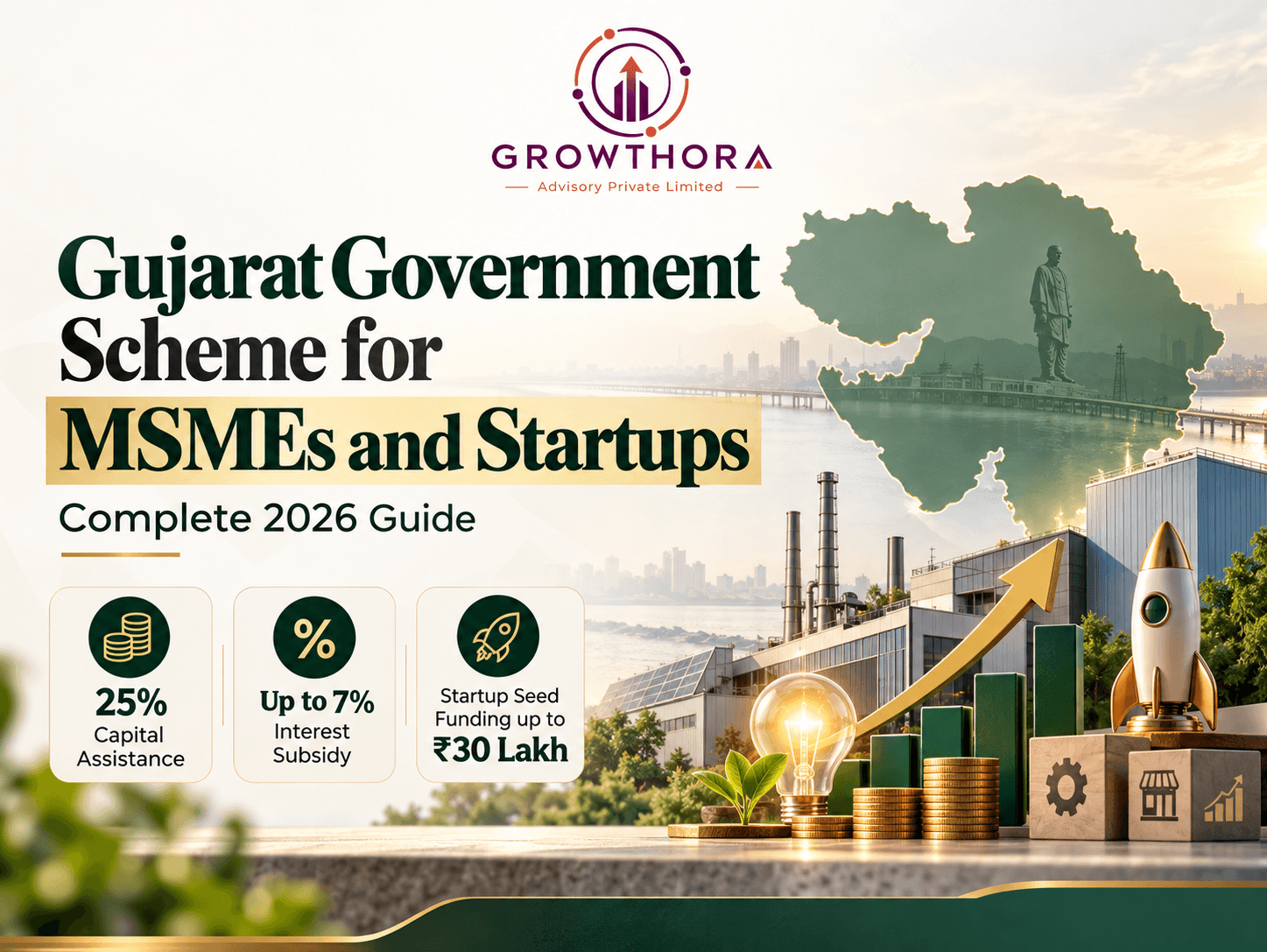
Viksit Gujarat Industrial Policy 2026-31: The Big Picture
The Viksit Gujarat Industrial Policy 2026-31, launched on 15 June 2026, is Gujarat's current strategic industrial framework aiming to attract around Rs 10 lakh crore in investment over five years, structured around four pillars, including Investment and Manufacturing and Innovation and Research, with dedicated incentive tracks for large industry, MSMEs, startups, and emerging sectors.
| Metric | Detail |
|---|---|
| Policy period | 2026 to 2031 |
| Investment target | Around Rs 10 lakh crore over 5 years |
| MSME units in Gujarat | Over 42 lakh, the highest of any Indian state |
| Cumulative investment under prior policies | Over Rs 7 lakh crore since 2012 |
| Startup ranking | Top Achiever in National Startup Ranking (DPIIT) since 2018 |
The policy also identifies textiles, technical textiles, footwear, and textile waste recycling as key thrust sectors, and industry commentary suggests it will replace elements of the earlier Aatmanirbhar Gujarat Scheme, potentially shifting from a net SGST reimbursement model toward a more upfront capital subsidy structure, which would improve early-stage liquidity for new industrial units.
Aatmanirbhar Gujarat Scheme for MSMEs
What does the Aatmanirbhar Gujarat Scheme actually offer MSMEs?
The Aatmanirbhar Gujarat Scheme for Assistance to MSMEs, run by the state's Industries and Mines Department and effective from 5 October 2022 to 4 October 2027, offers a combination of capital assistance of around 25 percent, an interest subsidy of up to 7 percent on term loans, and SGST-related refund support for eligible new and expanding MSME units, in line with the broader vision of both Aatmanirbhar Gujarat and Aatmanirbhar Bharat.
Interest Subsidy for Service Sector MSMEs
A specific component of the Aatmanirbhar Gujarat Scheme addresses interest subsidy for the service sector, covering areas such as financial services, healthcare services, audio-visual services, construction-related engineering services, transport and logistics services, and environmental services.
| Taluka Category | Interest Subsidy | Maximum Amount | Duration |
|---|---|---|---|
| Category 1 | 7% on term loan | Rs 35,00,000 per annum | 7 years |
| Category 2 | 6% on term loan | Rs 30,00,000 per annum | 6 years |
| Category 3 and Municipal Corporation Areas | 5% on term loan | Rs 25,00,000 per annum | 5 years |
Startup-Specific Support Under the 2026 Policy
What does Gujarat offer startups specifically?
Under the Viksit Gujarat Industrial Policy 2026, eligible startups receive monthly sustenance allowances, with ventures having women co-founders eligible for support of up to Rs 30,000 per month, along with seed funding assistance of up to Rs 30 lakh, positioning the state as one of the more generous state-level startup ecosystems in the country.
This state-level support sits on top of central schemes such as the Startup India Seed Fund Scheme and the Credit Guarantee Scheme for Startups, and since these funding sources generally sit in different buckets, a Gujarat-based startup founder can typically combine them without conflict.
Other Notable Components
- Assistance to GIDC for the development of multi-story sheds for micro and small enterprises, easing land and space constraints for smaller units
- Market Development Assistance to MSMEs, supporting participation in trade fairs and market expansion efforts
- Assistance for MSEs occupying sheds developed by private developers, widening access to ready industrial infrastructure
- Rooftop solar power provisions specifically eased for MSME units under earlier iterations of Gujarat's industrial policy
- R&D incentives of up to 50 percent in specific sectors under the Innovation and Research pillar of the 2026 policy
Eligibility and How to Apply
- Obtain free Udyam Registration at udyamregistration.gov.in, since it is generally a prerequisite for state MSME scheme eligibility.
- Identify which scheme component applies to your business, whether it is capital assistance, interest subsidy, service sector support, or startup seed funding.
- Confirm the taluka category of your unit's location, since incentive rates and caps vary meaningfully by category under several scheme components.
- Submit your application through the official Gujarat Industries and Mines Department or Industrial Extension Bureau (iNDEXTb) portal, verifying all details before final submission.
- Follow up with the relevant department roughly 5 to 7 days after submission to confirm receipt and understand the expected review timeline.
Key Takeaways
- The Viksit Gujarat Industrial Policy 2026-31, launched 15 June 2026, targets around Rs 10 lakh crore in investment over five years across four structural pillars.
- The Aatmanirbhar Gujarat Scheme for MSMEs, running from 2022 to 2027, offers roughly 25% capital assistance, up to 7% interest subsidy and SGST related support.
- Interest subsidy rates for service sector MSMEs vary by taluka category, ranging from 5% to 7% on term loans depending on location.
- Startups with women co-founders can access monthly sustenance allowances of up to Rs 30,000 and seed funding assistance of up to Rs 30 lakh under the 2026 policy.
- Udyam Registration is generally required to access these state schemes, and applications route through the Gujarat Industries and Mines Department or iNDEXTb portal.
FAQs
What is Gujarat's current industrial policy?
Gujarat's current framework is the Viksit Gujarat Industrial Policy 2026 to 2031, launched on 15 June 2026, which targets attracting around Rs 10 lakh crore in investment over five years and is anchored on four structural pillars: Investment and Manufacturing, Innovation and Research, alongside sustainability and startup promotion-focused measures.
What is the Aatmanirbhar Gujarat Scheme for MSMEs?
The Aatmanirbhar Gujarat Scheme for Assistance to MSMEs is an umbrella scheme by Gujarat's Industries and Mines Department, effective from 5 October 2022 to 4 October 2027, offering capital assistance, interest subsidy and SGST-related support to help the state's MSME sector grow and formalise.
How much capital assistance can a Gujarat MSME get?
Under the Aatmanirbhar Gujarat framework, eligible new and expanding MSMEs can access capital assistance of around 25 percent, along with an interest subsidy of up to 7 percent on term loans, with maximum annual amounts and durations varying by the taluka category in which the unit is located.
What support does Gujarat offer specifically to startups?
Under the Viksit Gujarat Industrial Policy 2026, eligible startups can receive monthly sustenance allowances of up to Rs 30,000 for ventures with women co-founders, along with seed funding assistance of up to Rs 30 lakh, positioning Gujarat as one of the more startup-friendly state governments in the country.
Is Udyam Registration required for Gujarat state MSME schemes?
Yes, Udyam Registration is generally a prerequisite for accessing Gujarat's state-level MSME assistance schemes, including the Aatmanirbhar Gujarat Scheme, alongside meeting the specific eligibility criteria and taluka classification rules set out under the relevant scheme component.
How does the interest subsidy vary across different areas of Gujarat?
The interest subsidy rate under Gujarat's MSME service sector assistance scheme varies by taluka category, with Category 1 talukas eligible for 7 percent subsidy up to Rs 35 lakh per annum for 7 years, Category 2 talukas eligible for 6 percent up to Rs 30 lakh per annum for 6 years, and Category 3 talukas and municipal corporation areas eligible for 5 percent up to Rs 25 lakh per annum for 5 years.
Conclusion
If your Gujarat-based MSME or startup wants help identifying which state scheme component actually fits your business and preparing the application, Growthora Advisory can guide the process end to end. Book a free consultation with our funding team today.
Next step
Apply this to your business.
Confirm whether this applies to your legal structure, industry classification, and credit history - in under 30 minutes with an advisor.