
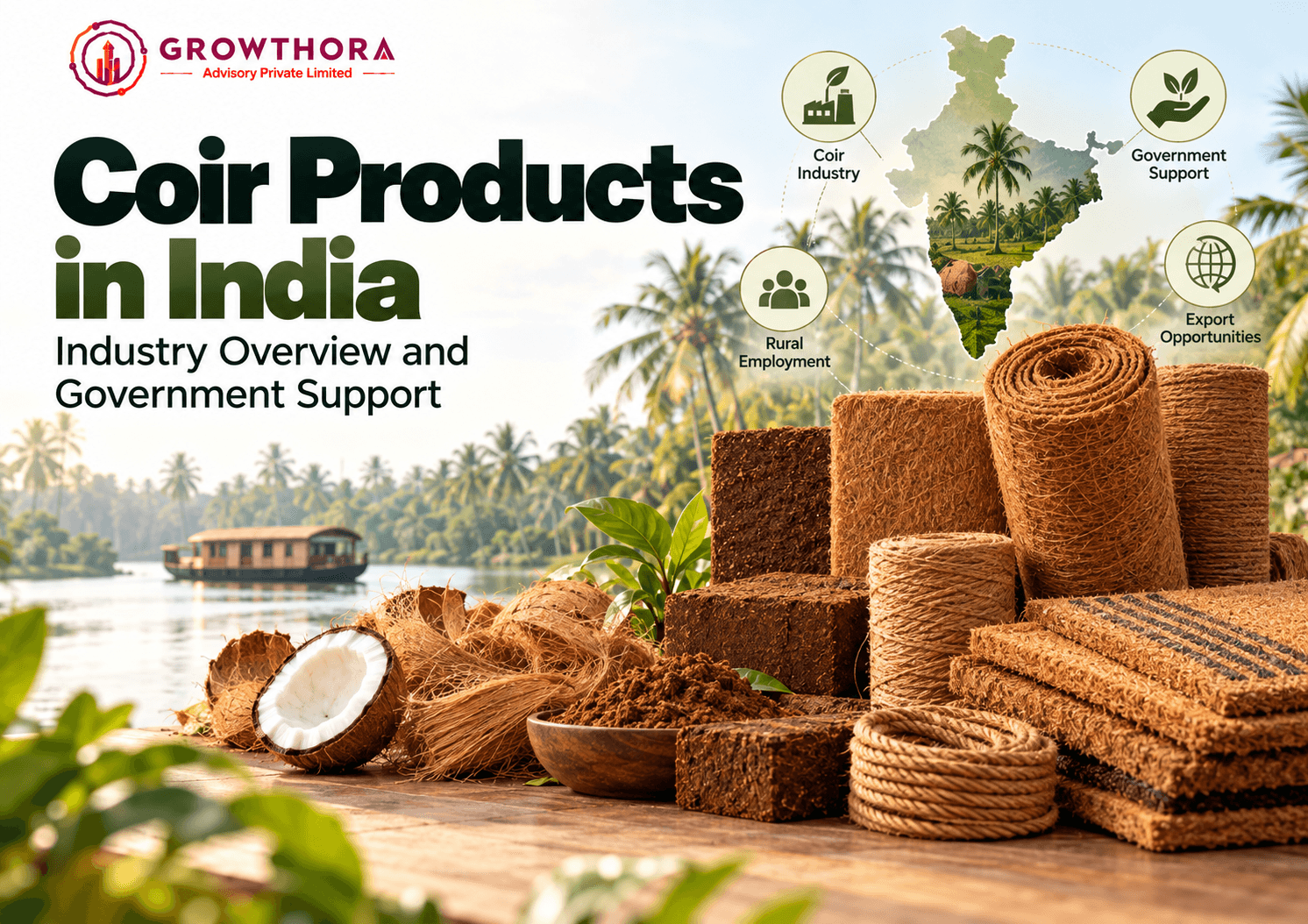
What Are Coir Products?
Coir products are goods manufactured from coir, the natural fibre extracted from the husk of the coconut, spanning categories such as coir fibre and yarn, coir mats and mattings, coir rope, coir geotextiles used for soil erosion control, coir pith and coco peat used as a growing medium in horticulture, and coir-based composite and wood-substitute materials.
India is the world’s largest producer and exporter of coir and coir products, with the industry concentrated heavily in Kerala, which has historically been the traditional heartland of coir processing, alongside significant production in Tamil Nadu, Andhra Pradesh, Odisha, West Bengal, Karnataka, and the Northeastern states.
The Coir Board and Its Role
What is the Coir Board?
The Coir Board is a statutory body constituted under the Coir Industry Act, 1953, functioning under the Ministry of Micro, Small and Medium Enterprises, responsible for the overall development and promotion of India’s coir industry, covering production and quality enhancement, financial and technical assistance, research and development, domestic and international marketing, and the welfare of coir workers.
The Board’s functions span industry modernization, training and skill development for entrepreneurs and workers, export facilitation through market intelligence and trade fair participation, financing and subsidy schemes specifically targeted at MSMEs in the sector, and a dedicated workers’ welfare fund covering healthcare and insurance support.
Coir Udyami Yojana: The Core Subsidy Scheme
What is Coir Udyami Yojana?
Coir Udyami Yojana, formerly known as the REMOT Scheme, is a Central Sector credit-linked subsidy scheme implemented by the Coir Board, providing assistance to set up any type of coir unit, with a maximum admissible project cost of Rs 10 lakh plus one cycle of working capital not exceeding 25 percent of the project cost, structured as 40 percent Government of India subsidy, 55 percent bank loan, and 5 percent beneficiary contribution.
Export Market Promotion Support
What export support does the Coir Board provide?
The Coir Board implements the Export Market Promotion Scheme under Coir Vikas Yojana, a Central Sector Scheme supporting registered coir exporters through sponsored trade delegations, participation in international seminars, conferences, and exhibitions, and financial assistance under the External Market Development Assistance component, introduced in 2000-01 to help Indian coir businesses build genuine international buyer relationships.
To access this support, a business typically needs Coir Board registration, Udyam registration, and a valid Importer Exporter Code, since these three registrations together establish both the entity’s MSME status and its legal standing to trade internationally. In a recent reporting period, the Coir Board registered 143 new exporter members and issued Registration-Cum-Membership Certificates, alongside disbursing financial assistance to dozens of coir entrepreneurs under the International Co-operation Scheme component of export promotion.
SFURTI: Cluster-Based Development
What is SFURTI in the coir sector?
SFURTI, the Scheme of Fund for Regeneration of Traditional Industries, launched by the Ministry of MSME in 2005, uses the Coir Board as the nodal agency for coir sector clusters, supporting the establishment of Common Facility Centres, capacity building, product development and design intervention, and market promotion including dedicated outlets in selected coir-producing clusters.
This cluster-based approach recognises that individual coir units, often small and dispersed across rural coastal areas, benefit disproportionately from shared processing infrastructure and coordinated market access that no single small unit could economically build on its own.
Why Coir Products Have Strong Export Demand
Global demand for coir products has grown steadily, driven by increasing interest in natural, biodegradable materials as an alternative to synthetic fibres and plastics, particularly in horticulture (coco peat as a growing medium), erosion control (coir geotextiles), and home furnishings (mats and mattings). This sustainability-linked demand gives Indian coir MSMEs a genuine structural tailwind, since buyers in Europe, the Middle East and parts of Asia increasingly favour natural fibre products for both functional and environmental reasons.
How to Enter the Coir Business
- Identify the specific coir product category you want to enter, whether raw fibre processing, finished products like mats and mattings, or higher-value categories like coir pith and coco peat for horticultural export.
- Complete Udyam Registration and register your unit with the Coir Board, since Coir Board registration is typically a prerequisite for accessing the Board’s own schemes.
- Apply for Coir Udyami Yojana if setting up a new unit, preparing a project report within the Rs 10 lakh project cost ceiling to access the 40 percent subsidy structure.
- If your business plan targets exports, obtain an Importer Exporter Code from DGFT alongside your Coir Board registration to access Export Market Promotion support.
- Explore whether your region has an active SFURTI coir cluster, since accessing shared Common Facility Centre infrastructure can meaningfully lower your own capital investment needs.
- Engage with Coir Board’s training programmes and technical guidance, since the sector’s quality and design standards are increasingly important for competing in higher-value export markets rather than only domestic commodity-grade sales
Key Takeaways
- India is the world’s largest producer and exporter of coir products, with Kerala as the traditional industry heartland alongside significant production in several other coastal states.
- Coir Udyami Yojana offers a genuinely favorable financing structure for new units: 40 percent government subsidy, 55 percent bank loan, and only 5 percent beneficiary contribution, within a Rs 10 lakh project cost ceiling.
- Export Market Promotion support under Coir Vikas Yojana helps registered exporters access trade fairs, international buyer connections, and financial assistance for market development.
- SFURTI uses the Coir Board as nodal agency for coir cluster development, supporting shared processing infrastructure that individual small units could not economically build alone.
- Growing global demand for natural, biodegradable materials gives Indian coir MSMEs a genuine structural export tailwind, particularly in horticulture, erosion control and home furnishings categories.
FAQs
What subsidy is available for setting up a new coir unit in India?
Coir Udyami Yojana provides a 40 percent Government of India subsidy on a project cost of up to Rs 10 lakh, with 55 percent financed as a bank loan and only 5 percent required as beneficiary contribution.
Which Indian state produces the most coir products?
Kerala is the traditional heartland of India’s coir industry, though significant production also takes place in Tamil Nadu, Andhra Pradesh, Odisha, West Bengal, Karnataka and the North Eastern states.
Do I need Coir Board registration to export coir products?
Yes, alongside Udyam Registration and a valid Importer Exporter Code, Coir Board registration is generally required to access the Board’s Export Market Promotion Scheme and related export support.
What is SFURTI and how does it help coir businesses?
SFURTI is a Ministry of MSME scheme using the Coir Board as nodal agency for coir sector clusters, supporting Common Facility Centres, capacity building, and market promotion infrastructure that individual small coir units share collectively.
What are the main categories of coir products?
Main categories include coir fibre and yarn, coir mats and mattings, coir rope, coir geotextiles for erosion control, and coir pith and coco peat used as a horticultural growing medium.
Why is global demand for coir products growing?
Demand is growing due to increasing global preference for natural, biodegradable materials over synthetic alternatives, particularly in horticulture, erosion control and home furnishing applications.
Conclusions
Setting up a Coir Udyami Yojana-backed unit, registering with the Coir Board, or structuring your export documentation for the coir sector involves several coordinated steps. Book a free consultation with Growthora Advisory’s MSME and export compliance team today.
Next step
Apply this to your business.
Confirm whether this applies to your legal structure, industry classification, and credit history - in under 30 minutes with an advisor.