
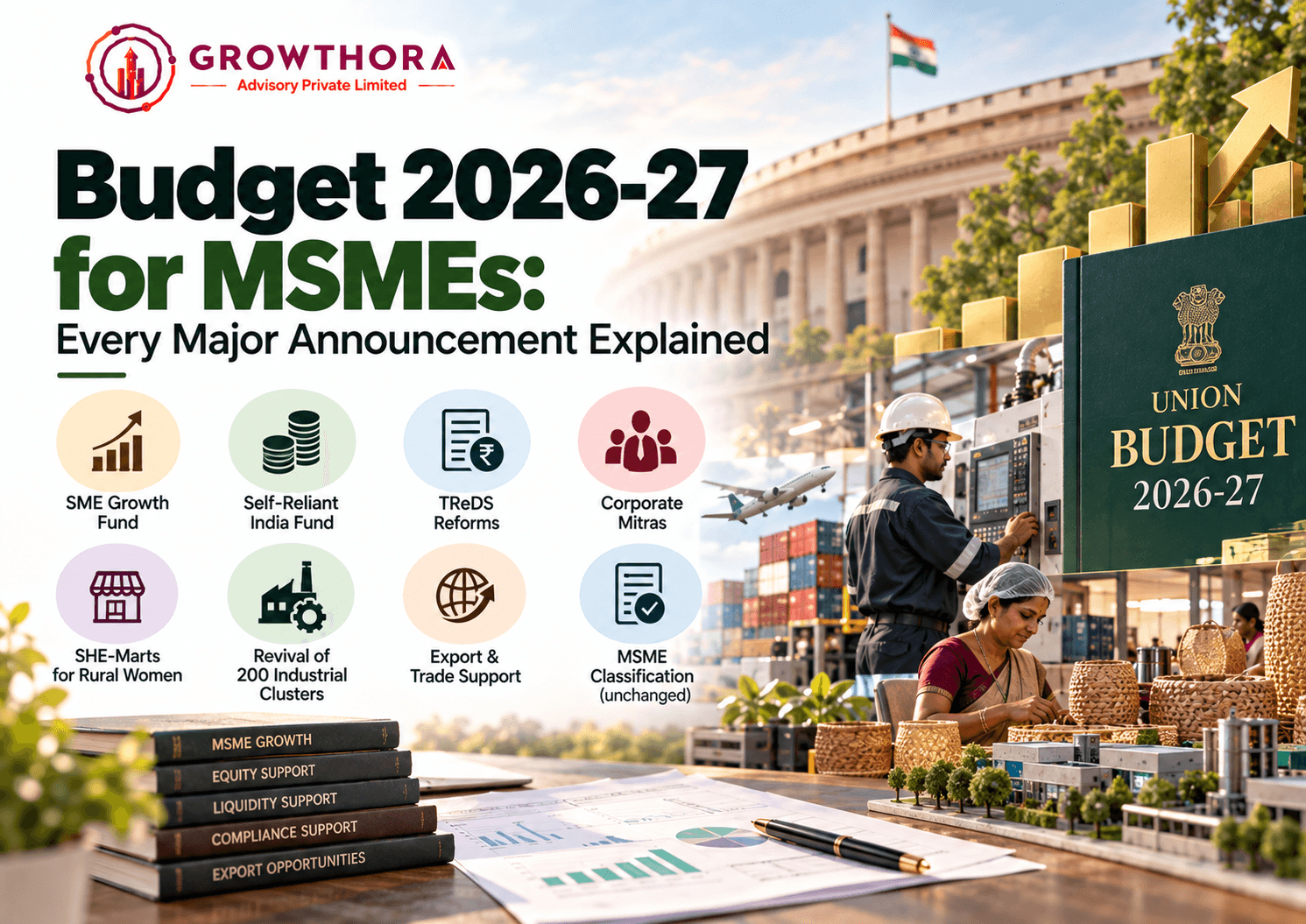
Overview: The Champion MSME Framework
What is the core MSME strategy in Budget 2026-27?
Budget 2026-27 sets out a three-pronged approach to help MSMEs grow as 'Champions': Equity Support to provide growth capital without heavy debt, Liquidity Support to speed up cash flow through TReDS reforms, and Professional Support to reduce the compliance burden through a new cadre of accredited para-professionals called Corporate Mitras.
The Finance Minister framed this as part of the Government's first 'kartavya', to accelerate and sustain economic growth by enhancing productivity and competitiveness and building resilience to volatile global dynamics, with 'Creating Champion MSMEs' listed as one of six specific intervention areas under that objective.
Pillar 1: Equity Support
- Rs 10,000 crore SME Growth Fund: a dedicated pool of equity and growth capital to create future 'Champion' enterprises, incentivising businesses based on select criteria such as a demonstrated manufacturing and innovation track record, with Rs 500 crore allocated for FY27.
- Rs 2,000 crore Self-Reliant India Fund top-up: an additional infusion into the Self-Reliant India Fund, originally set up in 2021, specifically to continue support to micro enterprises and maintain their access to risk capital.
Pillar 2: Liquidity Support Through TReDS Reforms
With more than Rs 7 lakh crore already made available to MSMEs through TReDS, the Trade Receivables Discounting System, Budget 2026-27 proposed four specific measures to deepen its impact:
- Mandating TReDS as the transaction settlement platform for all purchases from MSMEs by Central Public Sector Enterprises, setting a benchmark for other corporates
- Introducing a CGTMSE-backed credit guarantee support mechanism for invoice discounting on the TReDS platform
- Linking GeM with TReDS to share information about government purchases from MSMEs with financiers, enabling cheaper and quicker financing
- Introducing TReDS receivables as asset-backed securities, to help develop a secondary market and enhance liquidity and settlement
Pillar 3: Professional Support via Corporate Mitras
What problem are Corporate Mitras meant to solve?
Corporate Mitras are accredited para-professionals that the government will develop through short-term, modular courses designed with the Institute of Chartered Accountants of India, the Institute of Company Secretaries of India and the Institute of Cost Accountants of India, specifically to help MSMEs in Tier-II and Tier-III towns meet compliance requirements at an affordable cost, addressing the real-world gap many small businesses face in accessing professional advisory support.
SHE-Marts for Rural Women Entrepreneurs
Building on the Lakhpati Didi Programme, the Budget announced Self-Help Entrepreneur Marts, or SHE-Marts, community-owned retail outlets to be set up within cluster-level SHG federations, using enhanced and innovative financing instruments, to help women move from credit-led livelihoods toward genuine enterprise ownership.
Revival of 200 Legacy Industrial Clusters
Alongside the Champion MSME framework, the Budget proposed a scheme to revive 200 legacy industrial clusters, aimed at improving their cost competitiveness and operational efficiency through infrastructure and technology upgradation, an initiative expected to particularly benefit clusters of smaller manufacturers who depend heavily on shared local infrastructure.
Export and Trade Measures Relevant to MSMEs
- Removal of the courier export value cap: the previous Rs 10 lakh per-consignment value cap on courier exports was completely removed, specifically to support small businesses, artisans and start-ups seeking to access global markets through e-commerce.
- Extended export timelines: exporters of leather or textile garments, leather or synthetic footwear and other leather products now have 1 year, up from 6 months, to complete export of the final product manufactured from duty-free imported inputs.
- Expanded duty-free input limits for seafood exporters: the duty-free import limit for specified inputs used in seafood processing for export was raised from 1 percent to 3 percent of the previous year's FOB export turnover.
What Was Not Changed
Notably, Budget 2026-27 did not revise the MSME classification thresholds again; the limits set in Budget 2025-26, effective from 1 April 2025, of Rs 2.5 crore investment and Rs 10 crore turnover for micro, Rs 25 crore and Rs 100 crore for small, and Rs 125 crore and Rs 500 crore for medium enterprises, continue to apply unchanged.
Key Takeaways
- Budget 2026-27 introduced a three-pronged 'Champion MSME' framework: equity support, liquidity support and professional support.
- Equity support comprises a new Rs 10,000 crore SME Growth Fund and a Rs 2,000 crore top-up to the Self-Reliant India Fund.
- Liquidity support centres on four TReDS reforms, including a mandatory CPSE settlement platform requirement and a new CGTMSE-backed invoice discounting guarantee.
- Professional support introduces 'Corporate Mitras', accredited para-professionals developed with ICAI, ICSI and ICMAI, to lower MSME compliance costs in Tier-II and Tier-III towns.
- Separately, the Budget announced SHE-Marts for rural women entrepreneurs, revival of 200 legacy industrial clusters, and removal of the Rs 10 lakh courier export value cap; MSME classification limits were left unchanged.
FAQs
What are the main MSME announcements in Budget 2026-27?
Budget 2026-27, presented on 1 February 2026, introduced a three-pronged 'Champion MSME' framework covering equity support (a Rs 10,000 crore SME Growth Fund and a Rs 2,000 crore Self-Reliant India Fund top-up), liquidity support (TReDS reforms including a CPSE mandate and CGTMSE-backed invoice discounting guarantee), and professional support (a Corporate Mitra cadre developed with ICAI, ICSI and ICMAI), alongside SHE-Marts for rural women and the revival of 200 legacy industrial clusters.
What is the SME Growth Fund announced in Budget 2026-27?
The SME Growth Fund is a dedicated Rs 10,000 crore pool of equity and growth capital, with Rs 500 crore allocated for FY27, designed to help high-potential SMEs with a proven manufacturing and innovation track record scale into globally competitive 'Champion' enterprises.
How does Budget 2026-27 change TReDS for MSMEs?
Budget 2026-27 proposed making TReDS mandatory as the transaction settlement platform for all purchases from MSMEs by Central Public Sector Enterprises, introducing a CGTMSE-backed credit guarantee for invoice discounting on TReDS, linking GeM with TReDS to give financiers visibility into government purchase data, and enabling TReDS receivables to be issued as asset-backed securities.
What is the Self-Reliant India Fund top-up in Budget 2026-27?
The Finance Minister proposed topping up the Self-Reliant India Fund, originally set up in 2021, with an additional Rs 2,000 crore in Budget 2026-27, specifically to continue supporting micro enterprises and maintain their access to risk capital.
What are 'Corporate Mitras' announced in this Budget?
Corporate Mitras are a new cadre of accredited para-professionals that the government will develop in partnership with the Institute of Chartered Accountants of India, the Institute of Company Secretaries of India and the Institute of Cost Accountants of India, through short-term modular courses, to help MSMEs, especially in Tier-II and Tier-III towns, meet compliance requirements at affordable cost.
Did Budget 2026-27 change the MSME classification limits again?
No, Budget 2026-27 did not revise the MSME classification thresholds; the current limits of Rs 2.5 crore investment and Rs 10 crore turnover for micro, Rs 25 crore and Rs 100 crore for small, and Rs 125 crore and Rs 500 crore for medium enterprises were set in the previous year's Budget, effective 1 April 2025, and remain unchanged.
Talk to Growthora
If you want a clear read on how Budget 2026-27's SME Growth Fund, TReDS reforms or Corporate Mitra framework specifically apply to your business, Growthora Advisory can walk you through it and help you position for the schemes as they roll out. Book a free consultation with our funding team today.
Next step
Apply this to your business.
Confirm whether this applies to your legal structure, industry classification, and credit history - in under 30 minutes with an advisor.