
Why CPC was created
Before centralized processing, income tax returns were assessed individually by local assessing officers across the country, a system that was slow and inconsistent given the volume of returns filed every year. The Finance Act, 2008, introduced Section 143(1A), giving the Central Board of Direct Taxes the power to design a scheme for centralized, largely automated processing of returns, which led to the creation of the Centralized Processing Centre in Bengaluru.
CPC now functions as the first point of contact for virtually every electronically filed return in India, handling the preliminary computerized check before any human assessing officer gets involved, unless the return is specifically picked up for scrutiny or further assessment later.
Key Takeaways
- CPC was created after the Finance Act, 2008, inserted Section 143(1A) into the Income Tax Act, 1961, empowering the CBDT to set up a centralized scheme for processing returns.
- CPC operates two distinct units for different purposes: CPC (ITR), which processes income tax returns, and CPC (TDS), which separately handles Tax Deducted at Source processing and TDS return matching.
- Every electronically filed return, whether filed under Section 139 or in response to a notice under Section 142(1), passes through CPC for arithmetic verification, tax credit matching, and computation.
- The outcome of CPC processing is always one of three results: No Demand, No Refund, or Refund Determined, communicated through the Section 143(1) intimation.
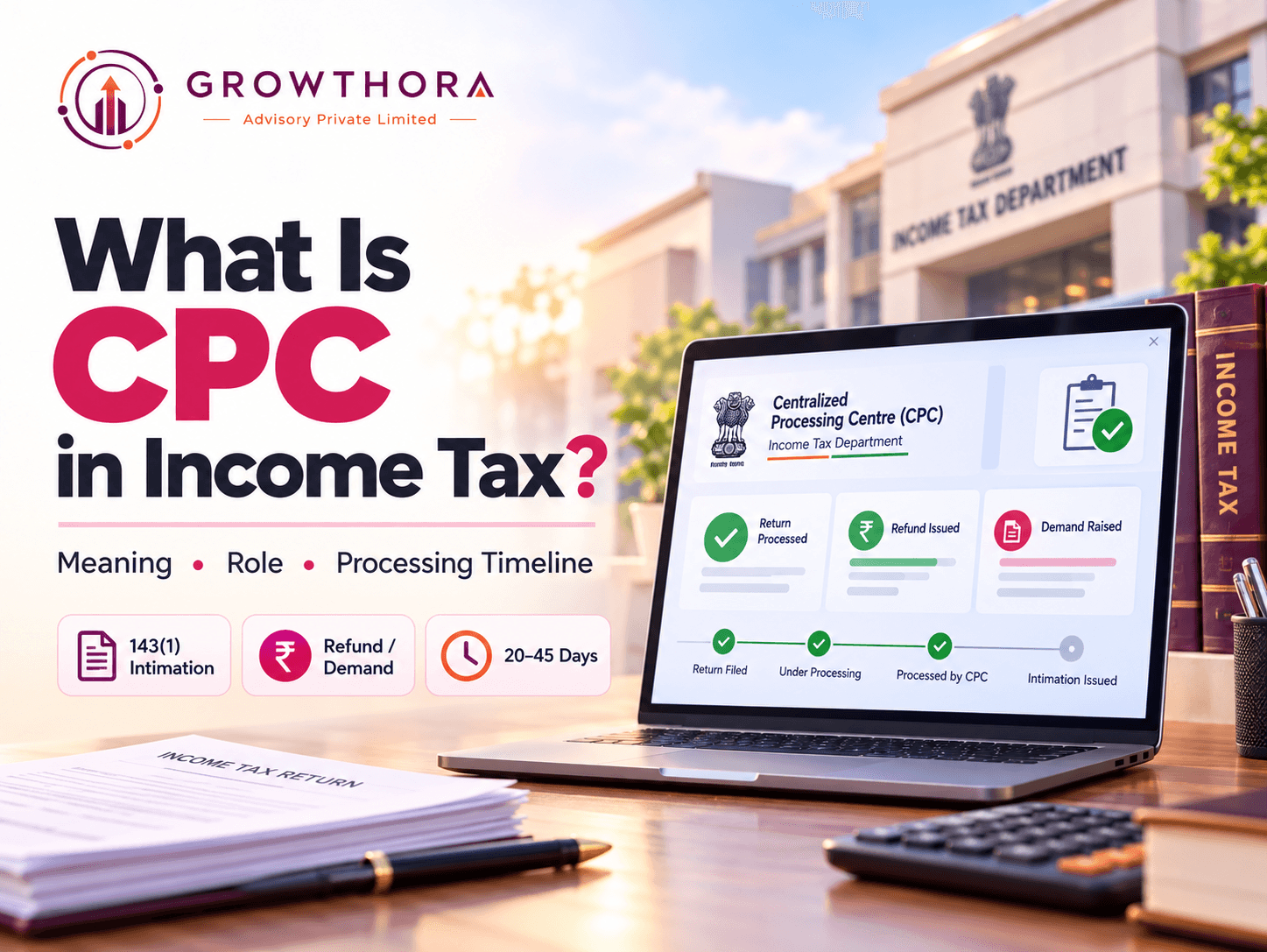
- By law, CPC must issue the intimation within nine months from the end of the financial year in which the return was filed, though in practice many returns are processed in 20 to 45 days after e-verification.
- Taxpayers who do not e-verify their return online must post the signed ITR-V to the Centralized Processing Centre, Income Tax Department, Bengaluru, 560500, since CPC only acts on returns it has formally received.
What CPC actually does with your return
- Validates the arithmetical accuracy of the figures reported in the return
- Matches tax credits claimed in the return against Form 26AS, the Annual Information Statement, and TDS records
- Checks for obvious inconsistencies, such as income reported in AIS that was not declared in the return
- Computes the final tax liability, interest where applicable, and any refund due
- Issues the Section 143(1) intimation summarising the comparison between what you filed and what CPC computed
CPC (ITR) versus CPC (TDS)
| Unit | What it handles |
|---|---|
| CPC (ITR) | Processing of filed Income Tax Returns, issuing Section 143(1) intimations and determining refunds or demands for individual and entity taxpayers |
| CPC (TDS) | Processing of TDS and TCS returns filed by deductors, matching challans and generating Form 16/16A and related TDS compliance communications |
Understanding Section 143(1) Intimation
The Section 143(1) intimation is the formal document CPC sends once processing is complete. It lays out CPC's computation line by line next to the figures you originally filed, making it possible to see exactly where, if anywhere, a difference arose. The outcome always falls into one of three categories: No Demand No Refund, meaning your filed figures were accepted as is; Refund Determined, meaning you are due money back; or Demand Determined, meaning CPC has calculated that you owe additional tax.
If CPC proposes an adjustment before finalising the intimation, for example a mismatch between your return and your Form 26AS or AIS, it first issues a notice under Section 143(1)(a), giving you an opportunity to respond or accept the adjustment before the final intimation is generated.
Typical CPC processing timeline
- E-verification of the return, either through Aadhaar OTP, net banking or other approved methods, triggers the start of CPC's processing timeline.
- If you do not e-verify online, you must post the signed ITR-V to Centralized Processing Centre, Income Tax Department, Bengaluru, 560500 within the stipulated window, since CPC only begins processing once your return is validated.
- Most straightforward returns are processed within 20 to 45 days of e-verification.
- The law allows the department up to nine months from the end of the financial year in which the return was filed to issue the Section 143(1) intimation, so complex or flagged returns can take considerably longer.
- Once the intimation shows a refund determined, CPC transmits the refund instruction to the State Bank of India, the department's designated refund banker, for payment to your registered bank account.
Where to check your CPC processing status
- Log in to the e-Filing portal and go to the Refund/Demand Status section under My Account to check the outcome of CPC processing.
- View the actual Section 143(1) intimation under the e-Proceeding or Intimation sections of the portal, or in the password-protected email CPC sends to your registered email address.
- The intimation's password is typically your PAN in lowercase followed by your date of birth in DDMMYYYY format, though you should confirm the exact format shown on the communication.
- If an intimation shows a demand you believe is incorrect, you can respond through the e-Filing portal's rectification or grievance process rather than ignoring the notice.
Frequently Asked Questions
What does CPC stand for in income tax?
CPC stands for Centralized Processing Centre, the Income Tax Department's automated facility in Bengaluru that processes all electronically filed income tax returns.
What is the difference between CPC (ITR) and CPC (TDS)?
CPC (ITR) processes individual and entity income tax returns and issues Section 143(1) intimations, while CPC (TDS) separately handles TDS and TCS return processing for deductors.
How long does CPC take to process an income tax return?
Most returns are processed within 20 to 45 days of e-verification, though the law allows up to nine months from the end of the relevant financial year for the department to issue the intimation.
What is a Section 143(1) intimation from CPC?
It is the formal communication CPC sends after processing a return, showing a comparison between the filed figures and CPC's computation, with an outcome of No Demand No Refund, Refund Determined, or Demand Determined.
What should I do if I don't e-verify my return online?
You must post the signed ITR-V to Centralized Processing Centre, Income Tax Department, Bengaluru, 560500, since CPC only starts processing once it has formally received a validated return.
What does it mean if my ITR status shows 'processed at CPC'?
It means the Centralized Processing Centre in Bengaluru has completed its assessment of your return, with income verified, TDS matched, and a final outcome of refund, demand or no change determined.
Received a confusing CPC intimation or a tax demand?
A Section 143(1) intimation can be hard to read line by line, and a demand-determined notice needs a timely, correct response. Book a free consultation with Growthora, and we will help you interpret your CPC intimation and respond to any discrepancy before the deadline.
Next step
Apply this to your business.
Confirm whether this applies to your legal structure, industry classification, and credit history - in under 30 minutes with an advisor.