
What should a startup include in a grant proposal?
Follow the funding call's required format first. As a general preparation checklist, organise the problem statement, proposed solution, work plan, measurable milestones, itemised budget and rationale, team capability, risks, and evidence of need or validation. Add the documents and declarations requested by the programme, and check every expense against its eligibility rules.
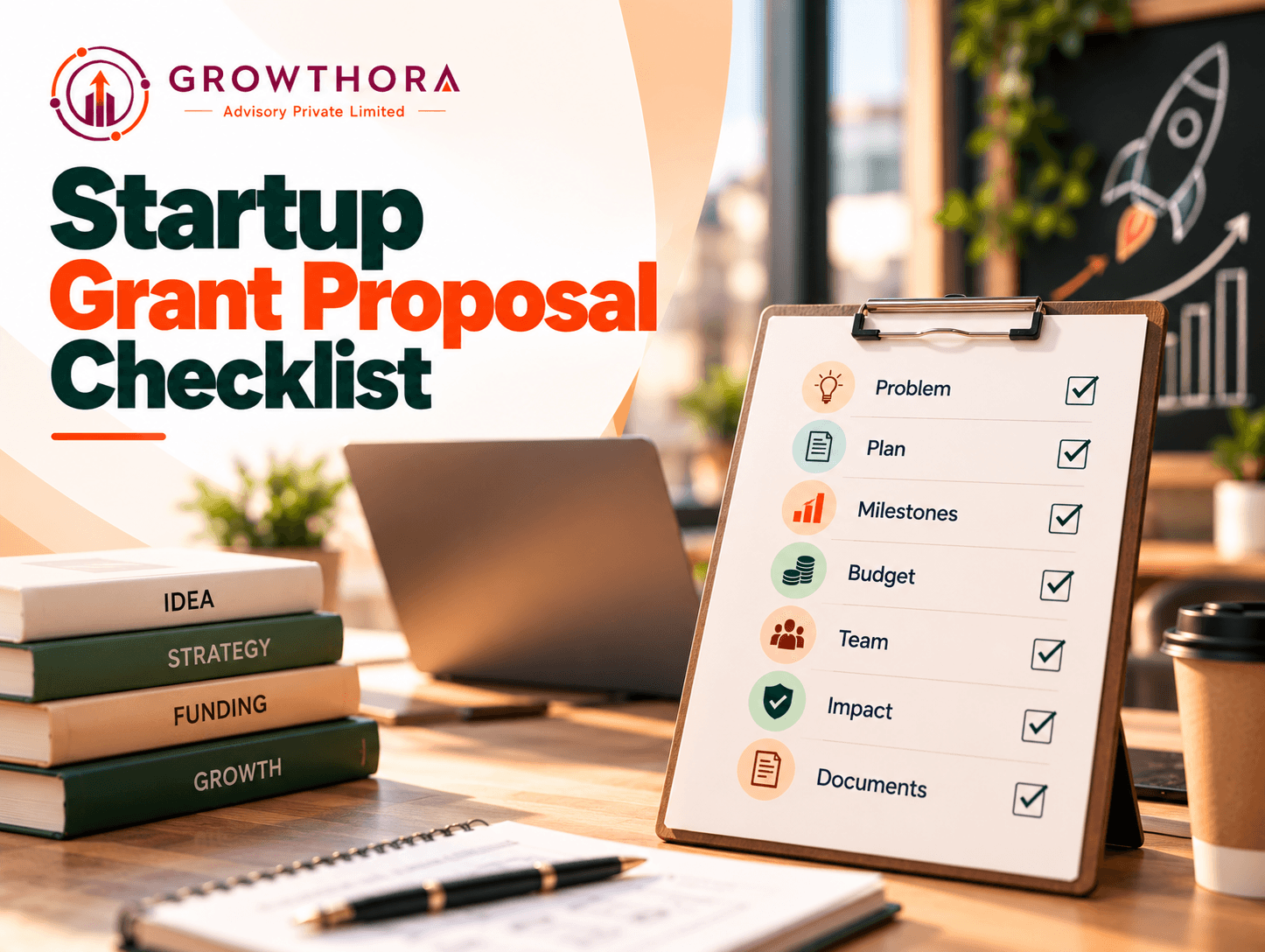
Startup grant proposal checklist
Use the table below to check whether the proposal is clear, supported by evidence and consistent across sections. Mark an item complete only when the relevant information is present and checked.
| Checklist item | What to prepare |
|---|---|
| Problem and need | Describe the problem, who experiences it and why it matters. Support the claim with credible research, user feedback or observed data. |
| Proposed solution | Explain what the startup will build or deliver, how it addresses the problem and what is distinct about the approach. |
| Objectives and scope | Define what the funded project will and will not cover. Keep the scope realistic for the proposed timeline. |
| Work plan | Break the project into activities, owners, dates and dependencies. Make the work plan consistent with the budget. |
| Measurable milestones | Define observable outputs or outcomes, target dates and the evidence that will demonstrate completion. |
| Budget and rationale | List each cost, calculation basis, timing and purpose. Connect costs to activities and milestones. |
| Team capability | Explain who will deliver the work and provide relevant experience, roles or capability gaps and how they will be addressed. |
| Need and impact evidence | Include appropriate validation such as user interviews, pilot results, test reports, letters of interest or baseline data. |
| Risks and mitigation | Identify technical, market, delivery, compliance or supplier risks and describe realistic mitigation steps. |
| Required documents | Use the programme's official checklist for incorporation, recognition, financial, identity, bank, declaration and other supporting records. |
| Monitoring and reporting | State how progress, spending and results will be tracked and what evidence can be reported to the funder. |
| Final compliance review | Confirm eligibility, application format, file types, word limits, signatures, deadline, portal fields and submission receipt. |
Grant application budget checklist
The budget should explain what the project needs and why each cost is reasonable. A number without a calculation or link to project activity is difficult to assess. The official call rules always decide which costs are allowed.
- List each expense separately rather than using one broad line such as 'project costs'.
- Show the calculation basis, for example, quantity multiplied by unit cost and duration, where relevant.
- Explain the purpose of each expense and connect it to an activity or milestone.
- Map the expected spending period to the project timeline and any proposed instalments.
- Separate costs by category only where the application format or programme rules require it.
- Check the call's rules on eligible and ineligible expenses, taxes, equipment, salaries, travel, consultants, procurement and quotations.
- Identify other funding or contributions if the form asks for them, and avoid double-counting the same cost.
- Keep supporting estimates, quotations and calculation notes available where requested.
- Make sure the requested amount matches the budget totals and the narrative in the proposal.
Example: connect a budget item to a milestone.
Illustrative example only: if a startup plans to test a prototype, a budget line for testing materials or a laboratory service should explain the quantity or service required, the estimated cost basis, when the expense will occur and which test report or result will demonstrate completion. Do not copy the example as an eligible expense without checking the specific call.
How to define useful startup grant project milestones
A milestone should describe a result that can be checked, not just an intention. Work on prototype' is vague. Complete prototype version 1 and submit a test report by the agreed month' it is easier to assess, provided that it matches the project and the funder's requested format.
| Milestone | What will be completed? |
|---|---|
| Target date or period | When should it be completed? |
| Owner | Who is responsible? |
| Budget link | Which planned costs support this work? |
| Evidence | What record proves completion, such as a test report, demo, user feedback or deliverable? |
| Dependency or risk | What could delay the milestone and what is the mitigation? |
Impact evidence: what should founders prepare?
Use evidence that directly relates to the problem, solution and stage of the startup. Early-stage teams may not have large datasets, and that is not a reason to overstate results. Be clear about the difference between completed work, early signals and future targets.
- Problem evidence: user interviews, field observations, credible research or baseline measurements.
- Validation evidence: prototype tests, pilot outcomes, usability feedback or documented experiments.
- Demand evidence: letters of interest, pilot partners, customer feedback or early sales records where available.
- Impact measures: a defined indicator, starting point, target and measurement method.
- Traceability: source, date, sample size or method where relevant, and limitations of the evidence.
Do not present projections as achieved outcomes or describe a small, informal sample as representative of an entire market. Explain the limits of the evidence and what the proposed grant-funded work will test next.
Common grant proposal documents
The exact document list depends on the scheme, applicant type and application stage. Common preparation items may include:
- Certificate of incorporation or registration and relevant entity details.
- DPIIT startup recognition certificate, if required by the programme.
- Founder, director, ownership or shareholding information, if requested.
- Pitch deck, project proposal or business plan in the prescribed format.
- Project timeline, milestone plan and itemised budget.
- Financial statements, bank details, and tax or compliance records where required.
- Letters of support, pilot evidence, test reports, quotations or other proof relevant to the project.
- Declarations, undertakings and consent forms specified in the application.
This is a general preparation list, not an official universal requirement. The current scheme guidelines and application portal take precedence.
Official example: milestone-based support under Startup India Seed Fund Scheme
The official Startup India Seed Fund Scheme guidelines describe grant support for proof-of-concept validation, prototype development or product trials, with disbursement in milestone-based instalments. The guidelines give examples such as prototype development, product testing and preparing a product for market launch. This illustrates why a proposal's milestones, spending plan and evidence should fit together.
Important status caveat: the official SISFS portal currently displays a notice stating that the last date for startup applications was 31 May 2026. Treat this as a dated scheme-specific notice and recheck the official portal before relying on it. This article uses SISFS only as an example of milestone-based proposal planning, not as a claim that applications are currently open.
A simple consistency check before submission
- Does each objective connect to an activity and at least one measurable milestone?
- Does each major budget item support an activity or milestone?
- Do the milestones fit the project duration and the team's capacity?
- Can the team provide the evidence promised for each milestone?
- Are assumptions, risks and dependencies stated honestly?
- Do the proposal, budget sheet and portal form use consistent amounts, dates and terminology?
- Have all mandatory attachments, declarations and signatures been included?
- Has a second reviewer checked the final files against the official call?
What should a startup include in a grant proposal?
Follow the call's required format first. Common preparation areas include the problem, proposed solution, work plan, measurable milestones, budget rationale, team capability, risks and evidence of need or validation. Include only the documents and declarations required by the specific programme.
How can a founder align a grant budget with milestones?
Map each expense to a deliverable and timeline, explain assumptions, separate eligible and ineligible costs according to the call, and show how results will be measured and reported. Make sure the budget total, activity plan and milestone schedule agree.
Frequently asked questions
What should a startup include in a grant proposal?
Follow the call's required format first. Common preparation areas include the problem, proposed solution, work plan, measurable milestones, budget rationale, team capability, risks and evidence of need or validation.
How can a founder align a grant budget with milestones?
Map each expense to a deliverable and timeline, explain assumptions, separate eligible and ineligible costs according to the call, and show how results will be measured and reported.
Which documents are commonly needed for a startup grant application?
Depending on the programme, applicants may need incorporation and startup recognition records, founder and shareholding details, a pitch deck or proposal, project plan, budget, financial information, bank details, declarations and supporting evidence. The official call checklist takes precedence.
Should a startup include a detailed budget in its grant proposal?
If the application requests a budget, show the amount, calculation basis, timing and purpose of each cost. Link each cost to an activity or milestone and check the programme's rules on eligible expenses, taxes, procurement and supporting quotations.
What are grant project milestones?
Milestones are specific, time-bound results that show progress, such as completing a prototype, running a defined test or validating a product with users. Use the milestones and evidence requirements requested by the funding programme.
What counts as impact evidence for a grant?
Evidence may include user interviews, pilot results, test reports, letters of interest, baseline data, customer feedback or other records relevant to the problem. Clearly label what is measured, estimated or planned, and do not present projections as achieved results.
Can I use the same grant proposal for every scheme?
Use a core proposal as a starting point, but tailor it to each call's objectives, eligibility, format, scoring criteria, budget rules and reporting requirements. Reusing a proposal without adapting it can leave important requirements unanswered.
Does a strong proposal guarantee grant approval?
No. A complete proposal helps reviewers assess the application, but selection depends on the programme's criteria, competition, available funding and due diligence. Never treat a checklist as a guarantee of approval.
Conclusion
A useful grant proposal is clear, evidence-led and internally consistent. Before submission, check the official format, connect the budget to measurable milestones, prepare the supporting documents and state the limits of your evidence honestly. Use this checklist to organise the work, then let the specific programme guidelines determine the final requirements.
Next step
Apply this to your business.
Confirm whether this applies to your legal structure, industry classification, and credit history - in under 30 minutes with an advisor.