
Pillar One: Does Your Entity Actually Qualify
A Section 8 company isn't just “a non-profit company"; it's a specific legal vehicle with conditions attached to both its purpose and its structure.
The purpose test
The company's objects must genuinely center on promoting commerce, art, science, sports, education, research, social welfare, religion, charity, protection of the environment, or another object of public benefit. This isn't a box-ticking declaration; the registrar and regional director scrutinize the stated objects during licensing, and a company whose real purpose is commercial with a charitable label attached will run into trouble at this stage.
The no-profit-distribution rule
Whatever surplus the company generates has to go back into promoting its objects. There's no dividend to shareholders or members, ever. The Memorandum of Association must include this restriction explicitly, and it's the single clause that most distinguishes a Section 8 company from an ordinary private or public company doing similar work.
The structural requirements
- There is a minimum of 2 directors for a private Section 8 company, minimum 3 for a public one
- At least one director must be a resident of India, meaning physically present in the country for 182 or more days in the previous calendar year
- No minimum paid-up capital requirement, a Section 8 company can start with as little as ₹100 of subscribed capital
- Whatever capital is subscribed in the MOA must actually be deposited into the company's bank account within 60 days of incorporation
- A one-person company cannot be incorporated as, or later converted into, a Section 8 company, under Rule 3 of the Companies (Incorporation) Rules, 2014
Section 8 vs. Trust vs. Society: why founders pick this structure
Trusts and societies are also common vehicles for non-profit work in India, registered under different, often state-specific laws rather than the central Companies Act. A Section 8 company tends to be the preferred choice when an organisation wants a single national governance framework instead of fragmented state rules, wants the credibility of MCA regulation and audited annual filings when approaching institutional donors or CSR funders, or plans to scale operations across multiple states. Trusts and societies remain simpler to set up for smaller, single-state, family- or community-run charitable efforts.
Pillar Two: Getting the License and Incorporation Done
Documents you'll need
- Identity and address proof for all proposed directors and subscribers
- A draft Memorandum of Association clearly stating the charitable objects and the no-dividend restriction
- Draft Articles of Association appropriate to a guarantee or share-capital structure, as chosen
- An estimate of income and expenditure for the next three years, showing how the company intends to fund its stated objects
- A declaration from a practising professional, typically a CA, CS, or advocate, confirming compliance with the Act's requirements
- Declarations from the promoters and directors as prescribed under the incorporation rules
- Proof of the registered office address, with an NOC from the owner where applicable
The process, step by step
- Decide on the structure, a company limited by guarantee or by shares, and reserve a name through SPICe+ Part A that reflects the entity's charitable purpose rather than a commercial brand name.
- Obtain digital signature certificates for all directors and, through the same integrated form, apply for director identification numbers.
- Draft the Memorandum of Association and Articles of Association, making sure the MOA explicitly states the charitable objects and the restriction on profit distribution.
- File SPICe+ Part B, the integrated incorporation and Section 8 licensing application, attaching the MOA, AOA, three-year income and expenditure estimate, professional declaration, and promoter declarations. Since the 2019 amendment, this single filing covers what used to require a separate INC-12 licence application to the regional director beforehand, though some older guides still describe the two as separate steps, worth keeping in mind if you're cross-referencing other sources.
- The Registrar of Companies scrutinizes the application with particular attention to whether the stated objects are genuinely charitable rather than commercial in substance.
- Once satisfied, the Registrar issues the Section 8 license and the Certificate of Incorporation together, along with the company's PAN and TAN through the same integrated filing.
What it costs
- MCA government fee: nominal, based on authorised capital, often around ₹2,000 for companies with minimal capital
- Digital Signature Certificate: ₹1,000 to ₹2,000 per director, so ₹2,000 to ₹4,000 total for a two-director private Section 8 company
- Stamp duty on incorporation documents: state-dependent
- Professional fees for drafting the MOA and AOA and handling the filing: typically the largest variable, commonly ₹5,000 to ₹20,000 depending on complexity
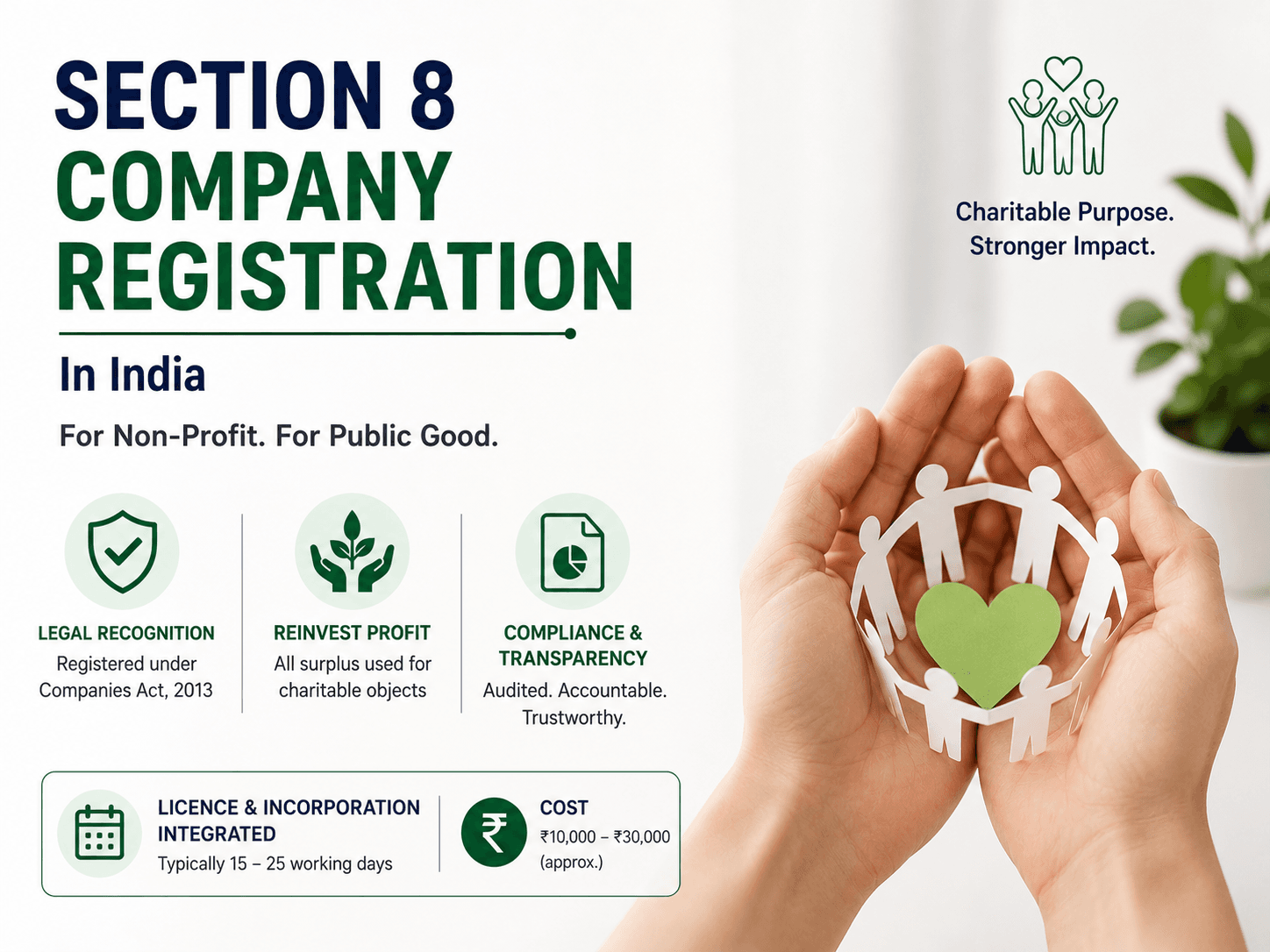
- All-inclusive typical total: ₹10,000 to ₹30,000
How long it takes
Most sources converge on 15 to 25 working days for the full process: name approval in 1 to 3 days; DSC and DIN issuance in a couple of days; the licensing and incorporation review by the Registrar taking up the bulk of the time; and final certificate issuance shortly after. Applications with vague or commercially flavored object clauses tend to draw queries from the Registrar, which extends this timeline.
Pillar Three: Compliance That Starts the Moment You're Registered
This is the part that gets underweighted in a lot of registration-focused guides, and it's the part that actually determines whether a Section 8 company can function the way its founders intended.
Tax exemption isn't automatic
Incorporating as a Section 8 company doesn't itself make donations to you tax-deductible or make the company's own income tax-exempt. Both of those require separate registration under Section 12A (income tax exemption for the entity) and Section 80G (tax deduction for donors) of the Income Tax Act, filed through Form 10A on the income tax e-filing portal. There's no government fee for either, but professional fees for the filing typically run ₹5,000 to ₹10,000 per registration. Both are now granted under Section 12AB with five-year validity, after which renewal through Form 10AB becomes mandatory.
If you plan to receive CSR funding
A Section 8 company that wants to receive corporate social responsibility funding from companies needs to separately register on Form CSR-1 with the MCA, a requirement that's easy to miss if you're focused only on the incorporation itself.
If you plan to seek government grants or foreign contributions
- NGO Darpan registration with NITI Aayog is typically necessary to access most government grants and schemes
- FCRA registration, entirely separate from incorporation, is required before receiving any foreign contribution, and generally requires the organisation to have existed and been active for at least three years before applying
Ongoing annual obligations
- Regular statutory filings and financial statements with the MCA, the same basic obligation any registered company carries
- Statutory audit of accounts, since Section 8 companies don't get an exemption from this simply because they're non-profit
- Keeping the Digital Signature Certificate current, since it typically lasts two years and needs renewal before the next filing cycle, easy to let lapse if nobody's tracking it
- Continuing to apply profits solely toward the stated charitable objects, since deviating from this is the core condition on which the Section 8 license itself was granted
What happens if compliance slips
The Section 8 license itself can be revoked by the central government if the company's conduct falls out of line with its stated objects or if it distributes profits in violation of its MOA. This is a real, not theoretical, risk: it's the one form of company registration in India where the underlying license to operate as a structure, not just your compliance standing, is directly tied to how faithfully you honor the non-profit purpose you registered under.
Frequently Asked Questions
What is a Section 8 company?
A non-profit company registered under Section 8 of the Companies Act, 2013, formed to promote objects like education, charity, art, science, sports, or environmental protection, with a legal restriction against distributing profits as dividends.
Who is eligible to register a Section 8 company?
Any group forming a company with genuinely charitable or public-benefit objects, with a minimum of 2 directors (private) or 3 (public), at least one Indian resident director, and no minimum capital requirement. One-person companies are explicitly excluded.
What documents are required for Section 8 company registration?
Director and subscriber identity proof, a draft MOA stating the charitable objects and no-dividend clause, draft AOA, a three-year income and expenditure estimate, and a professional's declaration of compliance.
How much does Section 8 company registration cost?
Typically ₹10,000 to ₹30,000 all-inclusive, covering nominal MCA fees, DSC for directors, stamp duty, and professional fees for drafting and filing.
How long does registration take?
Generally 15 to 25 working days, though this can extend if the Registrar raises questions about whether the stated objects are genuinely charitable.
Is there a separate INC-12 filing for the Section 8 licence?
Since the Companies (Incorporation) Sixth Amendment Rules, 2019, the Section 8 licence is applied for and granted together with incorporation through SPICe+ Part B, rather than as a separate prior filing to the Regional Director, which was the older process.
Does registering as a Section 8 company give automatic tax exemption?
No. Section 8 status is a corporate structure, not a tax status. Income tax exemption requires separate registration under Section 12A, and donor tax deductibility requires separate registration under Section 80G, both filed through Form 10A.
Can an OPC become a Section 8 company?
No. Rule 3 of the Companies (Incorporation) Rules, 2014, specifically prohibits a one-person company from being incorporated as, or converted into, a Section 8 company.
What's the difference between a Section 8 company, a trust, and a society?
A Section 8 company is registered centrally under the Companies Act with MCA oversight and mandatory audited filings, while trusts and societies are typically registered under state-specific laws with generally lighter, more localized compliance. Section 8 companies tend to suit organizations planning to scale nationally or seek institutional and CSR funding.
Is a minimum capital required for a Section 8 company?
No. A Section 8 company can be incorporated with as little as ₹100 in subscribed capital, whatever amount is subscribed must be deposited into the company's bank account within 60 days of incorporation.
Can a Section 8 company's licence be cancelled?
Yes. The Central Government can revoke the licence if the company's actual conduct departs from its stated charitable objects or if profits are distributed in violation of the MOA.
Do Section 8 companies need to be audited every year?
Yes. Statutory audit and regular MCA filings are mandatory for Section 8 companies just as they are for any other registered company, non-profit status doesn't exempt them from this.
What is CSR-1 registration, and does a Section 8 company need it?
It's a separate MCA registration required for any entity, including a Section 8 company, that wants to be eligible to receive corporate social responsibility funding from companies under the Companies Act's CSR provisions.
The Actual Order to Do This In
Get the objects clause right before you file anything, since that's what the Registrar scrutinizes most closely, and it's expensive to redo. Complete SPICe+ Part B for the combined license and incorporation once your MOA genuinely reflects a charitable purpose rather than a commercial one wearing a non-profit label. Then, as soon as incorporation is granted, treat 12A and 80G as part of the same project rather than an afterthought, since an organization that can't offer donors a tax deduction is starting with one hand behind its back when it comes to fundraising.
The founders who get the most out of this structure are the ones who plan for CSR-1, NGO Darpan, and eventually FCRA from day one, rather than registering the company first and figuring out the rest later. Compliance here isn't a separate chapter after incorporation; it's the reason the structure exists in the first place.
Next step
Apply this to your business.
Confirm whether this applies to your legal structure, industry classification, and credit history - in under 30 minutes with an advisor.