
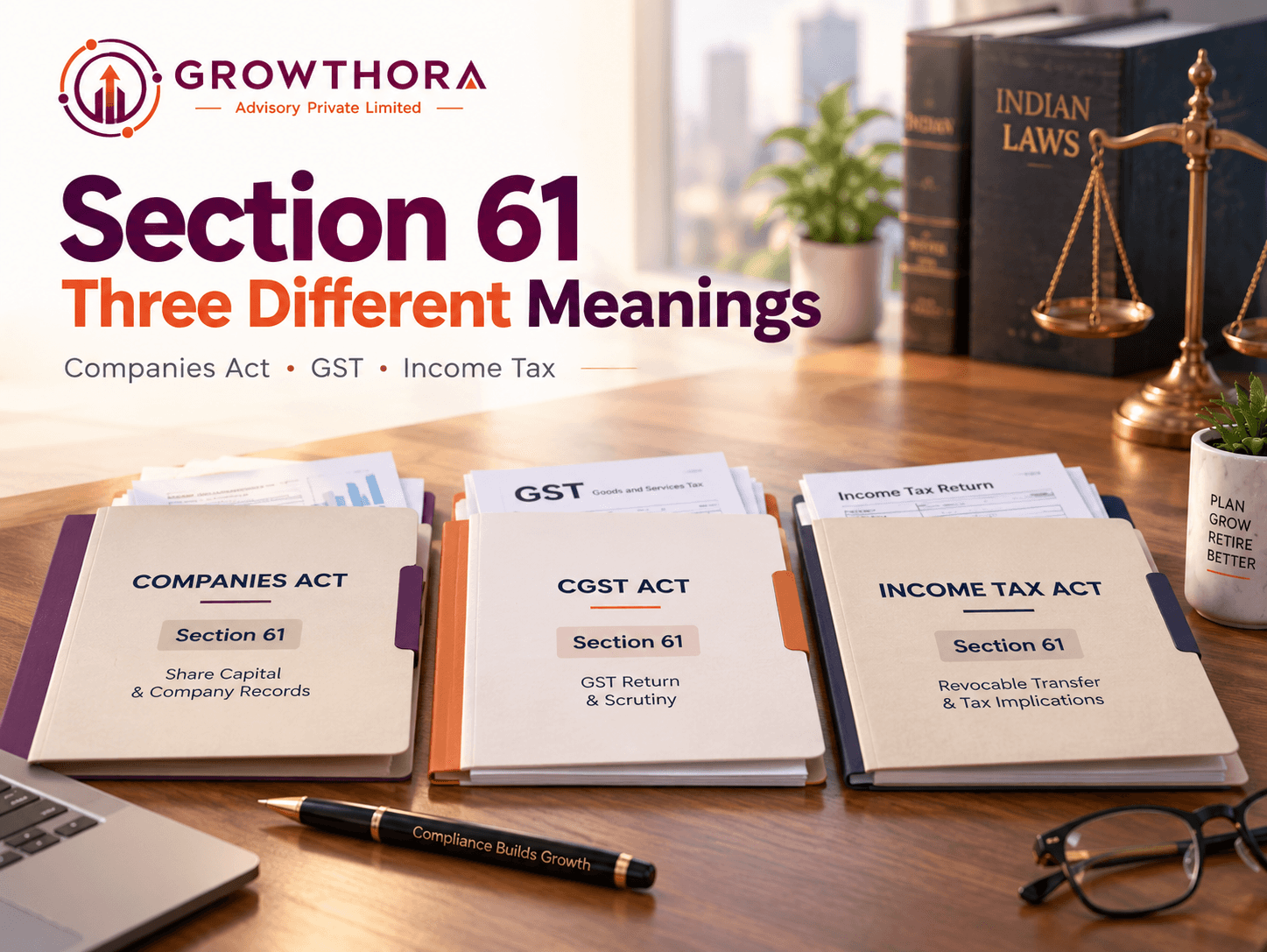
Why “Section 61” Causes Confusion
Every major Indian statute numbers its own sections independently, starting from Section 1. Because the Companies Act, the CGST Act, and the Income Tax Act are each numbered from scratch, it is pure coincidence that all three happen to have a Section 61, and each deals with a completely different subject. We see this mix-up constantly at Growthora: a client asks about a “Section 61 notice," meaning a GST scrutiny letter, while their CA colleague assumes they mean share capital alteration. Getting the law right at the start saves weeks of wasted back-and-forth with consultants and authorities.
Section 61, Companies Act 2013; Alteration of Share Capital
What is Section 61 of the Companies Act 2013?
It is the provision that allows a limited company, if authorized by its articles of association, to alter its share capital in a general meeting, without needing NCLT approval, unlike a reduction of capital under Section 66.
- Under Section 61(1), a company limited by shares can pass an ordinary resolution in a general meeting to:
Increase its authorized share capital by issuing new shares. - Consolidate and divide its share capital into shares of larger denomination (e.g., ten ₹10 shares into one ₹100 share).
- Convert fully paid-up shares into stock, and reconvert stock into shares.
- Subdivide its shares into smaller denominations (subject to the paid-up-to-called-up ratio staying the same)
- Cancel shares not taken up by any person, without reducing the amount of capital.
A practical friction point we see repeatedly: founders alter share capital in a board resolution but forget the mandatory filing of Form SH-7 with the Registrar of Companies within 30 days. Miss that window, and the ROC portal starts flagging the company for additional scrutiny on every future filing — a completely avoidable headache.
Section 61, CGST Act 2017; Scrutiny of Returns
What is Section 61 of the CGST Act?
It empowers a GST proper officer to scrutinize a registered taxpayer’s returns and related particulars to verify correctness and to seek an explanation from the taxpayer for any discrepancy found, typically through Form GST ASMT-10.
This is the Section 61 most MSME owners actually encounter, usually in the form of an automated notice flagging a mismatch, say, between GSTR-1 (outward supplies declared) and GSTR-3B (tax paid), or between GSTR-2B (auto-populated input tax credit) and the credit actually claimed. If the taxpayer’s reply in Form ASMT-11 is satisfactory, the officer closes the matter in Form ASMT-12. If not satisfied, the officer can initiate action under Sections 65, 66, 67, 73 or 74, meaning a scrutiny notice, left unanswered, escalates into a full audit or demand proceeding.
In our filing experience, the single biggest cause of a Section 61 notice for small businesses is a supplier who filed GSTR-1 late or incorrectly, which throws off the buyer’s auto-populated GSTR-2B, even though the buyer did nothing wrong. Reconciling books against GSTR-2B every month, not just at year-end, is the practical fix.
Section 61, Income Tax Act 1961; Revocable Transfer of Assets
What is Section 61 of the Income Tax Act?
It provides that income arising from a “revocable transfer” of assets, a transfer that can be revoked by the transferor or reversed to their benefit, is taxed in the hands of the original transferor, not the person who received the asset.
This is a clubbing-of-income provision. It exists to stop taxpayers from shifting income to a lower-slab family member (say, a spouse or adult child) through an asset transfer that is only nominal, while the transferor keeps effective control and can reclaim the asset. Sections 62 and 63 that follow define exceptions and what “transfer” and “revocable” mean for this purpose. Founders structuring family trusts or gifting shares of a private company to relatives should get this section reviewed before, not after, the transfer; reversing a badly structured transfer is far harder than doing it correctly the first time.
Side-by-Side Comparison Table
| Aspect | Companies Act, Section 61 | CGST Act, Section 61 | Income Tax Act, Section 61 |
|---|---|---|---|
| Subject | Alteration of share capital | Scrutiny of GST returns | Revocable transfer of assets |
| Who it affects | Companies limited by shares | GST-registered taxpayers | Individuals/HUFs making asset transfers |
| Trigger | Board/shareholder decision | System-flagged return mismatch | Income arising from a revocable transfer |
| Filing/response | Form SH-7 with ROC | Reply in Form ASMT-11 | Reported in the transferor’s own ITR |
| Consequence of inaction | ROC compliance flag | Escalation to audit/demand | Income clubbed and taxed regardless |
Key Takeaways
- Section 61 has three unrelated meanings across the Companies Act 2013, CGST Act 2017, and Income Tax Act 1961; always confirm which law is being discussed.
- Companies Act Section 61 covers routine share capital changes like increasing authorised capital or sub-dividing shares, filed via Form SH-7.
- CGST Act Section 61 is the scrutiny-of-returns provision behind most GST mismatch notices; a timely, well-documented reply in Form ASMT-11 usually closes the matter.
- Income Tax Act Section 61 taxes revocable-transfer income in the transferor’s hands, which matters heavily for family gifting and trust planning.
- Growthora reviews Section 61 matters under all three laws as part of its compliance retainer for MSMEs and startups.
FAQs
Is Section 61 the same under GST and Income Tax law?
No. Section 61 of the CGST Act deals with scrutiny of GST returns, while Section 61 of the Income Tax Act deals with revocable transfer of assets and clubbing of income, they are unrelated provisions in different statutes.
What happens if I ignore a Section 61 GST notice?
If you do not respond satisfactorily to a Form ASMT-10 notice issued under Section 61 of the CGST Act, the officer can proceed to a full audit, inspection, or demand proceeding under other sections, which usually means a larger tax, interest, and penalty exposure than resolving the original mismatch.
Does altering share capital under Section 61 need NCLT approval? No. Alteration of share capital under Section 61 of the Companies Act 2013 only needs an ordinary resolution passed by shareholders (assuming the articles permit it) and a filing with the ROC; it does not require NCLT approval, unlike a reduction of capital under Section 66.
Can I revoke a gift to avoid Section 61 income tax clubbing?
Making a transfer revocable does not avoid tax; it is precisely what triggers Section 61. The income from a revocable transfer is taxed in the transferor’s hands regardless of who legally holds the asset, so the clubbing cannot be avoided by structuring the transfer as revocable.
Who issues a scrutiny notice under Section 61 of the CGST Act? The jurisdictional GST proper officer issues the notice, usually in Form GST ASMT-10, after the GST portal’s system-level reconciliation flags a mismatch between returns such as GSTR-1, GSTR-3B, and GSTR-2B.
Is a board resolution enough to alter authorized share capital? A board resolution alone is not sufficient, Section 61 requires an ordinary resolution passed by shareholders in a general meeting, followed by filing Form SH-7 with the Registrar of Companies within 30 days of the resolution.
Talk to Growthora
Whether you are dealing with a GST scrutiny notice under Section 61, planning a share capital alteration, or structuring an asset transfer that could trigger clubbing provisions, getting the right section right matters. Book a free consultation with Growthora Advisory’s compliance team, and we will tell you exactly which Section 61 applies to your situation, and what to file next.
Next step
Apply this to your business.
Confirm whether this applies to your legal structure, industry classification, and credit history - in under 30 minutes with an advisor.