
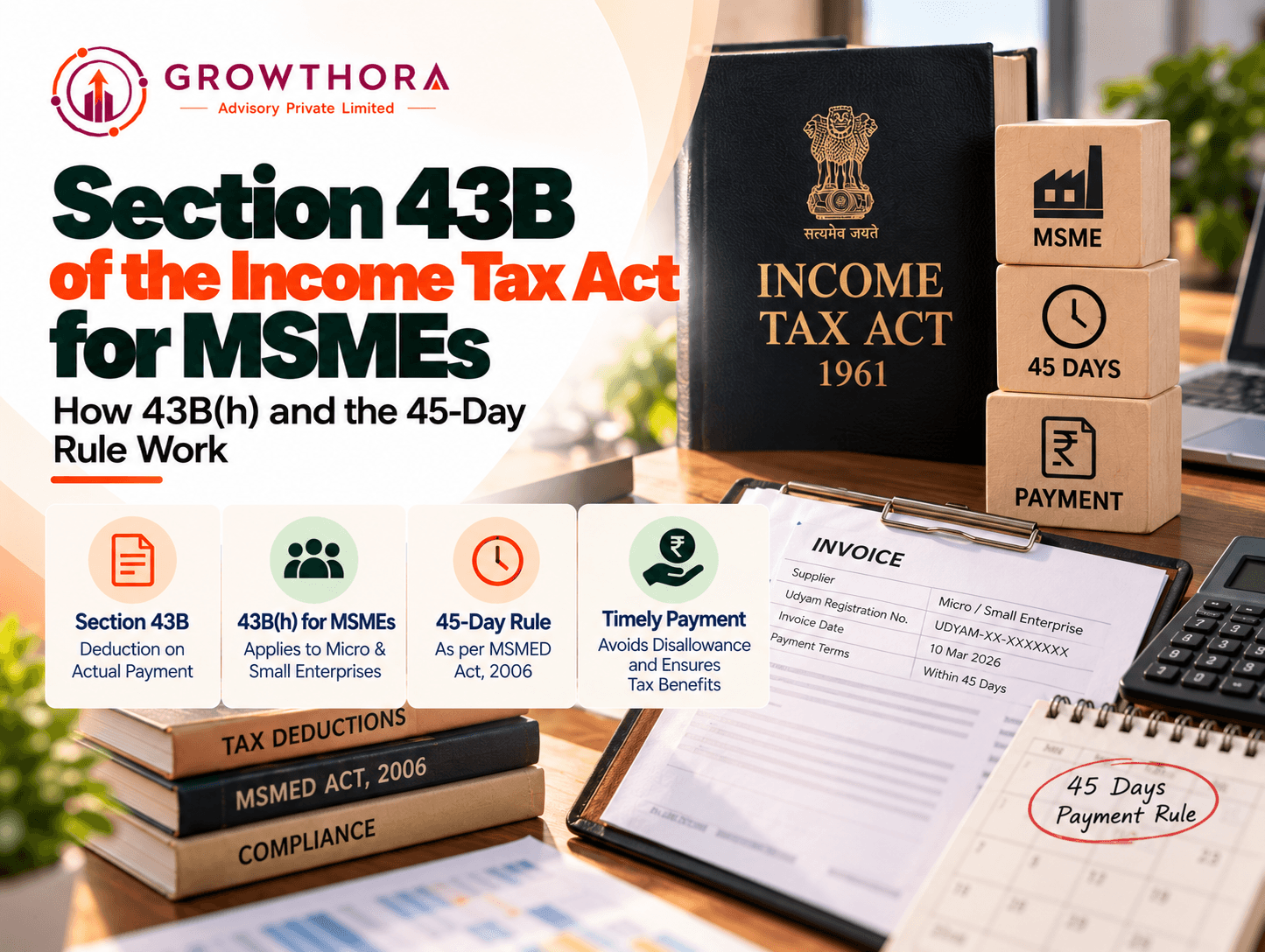
Key Takeaways
- Section 43B overrides normal accrual accounting for specified items, so the deduction is allowed on a paid basis and not when the expense is booked.
- Items under Section 43B include taxes, duties, cess and fees, employer contributions to provident fund and other funds, bonus and commission to employees, interest on loans from banks and financial institutions, and leave encashment.
- Clause (h) applies only to purchases of goods or services from micro and small enterprises that are registered on Udyam and not to medium enterprises.
- The time limit is the agreed period of up to 45 days from acceptance if there is a written agreement, and 15 days from acceptance or deemed acceptance if there is none.
- If payment is made after the time limit, the expense is disallowed in the year of accrual and allowed in the year of actual payment.
- For the older clauses, payment made on or before the due date of filing the return for that year still allows the deduction in the year of accrual, but this relief does not extend to clause (h).
What Section 43B does
Most businesses follow the mercantile system of accounting, where an expense is recorded when it becomes due, not when cash is paid. Section 43B puts a condition on a specific list of expenses. For them, the tax deduction is available only when the amount is actually paid, which prevents a business from claiming a deduction and delaying payment indefinitely.
For MSMEs this matters in both directions. As a buyer, you must pay on time to protect your deduction. As a supplier, you get a stronger legal and commercial lever to be paid on time.
Expenses covered by Section 43B
- Any tax, duty, cess or fee payable under any law, including GST and customs related dues as applicable
- Employer's contribution to provident fund, superannuation fund, gratuity fund or any other fund for the welfare of employees
- Bonus or commission payable to employees for services rendered
- Interest on loans and borrowings from scheduled banks, public financial institutions and similar lenders
- Payment in lieu of leave encashment to employees
- Sums payable to the Indian Railways for the use of its assets, where applicable
- Sums payable to a micro or small enterprise beyond the time limit under Section 15 of the MSMED Act, 2006 under clause (h)
How clause (h) works for MSMEs
| Situation | Time limit for payment | Tax effect for the buyer |
|---|---|---|
| Written agreement exists with a micro or small supplier | As agreed, but not more than 45 days from acceptance or deemed acceptance | Deduction in the year of accrual only if paid within the limit, otherwise allowed in the year of payment |
| No written agreement with a micro or small supplier | 15 days from acceptance or deemed acceptance | Same rule applies using the shorter limit |
| Supplier is a medium enterprise | Not covered by clause (h) | Normal accrual based deduction continues |
| Supplier is not registered on Udyam | Not covered by clause (h) | Normal accrual based deduction continues |
A simple example
Suppose a company buys goods worth ₹10 lakh from a registered micro enterprise in March 2026, with a written agreement allowing 45 days. If the company pays only after 70 days, in the next financial year, the ₹10 lakh deduction is disallowed in the year the purchase was booked and is allowed only in the year the payment is actually made. If it pays within 45 days, the deduction is available in the year of purchase.
This can change the taxable income of the buyer in a given year, so finance teams need to track supplier ageing against the 45 day and 15 day limits.
Compliance tips for MSME buyers
- Collect the Udyam registration number of every supplier and flag micro and small suppliers in your accounting system.
- Make written payment terms of no more than 45 days a standard part of purchase orders and agreements.
- Run a payables ageing report every month and prioritise payments approaching the 45 day or 15 day limit.
- Record the date of acceptance or deemed acceptance of goods and services to prove the start of the period.
- Keep the tax auditor informed, since the amount payable beyond the limit is reported in the tax audit report.
- Remember that delayed payments also attract interest under the MSMED Act at three times the bank rate, compounded monthly.
What MSME suppliers should do
- Obtain and quote your Udyam registration number on invoices and purchase orders.
- Mention the credit period clearly in your agreement and never agree to terms longer than 45 days.
- Record delivery acceptance in writing so that the payment clock is clear.
- Send reminders and, if needed, a formal notice and complaint on the MSME Samadhaan portal for delayed payments.
Frequently Asked Questions
What is Section 43B of the Income Tax Act?
It is a provision that allows certain specified expenses as a tax deduction only in the year they are actually paid, regardless of the accounting method followed.
What does Section 43B(h) say about MSMEs?
It disallows the deduction in the year of accrual for sums payable to micro and small enterprises that remain unpaid beyond the time limit in Section 15 of the MSMED Act, and allows it in the year of actual payment.
Does Section 43B(h) apply to medium enterprises?
No, it applies only to payments to micro and small enterprises, so purchases from medium enterprises and non Udyam suppliers are outside clause (h).
What is the payment time limit under 43B(h)?
Up to 45 days from acceptance or deemed acceptance when there is a written agreement, and 15 days when there is no agreement.
From when did Section 43B(h) apply?
It was introduced by the Finance Act, 2023 and applies from financial year 2023-24, which is assessment year 2024-25.
Can I save the deduction by paying before the due date of my income tax return?
That relief works for the older Section 43B items such as taxes and employer contributions, but not for clause (h), where payment must be made within the time limit.
Worried about 43B(h) disallowance in your tax audit?
A payables review and updated supplier agreements can prevent avoidable disallowances. Book a free consultation with Growthora and we will review your MSME payables, agreements and tax audit position.
Next step
Apply this to your business.
Confirm whether this applies to your legal structure, industry classification, and credit history - in under 30 minutes with an advisor.