
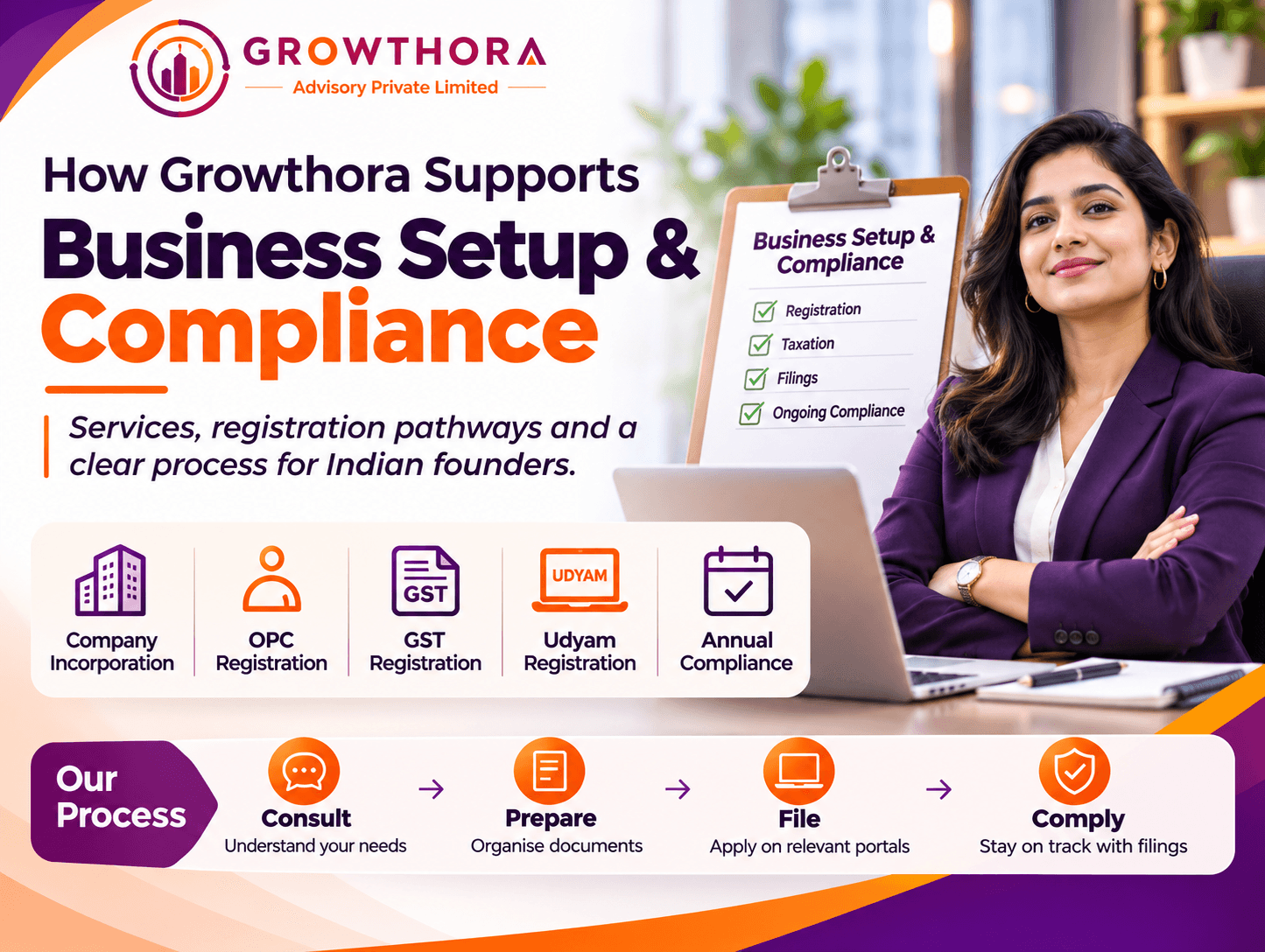
How Growthora Supports Business Setup and Compliance: Services and Process
Starting a business involves more than choosing a name and submitting a form. Founders need to select an appropriate legal structure, prepare consistent documents, complete the relevant registrations and understand the compliance responsibilities that follow. A missed filing, unsuitable entity structure or incorrect registration detail can create avoidable delays and administrative work later.
Growthora Advisory Private Limited presents its services as a connected business-support practice covering registrations, funding, certifications, legal and CA support, operations and growth. Its published registration practice lists company registration, GST registration, MSME or Udyam registration and GeM registration. Its wider service information also refers to Private Limited, LLP and OPC setup, GST, Udyam, taxation, post-registration compliance and legal and CA support.
This guide explains how a business registration consultant can support the process, what to prepare, which questions to ask and how Growthora's published process is described. Service scope, professional responsibility, fees and timelines should be confirmed directly before engagement. No consultant can guarantee a government approval or remove the business owner's statutory responsibilities.
What does a business registration consultant do?
A business registration consultant helps a founder understand the registration route, organize the required information, prepare application documents and coordinate filing through the relevant government portal or professional channel. Depending on the engagement, support may include:
- Understanding the proposed business activity, ownership, number of founders and future plans.
- Comparing suitable legal structures such as proprietorship, partnership, LLP, One Person Company or Private Limited Company.
- Preparing and checking documents for incorporation or registration.
- Coordinating applicable PAN, TAN, GST and Udyam registration steps, where included and eligible.
- Helping the founder understand post-registration obligations and recurring compliance requirements.
- Communicating application status, clarification requests and next steps.
The consultant's role is advisory and administrative unless a specific regulated professional service is separately provided by an appropriately qualified professional. The founder remains responsible for truthful information, timely decisions, statutory payments and ongoing compliance.
Growthora's published business setup and registration services
Growthora's website describes a registration and entity-setup practice for founders who need company setup, GST or Udyam registration and businesses preparing for lender review, vendor onboarding or government tenders. The service page says its registration work is intended to sequence registrations around what the business needs next and reduce delays caused by missing or inconsistent documents.
| Service area | What the service can involve |
|---|---|
| Company incorporation and entity setup | Growthora lists Private Limited Company, LLP, OPC, proprietorship and partnership registration among its business registration pathways. The right route depends on ownership, liability, governance, funding plans and compliance capacity |
| OPC registration consultant support | An OPC may suit an eligible single individual who wants a company structure. The founder should understand current Companies Act requirements, nominee arrangements, director obligations, annual filings and conversion rules before selecting this structure |
| GST registration consultant support | Growthora publishes GST registration support that includes eligibility assessment, document verification, application preparation and filing, clarification handling where applicable, and GSTIN/certificate follow-up. |
| Udyam registration assistance | Growthora lists MSME/Udyam registration as part of its registration practice. Udyam is the official MSME registration system; eligibility and classification should be checked against current government criteria before application |
| Company annual compliance and post-registration support | Growthora's wider Legal & CA practice lists post-registration compliance, legal compliance, agreement drafting and related professional support. The precise annual filing scope, responsible professional and filing calendar should be agreed in writing |
| Related registrations | Growthora's registration practice also lists GeM registration. Other service areas shown on the website include Startup India support, trademark registration, ISO certification and taxation services. These are separate services with their own eligibility and process |
Choosing the right legal structure
There is no universally best structure. A founder should compare ownership, liability, investment plans, governance, tax treatment, statutory filings and the practical cost of maintaining the entity. The following is a high-level orientation, not legal or tax advice.
| Structure | General characteristics |
|---|---|
| Proprietorship | One individual owns and operates the business. Often simpler to start, but the business and owner are not separate legal persons and personal liability may arise |
| Partnership firm | Two or more partners operate under a partnership arrangement. The deed should clearly address capital, roles, profit sharing, decision-making and exit. Partners may have personal liability under the applicable law |
| One Person Company (OPC) | A company form with one member and a nominee arrangement under the Companies Act. It has corporate formalities and ongoing filing obligations. |
| Limited Liability Partnership (LLP) | A separate body corporate with partners and limited liability subject to law. It has LLP-specific incorporation and annual filing requirements |
| Private Limited Company | A company with share capital and shareholders/directors. It may suit businesses seeking a formal equity structure, but carries company-law governance and filing obligations |
Before incorporation, discuss expected shareholders or partners, capital, decision rights, fundraising plans, ownership changes, intellectual property, liability exposure and compliance budget. A structure selected only because it appears inexpensive at incorporation may prove unsuitable later.
Company incorporation process: a practical overview
The precise process depends on the entity type and current rules. For a company incorporated through the Ministry of Corporate Affairs (MCA), the process generally involves the following stages:
- Initial consultation and structure selection: confirm the business model, proposed ownership, directors, registered office and capital structure.
- Name planning: prepare suitable name options and check availability and naming restrictions.
- Digital identity and authorizations: arrange Digital Signature Certificates and other required identity or authorization steps for the proposed subscribers and directors.
- Document preparation: compile identity and address proofs, registered-office evidence, declarations, consent and constitutional documents as applicable.
- Application preparation: prepare the applicable MCA incorporation forms and linked registrations through the current filing system, including SPICe+ where applicable.
- Submission and government review: submit the application and respond to any clarification or resubmission request within the stated time.
- Certificate and post-incorporation steps: on approval, review the Certificate of Incorporation and related identifiers, then complete bank, accounting, tax and other applicable setup tasks.
MCA forms, filing requirements, fee concessions and linked services can change. Check the live MCA portal and current instructions for the entity type rather than relying on an old checklist.
OPC registration: what a founder should understand
An OPC is a company structure designed for a single member, subject to the Companies Act and applicable rules. It can provide a corporate legal identity, but it is not a no-compliance or no-paperwork option.
Common OPC preparation points
- Confirm that the proposed member meets the current statutory eligibility requirements.
- Identify and obtain consent from the nominee as required by the applicable rules.
- Decide the proposed company name, registered office, business objects and capital structure.
- Prepare member, nominee and director identity and address information.
- Understand director duties, accounting, statutory audit where applicable, annual returns and financial statement filing.
- Consider whether the business may need multiple shareholders or external equity investment in the future, and whether another structure is more suitable.
A founder comparing OPC registration consultant providers should ask who checks eligibility, prepares nominee documentation, handles MCA resubmissions and explains annual obligations after incorporation.
GST registration consultant support
GST registration depends on the nature of supplies, turnover, location, applicable thresholds, compulsory-registration provisions and specific business circumstances. Do not assume every business must register immediately or that one turnover threshold applies in every case.
Growthora's published GST service page describes an assistance flow involving eligibility assessment, document verification, preparation and filing on the GST portal, clarification handling and GSTIN/certificate follow-up. The page also lists common document categories such as PAN, Aadhaar, business constitution proof, principal place of business proof, bank details and Digital Signature Certificate where relevant.
Typical GST registration workflow
- Assess whether registration is required or commercially appropriate under the applicable GST provisions.
- Identify the correct legal name, PAN, business constitution, place of business and authorized signatory.
- Prepare address and bank evidence and other documents required for the case.
- Complete the GST portal application and authentication steps that apply.
- Track the application reference and respond to any departmental clarification.
- After approval, verify the GST registration certificate and set up invoicing, record keeping and return-filing responsibilities.
Registration does not end the compliance task. A registered taxpayer may need periodic returns, payment, invoice controls, reconciliations, records and notice responses depending on the registration and applicable GST rules. Confirm whether ongoing return filing is included in the engagement.
Udyam registration assistance
Udyam Registration is the Government of India's official MSME registration system. It is based on the enterprise's information and applicable classification criteria. The official portal states that registration is free, paperless and based on self-declaration, with no renewal requirement under the system.
A consultant may help a business understand the registration information, prepare accurate enterprise details and navigate the portal. The business owner should verify the PAN, Aadhaar-linked details, activity information, bank details and classification information before submission.
Udyam registration does not itself guarantee a loan, subsidy, tender award or eligibility for every MSME scheme. Each benefit has separate conditions.
Company annual compliance: plan after incorporation
Incorporation creates continuing responsibilities. The exact calendar depends on the legal form, financial year, turnover, transactions, registrations and statutory applicability. For companies, common areas to discuss with a qualified company secretary, chartered accountant or other competent professional include:
- Maintenance of books of account and supporting records.
- Preparation of financial statements and statutory audit where required.
- Board meetings, minutes, registers and other governance records as applicable.
- Annual general meeting requirements and annual filings with the Registrar of Companies.
- Income-tax return, tax audit where applicable, advance tax and TDS obligations.
- GST returns, payments, reconciliations and e-invoicing requirements where applicable.
- Event-based filings for changes in directors, registered office, share capital, ownership or other reportable matters.
- Renewals, sector-specific licences and labour or local registrations where applicable.
Do not treat this list as a complete filing calendar. A compliance calendar should be prepared for the specific entity and reviewed as laws, thresholds and due dates change. Ask the service provider to identify the responsible professional, included forms, due-date tracking, statutory fees, professional fees and exclusions.
Growthora's published service process
Growthora's homepage describes a five-stage process: Consultation, Documentation, Application, Approval and Support. The registration practice page also describes sequencing filings according to business needs and readiness.
| Stage | What happens |
|---|---|
| 01. Consultation | Discuss the business activity, founders, structure, location, registration needs and immediate priorities. |
| 02. Documentation | Collect and review the documents and information relevant to the chosen registration. Resolve gaps or inconsistencies before filing. |
| 03. Application | Prepare and submit the relevant application through the applicable government portal or process, within the agreed service scope |
| 04. Approval follow-up | Track the application and coordinate responses to government clarification requests. The approval decision remains with the relevant authority |
| 05. Ongoing support | Discuss post-registration compliance, renewals, filings or other business support required after the initial registration |
The website describes this as Growthora's service approach. Actual deliverables, turnaround, communications and follow-up should be confirmed in the engagement proposal. Government processing time is outside a consultant's control.
Documents founders should keep ready
- PAN and identity/address proof of proprietors, partners, members, directors and authorized signatories, as applicable.
- Recent photographs and contact details where requested by the applicable portal.
- Registered-office or principal-place-of-business proof, such as ownership evidence, rent or lease documentation and utility bill, as applicable.
- Consent, declarations, nominee information and constitutional documents for the selected legal structure.
- Business activity description, proposed name and ownership or capital details.
- Bank account evidence and cancelled cheque or statement where required.
- Digital Signature Certificate and director identification information where applicable.
- Existing registration certificates, licences and prior application references, if the business is already operating.
- Never share passwords, OTPs or private signing credentials with an unknown person. Use secure channels, understand who is authorized to submit on your behalf and retain copies of filed forms, challans, acknowledgements and certificates.
How to compare business registration consultant providers
| Comparison point | Question to ask |
|---|---|
| Scope clarity | Does the proposal state the exact entity type, registrations, forms, deliverables and exclusions? |
| Professional responsibility | Who provides legal, tax, accounting or company-secretarial advice, and are they appropriately qualified for that work? |
| Document handling | How are personal and business documents collected, stored, accessed and returned? |
| Filing transparency | Will you receive application copies, challans, acknowledgements and final certificates? |
| Government fees vs professional fees | Are statutory charges, stamp duty, DSC, name reservation, professional fees and taxes itemized separately? |
| Resubmission support | Does the quote include responses to routine clarification or resubmission requests? What attracts extra fees? |
| Post-registration obligations | Will the provider explain annual filings, GST returns and other ongoing responsibilities? |
| Timeline assumptions | Are estimates based on document readiness and government processing, with dependencies explained ? |
| Communication | Who is the point of contact and how often will status updates be shared? |
Common mistakes to avoid
- Selecting a legal structure without considering future ownership, liability and compliance costs.
- Using inconsistent names, addresses or personal details across forms and supporting documents.
- Assuming GST registration is mandatory for every business or applying without checking the relevant provisions.
- Believing Udyam registration automatically grants a subsidy or loan.
- Treating incorporation as the end of statutory responsibilities.
- Not budgeting for annual accounting, audit, tax and company-law compliance.
- Paying a provider without a written scope, fee breakup and refund or resubmission policy.
- Sharing OTPs, passwords or DSC credentials without safeguards.
- Believing a consultant can guarantee approval or control government processing timelines.
What Growthora prospects should clarify before onboarding
A useful first discussion should produce a clear scope rather than a generic promise. Prospects can ask Growthora to confirm:
- Which legal structure appears suitable for the stated ownership and business plans, and what professional review is required?
- Which registrations are legally required now, which are optional and which may be deferred?
- Whether the requested service includes OPC, Private Limited, LLP, GST, Udyam or annual compliance.
- Which documents are required and how they will be protected.
- Who will prepare and submit each application and who will handle professional advice.
- What is included in the quoted professional fee and what government or third-party charges are additional?
- What happens if the government raises a query or rejects an application?
- What post-registration obligations should be budgeted for in the first financial year?
Frequently asked questions
1. Why should I use a business registration consultant?
A consultant can help compare registration routes, organize documents, coordinate filings and explain the compliance steps that follow. Choose a provider with a clear scope and transparent fees.
2. What is included in company incorporation support?
Depending on the engagement, it may include structure discussion, name planning, document collection, preparation of incorporation forms, filing coordination and follow-up on government queries.
3. Can Growthora help with Private Limited Company registration?
Growthora's website lists Private Limited Company registration within its business registration and entity setup practice. Confirm the exact deliverables, professional fees and current timelines directly with the company.
4. Does Growthora provide OPC registration consultant support?
Growthora's website lists OPC among its entity setup pathways. Confirm eligibility review, nominee documentation, MCA filing scope and post-incorporation support before onboarding.
5. What documents are required for OPC registration?
The required information commonly includes member and nominee identity and address details, consent and declarations, registered-office evidence, proposed company details and applicable digital signature information. The current MCA requirements should be checked for the specific case.
6. How do I choose between OPC and Private Limited Company?
Compare the number of owners, nominee requirements, plans for equity investment, governance, liability, conversion needs and annual compliance costs. Obtain legal and tax advice for the facts of your business.
7. Does every business need GST registration?
No. GST registration depends on turnover thresholds, nature of supply, location and compulsory-registration provisions. Check the current GST law and facts of the business.
8. What does a GST registration consultant do?
A GST registration consultant may assess applicability, review documents, prepare and file the application, track the reference number and assist with clarification queries within the agreed scope.
9. Is Udyam registration free?
The official Udyam portal states that MSME registration is free and paperless. Use the official government portal and avoid paying unofficial websites for a government registration fee.
10. Does Udyam registration incorporate my business?
No. Udyam registers an eligible enterprise as an MSME. It does not create a company, LLP or partnership and does not replace other registrations that apply.
11. What is company annual compliance?
It refers to recurring statutory, financial, tax and governance obligations applicable to a company, including accounting records, audit where required, meetings and MCA filings, tax returns and event-based filings.
12. Can a consultant guarantee company incorporation or GST approval?
No. A consultant can help prepare and submit an application and respond to queries, but the government authority makes the approval decision.
13. How long does business registration take?
Timelines vary by entity type, document readiness, name availability, application accuracy, government review and resubmission requirements. Ask for an estimate with dependencies rather than a guaranteed date.
14. Are government fees included in a consultant's professional fee?
Not necessarily. Ask for a written breakup of professional fees, statutory filing charges, stamp duty, DSC, taxes and third-party expenses.
15. Does Growthora support businesses after registration?
Growthora's website lists post-registration compliance and Legal & CA support as part of its broader advisory practice. Confirm the precise annual filing and recurring service scope in writing.
Next step
Apply this to your business.
Confirm whether this applies to your legal structure, industry classification, and credit history - in under 30 minutes with an advisor.