
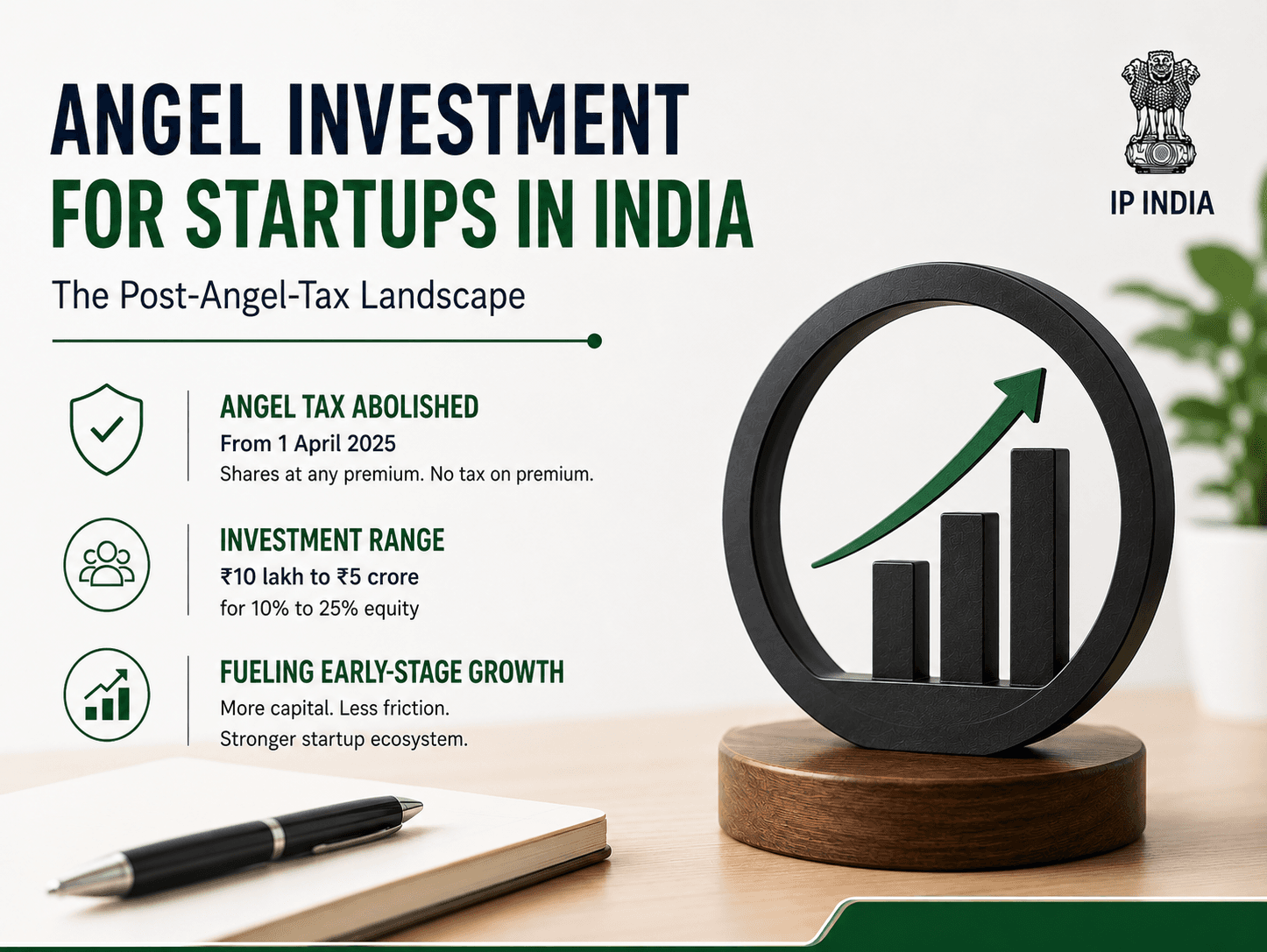
The Change That Actually Matters Here: Angel Tax Is Gone
| Before 1 April 2025 | From 1 April 2025 | |
|---|---|---|
| Section 56(2)(viib) applicability | Applied when shares were issued above fair market value, taxing the premium as income | Abolished entirely, for all investor classes including resident and non-resident angels |
| Share premium tax treatment | Premium above FMV taxed as “income from other sources” in the company's hands | No tax consequence on premium, regardless of the gap between issue price and any FMV calculation |
| CCPS conversion | Conversion of Compulsorily Convertible Preference Shares at a premium attracted scrutiny | Conversion can happen at any ratio or effective price without angel tax liability |
| Effect on deal volume | Contributed to a documented decline in angel deal activity, alongside broader funding winter conditions | Early-stage deal flow is expected to recover as the tax barrier is removed |
One important caveat: this abolition applies going forward. Legacy assessments from years before the change aren't automatically resolved just because the provision itself is gone, so if your startup has an open angel tax matter from an earlier assessment year, that still needs separate resolution with your CA rather than being treated as moot.
What Angel Investment Actually Is
An angel investor is typically a high-net-worth individual investing personal capital, as opposed to a venture capital fund investing pooled money from limited partners. Angels invest earliest in a startup's life, commonly at the pre-seed or seed stage, often before a product has meaningful revenue, and in exchange for that early risk, they typically negotiate a lower valuation and higher potential return multiple than later-stage investors.
How Much and For How Much Equity
| Metric | Typical Range |
|---|---|
| Individual angel cheque size | ₹10 lakh to ₹5 crore |
| Minimum ticket size (individual) | Around ₹10 lakh, though syndicates often allow smaller amounts within a larger round |
| Equity taken | 10% to 25%, depending on amount raised and valuation |
| Typical instrument | Equity shares, Compulsorily Convertible Preference Shares (CCPS), or convertible notes |
As a founder, the practical trade-off is straightforward to state but easy to get wrong in the moment: give up enough equity to actually get the capital and support you need, without over-diluting before a Series A, where you'll likely need to give up a further 15% to 25%. Stacking multiple angel rounds without tracking cumulative dilution is a common way founders find themselves holding a smaller stake than they expected by the time institutional money arrives.
Where to Actually Find Angels
| Route | How It Works | Best Fit |
|---|---|---|
| Angel networks (Indian Angel Network, Mumbai Angels) | A curated group of HNI members reviews and collectively invests in vetted startups | Founders wanting access to a structured group with shared due diligence |
| Syndicate platforms (LetsVenture, AngelList India, 100x Entrepreneur) | Platform-based syndication pools individual angel cheques into a single deal, often via an SPV | Founders wanting broader reach across many individual angels efficiently |
| Sector-specific groups | Networks organised around former founders in a specific vertical, such as SaaS, fintech, or D2C | Founders wanting investors who bring direct domain expertise, not just capital |
| Direct HNI relationships | Personal introductions to individual angels without a network intermediary | Founders with an existing personal or professional network of relevant HNIs |
| SEBI-registered Angel Funds (Category I AIF) | SEBI-registered Angel Funds (Category I AIF) | Larger, more structured rounds wanting institutional-style governance from angel-stage capital |
The Process, From First Conversation to Money in the Bank
- Get your startup investor-ready first: a clear pitch deck, a basic financial model, and evidence of traction, even early traction, since angels increasingly expect more than just an idea.
- Identify angels or networks with genuine sector relevance rather than approaching broadly, since warm, relevant introductions convert dramatically better than cold outreach.
- Pitch and answer initial questions, typically leading to either a pass or continued interest and a term sheet discussion.
- Negotiate the term sheet, covering valuation, instrument type, board or information rights, and any protective provisions, ideally with input from a startup-focused lawyer.
- Go through due diligence, generally lighter and more confirmatory at the angel stage than at Series A, focused on the founders, the product, market opportunity, and basic legal integrity of the company.
- Sign definitive documents, a share subscription agreement, and a shareholders agreement, and receive funds, with the round typically closing faster at the angel stage than institutional rounds.
What You Need to Actually Receive Angel Money
- A Private Limited Company structure, since only companies can issue equity shares, LLPs and partnerships cannot
- DPIIT recognition, to access the associated startup tax benefits and signal credibility to investors
- A clean cap table with no unresolved ownership ambiguity among founders
- Investor KYC, source-of-funds declarations, and bank transfer confirmations, maintained as part of your compliance record
- Board resolutions, a valuation report, and the share subscription agreement are all part of the standard closing documentation
- Retained investment records for at least 8 years from the end of the relevant assessment year, per standard compliance practice
Frequently Asked Questions
Is angel tax still applicable in India?
No. Section 56(2)(viib) was abolished for all investor classes effective 1 April 2025. Share premium is no longer taxed regardless of the gap between issue price and fair market value.
What is the typical ticket size for angel investment?
Generally ₹10 lakh to ₹5 crore per angel or syndicate deal, though platforms and syndicates often allow smaller individual cheques within a larger combined round.
How much equity do angel investors typically take?
Roughly 10% to 25%, depending on the amount raised relative to the startup's valuation and the specific terms negotiated.
What's the difference between an angel investor and a venture capitalist?
Angels invest personal money, usually at the pre-seed or seed stage, and decisions can be made individually or by a small group. VCs invest pooled capital from limited partners through a fund structure, typically at later stages with larger cheques and a more formal decision process.
Can only private limited companies raise angel investment?
Effectively yes. Only a company can issue equity shares to investors; LLPs and partnership firms cannot, which is one reason most startups planning to raise external equity incorporate as a private limited company from the outset.
What documents do I need to close an angel round?
A cap table, investor KYC and source-of-funds declarations, board resolutions, a valuation report, and a share subscription agreement, all of which should be retained for at least 8 years from the end of the relevant assessment year.
How long does an angel round typically take to close?
Generally faster than institutional rounds, often a matter of weeks to a couple of months from first pitch to funds received, though this varies based on the specific investors and how quickly due diligence and legal documentation move.
What is a SEBI-registered angel fund, and how is it different from direct angel investing?
It's a Category I alternative investment fund structure that pools capital from accredited investors under SEBI's regulatory framework, offering a more structured, governed route into angel-stage investing compared to writing individual cheques directly.
Does angel tax abolition apply to non-resident investors too?
Yes. The abolition of Section 56(2)(viib) applies across all investor classes, resident and non-resident alike, from 1 April 2025.
Are there any lingering angel tax risks for older funding rounds?
Potentially. The abolition applies going forward, but legacy assessments from years before the change aren't automatically resolved. A startup with an open matter from an earlier assessment year should address it separately with a CA rather than assuming it's moot.
What instrument do angels typically invest through?
Commonly equity shares, Compulsorily Convertible Preference Shares (CCPS), or convertible notes, with CCPS remaining a common choice for seed and Series A rounds in India.
What This Means for a Founder Raising Right Now
The regulatory environment for early-stage fundraising in India is genuinely more founder-friendly than it's been in years, and the practical implication is worth internalizing: a decision that used to require careful tax structuring, how much premium to charge on a share issuance, no longer carries the same risk it once did. That doesn't mean valuation and dilution stop mattering; they still shape your ownership and your next round's negotiating position, but the tax overhang that made a lot of early-2020s angel rounds more complicated than they needed to be is now genuinely gone.
Next step
Apply this to your business.
Confirm whether this applies to your legal structure, industry classification, and credit history - in under 30 minutes with an advisor.