
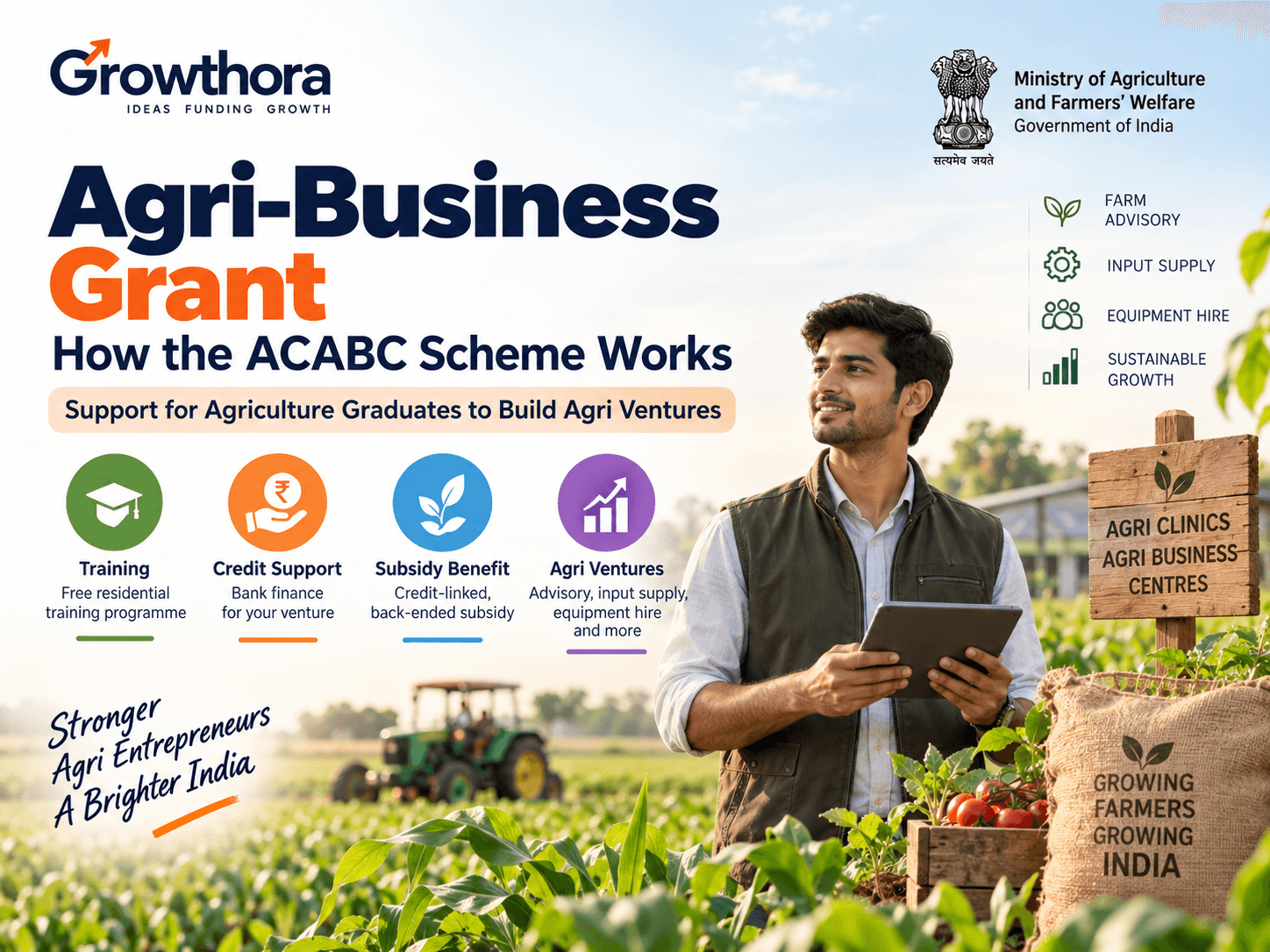
Key Takeaways
- ACABC is implemented by the Ministry of Agriculture and Farmers' Welfare, with NABARD channelising the subsidy through participating banks.
- Eligible candidates first complete a free residential training programme, coordinated through MANAGE-approved nodal training institutes, before applying for bank finance.
- The subsidy is a credit-linked, back-ended composite subsidy, meaning it is adjusted against the loan after the venture is established and functioning, rather than paid upfront.
- The scheme targets agriculture graduates, diploma holders, and certain intermediate-level qualification holders in agriculture and allied subjects.
- Project cost ceilings and subsidy percentages are periodically revised, so applicants should confirm current figures on the official ACABC guidelines before applying.
- This is different from a pure cash grant, since the benefit is realised through the loan and subsidy adjustment process, not as a standalone payout.
What Is the ACABC Scheme?
Agri-Clinics and Agri-Business Centres were introduced in 2002 to create self-employment opportunities for trained agricultural professionals while extending expert farm advisory services to farmers. Agri-clinics provide advice on crop and livestock management, soil testing, and related services, while agri-business centres are commercial ventures such as input supply, equipment hire, and post-harvest support.
The scheme combines two elements: structured training and handholding for the entrepreneur, followed by bank credit backed by a government subsidy to help establish the venture.
How This Differs From Related Support
- ACABC vs Agriculture Infrastructure Fund (AIF/NAIF): AIF funds larger infrastructure like warehouses and cold chains for a broad range of applicants, while ACABC is specifically aimed at individual agriculture graduates setting up advisory or input-based agri-business ventures.
- ACABC vs a direct cash grant: ACABC's benefit comes as a back-ended subsidy adjusted against a bank loan after the venture is functional, not as an upfront cash disbursement.
- ACABC vs general MSME loan schemes: ACABC includes a mandatory training and handholding component before credit is extended, which general MSME loan schemes do not require.
Who Is Eligible
- Graduates in agriculture and allied subjects from State Agricultural Universities, Central Agricultural Universities, or institutions recognised by ICAR or UGC.
- Diploma holders in agriculture and allied subjects from recognised institutions.
- Certain intermediate-level qualification holders in agriculture-related subjects, as notified by the Ministry, generally subject to a minimum marks requirement.
- Candidates within the age bracket specified by the scheme guidelines, generally aimed at those aged 18 to 60
Documents and Requirements
- Educational qualification certificates in agriculture or an allied subject
- Identity and address proof
- A viable business plan for the proposed agri-clinic or agri-business venture
- Bank account details for loan processing
- Any additional documents specified by the nodal training institute or the financing bank
Step-by-Step: How the Scheme Works
- Check your eligibility based on your agricultural qualification and confirm current guidelines on the official ACABC or NABARD page.
- Enrol in the free residential training programme at a MANAGE-approved nodal training institute.
- Complete the training and prepare a detailed business plan for your proposed agri-clinic or agri-business venture.
- Approach a participating bank with your business plan to apply for a term loan under the scheme.
- On sanction and disbursement, establish the venture as per the approved plan.
- The back-ended composite subsidy is adjusted against your loan account once the venture meets the conditions specified by NABARD and the bank.
Common Mistakes and Rejection Reasons
- Applying for the bank loan without completing the mandatory training first, which is a precondition under the scheme.
- Submitting a vague business plan that does not clearly show viability or a realistic revenue model.
- Assuming the subsidy is paid upfront in cash, rather than adjusted against the loan later.
- Not confirming current project cost ceilings and subsidy percentages, which are revised periodically
Practical Tips
- Choose a nodal training institute with strong placement and handholding support, since post-training mentorship affects your venture's success.
- Prepare your business plan around a clear local demand, such as a specific crop advisory gap or equipment shortage in your area.
- Keep your loan documentation and venture records organised from day one, since the subsidy adjustment depends on meeting the bank's and NABARD's conditions.
- Always verify current eligibility, project cost ceiling, and subsidy percentage on the official NABARD ACABC page before applying, as these terms are revised from time to time.
Who Should Consider This
Agriculture graduates and diploma holders who want to start an advisory, input-supply, or equipment-hire venture serving farmers in their region are well suited to this scheme, especially those comfortable combining structured training with bank-financed entrepreneurship.
FAQs
Is the Agri-Business Grant a direct cash payment?
No. Under the ACABC scheme, the benefit is a credit-linked, back-ended composite subsidy adjusted against a bank loan after the venture is established, not an upfront cash grant.
Who administers the ACABC scheme?
It is implemented by the Ministry of Agriculture and Farmers' Welfare, with NABARD acting as the subsidy channelising agency through participating banks.
Do I need a specific qualification to apply?
Yes. You generally need to be a graduate or diploma holder in agriculture or an allied subject from a recognised institution, though certain intermediate-level qualifications are also considered.
Is training compulsory before getting the loan?
Yes. Candidates must first complete the free residential training at an approved nodal training institute before applying for bank finance under the scheme.
What kind of ventures can be set up under this scheme?
Agri-clinics offering farm advisory services and agri-business centres such as input sales, equipment hire, and post-harvest support ventures.
Where can I find the current subsidy percentage and project cost ceiling?
These figures are revised periodically, so check the official NABARD ACABC page for the current guidelines before applying.
Next step
Apply this to your business.
Confirm whether this applies to your legal structure, industry classification, and credit history - in under 30 minutes with an advisor.