
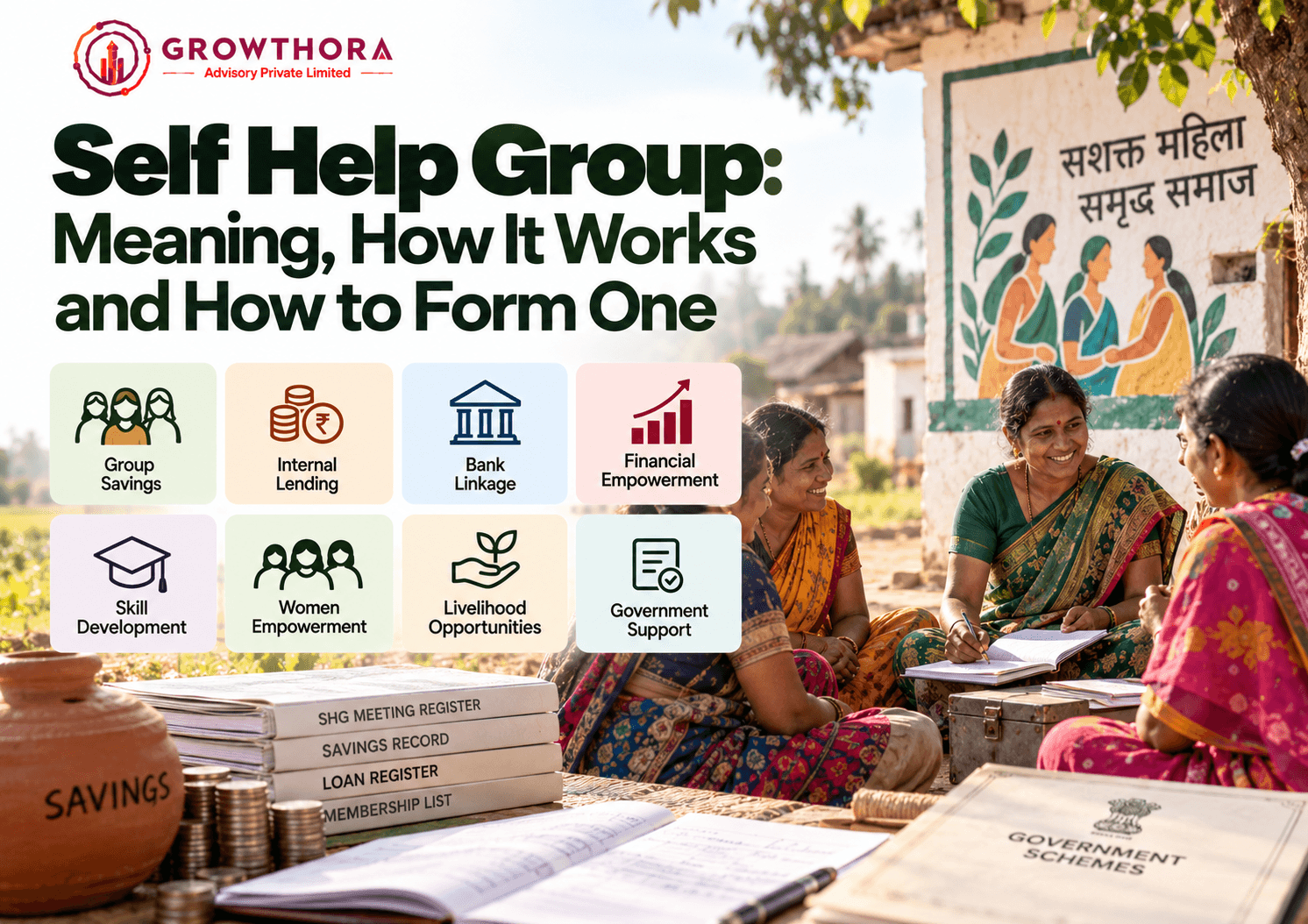
What is a self-help group?
A self help group, or SHG, is a voluntary, informal association of people, typically 10 to 20 members from a similar economic and social background, who come together to save small amounts of money regularly, lend that pooled money to each other for personal or livelihood needs, and gradually build a track record that allows the group to access formal bank credit.
SHGs are not a government invention; the model has roots in community savings traditions and was formalized for rural credit delivery through NABARD's SHG Bank Linkage Programme starting in the early 1990s. The Government of India later built its flagship rural livelihoods architecture, the Deendayal Antyodaya Yojana, National Rural Livelihoods Mission, directly on top of this SHG structure.
Structure and Membership Rules
- Group size is typically 10 to 20 members, with a minimum of 5 members allowed in special areas such as hilly, desert, or sparsely populated regions, and for groups formed exclusively of persons with disabilities.
- Members generally belong to similar economic circumstances, most commonly rural women from below the poverty line or vulnerable households.
- Each group elects its own office bearers, usually a president, secretary, and treasurer, on a rotational basis.
- Groups are usually formed within a single village or a small cluster of nearby hamlets so that members can meet easily and know each other well.
How an SHG Actually Functions
- Regular savings: every member contributes a fixed, small amount weekly or monthly into a common fund.
- Internal lending: members can borrow from this pooled fund for consumption or small livelihood needs, at an interest rate the group itself decides.
- Record keeping: the group maintains basic books such as a savings register, loan ledger, and meeting minutes book, often supported by a community resource person.
- Regular meetings: most groups meet weekly or fortnightly to collect savings, discuss loan requests and review repayment.
The SHG to Bank Linkage Journey
How does an SHG get a loan from a bank?
After a group has saved regularly and lent internally for a period, typically around six months, and demonstrates consistent attendance, savings and repayment discipline, it undergoes a grading exercise, after which banks extend a Cash Credit Limit or term loan directly to the group's bank account, which the group then relends to its own members based on its internal rules.
This graduated pathway, savings first, internal lending second, and bank credit third, is deliberately designed to build financial discipline before larger sums of money enter the group, which is a major reason SHG bank linkage has maintained comparatively strong repayment rates over more than three decades.
Interest Rates and Interest Subvention
What interest rate do women's SHGs pay on bank loans?
Under DAY-NRLM, women's SHGs in eligible districts can access bank credit at 7 percent per annum, and an additional interest subvention of 3 percent is provided for prompt repayment, effectively bringing the cost of credit down to around 4 percent per annum in many designated districts across the country.
Federations: Village Organizations and Cluster-Level Federations
As the SHG model has scaled, groups have been federated into higher-level bodies for greater bargaining power and market access. Village Organisations bring together multiple SHGs at the village level, while Cluster Level Federations aggregate several Village Organisations at a block or cluster level. These federations are now the base on which newer initiatives, including SHE-Marts announced in Budget 2026-27, are being built to give SHG members a direct retail market for what they produce.
Benefits of Joining an SHG
- Access to collateral-free credit without approaching moneylenders charging exploitative interest
- A structured savings habit and basic financial literacy built through regular group meetings
- A collective voice and negotiating power for accessing markets, government schemes and skill training
- A pathway to enterprise development through programmes such as Lakhpati Didi Yojana and, more recently, SHE-Marts
- Social support and solidarity among members facing similar economic circumstances
How to Form a Self-Help Group
- Form a group of like-minded members: Bring together 10 to 20 people from a similar social and economic background, ideally within the same village or neighbourhood, who agree to save and borrow together.
- Choose office bearers and set group rules: Elect a president, secretary and treasurer, and agree on the savings amount, meeting frequency, interest rate on internal loans and repayment rules.
- Start regular savings: Begin weekly or monthly savings contributions from every member into a common group fund, maintaining basic passbooks and registers.
- Open a group bank account: Open a savings bank account in the group's name, which is a prerequisite for both internal fund management and future bank linkage.
- Get graded and linked to a bank: After roughly six months of regular savings and internal lending, apply through your block's NRLM or SRLM office for grading, after which the bank extends a cash credit limit to the group.
- Access government schemes and enterprise support: Once bank linked, the SHG and its members can access revolving fund support, Community Investment Fund assistance, and schemes such as Lakhpati Didi Yojana for enterprise development.
Key Takeaways
- A self help group is a voluntary group of typically 10 to 20 members who save together, lend to each other, and eventually access formal bank credit as a unit.
- SHGs form the base of India's rural livelihoods architecture under DAY-NRLM, which has mobilised more than 10 crore rural women into roughly 90 lakh groups.
- Bank linkage follows a graduated path: savings first, internal lending second, and bank credit through a cash credit limit third, generally after around six months of consistent group discipline.
- Women's SHGs in eligible districts can access bank credit at 7 percent per annum, reduced further to around 4 percent through interest subvention for prompt repayment.
- SHGs federate into village organizations and cluster-level federations, which are now the platform for newer initiatives like SHE-Marts and Lakhpati Didi Yojana.
FAQs
What is a self help group?
A self help group, commonly called an SHG, is a voluntary association of usually 10 to 20 people, most often women from similar social and economic backgrounds, who come together to pool small regular savings, extend small loans to each other, and build a joint pathway toward financial independence and livelihood support.
How many members does a self-help group typically have?
Under the Deendayal Antyodaya Yojana, National Rural Livelihoods Mission, a self-help group generally has between 10 and 20 members, though smaller groups of at least 5 members are permitted in special areas such as hilly regions, desert areas, and for groups working with persons with disabilities.
How does an SHG get money to lend to its members?
An SHG builds its own internal corpus first through regular member savings, and once it demonstrates consistent savings and repayment discipline for a few months, it becomes eligible for bank linkage, through which banks extend a cash credit limit or term loan directly to the group at concessional interest rates, which the group then on lends to its own members.
What is the interest rate on an SHG bank loan?
Under the Deendayal Antyodaya Yojana, National Rural Livelihoods Mission, women's SHGs in eligible districts can access bank credit at 7 percent per annum, with an additional 3 percent interest subvention for prompt repayment effectively bringing the rate down to around 4 percent per annum in many designated districts.
Can men form a self help group?
Yes, self help groups are not restricted to women, but the government's flagship rural livelihood programmes, particularly DAY-NRLM, are specifically designed around women's SHGs because of the strong evidence that women-led savings and credit groups improve household welfare and repayment discipline, so the large majority of government supported SHGs in India are women-only groups.
How do I check if my SHG is registered under NRLM?
You can verify your SHG's registration status by visiting the official NRLM MIS portal at nrlm.gov.in and searching under your state, district, block and village, or by asking your Community Resource Person or Bank Sakhi to confirm your group's registration and grading status directly.
Conclusion
If you are helping form or strengthen a self help group and want guidance on bank linkage, grading, or connecting your group to schemes like Lakhpati Didi Yojana, Growthora Advisory can walk you through the process. Book a free consultation with our funding team today.
Next step
Apply this to your business.
Confirm whether this applies to your legal structure, industry classification, and credit history - in under 30 minutes with an advisor.