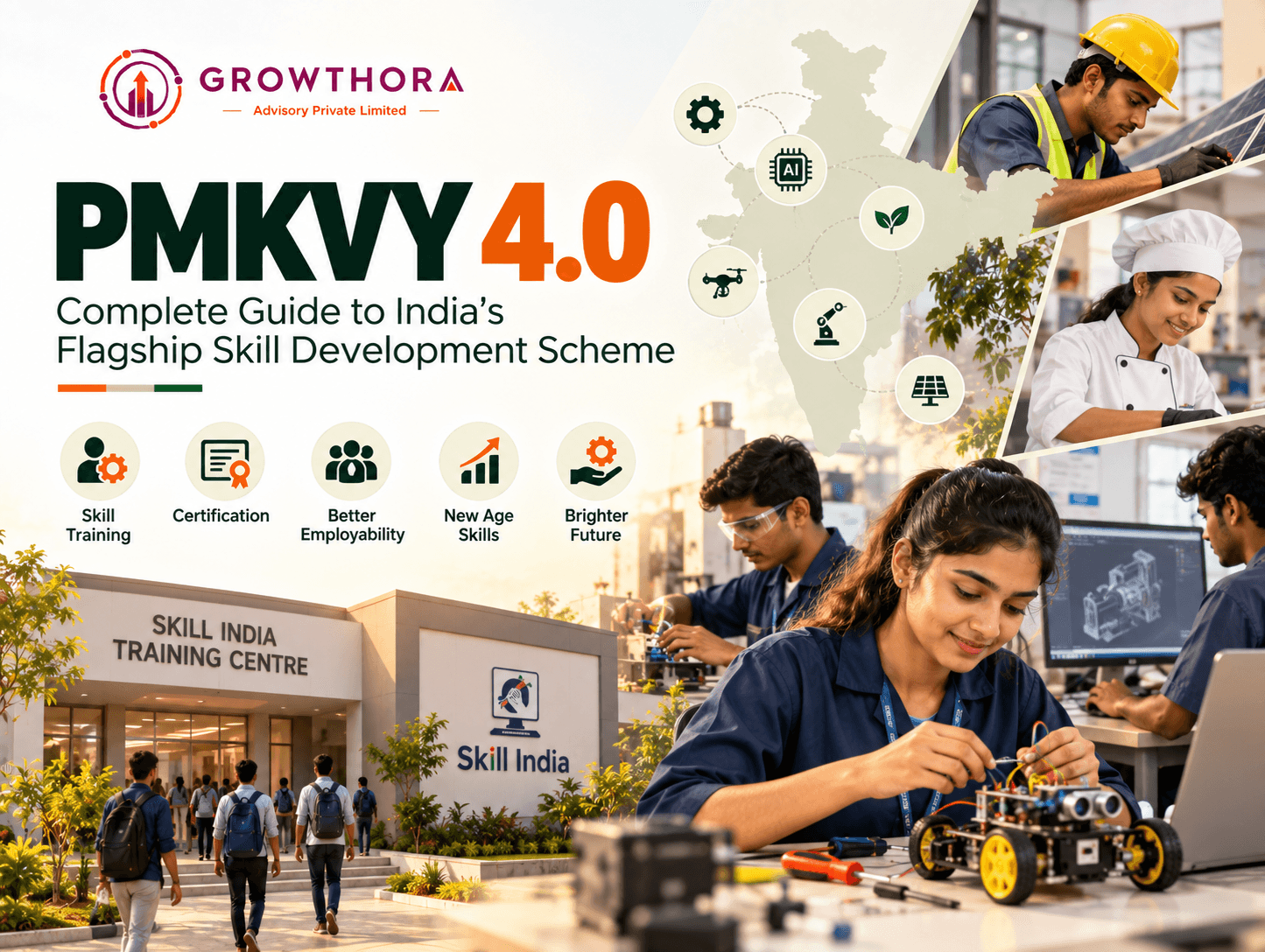
What is PMKVY?
What is Pradhan Mantri Kaushal Vikas Yojana?
PMKVY is a Central Sector Scheme implemented by the National Skill Development Corporation under the Ministry of Skill Development and Entrepreneurship, providing free, industry-relevant skill training and certification to unemployed youth, school and college dropouts, and existing workers, aimed at recognizing and standardizing skills to improve employability and support the government’s broader Skill India Mission.
The scheme’s core promise has remained consistent since 2015: give India’s youth practical, industry-recognized skills at zero personal cost, whether they are entering the workforce for the first time or need formal recognition for skills they already have but lack certification for.
How PMKVY Has Evolved: 1.0 to 4.0
PMKVY began as a pilot in 2015-16, then scaled through PMKVY 2.0 (2016-2020) and PMKVY 3.0 (2020-2021), before moving into its current phase, PMKVY 4.0, originally planned for 2022-23 to 2025-26. Following the Union Cabinet’s approval on 23 May 2026 with an outlay of Rs 18,500 crore, PMKVY 4.0 has been extended until 31 December 2026, and early planning discussions point toward a future PMKVY 5.0 expected to introduce skill vouchers, outcome-linked bonds, and APAAR ID integration.
| Phase | Period | Key Focus |
|---|---|---|
| PMKVY (Pilot) | 2015-16 | Initial rollout and framework testing |
| PMKVY 2.0 | 2016-2020 | Nationwide scale-up |
| PMKVY 3.0 | 2020-2021 | Decentralised, district-level implementation |
| PMKVY 4.0 | 2022-2026 (extended) | New-age skills: AI, robotics, IoT, drones, green jobs |
| PMKVY 5.0 (planned) | Expected 2027 | Skill vouchers, outcome bonds, APAAR ID integration |
What’s New in PMKVY 4.0
What makes PMKVY 4.0 different from earlier phases?
PMKVY 4.0 is candidate-centric and industry-led, moving away from the purely target-driven approach of earlier phases toward decentralized planning, on-the-job training components, and full integration with the Skill India Digital Hub, giving candidates a seamless, end-to-end digital experience from registration through certification.
The phase specifically emphasizes New Age Courses aligned with Industry 4.0, covering artificial intelligence, robotics, mechatronics, the Internet of Things, 3D printing, drones, and solar energy, reflecting a deliberate shift toward the skill categories that employers are increasingly seeking as automation and digital transformation reshape traditional job roles.
Training Components Under PMKVY
- Short-term training (STT) targets school and college dropouts or unemployed youth, covering technical skills, soft skills, and digital literacy, typically delivered over courses lasting a few hundred hours.
- Recognition of Prior Learning (RPL) certifies existing informal skills that workers already possess in line with the National Skills Qualification Framework, giving formal recognition to skills gained through experience rather than classroom training.
- Special projects are customized programs designed for marginalized groups, remote or underserved areas, or niche job roles that standard training centres may not adequately cover
- Kaushal & Rozgar Mela are placement fairs conducted biannually to connect trained candidates directly with employers seeking to hire
Eligibility Criteria
- The applicant must be an unemployed youth or school/college dropout, generally aged between 15 and 45 years.
- The applicant should not already hold a formal degree or certification in the specific trade they wish to train in under short-term training, since RPL exists specifically for those with informal prior experience instead.
- The applicant must complete Aadhaar-based e-KYC as part of the registration process on the Skill India Digital Hub.
- No income or educational qualification barrier applies beyond the basic age criterion, since the scheme is specifically designed to be broadly accessible
| Benefit | Detail |
|---|---|
| Training cost | Fully government-funded; average cost of around Rs 9,540 per candidate for a 300-hour course |
| Certification | Industry-recognised certificate aligned with the National Skills Qualification Framework |
| Accidental insurance | Coverage of Rs 2 lakh for the training period, at government cost |
| Placement support | Access to Kaushal & Rozgar Mela placement fairs and employer connections |
| Attendance tracking | Aadhaar-enabled biometric attendance ensuring training quality and accountability |
How to Register on Skill India Digital Hub
- Visit the official Skill India Digital Hub (SIDH) portal and register your mobile number.
- Complete the biometric-based Aadhaar e-KYC process to verify your identity.
- Create a personalized profile, entering your educational background and career goals.
- Use the search directory to find authorized training centers located near you.
- Choose your preferred industry sector and enrol in the corresponding certification course, whether under short-term training or recognition of prior learning as applicable to your situation.
- Complete the training program and participate in the mandatory assessment to receive your digital, industry-recognized certificate.
Key Takeaways
- PMKVY 4.0, approved by the Union Cabinet on 23 May 2026 with an outlay of Rs 18,500 crore, has been extended until 31 December 2026.
- The current phase emphasizes New Age Courses in AI, robotics, IoT, 3D printing, drones, and solar energy, reflecting Industry 4.0 skill demand.
- Training is delivered through short-term training for new learners and recognition of prior learning for those with existing informal skills.
- All training is fully government-funded, including industry-recognized certification and one year of accidental insurance coverage worth Rs 2 lakh.
- Registration happens entirely through the Skill India Digital Hub, using Aadhaar-based e-KYC for identity verification.
FAQs
What is the age eligibility for PMKVY?
Applicants are generally required to be between 15 and 45 years of age, targeting unemployed youth and school or college dropouts.
Is PMKVY training completely free?
Yes, PMKVY training is fully government-funded, with an average cost of around Rs 9,540 per candidate for a 300-hour course borne entirely by the government.
What new skills does PMKVY 4.0 focus on?
PMKVY 4.0 emphasizes New Age Courses aligned with Industry 4.0, including Artificial Intelligence, Robotics, Mechatronics, Internet of Things, 3D Printing, Drones, and Solar Energy.
What is Recognition of Prior Learning under PMKVY?
RPL is a component that certifies existing informal skills a worker already has, aligning them with the National Skills Qualification Framework, without requiring the person to undergo fresh classroom training.
How do I register for PMKVY training?
Registration happens through the Skill India Digital Hub, requiring mobile number registration, Aadhaar-based e-KYC, and selection of a training center and course through the platform’s search directory.
Until when has PMKVY 4.0 been extended?
Following the Cabinet’s approval on 23 May 2026 with an outlay of Rs 18,500 crore, PMKVY 4.0 has been extended until 31 December 2026.
Conclusion
If your business wants to engage with PMKVY-trained talent, or you want to understand how skilling programs like PMKVY complement your workforce planning, Growthora Advisory can help you think through the practical connections. Book a free consultation with our team today.
Next step
Apply this to your business.
Confirm whether this applies to your legal structure, industry classification, and credit history - in under 30 minutes with an advisor.