
Why PM-KUSUM Matters
PM-KUSUM matters because irrigation is one of the biggest recurring costs for Indian farmers, and it addresses that cost while also supporting India's renewable energy goals.
Detailed Explanation: For farmers, diesel or grid electricity for irrigation is a recurring, often rising, expense. Solarizing pumps reduce this dependency and, in states where surplus power sale is enabled, can turn an expense into a source of income. For the wider energy system, decentralized solar generation on farmland eases pressure on DISCOMs, which often provide power or diesel subsidies to the agriculture sector, and it supports the country's clean energy transition.
The 3 Components of PM-KUSUM
PM-KUSUM is delivered through three distinct components, each targeting a different need:
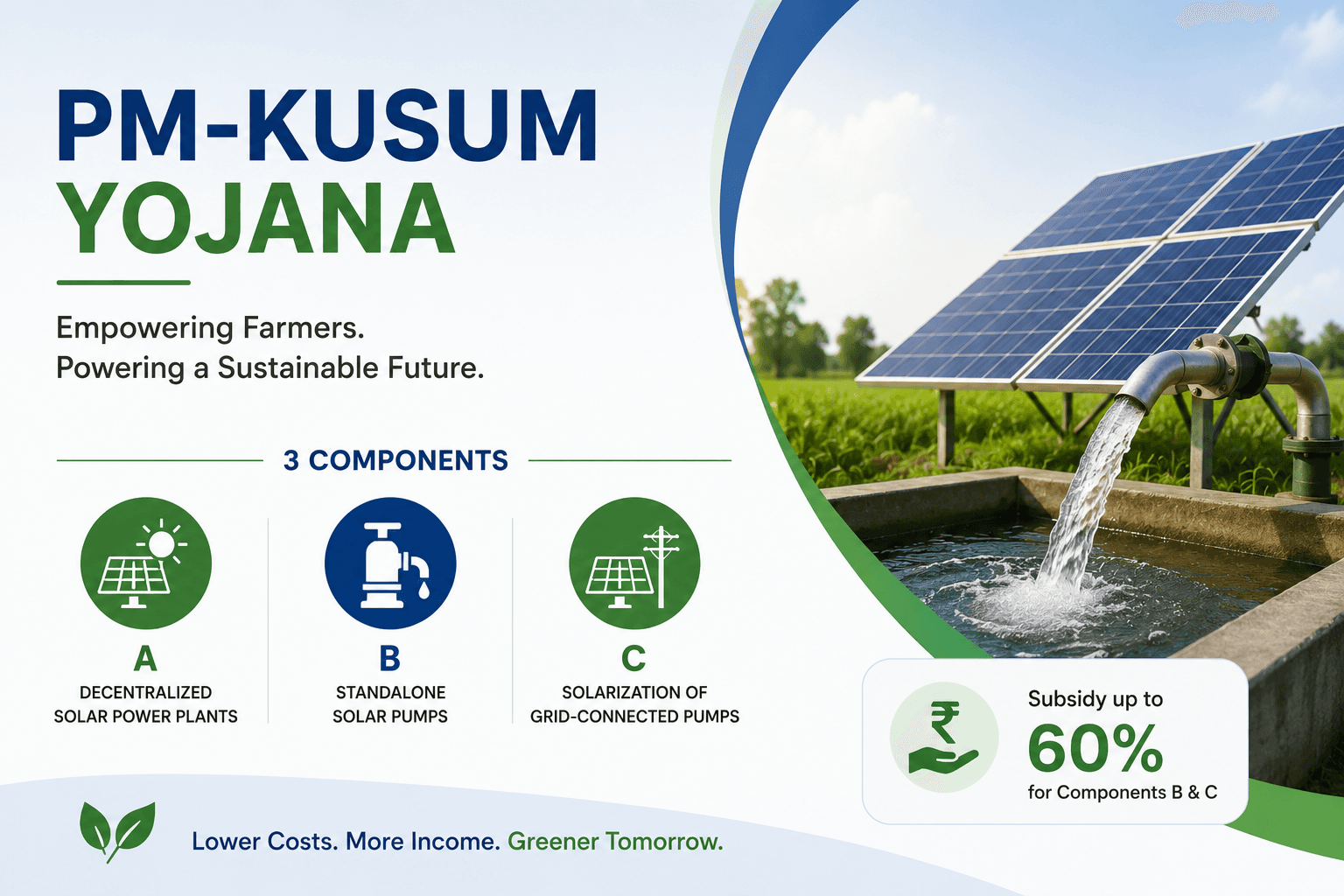
- Component A: Decentralized Solar Power Plants: Supports setting up small, ground- or stilt-mounted solar power plants (individually up to 2 MW) on barren or cultivable land, with power typically sold to the local DISCOM.
- Component B: Standalone Solar Pumps: Provides subsidized standalone solar-powered irrigation pumps for farms without reliable grid access.
- Component C: Solarization of Grid-Connected Pumps: Helps farmers who already have grid-connected pumps add solar capacity, letting them use solar power for irrigation and sell any surplus to the grid.
| Component | What It Covers | Best Suited For |
|---|---|---|
| Component A | Small decentralized solar power plants on farmland | Landowners with barren/cultivable land near a substation |
| Component B | Standalone solar irrigation pumps | Component B Standalone solar irrigation pumps Farmers without reliable grid electricity access |
| Component C | Solarizing existing grid-connected pumps | Farmers already using grid-powered irrigation pumps |
PM-KUSUM Subsidy: How Much Can You Get?
Under Components B and C, eligible farmers can generally receive up to 60% subsidy: 30% from the central government and 30% from the state government, with the remaining cost typically covered through beneficiary contribution and/or financing/loans.
Detailed Explanation: The central subsidy portion is fixed by MNRE, but state governments can and do vary their own contribution; some states offer higher top-ups, which is why total subsidy figures reported online sometimes range well above 60% in specific states. For Component A, the arrangement is different: rather than a subsidy on a personal purchase, landowners typically lease land or partner with a developer, earning income from the sale of power rather than receiving a direct pump subsidy.
Who Is Eligible for PM-KUSUM?
Eligibility depends on the component: individual farmers, farmer groups, cooperatives, panchayats, and water user associations can generally apply for Components B and C, while landowners, cooperatives, and developers are typically eligible under Component A.
Detailed Explanation: Because PM-KUSUM is implemented state-by-state through SNAs and DISCOMs, exact eligibility criteria, land size requirements, proximity to a substation for Component A, documentation, and priority categories differ from state to state. As a general rule, Component A applicants need land within a certain distance of a grid substation, while Component B and C applicants need an active or planned irrigation connection.
How to Apply for PM-KUSUM: Step-by-Step
Applications are submitted through your state's designated renewable energy nodal agency or DISCOM portal, not through a single national website, after which eligibility is verified, a subsidy is sanctioned, and installation is carried out by an empanelled vendor.
Detailed Explanation:
- Identify your component. Decide whether you need a standalone pump (B), solarization of an existing pump (C), or want to lease land for a solar plant (A).
- Find your state's nodal agency. Each state runs its own PM-KUSUM portal or process through its renewable energy development agency, or DISCOM.
- Register and submit documents. Typically includes land records, identity proof, bank details, and existing electricity connection details (for Component C).
- Verification and sanction. The nodal agency verifies eligibility and site suitability before sanctioning the subsidy.
- Installation by an empanelled vendor. Farmers typically choose from a list of vendors empanelled by the state agency, who handle installation and commissioning.
- Subsidy disbursement. The subsidy is generally adjusted against the total cost or reimbursed as per the state's process, with the farmer paying their contribution share.
Common Mistakes Applicants Make
- Applying through unofficial websites. MNRE has warned farmers about fake portals asking for registration fees or advance payments; always use your state's official nodal agency portal.
- Choosing the wrong component. Farmers with existing grid pumps sometimes apply under Component B instead of C, or vice versa, delaying approval.
- Underestimating land requirements for Component A. Roughly 4-5 acres are typically needed per MW of solar capacity, a common miscalculation for smaller landholders.
- Assuming the subsidy percentage is the same everywhere. State top-ups mean the actual net cost can vary significantly by location.
- Skipping vendor verification. Using a non-empanelled installer can disqualify the subsidy claim in some states.
Best Practices for a Smooth Application
- Confirm your state's current subsidy percentage and caps directly with the nodal agency before budgeting.
- Keep land and electricity connection documents ready in advance to avoid processing delays.
- Use only MNRE-empanelled vendors for installation.
- For Component A, confirm substation distance and grid evacuation capacity before finalizing land.
PM-KUSUM Component A vs. B vs. C: Quick Comparison
| Aspect | Component A | Component B | Component C |
|---|---|---|---|
| Purpose | Solar power plant on land | Standalone solar pump | Solarize existing grid pump |
| Who benefits | Landowners, cooperatives, developers | Farmers without grid access | Farmers with grid-connected pumps |
| Income model | Sale of power to DISCOM | Reduced irrigation cost | Reduced cost + surplus power sale |
FAQ Section
What does PM-KUSUM stand for?
Direct Answer: PM-KUSUM stands for Pradhan Mantri Kisan Urja Suraksha Evam Utthaan Mahabhiyan.
It is a Government of India scheme aimed at helping farmers adopt solar energy for irrigation and, in some cases, generate additional income by selling surplus solar power.
How much subsidy does PM-KUSUM provide?
Direct Answer: Under Components B and C, farmers can generally access up to 60% subsidy (30% central plus 30% state), with the rest covered by the farmer or through financing.
[VERIFY CURRENT FACT OR SOURCE] Some states add extra top-up subsidies beyond the standard central-state split, so actual out-of-pocket cost can vary by state and change over time.
Who implements the PM-KUSUM scheme?
Direct Answer: It's implemented by the Ministry of New and Renewable Energy (MNRE), delivered through State Nodal Agencies and DISCOMs in each state.
Because implementation is state-specific, application steps, empanelled vendors, and documentation requirements can differ from one state to another.
Can a farmer apply for more than one PM-KUSUM component?
Direct Answer: It depends on the state's specific guidelines and the farmer's existing infrastructure.
A farmer with an existing grid-connected pump would typically apply under Component C, while one without grid access would look at Component B; combining components on the same holding is subject to state-level rules.
How is PM-KUSUM Component A different from B and C?
Direct Answer: Component A is about setting up a small solar power plant on land to sell electricity, while Components B and C are about powering irrigation pumps with solar energy.
Component A suits landowners and cooperatives with land near a substation, whereas B and C are aimed directly at farmers who need irrigation power.
Where can I apply for PM-KUSUM?
Direct Answer: Through your state's designated renewable energy nodal agency or DISCOM portal, there isn't a single national application website that covers every state.
Are there risks of fraud with PM-KUSUM applications?
Direct Answer: Yes, MNRE has publicly warned farmers about fake websites and agents demanding registration fees or advance payments.
Apply only through your state's official nodal agency and use MNRE-empanelled vendors to avoid scams.
Conclusion
PM-KUSUM isn't a single application you fill out once; it's a state-implemented scheme with three distinct components, each suited to a different farming situation. Whether you're looking to add a standalone solar pump, solarize an existing connection, or lease land for a small solar plant, the right first step is identifying which component fits your situation and then checking your state's specific nodal agency for current subsidy rates and application windows. Because subsidy percentages, land requirements, and deadlines vary by state and are updated periodically, treat the numbers in this guide as a starting point, and verify current terms directly with your state's renewable energy agency before applying.
Next step
Apply this to your business.
Confirm whether this applies to your legal structure, industry classification, and credit history - in under 30 minutes with an advisor.