
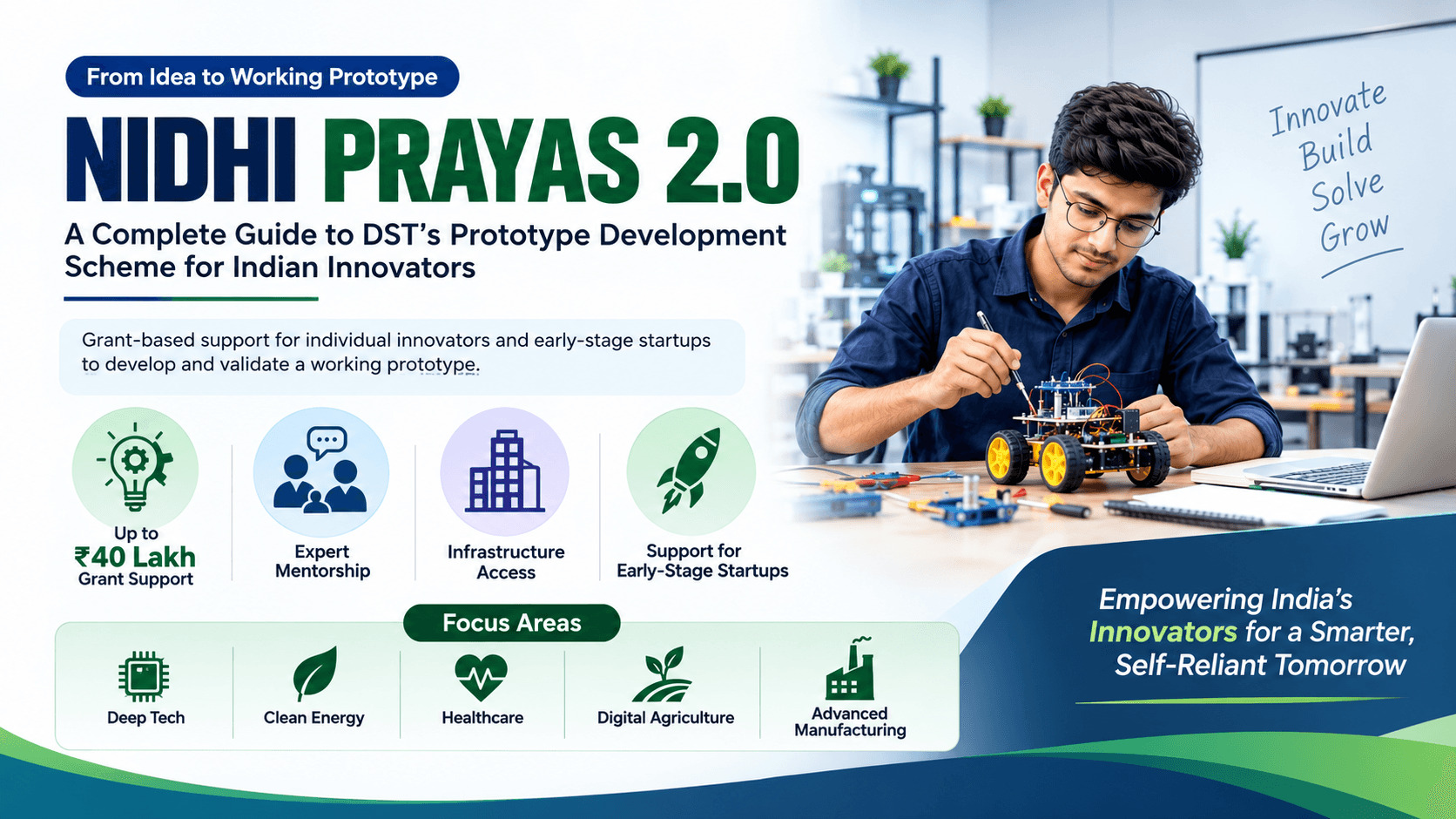
From NIDHI PRAYAS 1.0 to NIDHI PRAYAS 2.0
NIDHI PRAYAS 2.0 builds on NIDHI PRAYAS 1.0, which supported innovators in developing functional prototypes and, in many cases, transitioning into registered startups. Version 2.0 keeps that early-stage proof-of-concept mission but adds a second, more advanced tier, the Advance PRAYAS Centre, specifically for deep-tech and higher-validation prototypes that need more infrastructure and a longer runway toward commercialization.
If you received funding under PRAYAS 1.0, that history directly affects where you can apply next under 2.0, covered in the eligibility section below.
Who Runs NIDHI PRAYAS 2.0?
The scheme is sponsored and funded by the Department of Science and Technology (DST), Government of India, and implemented on the ground through the Society for Innovation and Entrepreneurship (SINE), IIT Bombay, which serves as the Program Management Unit (PMU). Day-to-day support and applications, however, run through your chosen PRAYAS Centre or Advance PRAYAS Centre not directly through DST or SINE.
Objectives of NIDHI PRAYAS 2.0
• Prototype development: translate innovative ideas into functional, testable prototypes.
• Rapid experimentation: give innovators room to iterate without the financial risk of failure.
• Indigenous solutions: encourage technology built in India for Indian and global problems.
• Startup encouragement: nudge problem-solving innovators toward formal, technology-driven startups.
• Quality pipeline: build a stronger pipeline of investable, demo-ready startups.
• Ecosystem building: connect innovators with academia, mentors, and incubators.
• Ministry catalyst: channel innovation toward problem statements raised by government ministries.
How NIDHI PRAYAS 2.0 Works: PRAYAS Centres vs. Advance PRAYAS Centres
NIDHI PRAYAS 2.0 operates through two types of incubator-run centers: PRAYAS Centres (PCs), the standard entry point for early-stage, technology-based ideas, and Advance PRAYAS Centres (APCs), reserved for deep-tech or advanced prototypes that need more specialized infrastructure and validation.
PRAYAS Centres (PCs)
PCs are the default starting point for most applicants. They support early-stage, technology-based innovations with infrastructure, mentorship, IP support, and prototype funding of up to ₹20 lakh per innovator.
Advance PRAYAS Centres (APCs)
APCs support a narrower category: deep-tech or advanced prototypes that require specialized infrastructure, rigorous technical validation, and readiness to move toward commercialization or investor conversations. Funding here goes up to ₹40 lakh per innovator (as an overall cap, not necessarily an additional amount, see the funding section below).
Priority Sectors Under NIDHI PRAYAS 2.0
DST has named specific focus areas it wants to see more innovation in. Falling inside one of these doesn’t guarantee selection, but it does align your proposal with the scheme’s stated priorities:
- Energy security, transition, and climate action
- Deep technology, quantum computing, robotics, space
- Hardware-based artificial intelligence applied to Indian problems
- Medical devices and healthcare
- Digital agriculture
- Advanced defense technologies
- Assistive devices
- Manufacturing
- Technologies critical to economic security and self-reliance (Atmanirbharta)
- Other sectors deemed necessary in the public interest
How Much Funding Can You Get Under NIDHI PRAYAS 2.0?
Individual innovators and startups can receive up to ₹20 lakh through a PRAYAS Centre (PC) or up to ₹40 lakh through an Advance PRAYAS Centre (APC). These are not stackable in full; total NIDHI PRAYAS 2.0 support for any single innovation is capped at ₹40 lakh overall, including any amount already received under PRAYAS 1.0.
Detailed Explanation: The rules around how PC and APC funding interact matter more than the headline numbers:
- If you’ve never received PRAYAS 1.0 or 2.0 funding, you can apply to either a PC (up to ₹20 lakh) or an APC (up to ₹40 lakh).
- If you received PC funding first, you can later apply to an APC for the balance only, i.e., up to ₹40 lakh minus whatever you already received.
- If you receive any amount from an APC, you become ineligible to apply to a PC afterward.
- If you were funded under PRAYAS 1.0, you can only apply to an APC under 2.0, and your total combined support (1.0 + 2.0) still cannot exceed ₹40 lakh.
- If your proposal is evaluated and rejected at the PLMC (PRAYAS Local Monitoring Committee) level of an APC, you become ineligible to apply to any standard PC afterward under this scheme.
- Applicants who have cumulatively received more than ₹40 lakh in grant funding across any government scheme are not eligible at all.
- Funds are released on a tranche/milestone basis, not as a single lump sum.
- Innovators or founding teams with no other income source may qualify for a sustenance allowance of up to 20% of the approved grant, subject to approval by the center's local monitoring committee and a full-time commitment to the project.
Funding Support to Incubators (PC vs. APC)
| Support Category | PRAYAS Centre (PC) | Advance PRAYAS Centre (APC) |
|---|---|---|
| Capital support (DST NIDHI Maker Bhavan — fab lab + co-working) | 1.50 crore | 1.50 crore |
| Prototyping grant (funding routed to innovators | 2.00 crore | 4.00 crore |
| Annual operational support | 30 lakh | 30 lakh |
Who Is Eligible to Apply?
Direct Answer: Any Indian citizen aged 18 or older with a technically sound, hardware-grounded innovation can apply as an individual innovator; startups incorporated in India for under five years, majority Indian-owned, and under ₹1 crore annual turnover can apply as an entity. Pure software, e-commerce, app-only, and service-based ideas are not eligible.
Individual Innovator Eligibility
- Must be at least 18 years old on the date of application, with proof of age and Indian citizenship (Aadhaar, passport, or voter ID).
- Must demonstrate clear ownership or a licensed right to use the IP behind the proposed prototype.
- You do not need to have a registered startup to apply.
- If applying as a team, the group must designate a lead innovator; funds go to the lead’s account, and IP ownership follows whatever agreement the team has made.
- Individual innovators are encouraged (not strictly mandated as a precondition) to formally incorporate as a DPIIT-registered startup within 6–8 months of receiving support.
- Employed applicants or full-time students must submit a No Objection Certificate (NOC) from their employer or institution, confirming they can engage with the project and that resulting IP vests with them.
Startup Eligibility
- Incorporated in India for no more than 5 years as of the application date.
- At least 51% of equity held by Indian citizens.
- Annual turnover has not exceeded ₹1 crore in any financial year since incorporation.
- Founder must be at least 18 years old, with proof of age and Indian citizenship.
- Same IP ownership and prior-funding-cap rules as individual innovators apply.
What Will Not Be Funded
- Pure software development, e-commerce platforms, service-based businesses, or app-only solutions (software as one component of a hardware/phygital product, e.g., firmware for an IoT device, is fine).
- Academic research funding or student internships within institutions.
- Innovators are already being supported in parallel under NIDHI-EIR.
- Products that have already crossed the MVP stage, this is proof-of-concept and prototype-stage funding, not scale-up funding.
Step-by-Step Application Process
- Choose your entry point. Assess honestly whether your idea is early-stage (PC) or a deep-tech, higher-validation prototype (APC), this decision has consequences for what you’re eligible to apply to later.
- Confirm eligibility. Check age, citizenship, IP ownership, prior government grant history, and that your product is hardware/phygital, not purely software.
- Prepare documentation. Gather age and citizenship proof, IP ownership or licensing evidence, a team agreement (if applicable), and an NOC if you’re employed or a full-time student.
- Identify a center. Applications are submitted through a specific PC or APC, not directly to DST; a list of active centers is available on the official NIDHI PRAYAS site.
- Submit your application through the centre’s process, typically via the official PRAYAS portal.
- Evaluation. Your proposal is reviewed by the PRAYAS Local Monitoring Committee (PLMC) at your chosen center.
- Onboarding and disbursement. If selected, funding is released in tranches tied to project milestones, alongside access to the center's fab lab, mentorship, and infrastructure.
- Execute the 15-month project, working toward a validated, demo-ready prototype with a clear path to commercialization.
- Close-out. Return any unutilized grant balance to your center, and, if you’re an individual innovator, consider formal DPIIT startup registration within 6–8 months.
Project Duration and Fund Disbursement
Each PRAYASEE (a selected grant recipient) gets a 15-month project term, extendable by up to 6 months under exceptional circumstances with committee approval. There’s no application fee and no participation charge to apply through a PC or APC, and centers are explicitly barred from taking equity in exchange for services rendered under the grant.
Benefits of NIDHI PRAYAS 2.0 Beyond the Money
- Non-dilutive funding, no equity given up in exchange for the grant.
- Access to fab labs, co-working space, and prototyping infrastructure through the DST NIDHI Maker Bhavan network.
- Structured mentorship and technical guidance during the build-and-test phase.
- IP filing and patent support.
- A built-in pathway toward DPIIT startup registration and, for APC-track deep-tech projects, positioning toward VC funding or the RDI Scheme.
Common Mistakes Applicants Make
| Mistake | Why It Happens | How to Avoid It |
|---|---|---|
| Applying with a pure software or app idea | Assuming “tech innovation” automatically qualifies | Confirm your product has a genuine hardware or phygital component before applying |
| Jumping straight to an APC for the bigger funding number | Treating ₹40 lakh as simply “better” than ₹20 lakh | Apply to a PC first unless your project genuinely meets deep-tech/advanced-validation criteria |
| Skipping the NOC as a student or employee | Not realizing it’s a hard documentation requirement | Secure your NOC from your employer or institution before you apply, not after |
| Treating IP ownership as a formality | Assuming ownership is “obvious” | Prepare clear, documented proof of IP ownership or licensing rights in advance |
| Reapplying to a PC after an APC rejection at PLMC stage | Not reading the eligibility fine print | Understand this path is explicitly closed once a PLMC-level APC rejection occurs. |
| Budgeting as if funds arrive as one lump sum | Comparing to other grant structures | Plan cash flow around milestone-based tranche disbursement |
NIDHI PRAYAS 1.0 vs. NIDHI PRAYAS 2.0
| Aspect | NIDHI PRAYAS 1.0 | NIDHI PRAYAS 2.0 |
|---|---|---|
| Centre structure | PRAYAS Centres only | PRAYAS Centres (PC) + Advance PRAYAS Centres (APC) |
| Funding ceiling (per innovator) | Lower, centre-dependent cap [VERIFY CURRENT FACT OR SOURCE] | Up to ₹40 lakh cumulative, including any 1.0 support |
| Focus | Early-stage prototype / proof-of-concept funding | Early-stage and deep-tech / advanced prototype funding |
| Strategic alignment | General innovation support | Explicitly aligned with Atmanirbhar Bharat and Viksit Bharat @2047 priority sectors |
| Path for 1.0 recipients | - | Can only re-apply through an APC, capped at ₹40 lakh total |
PRAYAS Centre (PC) vs. Advance PRAYAS Centre (APC): Which Should You Apply To?
| Factor | PRAYAS Centre (PC) | Advance PRAYAS Centre (APC) |
|---|---|---|
| Best for | First-time applicants, early-stage ideas | Deep-tech, higher-TRL, near-commercialization prototypes |
| Max individual funding | 20 lakh | 40 lakh (cumulative cap) |
| Typical project maturity | Concept to early prototype | Advanced prototype/MVP with measurable TRL progress |
| Can move to the other tier later? | Yes — can later apply to an APC for the balance | No — APC funding closes the door to PC applications |
Frequently Asked Questions
What is NIDHI PRAYAS 2.0?
NIDHI PRAYAS 2.0 is a DST-run Government of India scheme that gives individual innovators and early-stage startups non-dilutive grant funding, mentorship, and lab access to build and validate a science- or technology-based prototype through a network of PRAYAS Centres and Advance PRAYAS Centres.
How much funding can I get under NIDHI PRAYAS 2.0?
Up to ₹20 lakh through a PRAYAS Centre (PC), or up to ₹40 lakh through an Advance PRAYAS Centre (APC). Total support per innovation is capped at ₹40 lakh overall, including anything received under PRAYAS 1.0, and funds are released in tranches, not as a lump sum.
Who is eligible to apply for NIDHI PRAYAS 2.0?
Any Indian citizen aged 18+ with a hardware-grounded, technically sound innovation can apply individually. Startups incorporated in India for under 5 years, at least 51% Indian-owned, and under ₹1 crore turnover are also eligible. You don’t need a registered company to apply as an individual.
Is there an application fee?
No. There is no application fee or participation charge to apply through a PRAYAS Centre or Advance PRAYAS Centre.
Can I apply with a software-only product?
No. Pure software, e-commerce, app-based, and service-based products are not eligible. Software as one component of a hardware or phygital product, like firmware in an IoT device, can be considered.
What’s the difference between a PRAYAS Centre (PC) and an Advance PRAYAS Centre (APC)?
PCs support early-stage, technology-based ideas with funding up to ₹20 lakh. APCs support deep-tech or advanced prototypes needing more validation and infrastructure, with funding up to ₹40 lakh. Receiving APC funding closes off future PC applications under this scheme.
How long is the project term?
15 months, with a possible 6-month extension under exceptional circumstances and committee approval.
Do I have to return the grant after the project ends?
The grant itself doesn’t need to be repaid if it’s utilized for the approved prototype. Any unutilized balance, however, must be returned to your designated center.
Conclusion
NIDHI PRAYAS 2.0 is one of the more accessible entry points into government-backed innovation funding in India, precisely because it doesn’t require you to already have a registered company, doesn’t take equity, and is designed for the stage most innovators actually get stuck at, going from idea to working prototype. The trade-off is real specificity in the eligibility rules: your product needs a genuine hardware or phygital component, your funding path through PC and APC is largely a one-way door, and documentation (IP proof, NOCs, citizenship proof) needs to be sorted before you apply, not during review.
If your innovation fits the scheme’s scope, the most useful next step is reading the official program guidelines in full and identifying an active PRAYAS Centre or Advance PRAYAS Centre aligned with your sector, since specific centres, application windows, and portal details can change and should be confirmed directly on the official site before you apply.
Next step
Apply this to your business.
Confirm whether this applies to your legal structure, industry classification, and credit history - in under 30 minutes with an advisor.