
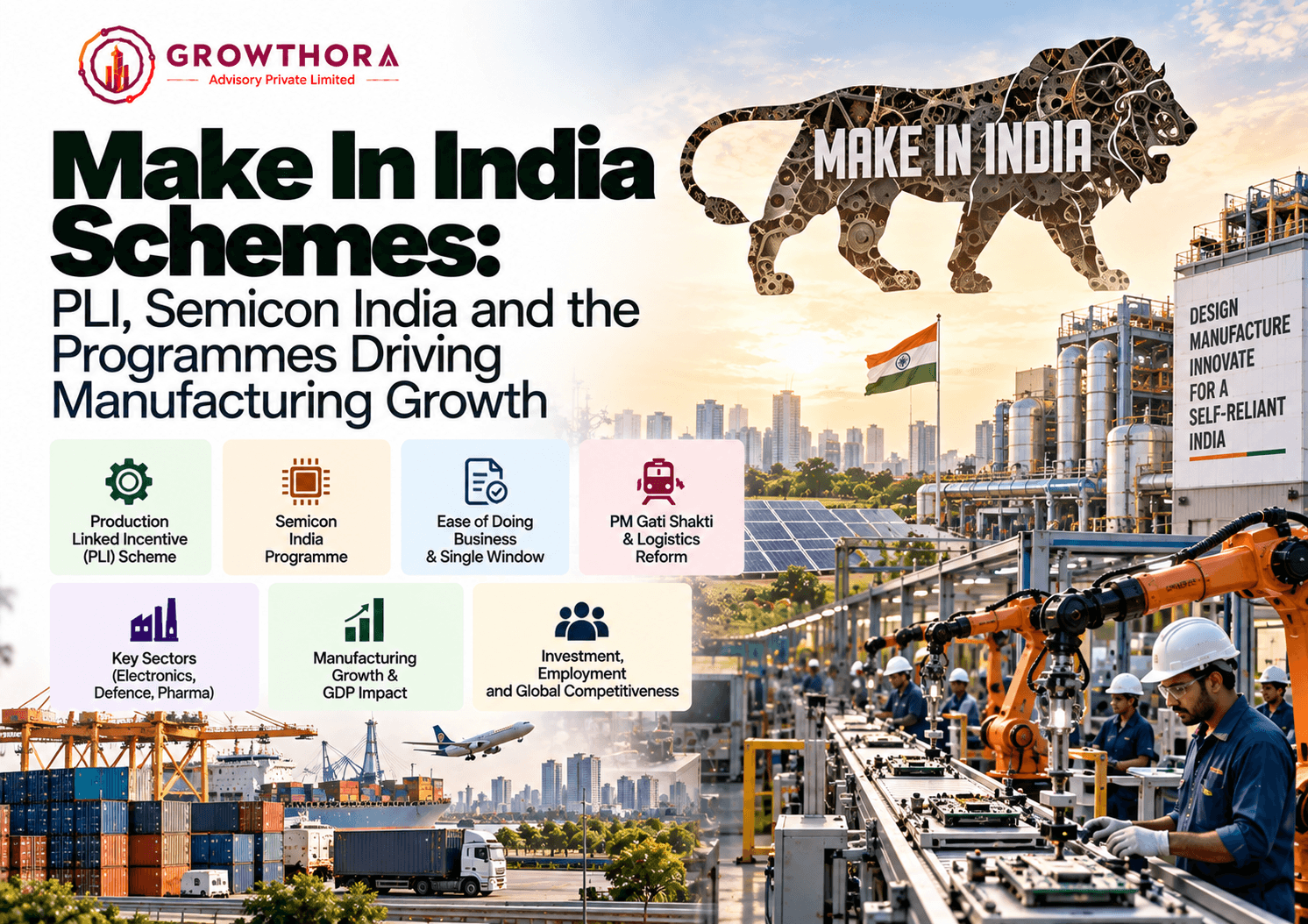
What is Make in India?
Make in India is a flagship Government of India initiative launched in September 2014 to encourage both domestic and foreign companies to manufacture their products within the country, aiming to raise manufacturing's share of GDP, generate large-scale employment, and position India as a globally competitive manufacturing and design hub.
Over more than a decade, the initiative has been backed by a series of specific reform measures and financial schemes rather than remaining a broad slogan, and understanding those individual schemes matters far more for a business owner than the overarching brand name itself.
Production Linked Incentive (PLI) Scheme
What does the PLI scheme actually offer?
The Production Linked Incentive scheme offers direct financial incentives to eligible manufacturing companies based on their incremental sales of goods produced in India over a base year, currently spanning 14 strategic sectors with a combined incentive outlay of around Rs 1.91 lakh crore, covering electronics, pharmaceuticals, automobiles and auto components, textiles, specialty steel, solar PV modules, white goods, medical devices, advanced chemistry cells, and food products, among others.
| Metric | Reported Figure |
|---|---|
| Total PLI outlay | Around Rs 1.91 lakh crore |
| Sectors covered | 14 strategic sectors |
| Applications approved | Around 836 across all sectors |
| Strongest sector response | Electronics, auto components and pharmaceuticals |
Independent analysis has suggested the scheme has the potential to add roughly 4 percent to GDP annually in incremental revenue terms if fully realized, though actual outcomes vary meaningfully by sector, with electronics and mobile phone manufacturing showing the strongest and most consistent uptake so far.
Semicon India Programme
What progress has the Semicon India Programme made?
The Semicon India Programme, carrying an outlay of around Rs 76,000 crore, has approved 12 semiconductor manufacturing units as of 2026 with investments exceeding Rs 1.64 lakh crore, including three units that have already begun commercial production, marking a significant step in building India's domestic semiconductor design and fabrication ecosystem.
The programme is being deepened further through ISM 2.0, announced in Budget 2026-27, which extends the mission's scope to equipment and materials manufacturing, full-stack Indian intellectual property design, and industry-led research and training centres to build the skilled workforce this sector requires.
National Single Window System and Ease of Doing Business
The National Single Window System was built to integrate clearances from 32 ministries and departments and 29 states and union territories into a single digital platform, aiming to cut the time and complexity involved in getting the multiple approvals a new manufacturing unit typically requires, directly addressing one of the most commonly cited obstacles to setting up manufacturing capacity in India.
PM Gati Shakti and Logistics Reform
PM Gati Shakti, the National Master Plan for multimodal infrastructure, supports Make in India by enabling data-based, integrated planning across road, rail, port and other infrastructure, directly targeting India's comparatively high logistics costs, which industry feedback has repeatedly flagged as a bigger competitive disadvantage than factory-gate manufacturing costs when compared with countries like Vietnam and Bangladesh.
Sector Level Progress: Electronics, Defence, and Pharma
- Electronics: production has grown roughly sevenfold to around Rs 13.11 lakh crore by FY 2025-26, making India the world's second largest mobile phone manufacturer.
- Defense: production reached around Rs 1.78 lakh crore in FY 2025-26, with exports surging over 5,500 percent from earlier levels to roughly Rs 38,424 crore, now reaching more than 80 countries.
- Pharmaceuticals: India ranks third globally in pharmaceutical production volume, with PLI backed investments in the sector exceeding Rs 51,997 crore and cumulative sales reaching around Rs 3.88 lakh crore.
Has Make in India Met Its Manufacturing GDP Target?
Has manufacturing's share of India's GDP actually increased since Make in India launched?
Not yet by the headline metric; manufacturing's share of gross value added stood at around 15.9 percent in a recent assessment, compared to about 16.7 percent when the programme launched in 2013-14, meaning the government's own target of a 25 percent manufacturing GDP share, originally aimed at 2030 and now increasingly framed around the longer horizon toward 2047, has not yet been achieved, even as absolute manufacturing output and exports have grown substantially.
Government officials have attributed the gap not just to insufficient investment but to bottlenecks in technology adoption and skills, arguing that when investment, technology, and skilling come together consistently, the momentum needed to shift the GDP share meaningfully will follow.
Key Takeaways
- Make in India, launched in September 2014, has evolved into a set of specific schemes, most notably PLI and Semicon India, rather than remaining a broad slogan.
- The PLI scheme now covers 14 sectors with a combined outlay of around Rs 1.91 lakh crore, with the strongest response from electronics, auto components, and pharmaceuticals.
- Semicon India has approved 12 manufacturing units worth over Rs 1.64 lakh crore, with ISM 2.0 announced in Budget 2026-27 to deepen the ecosystem further.
- Sector-level results are strong in electronics, defense exports, and pharmaceuticals, even though manufacturing's overall GDP share has not yet reached the government's 25 percent target.
- Complementary reforms like the National Single Window System and PM Gati Shakti address regulatory and logistics bottlenecks that have historically limited India's manufacturing competitiveness.
FAQs
What is Make in India?
Make in India is a flagship initiative launched by the Government of India in September 2014 to transform the country into a global manufacturing and design hub by encouraging both domestic and foreign companies to manufacture their products within India, easing regulatory processes and attracting investment across a wide range of sectors.
What is the production-linked incentive scheme under Make in India?
The Production Linked Incentive, or PLI, scheme is a set of sector-specific programmes launched in 2020 that offer financial incentives to eligible companies based on incremental sales of goods manufactured in India, currently covering 14 sectors with a total incentive outlay of around Rs 1.91 lakh crore, spanning electronics, pharmaceuticals, automobiles, textiles and more.
Has Make in India succeeded in raising manufacturing's share of GDP?
Progress has been mixed on this specific metric; manufacturing's share of gross value added stood at around 15.9 percent in a recent year compared to roughly 16.7 percent when the programme launched in 2014, meaning the headline GDP share target has not yet been met, even as absolute manufacturing output, exports and investment under specific programmes like PLI and Semicon India have grown substantially.
What is the Semicon India Programme?
The Semicon India Programme is a dedicated scheme under the broader Make in India and semiconductor mission framework, with an outlay of around Rs 76,000 crore, aimed at building India's semiconductor design, fabrication and packaging ecosystem, and as of 2026 it has approved 12 manufacturing units involving investments exceeding Rs 1.64 lakh crore.
What is the government's manufacturing GDP share target and by when?
The government has set a target of raising manufacturing's share of GDP to 25 percent, with earlier communications referencing 2030 as a goal and more recent long-term framing extending the ambition toward 2047, alongside the broader Viksit Bharat vision.
How is Make in India different from Atmanirbhar Bharat?
Make in India, launched in 2014, is primarily focused on positioning India as a global manufacturing and investment destination open to both domestic and foreign companies, while Atmanirbhar Bharat, launched in 2020, added a more explicit emphasis on reducing import dependence in strategic sectors and building supply chain resilience, and the two initiatives are designed to work together rather than as substitutes.
Conclusion
If your manufacturing business wants to understand how to access PLI incentives, Semicon India-linked opportunities, or other Make in India schemes relevant to your sector, Growthora Advisory can help you navigate eligibility and application. Book a free consultation with our funding team today.
Next step
Apply this to your business.
Confirm whether this applies to your legal structure, industry classification, and credit history - in under 30 minutes with an advisor.