
Introduction
Women entrepreneurs in India can access several forms of public support, but there is no single scheme that fits every business. Some programmes provide a bank loan, some offer a credit guarantee to the lender, some give a back-ended subsidy, and others support training, procurement, exhibitions, digital market access or artisan skills.
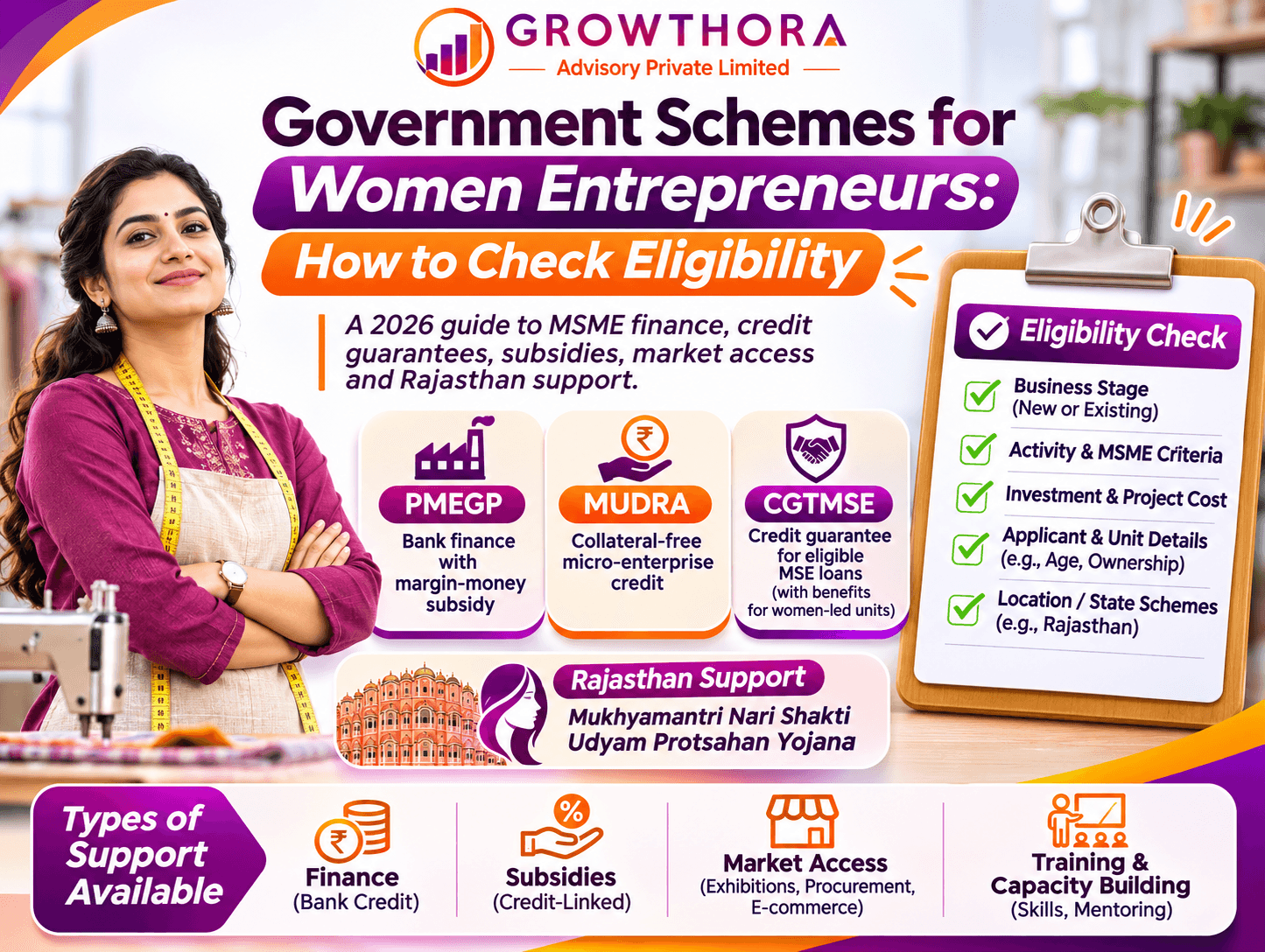
The right starting point is your business stage and funding purpose. A woman starting a new unit may look at PMEGP. An existing micro business needing working capital may compare MUDRA and regular bank finance. A lender may consider CGTMSE guarantee cover for an eligible loan. A Rajasthan resident may also examine the Mukhyamantri Nari Shakti Udyam Protsahan Yojana. If your business is not registered yet, start with our Udyam registration guide, because many schemes ask for Udyam details.
This guide uses official government material available as of 12 November 2026. Scheme windows, guidelines, budgets and lender products can change, so verify the live notification and get written confirmation from the implementing agency or lender before spending money or relying on a benefit.
First understand the type of support
Many applicants confuse a loan, a guarantee and a subsidy. They are different things.
- Bank-linked credit: a lender appraises and sanctions a repayable loan or working-capital facility. It is not a grant. Our overview of an MSME loan explains how this works for small businesses.
- Credit guarantee: a government-backed trust covers part of the lender’s eligible risk. It may make a lender more willing to lend, but you still repay the loan.
- Credit-linked subsidy: a subsidy tied to a loan, often back-ended and released under scheme conditions.
- Interest or margin support: reduces eligible financing cost or supports a defined project component for eligible applicants and periods.
- Market access and procurement: support for exhibitions, vendor development, e-commerce or public procurement. This improves access, not necessarily cash funding.
- Training and capacity building: skill development, entrepreneurship training and mentoring, sometimes with a stipend.
Major central government schemes for women entrepreneurs
- PMEGP: bank finance linked to margin-money subsidy for eligible new micro-enterprises in the non-farm sector. Women are a special category.
- Pradhan Mantri MUDRA Yojana (PMMY): collateral-free micro-enterprise credit through participating lenders for eligible non-farm and allied-agriculture activities.
- CGTMSE credit guarantee: guarantee cover to member lenders for qualifying MSE credit. Women-led MSEs receive enhanced coverage and a guarantee-fee concession under applicable rules.
- Procurement and Marketing Support (PMS): support for trade fairs, exhibitions, vendor development and marketing, including a benefit for women-owned MSEs.
- MSME Trade Enablement & Marketing (TEAM): digital market access and onboarding support, including ONDC-related enablement under RAMP.
- PM Vishwakarma: training, toolkit incentive, concessional credit and market support for artisans in 18 notified traditional trades.
- Skill Upgradation and Mahila Coir Yojana: skill development for women artisans in the coir sector.
- Startup India ecosystem: incubation and seed funding through approved incubators. Funding is not an automatic entitlement.
PMEGP: eligibility and application for women
The Prime Minister’s Employment Generation Programme is a credit-linked subsidy for new micro-enterprises in the non-farm sector. Women are a special category for contribution and subsidy. The bank appraises the project, and the subsidy is released under scheme conditions, not as an unrestricted upfront grant. A clear detailed project report is the backbone of a good PMEGP application.
Key PMEGP figures for women
- Beneficiary contribution: generally 5% of project cost for special-category applicants, including women.
- Margin-money subsidy: 25% in urban areas and 35% in rural areas, subject to scheme definitions.
- Maximum project cost: up to ₹50 lakh for manufacturing and ₹20 lakh for service or business projects.
- Education condition: at least VIII standard pass for manufacturing projects above ₹10 lakh and service projects above ₹5 lakh.
- Age: the individual applicant generally must be above 18 years.
- Project type: a new, viable non-farm micro-enterprise, excluding negative-list activities.
Your project report should state the activity, location, cost, machinery or service setup, working capital, promoter contribution, employment, projected revenue and repayment capacity. Do not assume an existing unit qualifies as a new PMEGP project. Separate rules apply to eligible second-loan and upgradation cases.
PMEGP application steps
- Read the current PMEGP guidelines and confirm your activity is eligible.
- Prepare a realistic project report, cost estimates and supplier quotations.
- Keep identity, address, education and category documents ready, along with Udyam or other records as required.
- Apply on the official PMEGP portal and select the implementing agency and bank.
- Complete scrutiny, interview or verification steps and answer bank queries.
- Complete Entrepreneurship Development Programme (EDP) training where applicable.
- Bring in the promoter contribution and complete bank documentation.
- Track sanction, disbursement, physical verification and margin-money adjustment.
MUDRA: small-business credit for women
Pradhan Mantri MUDRA Yojana provides institutional credit to eligible micro-enterprises through banks, NBFCs, MFIs and other participating lenders. It is a loan, not a subsidy. It can support term-loan and working-capital needs. If you want help preparing your proposal, see our MUDRA loan support page.
- Shishu: up to ₹50,000
- Kishor: above ₹50,000 and up to ₹5 lakh
- Tarun: above ₹5 lakh and up to ₹10 lakh
- Tarun Plus: above ₹10 lakh and up to ₹20 lakh, for entrepreneurs who have successfully repaid a previous Tarun-category loan
Approach a participating lender with a clear purpose, business proof, KYC, bank statements, quotations or a working-capital estimate. Approval, interest rate, tenure and repayment terms are decided by the lender.
CGTMSE: guarantee support for women-led MSEs
CGTMSE does not lend money to entrepreneurs. It gives guarantee cover to eligible member lenders for qualifying credit to micro and small enterprises. The bank decides whether to seek cover. This is the mechanism behind many a collateral-free business loan.
- For women-led MSEs, official material reports enhanced guarantee coverage of up to 90% under the applicable scheme.
- The government also reports a 10% concession in the annual guarantee fee for women-led MSEs.
- The overall guarantee ceiling was raised to ₹10 crore from 1 April 2025. This does not mean every borrower can get a ₹10 crore loan.
- Guarantee cover protects the lender. It does not waive your repayment obligation.
Ask your bank whether your business, facility, amount, security and borrower category qualify under the current scheme document. Do not rely on a universal coverage percentage without checking.
Rajasthan: Mukhyamantri Nari Shakti Udyam Protsahan Yojana
Rajasthan has a state programme for women applicants and women self-help groups starting a new enterprise or expanding, diversifying or modernising an existing one. The official Rajasthan FAQ lists individual women above 18 years, women SHGs and federations as potential applicants, subject to conditions. For wider state-level options, read about Rajasthan startup and MSME support.
- Enterprise establishment: up to ₹1 crore
- Trade: up to ₹10 lakh
- Individual woman or women SHG: up to ₹50 lakh
- Federation of women SHGs: up to ₹1 crore
The applicant must be a resident of Rajasthan. The FAQ lists nationalised banks, eligible private and small finance banks, regional rural banks, Rajasthan Financial Corporation and SIDBI as possible lenders. SHGs and federations must meet registration requirements.
These are maximum amounts shown in the FAQ, not guaranteed sanctions or grants. Check the current scheme order and the selected institution for the actual amount, margin, subsidy or interest support, and security conditions. Official FAQ: https://ssoapps.rajasthan.gov.in/imsupy/faq.aspx
Market access and procurement support
Procurement and Marketing Support Scheme
This scheme supports eligible MSE participation in trade fairs, exhibitions and vendor-development programmes. Government communications state that women-owned MSEs may receive 100% subsidy on built-up space rent for eligible trade-fair participation. Confirm the event-specific guideline and eligible expenses before booking.
TEAM and ONDC enablement
The MSME Trade Enablement & Marketing initiative under RAMP helps MSEs use digital commerce and ONDC-related channels. Government reporting describes it as a three-year initiative for 2024-27. Check current partners, onboarding availability and eligibility in your district.
Public procurement
The Public Procurement Policy for Micro and Small Enterprises includes a sub-target for procurement from women-owned MSEs. This is a market route, not a grant. Check your Udyam details, ownership conditions and tender requirements, and consider completing GeM seller registration to access government buyers.
PM Vishwakarma and sector-specific support
Women artisans may qualify for PM Vishwakarma if they work in one of the 18 notified traditional trades and meet the conditions. The scheme includes skill training, stipend, toolkit incentive, credit support and market linkage. Applications go through Common Service Centres and a verification process.
Women in the coir sector can check the Skill Upgradation and Mahila Coir Yojana, which is a skill programme, not a general business loan. Other sector schemes may exist in food processing, textiles, rural livelihoods, agriculture or science and technology, so match your activity to the right ministry before applying.
How to check eligibility before applying
Answer these questions first, and keep the evidence ready. A registered business with correct tax details, including GST reg
istration where required, avoids many delays.
- Applicant: are you an individual woman, proprietorship, partnership, company, SHG or federation? Does the scheme require women ownership or control? Keep KYC, constitution documents and ownership records ready.
- Business stage: is it a new unit, existing unit, expansion, modernisation or startup? Keep registration dates and previous scheme benefits on record.
- Location: is the project rural or urban? Is Rajasthan residence or a particular district required? Keep address proof and any rural-area certificate.
- Activity: is the activity allowed, or is it on a negative list? Keep licences and the project report ready.
- Project cost: does the cost fit scheme limits and eligible expenses? Keep quotations and working-capital calculations.
- Credit history: do you have existing loans, defaults or previous scheme loans? Keep your credit report and statements ready.
- Education and training: does the scheme need minimum education, EDP or technical qualifications?
- Application window: is the scheme open, and is the bank or portal accepting applications now?
Documents commonly requested
- Aadhaar or other accepted identity proof, PAN, photographs and address proof.
- Business address proof, rent agreement or ownership document.
- Udyam Registration Certificate, GST registration where applicable, and constitution documents.
- Promoter profile, ownership details and bank statements.
- Project report with project cost, means of finance and repayment projections.
- Supplier quotations, machinery details and working-capital calculations.
- Financial statements, ITRs, GST returns, sales records and loan statements for existing businesses.
- Category, rural-area, education, artisan-trade, SHG or Rajasthan-residence documents where required.
- Customer orders, licences and statutory registrations relevant to the activity.
This is a preparation list, not an official universal checklist. The agency or lender may ask for additional or different documents.
Common mistakes to avoid
- Treating a loan, a credit guarantee and a subsidy as the same benefit.
- Assuming being a woman entrepreneur automatically qualifies you for every scheme.
- Applying for PMEGP for an existing unit without checking new-unit and second-loan rules.
- Assuming a CGTMSE guarantee is a cash grant or waives repayment.
- Using an old scheme PDF without checking amendments or the live portal.
- Confusing the maximum scheme limit with the amount a bank will sanction.
- Submitting inconsistent project costs, contribution or ownership details.
- Paying an agent who promises guaranteed sanction or subsidy release.
- Not checking whether the scheme is open, active in your district or supported by your bank.
- Failing to keep application numbers, written clarifications, sanction letters and disbursement records.
Practical application workflow
- Write down your business activity, stage, location and exact funding need.
- Confirm you meet the scheme’s ownership, age, location and activity conditions.
- Download the latest official guideline and note the channel, eligible expenses, contribution and deadlines.
- Prepare a realistic project report, projections and documents.
- Ask the agency or bank for its current checklist in writing.
- Submit through the official portal or authorised institution and save the acknowledgement.
- Answer clarifications and complete training, verification or inspection steps.
- Read the sanction letter carefully, including interest, tenure, security, fees, subsidy treatment and repayment.
- Track post-sanction conditions, utilisation proof and subsidy adjustment.
Frequently asked questions
Which government schemes support women entrepreneurs in India in 2026?
Relevant routes include PMEGP, MUDRA, CGTMSE-backed lending, Procurement and Marketing Support, TEAM/ONDC enablement, PM Vishwakarma for eligible artisans, and state-specific programmes such as Rajasthan’s Mukhyamantri Nari Shakti Udyam Protsahan Yojana.
Which scheme gives subsidy to women starting a business?
PMEGP provides a credit-linked margin-money subsidy for eligible new micro-enterprises. Women are a special category, with subsidy rates generally 25% in urban areas and 35% in rural areas, subject to scheme conditions.
What is the PMEGP subsidy for women?
The PMEGP special-category rate for women is generally 25% in urban areas and 35% in rural areas. The applicant contribution is generally 5%, and the project must satisfy current eligibility and cost rules.
Can an existing women-owned business apply under PMEGP?
PMEGP primarily supports new units. Separate second-loan or upgradation provisions may apply to eligible existing PMEGP or MUDRA units. Check the latest guidelines before applying.
Does CGTMSE give loans directly to women entrepreneurs?
No. CGTMSE provides guarantee cover to eligible member lenders. The bank or lender sanctions the loan and the borrower remains responsible for repayment.
What CGTMSE benefit is available to women-led MSEs?
Government communications report enhanced guarantee coverage of up to 90% for women-led MSEs and a 10% concession in annual guarantee fees, subject to the applicable scheme and facility conditions.
Can a woman apply for a MUDRA loan for a small business?
Yes. An eligible woman entrepreneur can apply through a participating lender for an eligible micro-enterprise activity. The lender assesses the proposal, documents and repayment capacity.
What is the maximum MUDRA loan amount?
Tarun Plus can provide above ₹10 lakh and up to ₹20 lakh to eligible entrepreneurs who have successfully repaid a previous Tarun-category loan. Other categories have lower limits.
Is there a Rajasthan government scheme specifically for women entrepreneurs?
Rajasthan’s Mukhyamantri Nari Shakti Udyam Protsahan Yojana supports eligible individual women, women SHGs and federations for new enterprises and expansion, subject to state residence and scheme rules.
Can a women self-help group apply under Rajasthan’s Nari Shakti scheme?
The official Rajasthan FAQ includes women SHGs and SHG federations, with registration requirements. Applicants should confirm current conditions with the implementing department.
Are government schemes available for women artisans?
Eligible women artisans may check PM Vishwakarma if they work in one of its 18 notified trades, and women coir artisans may check the Mahila Coir Yojana.
Do I need Udyam registration to apply for these schemes?
Many MSME schemes, procurement routes and lender processes ask for Udyam details at some stage, but the requirement differs by scheme. Check the current guideline for each programme.
How can a woman check scheme eligibility?
Check applicant type, ownership, business stage, location, activity, project cost, contribution, credit history, documents and whether the scheme is currently accepting applications.
Does scheme eligibility guarantee loan approval?
No. Where a bank loan is involved, the lender independently appraises credit history, project viability, repayment capacity, documents and scheme compliance.
Next step
Apply this to your business.
Confirm whether this applies to your legal structure, industry classification, and credit history - in under 30 minutes with an advisor.