
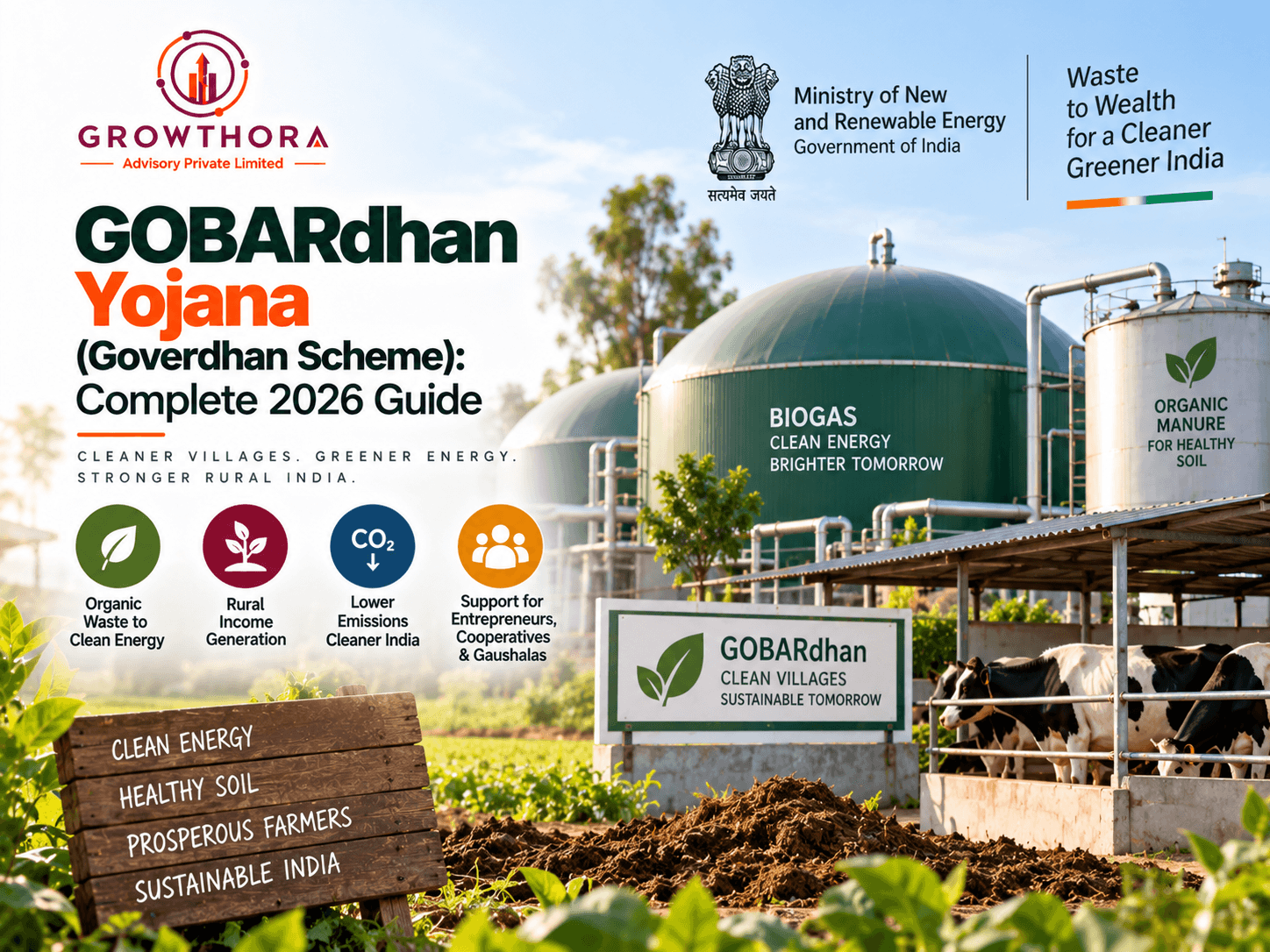
What is GOBARdhan Yojana?
GOBARdhan, which stands for Galvanizing Organic Bio-Agro Resources Dhan, is the Government of India’s National Circular Bioenergy Scheme, approved by the Union Cabinet with a total outlay of Rs 23,731 crore, aimed at scientifically managing agricultural residue, cattle dung, press mud and municipal organic waste to produce Compressed Biogas, organic manure and rural income, linked aclosely with the Swachh Bharat Mission-Gramin.
The scheme reflects a genuinely large policy bet: India generates enormous volumes of cattle dung and organic waste every day, most of it currently unmanaged or underutilized, and GOBARdhan is designed to convert that waste into a structured, investable energy and fertilizer value chain rather than leaving it as an environmental and sanitation burden.
Why the Scheme Matters
- Scientific waste management through productive use of agricultural residue, cattle dung, municipal organic waste, and other biomass resources
- Lower greenhouse gas emissions through replacement of fossil fuels with compressed biogas
- Nearly tenfold growth target in domestic compressed biogas production over the scheme period
- Rural income generation across feedstock supply, transportation, plant operations, and organic manure production
- Strategic import reduction, with the scheme expected to meaningfully cut India’s dependence on imported gas and fertilizer over time
Funding Models Under GOBARdhan
What are the funding models under GOBARdhan Yojana?
GOBARdhan operates through two distinct models: a community model, where villages access a financial provision of up to Rs 50 lakh to build and operate smaller, community-owned biogas infrastructure, and a commercial model, where entrepreneurs, cooperatives, gaushalas and dairies can set up larger biogas or compressed biogas plants with capital assistance, assured offtake and access to finance under the scheme’s broader framework.
| Model | Who It’s For | What It Offers |
|---|---|---|
| Community Model | Villages, especially those with high cattle populations | Financial provision of up to Rs 50 lakh per village for community-owned, operated and managed infrastructure |
| Commercial Model | Entrepreneurs, cooperatives, gaushalas, dairies | Support to set up large biogas or Compressed Biogas plants, with capital assistance, stable pricing and pipeline connectivity |
The community model prioritises villages with a high cattle population, since feedstock availability is naturally higher in those areas, while the commercial model is designed to attract genuine private investment into larger-scale plant infrastructure.
CBG Offtake Assurance Framework
How does GOBARdhan ensure a market for compressed biogas producers?
The scheme establishes a dedicated CBG Offtake Assurance framework, under which City Gas Distribution entities are required to procure Compressed Biogas to meet a notified CBG Obligation trajectory, set at 3 percent in FY 2026-27, rising to 4 percent in FY 2027-28 and 5 percent from FY 2028-29 onwards in the CNG (Transport) and PNG (Domestic) segments.
This offtake assurance is arguably the most important structural feature of the scheme for a potential investor or entrepreneur, since it converts what would otherwise be an uncertain, buyer-dependent market into a predictable, government-mandated demand trajectory, addressing one of the biggest historical risks that has slowed private investment in biogas and CBG infrastructure in India.
Who Can Set Up a Plant
- Entrepreneurs looking to enter the renewable energy and waste management sector through a commercial biogas or CBG plant
- Cooperatives and Farmer Producer Organisations with access to consistent agricultural residue or cattle dung feedstock
- Gaushalas and dairies, which have a natural, consistent source of cattle dung feedstock as part of their existing operations
- Village-level community groups seeking to access the community model’s financial provision for smaller, locally-managed infrastructure
How to Get Involved
- Determine whether your interest fits the community model, suited to village-level, community-managed infrastructure, or the commercial model, suited to larger-scale entrepreneurial or institutional investment
- Review the detailed scheme guidelines released following the Cabinet approval, since implementation details, application procedures and eligible feedstock categories are specified there
- For the commercial model, prepare a project report covering feedstock availability, proposed plant capacity, capital requirement and offtake arrangement with the relevant City Gas Distribution entity
- Engage with your state’s agriculture or rural development department, or the relevant nodal ministry, for guidance on the application and approval process specific to your state and project type
- Explore complementary financing routes, since a commercial CBG plant project may also be eligible for support under other government funding schemes and priority sector lending, depending on its structure and scale
- Track official updates through the Ministry’s Gobardhan Scheme Spotlight page and the unified registration portal, since implementation guidelines continue to be rolled out progressively after the scheme’s approval
Key Takeaways
- GOBARdhan Yojana has a total outlay of Rs 23,731 crore, running from FY 2026-27 to FY 2035-36, aimed at converting organic waste into Compressed Biogas, organic manure and rural income.
- The scheme operates through a community model, offering villages up to Rs 50 lakh in financial provision, and a commercial model, supporting entrepreneurs, cooperatives, gaushalas and dairies in setting up larger CBG plants.
- A CBG Offtake Assurance framework mandates City Gas Distribution entities to meet a rising CBG Obligation trajectory, from 3 percent in FY 2026-27 to 5 percent from FY 2028-29 onwards.
- The scheme is closely linked to the Swachh Bharat Mission-Gramin and aims for nearly ten-fold growth in domestic Compressed Biogas production.
- Detailed application procedures and eligibility criteria continue to be notified progressively, so applicants should track official government updates for the latest guidance.
FAQs
What is the full form of GOBARdhan?
GOBARdhan stands for Galvanizing Organic Bio-Agro Resources Dhan, a scheme that converts cattle dung, agricultural residue and organic waste into Compressed Biogas and organic manure.
What is the total outlay of the GOBARdhan Scheme?
The scheme has a total approved outlay of Rs 23,731 crore, running from FY 2026-27 to FY 2035-36.
Who can set up a Compressed Biogas plant under GOBARdhan?
Entrepreneurs, cooperatives, gaushalas and dairies are eligible to set up large biogas or Compressed Biogas plants under the scheme’s commercial model.
What is the CBG Obligation trajectory under GOBARdhan?
City Gas Distribution entities must meet a CBG Obligation of 3 percent in FY 2026-27, rising to 4 percent in FY 2027-28, and 5 percent from FY 2028-29 onwards in the CNG (Transport) and PNG (Domestic) segments.
- How much financial support can a village receive under the community model?
Villages can access a financial provision of up to Rs 50 lakh under the community model to build and manage community-owned biogas infrastructure.
- Is GOBARdhan Yojana linked to any other government mission?
Yes, the scheme is closely linked to the Swachh Bharat Mission-Gramin and supports India’s broader circular economy and Mission LiFE objectives.
Conclusion
If you are an entrepreneur, cooperative, gaushala, or dairy exploring a commercial Compressed Biogas plant under GOBARdhan, Growthora Advisory can help you navigate project structuring, applicable registrations, and complementary funding schemes. Book a free consultation with our team today.
Next step
Apply this to your business.
Confirm whether this applies to your legal structure, industry classification, and credit history - in under 30 minutes with an advisor.