
Key Takeaways
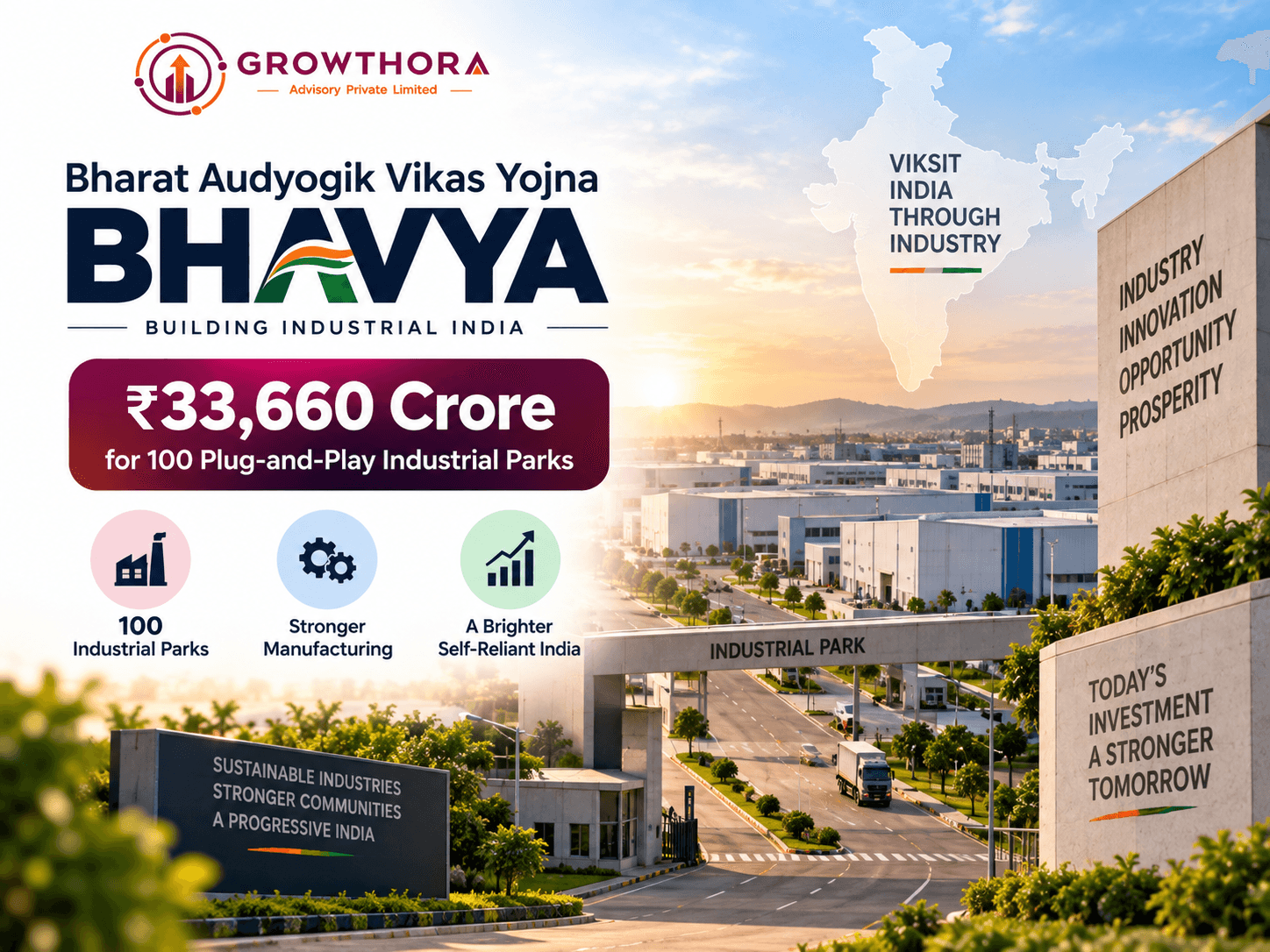
- BHAVYA was notified by the Department for Promotion of Industry and Internal Trade in 2026, with a total financial outlay of ₹33,660 crore, of which ₹60 crore is set aside for administration.
- The scheme runs for six years, from financial year 2026-27 to 2031-32, and targets 100 globally competitive industrial parks by 2032.
- Projects are selected through a Challenge Mode, a competitive process open to state and union territory governments rather than a discretionary allocation, with the first phase targeting up to 50 proposals.
- The Centre provides financial support of up to ₹1 crore per acre for core, value-added and social infrastructure, plus up to 25 per cent of project cost for external connectivity.
- Industrial parks under the scheme range from 100 to 1,000 acres, with a lower threshold of 25 acres for hilly and northeastern states.
- BHAVYA is aligned with PM Gati Shakti principles, prioritising multi-modal connectivity and proximity to national highways, ports, airports and existing NICDP industrial corridors.
What BHAVYA aims to achieve
India's manufacturing ambitions have long been constrained by the time it takes a company to move from deciding to invest to actually starting production. Land acquisition, multiple approvals and missing infrastructure can stretch this timeline by years. BHAVYA is designed to remove that friction by creating industrial parks where land, utilities, approvals and connectivity are already in place before an investor arrives.
The scheme builds on the experience of Industrial Smart Cities developed
The scheme builds on the experience of Industrial Smart Cities developed under the National Industrial Corridor Development Programme, extending the same plug-and-play philosophy to 100 new parks spread across the country, developed jointly by the Centre, state governments and private players.
Who can apply under BHAVYA?
BHAVYA does not have individual business applicants. Proposals are submitted by state and union territory governments, typically through a dedicated Special Purpose Vehicle set up for each industrial park, in response to a Challenge Mode invitation issued by the National Industrial Corridor Development Corporation.
Once a park is developed and operational, individual manufacturers, MSMEs and large industries can then apply to set up units inside the park through the respective state industrial development agency or the park's operating SPV.
How proposals are evaluated under Challenge Mode
- Multi-modal connectivity, including proximity to national or state highways, ports, airports and existing logistics hubs
- Availability of contiguous, encumbrance-free land ready for development
- Existing or planned industrial demand in the region
- Alignment with PM Gati Shakti's integrated infrastructure planning approach
- Strength of state-level reforms supporting ease of doing business, single-window clearances and investor facilitation
Financial support available under the scheme
| Infrastructure type | What it covers |
|---|---|
| Core infrastructure | Internal roads, underground utilities, drainage, common effluent treatment facilities, ICT and administrative systems, funded up to ₹1 crore per acre. |
| Value-added infrastructure | Ready-built factory sheds, built-to-suit units, testing laboratories and warehousing, funded within the same per-acre ceiling. |
| Social infrastructure | Worker housing and basic amenities for the workforce employed within the park. |
| External connectivity | Up to 25 percent of the project cost for roads, rail links or utility connections linking the park to the wider transport network. |
Park size and land norms
- Standard industrial parks under BHAVYA range from 100 to 1,000 acres.
- A reduced minimum of 25 acres applies to proposals from hilly states and the North Eastern region, recognising land constraints in those areas.
- Land must generally be encumbrance-free and readily available for development to qualify under Challenge Mode.
Implementation timeline
BHAVYA runs across financial years 2026-27 to 2031-32. The first phase of selection targets up to 50 proposals from states and union territories, with subsequent phases expected to bring the total to 100 parks by 2032. The National Industrial Corridor Development Corporation, functioning under the Department for Promotion of Industry and Internal Trade, manages selection, appraisal and fund disbursement through project-specific Special Purpose Vehicles.
Frequently Asked Questions
What is the Bharat Audyogik Vikas Yojna (BHAVYA)?
BHAVYA is a Central Sector Scheme with a ₹33,660 crore outlay to develop 100 plug-and-play industrial parks across India between 2026-27 and 2031-32, giving investors pre-approved land and ready infrastructure.
Which ministry and agency implement BHAVYA?
The Department for Promotion of Industry and Internal Trade, under the Ministry of Commerce and Industry, is the nodal department, while the National Industrial Corridor Development Corporation manages implementation.
Can an individual company apply under BHAVYA?
No. Proposals come from state and union territory governments through Challenge Mode. Individual companies apply to set up units only after a park is developed and operational.
How much financial support does the Centre provide per acre?
The Centre provides financial support of up to ₹1 crore per acre for core, value-added and social infrastructure, plus up to 25 percent of project cost for external connectivity.
What is the minimum land size for a BHAVYA industrial park?
Parks generally range from 100 to 1,000 acres, with a lower threshold of 25 acres for proposals from hilly and North Eastern states.
By when does the government aim to complete all 100 parks?
The scheme targets completion of 100 globally competitive industrial parks by 2032, within its six-year implementation window from 2026-27 to 2031-32.
Planning an industrial investment in India?
Understanding which BHAVYA-linked industrial park fits your sector, and navigating the state-level approvals to set up inside one, takes specialised guidance. Book a free consultation with Growthora and we will help you evaluate the right location, incentives and compliance pathway for your manufacturing investment.
Next step
Apply this to your business.
Confirm whether this applies to your legal structure, industry classification, and credit history - in under 30 minutes with an advisor.