
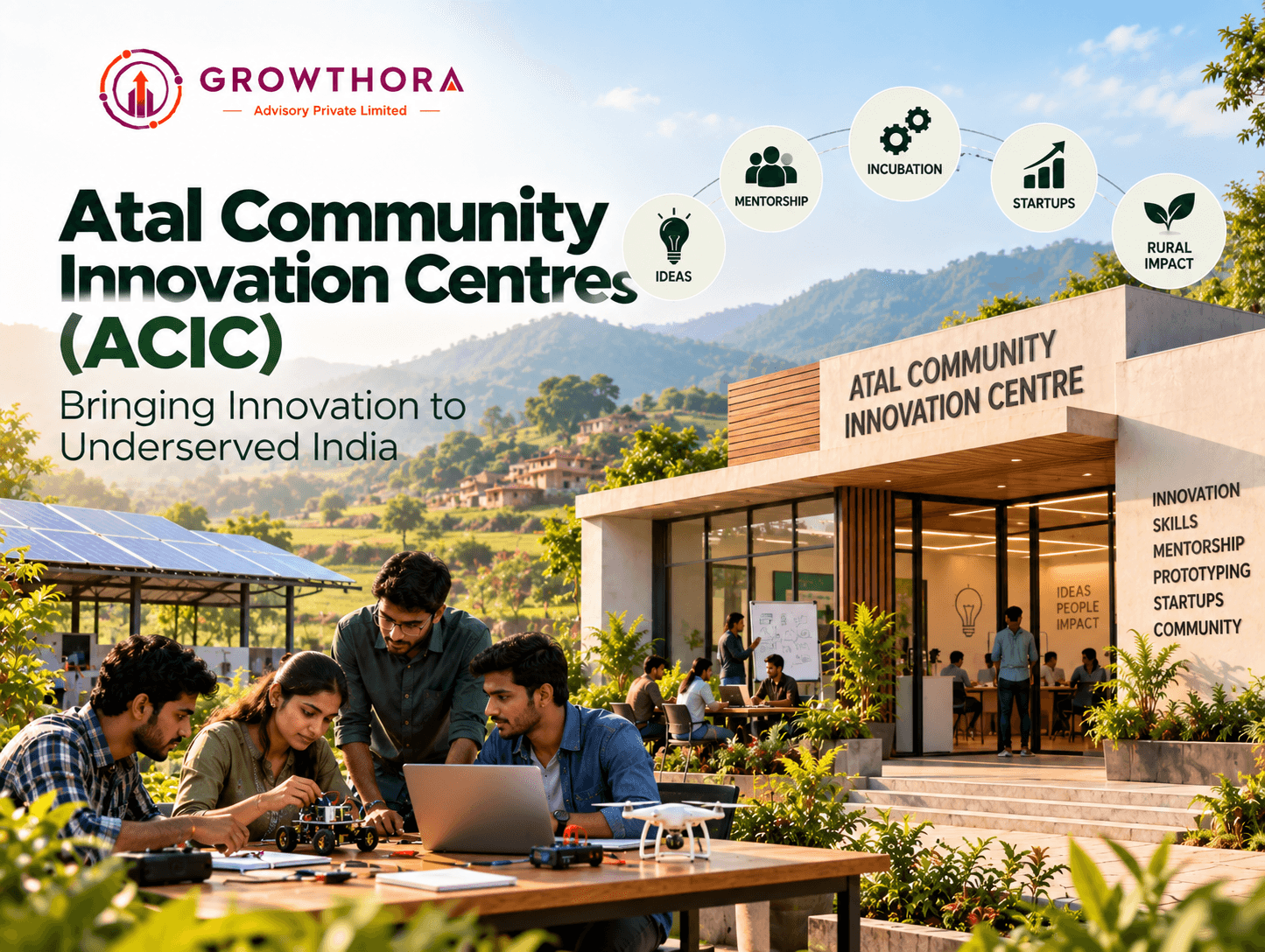
What is an Atal Community Innovation Centre?
An ACIC is an innovation and incubation support center established under the Atal Innovation Mission, specifically envisioned to bring startup and innovation ecosystem benefits to unserved and underserved parts of India, including Tier-2 and Tier-3 cities, smart cities beyond the major metros, and rural and tribal areas that typically have limited access to formal incubation infrastructure.
ACICs exist because India’s startup and innovation ecosystem has historically concentrated in a handful of major metropolitan hubs, leaving genuinely talented innovators in smaller towns and rural regions with little structured support to turn an idea into a viable enterprise, and this scheme is a direct policy response to that geographic imbalance.
Why ACICs Exist Separately From AICs
While Atal Incubation Centres target world-class, competitive startup incubation broadly across universities, institutions, and corporates, ACICs are structured with a deliberately different mandate and a smaller grant size, recognizing that grassroots innovation in an underserved region looks different from a metro-based technology startup, both in the type of support needed and the realistic scale of operations a centre in such a region can sustain. Running a separate vertical with its own eligibility framework, rather than forcing underserved-region applicants to compete directly against well-resourced metro institutions for AIC funding, is what allows the mission to genuinely reach these regions rather than see funding concentrate in already-advantaged areas.
What the Rs 2.5 Crore Grant Covers
What can the ACIC grant be used for?
Each Atal Community Innovation Centre is supported with a grant-in-aid of up to Rs 2.5 crore over five years, intended to fund the physical and operational infrastructure needed to support grassroots innovators, including workspace, basic prototyping and testing equipment, mentorship coordination, and programme delivery costs suited to the scale and context of the underserved region being served.
The smaller grant size relative to an AIC reflects a realistic difference in scale and cost structure rather than a lesser level of ambition; a centre serving a rural or Tier-3 innovation ecosystem generally does not need, and could not efficiently absorb, the same infrastructure investment as a metro-based AIC working with venture-scale technology startups.
Who ACICs Are Designed to Serve
- Innovators and entrepreneurs in Tier-2 and Tier-3 towns, who often have strong practical, locally relevant ideas but limited access to structured incubation support
- Rural and tribal area innovators, whose ventures frequently address genuinely local problems, from agricultural processing to local craft-based enterprise, that metro-focused incubators rarely prioritize
- Community-rooted innovation, meaning ideas and enterprises that emerge from and serve the specific needs of their local community, rather than being designed primarily for metro or export markets
- First-generation entrepreneurs in regions where formal entrepreneurship support and mentorship networks have historically been thin or entirely absent
Eligibility for Hosting an ACIC
- Institutions, including local colleges, community organizations, and regional bodies located in or serving unserved and underserved areas, are the intended hosts, rather than large, already well-resourced metro institutions.
- The hosting entity needs to demonstrate genuine connection to and understanding of the local innovation ecosystem it intends to serve.
- Similar to AICs, hosting institutions are expected to maintain proper governance and financial accountability for the grant funds, scaled appropriately to the centre’s size and scope
- A credible plan for reaching and supporting genuinely local innovators, rather than simply replicating a metro incubation model in a smaller town, strengthens an ACIC hosting proposal.
Regional Development Impact
ACICs are explicitly positioned as a regional development tool as much as an innovation support mechanism, since concentrating innovation infrastructure only in major cities tends to reinforce existing regional economic imbalances rather than correct them. By supporting community-rooted innovation in underserved regions, the ACIC vertical aims to create local job opportunities, retain talented individuals who might otherwise migrate to metro cities for entrepreneurship support, and build innovation capacity that is genuinely responsive to the specific economic and social context of Tier-2, Tier-3, and rural India.
How to Apply
- Institutions and community organizations based in or serving unserved and underserved regions should monitor the official AIM portal, aim.gov.in, for ACIC Call for Application windows
- Prepare a proposal that clearly demonstrates the applicant’s connection to and understanding of the local innovation ecosystem, rather than a generic incubation plan
- Outline a realistic, appropriately scaled infrastructure and programme plan suited to the Rs 2.5 crore grant ceiling and the region’s actual innovation landscape
- Innovators and entrepreneurs in Tier-2, Tier-3, or rural areas seeking ACIC support should identify whether an ACIC already operates in or near their region through the AIM portal’s centre directory.
- Engage directly with the relevant ACIC’s own intake process, since each centre, like AICs, manages its own selection of the local innovators and entrepreneurs it supports
- Track AIM’s periodic announcements for new ACIC establishment rounds, since coverage continues to expand as the mission works toward reaching more underserved regions over time
Key Takeaways
- ACICs are a distinct Atal Innovation Mission vertical, each supported with a grant of up to Rs 2.5 crore over five years, specifically targeting unserved and underserved regions.
- 14 ACICs have been established nationally, focused on Tier-2 and Tier-3 towns, smart cities beyond major metros, and rural and tribal areas.
- The smaller grant size compared to AICs reflects a realistic, appropriately scaled infrastructure need for grassroots, community-rooted innovation rather than venture-scale technology startups.
- ACICs function as a regional development tool, aiming to retain local talent and reduce reliance on metro-concentrated innovation infrastructure.
- Hosting institutions should be genuinely rooted in or connected to the underserved region they intend to serve, rather than replicating a generic metro incubation model.
FAQs
How much grant funding does an Atal Community Innovation Centre receive?
Each ACIC receives a grant-in-aid of up to Rs 2.5 crore over five years, covering workspace, basic infrastructure, mentorship coordination, and programme delivery costs.
How many ACICs have been established in India?
14 Atal Community Innovation Centres have been established nationally as part of the Atal Innovation Mission’s regional innovation push.
What is the difference between an ACIC and an AIC?
ACICs receive up to Rs 2.5 crore and specifically target unserved and underserved Tier-2 and Tier-3 regions, while AICs receive up to Rs 10 crore and broadly support world-class startup incubation across universities, institutions and corporates.
Who can host an Atal Community Innovation Centre?
Institutions, community organisations, and regional bodies located in or genuinely connected to unserved and underserved areas are the intended hosts, rather than already well-resourced metro institutions.
What kind of innovators does an ACIC support?
ACICs support innovators and entrepreneurs in Tier-2 and Tier-3 towns, rural and tribal areas, and first-generation entrepreneurs in regions with historically limited access to formal incubation and mentorship networks.
How is an ACIC different from a generic rural skilling programme?
An ACIC specifically supports innovation and entrepreneurship, providing incubation infrastructure and mentorship for building enterprises, rather than focused vocational skill training for employment, which is the domain of programmes like PMKVY.
Conclusion
If your institution serves an underserved region and is considering hosting an ACIC, or you are a local innovator looking to connect with one, Growthora Advisory can help you navigate the application and eligibility process. Book a free consultation with our team today.
Next step
Apply this to your business.
Confirm whether this applies to your legal structure, industry classification, and credit history - in under 30 minutes with an advisor.