
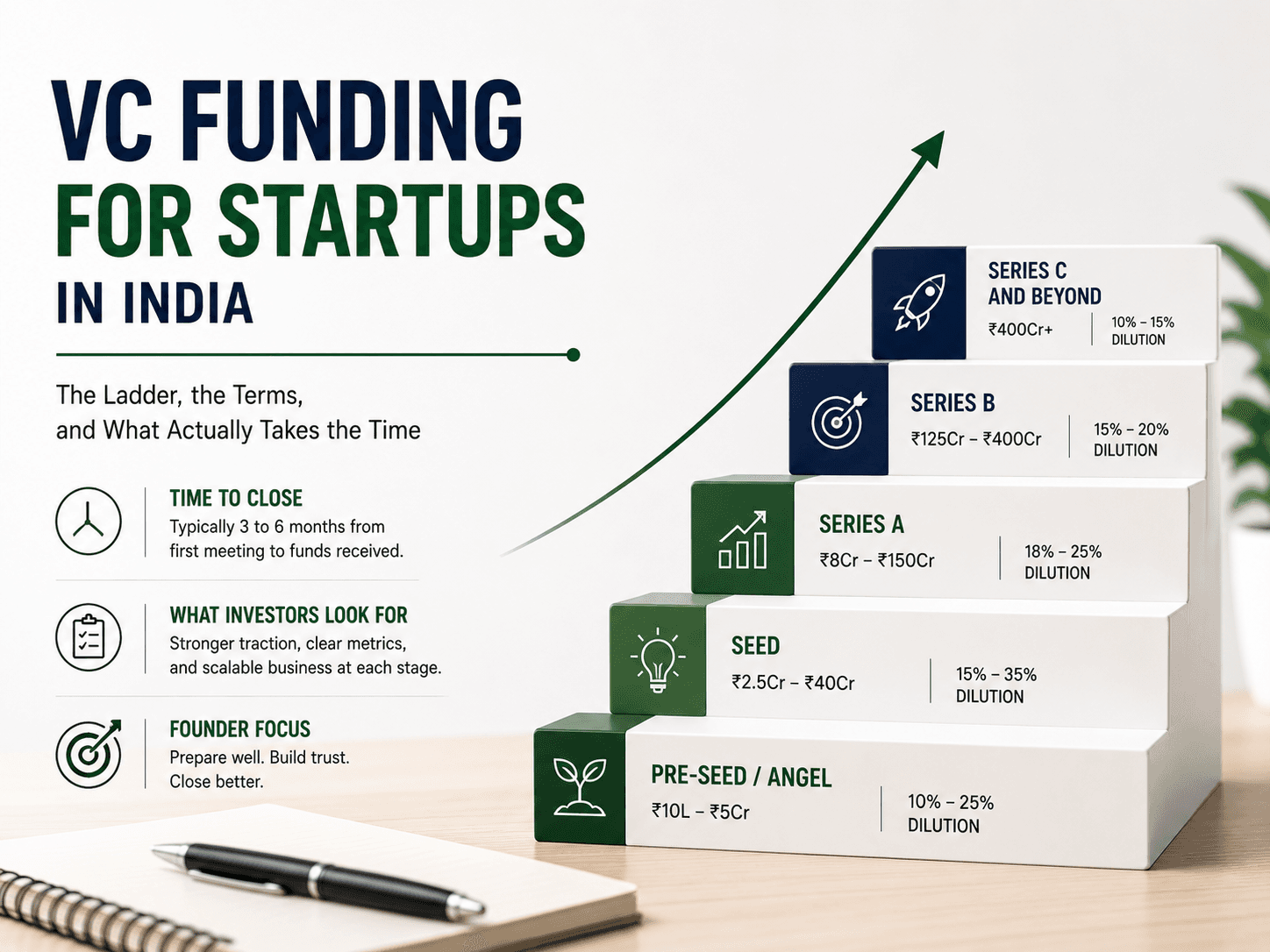
The Funding Ladder
Sources differ noticeably on exact round sizes for the Indian market, some quote figures closer to global medians, others quote India-specific ranges that run lower. Rather than pick one source and present it as gospel, here's a range that reflects that spread honestly.
| Stage | Typical Round Size (India) | Typical Dilution | What Investors Expect to See |
|---|---|---|---|
| Pre-seed / Angel | ₹10 lakh to ₹5 crore | 10% to 25% | A founding team, a product concept, and early signs of demand |
| Seed | ₹2.5 crore to ₹40 crore (estimates vary by source) | 15% to 35% | Early product-market fit signals, user adoption, a defined go-to-market plan |
| Series A | ₹8 crore to ₹150 crore (wide range across sources) | 18% to 25% | Repeatable revenue, credible unit economics, a scalable go-to-market motion |
| Series B | ₹125 crore to ₹400 crore | 15% to 20% | Proven growth at scale, expansion into new markets or segments, senior leadership hires |
| Series C and beyond | Highly variable, often ₹400 crore+ | 10% to 15% | Predictable growth, a credible path to profitability or exit, IPO or M&A readiness |
Treat the round-size figures as directional rather than exact, given how much they vary by sector, investor appetite in a given year, and which source you're reading. What's more consistent across sources is the qualitative bar at each stage; the evidence investors expect gets more demanding and less forgiving of a good story alone as you move up the ladder.
The Process, Stage by Stage
| Phase | Typical Duration | What Happens |
|---|---|---|
| Sourcing and pitching | 4 to 8 weeks | Building an investor shortlist by stage, sector, and check size, and pitching, ideally through warm introductions rather than cold outreach |
| Term sheet negotiation | 2 to 4 weeks after a positive pitch | Non-binding term sheet setting out valuation, instrument, and key governance terms |
| Due diligence | 4 to 8 weeks, or 4 to 12 weeks by some estimates | Legal, financial, tax, IP, and founder background review, typically via third-party lawyers and accountants engaged by the lead investor |
| Legal documentation and closing | 3 to 6 weeks | Definitive agreements drafted and signed, funds wired on completion |
A useful rule of thumb: seed rounds can close in as little as 6 to 12 weeks total when everything goes smoothly, while Series A and later rounds more commonly take the fuller 3 to 6 month range, largely because due diligence goes deeper and data room requests multiply as legal teams review a more complex company.
What Founder Preparation Actually Looks Like
- A clean cap table with no unresolved founder equity disputes
- Updated MCA and GST compliance records, since gaps here are a common and entirely avoidable cause of due diligence delays.
- Properly assigned intellectual property, confirming the company, not an individual founder personally, owns the IP being pitched
- A clear, defensible financial model and realistic valuation expectation going into the first conversation
- A data room prepared in advance, since legal due diligence is consistently the longest part of the process and an incomplete data room is a frequent source of weeks-long delay
- Founder vesting schedules and ESOP pool documentation in order, since these are now standard early diligence items even at seed stage
Term Sheet Basics Worth Understanding Before You Negotiate
| Term | What It Means for You |
|---|---|
| Valuation (pre-money / post-money) | Pre-money is the company's value before the new investment; post-money adds the new capital. Your dilution is calculated against post-money. |
| Instrument (equity vs CCPS vs convertible note) | CCPS is the most common institutional instrument in India; it converts to equity on defined terms and typically carries preferential rights |
| Anti-dilution protection | Protects the investor if a future round happens at a lower valuation, at the founder's or other shareholders' expense |
| Board and information rights | Defines how much oversight and reporting the investor gets going forward, worth negotiating carefully rather than accepting as boilerplate |
| Liquidation preference | Determines who gets paid first, and how much, in an exit or wind-down scenario before common shareholders see anything |
Don't sign a term sheet without review from a startup-focused lawyer and a qualified CA, particularly for anything involving cross-border investment, ESOP pool sizing, or preference share structuring. This is one of the few points in a company's life where a document signed quickly and without proper review can have consequences that last through every subsequent funding round.
Common Mistakes That Slow Down or Sink a Raise
- Setting an early-stage valuation too high, which scares off investors who are realistic about comparable deals rather than signalling confidence
- Overlooking compliance or legal gaps that surface during due diligence and stall the process for weeks
- Treating every investor conversation as equally likely to close, spreading founder bandwidth too thin during a critical fundraising window
- Skipping formal due diligence preparation on the assumption it only matters at Series A, when seed-stage investors increasingly run structured diligence too
- Not clarifying IP ownership early, then discovering during diligence that a founder, not the company, holds a patent or key piece of technology personally
VC vs. Angel, the Practical Difference
| Venture Capital | Angel Investment | |
|---|---|---|
| Capital source | Pooled fund from limited partners | Personal funds |
| Typical stage | Seed onward, often more common from Series A | Pre-seed and seed |
| Decision process | Formal, involves partnership approval and fund documents | Individual or small group, often faster |
| Typical check size | Larger, often with reserved follow-on capital | Smaller, ₹10 lakh to ₹5 crore range |
| Governance expectations | More formal board seats and reporting rights | Lighter, sometimes informal advisory involvement |
Frequently Asked Questions
How long does it take to close a VC funding round in India?
Typically 3 to 6 months from the first investor meeting to funds received, covering sourcing, term sheet negotiation, due diligence, and legal closing. Seed rounds can sometimes close faster, in 6 to 12 weeks.
How much equity do founders give up at each funding stage?
Commonly 10% to 25% at pre-seed or angel stage, 15% to 35% at seed, 18% to 25% at Series A, and progressively smaller percentages at later stages as round sizes grow relative to company valuation.
What documents do investors ask for during due diligence?
A clean cap table, updated MCA and GST records, IP assignment documentation, financial statements, founder vesting schedules, and ESOP pool details, typically compiled into a data room reviewed by the lead investor's lawyers and accountants.
What is the difference between pre-money and post-money valuation?
Pre-money valuation is what the company is worth before the new investment. Post-money valuation adds the new capital raised. Your dilution as a founder is calculated against the post-money figure.
What instrument do Indian VCs typically invest through?
Compulsorily Convertible Preference Shares (CCPS) are the most common instrument in institutional funding rounds in India, converting to equity on terms set out in the definitive agreements.
Should I hire a lawyer before signing a term sheet?
Yes. A term sheet, while typically non-binding on most commercial terms, sets the framework for definitive agreements that follow. A startup-focused lawyer and a qualified CA should review it before signing, especially for cross-border investment or preference share structuring.
Why do Series A rounds take longer to close than seed rounds?
Series A involves deeper legal, financial, and technical due diligence, and typically larger, more complex data room requests, which extends the timeline compared to the lighter, more confirmatory diligence common at seed stage.
What is anti-dilution protection, and why does it matter to founders?
It's a term sheet provision protecting an investor if a future round happens at a lower valuation, typically at the expense of the founders' or other shareholders' ownership percentage. It's worth understanding and negotiating rather than accepting as standard boilerplate.
Can a startup raise VC funding without prior angel investment?
Yes, though it's less common. Many startups raise an angel or seed round first to build traction before approaching institutional VCs, but a sufficiently compelling team or early metric can sometimes attract VC interest directly at the seed stage.
What is a liquidation preference?
A term sheet provision determining who gets paid first and how much, in an exit or wind-down scenario before common shareholders, including founders, receive any proceeds.
How is VC funding different from angel investment?
VCs invest pooled capital from limited partners through a formal fund structure, usually at later stages with larger cheques and more structured governance. Angels invest personal money, typically earlier, in smaller amounts, with a faster and less formal decision process.
The One Thing Worth Internalising About Timing
Founders consistently underestimate how much of the fundraising timeline sits in due diligence rather than in getting investors interested in the first place. A strong pitch can get you a term sheet in weeks; it's the legal, financial, and compliance review afterward that typically determines whether you're closing in two months or five. The single highest-leverage thing you can do before starting a raise isn't refining the pitch deck further, it's making sure your cap table, compliance filings, and IP assignments are already clean, since that's what actually determines how fast the back half of the process moves.
Next step
Apply this to your business.
Confirm whether this applies to your legal structure, industry classification, and credit history - in under 30 minutes with an advisor.